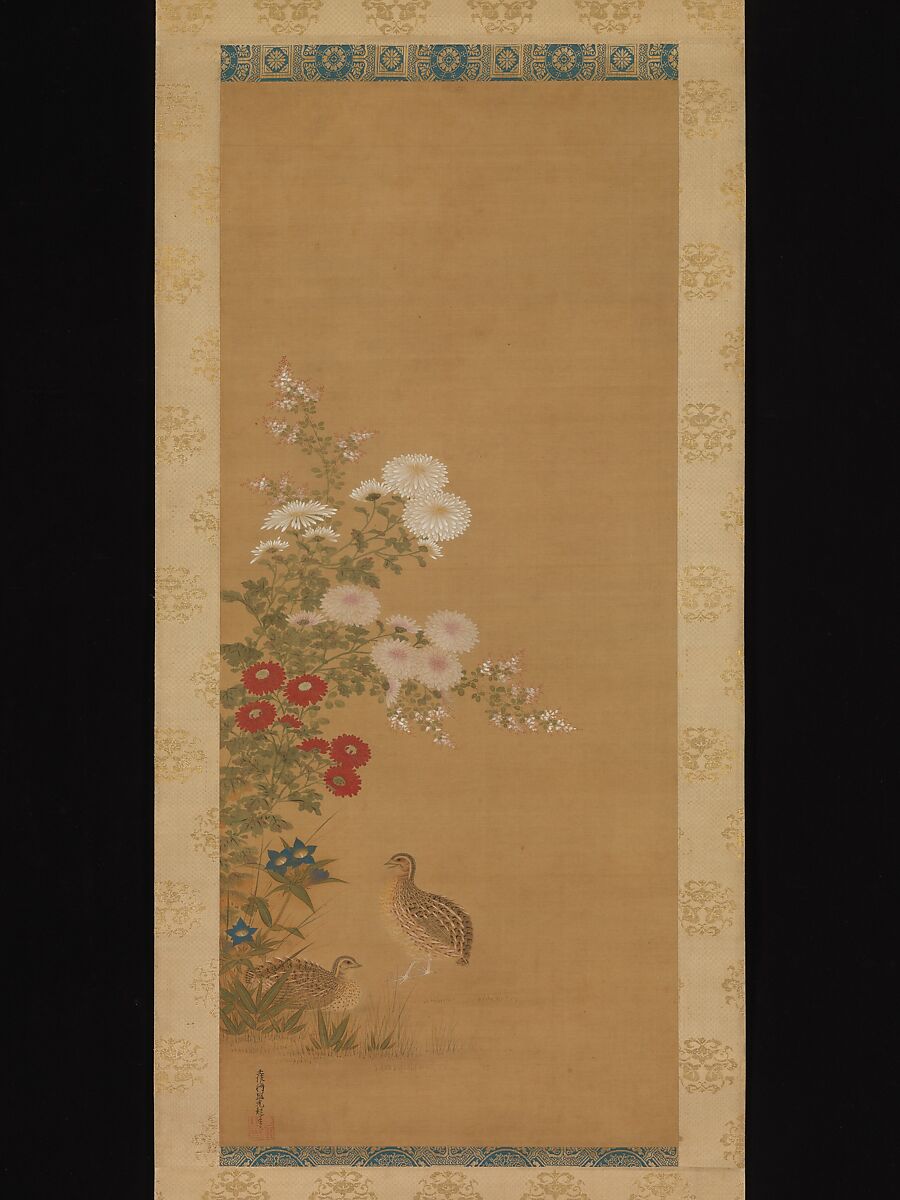
The first quail is almost hidden. It crouches beneath pointed leaves at the lower left, its back repeating the brown stipple of the earth. The second stands in the open, head raised, but occupies only a small island of ground. Above them, chrysanthemums climb through most of the painted field, their white, pink and red heads held on bending stems. A few blue Chinese bellflowers cool the lower edge. Everything important happens near the bottom of a tall expanse of silk.
Tosa Mitsuoki's Quail and Autumn Flowers, painted in the late 17th century, is a study in how precision can produce quiet. The Metropolitan Museum of Art lists the work under the Japanese title 秋の花に鶉図, identifies it as a signed hanging scroll in ink and color on silk, and dates it to the closing decades of Mitsuoki's life. It is not currently on view, but the museum makes a high-resolution image available as Public Domain through its Open Access program.
The scroll is beautiful enough to survive as a seasonal image. It becomes more consequential when placed inside Mitsuoki's career. In 1654 he recovered the court position of edokoro azukari, superintendent of the imperial painting office, for a lineage that had lost its institutional footing amid war and the ascent of the Kano school. His revival of the Tosa tradition did not consist of sealing it away from outside influence. This small autumn world shows the opposite: survival required disciplined borrowing.
A picture built from two speeds
The plants rise; the birds remain. That simple opposition gives the scroll its temporal tension. Chrysanthemum stems bend outward and then recover their upward movement. Bush clover flickers in small clustered blossoms. Bellflowers open as firm blue stars. The quail, by contrast, are compact and earthbound, their rounded bodies gathering the composition's energy close to the ground.
Mitsuoki does not distribute detail evenly. The petals are counted with astonishing patience, yet the open silk above them is left largely undisturbed. The emptiness is not unfinished background. It gives the flowering stems room to be measured, makes the two small birds feel more vulnerable, and turns the vertical climb from earth to blossom into the painting's main event.
The quail reward close looking. Fine marks differentiate breast, wing and back; pale legs are nearly absorbed by the ground. One bird presents its profile clearly while the other is interrupted by foliage. The difference prevents the pair from becoming a heraldic emblem. They share a habitat, but they do not pose symmetrically for us.
Why quail belonged among autumn grasses
Quail in fields of autumn plants formed an established subject long before Mitsuoki. Cultural Heritage Online, operated under Japan's Agency for Cultural Affairs, describes quail playing in miscanthus as a classical theme of Japanese painting. Other works associated with the artist and his family join the birds to millet, white chrysanthemums, bellflowers and grasses. Tokyo National Museum's record for Quail Calling in an Autumn Field says Mitsuoki was especially renowned as a master of quail.
The subject was not exclusively Japanese. The Met notes that the pairing of quail and chrysanthemums was particularly favored by painters of China's Southern Song dynasty and carried associations of peace and longevity. Bush clover—hagi—and Chinese bellflower—kikyō—extend the seasonal setting. It would be too neat to assign every stem one fixed coded meaning. Here the plants also do practical pictorial work: they place the birds in early autumn, build height and create alternating densities of color.
That mixture of inherited motif and observed life suited Mitsuoki's larger project. The Tosa school had long specialized in yamato-e, paintings associated with Japanese narratives, poetry, court ceremony and finely worked color. Bird-and-flower painting let him preserve the school's minute line and luminous pigments while engaging compositions and natural description developed in Chinese painting and by Japanese rivals.
The Tosa school had lost more than fashion
Calling Mitsuoki a “reviver” can sound as if a style merely fell out of taste. The crisis was institutional. The Tosa lineage had served the court and was closely associated with the imperial painting office. In 1569, Mitsuoki's ancestor Tosa Mitsumoto died in battle. The Shizuoka Prefectural Museum's artist record says the family lost its position as edokoro azukari, the office through which it had worked at court, while the Kano school expanded under warrior patronage.
The family continued to paint. Its center, however, shifted to the commercial city of Sakai. Mitsuoki was born there in 1617 and moved to Kyoto with his father, Tosa Mitsunori, in 1634. Twenty years later he received court rank and the office associated with directing imperial painting. The return was roughly 85 years after Mitsumoto's death.
Office mattered because large commissions, reputation, workshop continuity and access to elite patrons depended on more than individual talent. The word “school” describes a system of labor and transmission: family succession, pupils, copied models, inherited designs, titles, workshops and commissions. Mitsuoki's achievement was therefore political and administrative as well as aesthetic. He made the Tosa name usable again at court.
1569 — Tosa Mitsumoto dies in battle; the lineage loses its court-office position.
1617 — Mitsuoki is born in Sakai.
1634 — He moves to Kyoto with his father.
1654 — He receives court rank and restores the Tosa connection to the imperial painting office.
1681 — His son Mitsunari succeeds him in the office; Mitsuoki takes Buddhist vows and uses the name Jōshō.
1690 — The National Institute of Japanese Literature dates Honchō Gahō Taiden, a painting treatise attributed to Mitsuoki, to this year.
Revival by crossing boundaries
The Kano and Tosa schools are often introduced as opposites: Kano painters serving shoguns and warriors with forceful ink and monumental formats; Tosa painters serving the court with jewel-like color and literary themes. The distinction is useful, but a painting such as this exposes its limits. Artists studied successful rivals. Workshops responded to patrons. Chinese models moved through Japanese collections. Technique crossed institutional borders even when names and offices remained important.
The Met's record for Mitsuoki's Egrets and Cotton Roses identifies his debt to Southern Song bird-and-flower painting and notes his interest in Kano brushwork and contemporary Rinpa methods. Its record for Heron similarly describes his combination of traditional yamato-e with Kano techniques and Chinese compositions. Such borrowing did not erase the Tosa identity. It gave the inherited precision new subjects, spatial rhythms and degrees of naturalism.
Quail and Autumn Flowers makes that synthesis unusually clear. The colors remain measured and precious. Contours retain authority. Yet the birds possess weight, individual postures and patterned plumage; the stems overlap as plants do rather than lining up as decorative signs. Courtly order and empirical attention reinforce one another.
White, red and blue hold the season together
The palette is restrained by modern standards but strategically intense. White chrysanthemums catch the eye first because their many fine petals create the brightest concentration. Pink flowers soften the transition downward; red blooms introduce a denser beat near the birds. Blue bellflowers are few, yet their complementary coolness makes them disproportionately strong.
Green never becomes a uniform mass. Leaves darken or fade, turn to show different surfaces and gather into overlapping fans. Brown passages in the quail echo the silk ground, while black touches sharpen eyes, beaks and feather divisions. The painting moves from chromatic display in the flowers to near-camouflage in the birds.
| Element | What Mitsuoki does | What it makes the eye feel |
|---|---|---|
| Open upper field | Leaves most of the tall silk unoccupied | Quiet, height and room for the plants to rise |
| Chrysanthemums | Builds clustered white, pink and red circular forms | A measured ascent and the fullness of autumn |
| Bush clover | Scatters small blossoms around larger flower heads | Air, delicacy and a finer rhythm |
| Bellflowers | Places a few saturated blue stars low in the group | A cool accent that anchors the lower edge |
| Two quail | Shows one openly and one partly screened by leaves | Pairing without rigid symmetry; attention pulled toward the ground |
A treatise written near the end
Mitsuoki's revival was also an act of recording. The National Institute of Japanese Literature catalogs Honchō Gahō Taiden—本朝画法大伝—under his name and dates its formation to Genroku 3, or 1690, the year before his death. Surviving manuscript traditions require care: the text should not be treated as a transparent transcript of everything the historical painter thought. Its association with his name nevertheless points to a central problem for hereditary workshops—how to keep techniques consistent beyond one gifted hand.
That concern changes how the tiny marks in the quail are read. Precision is not simply virtuosity performed for a patron. It is reproducible knowledge: how to prepare silk, control mineral and organic color, build a contour, layer a feather, vary a leaf, preserve a model and teach another painter to recognize the standard.
Mitsuoki eventually passed the court office to his son Tosa Mitsunari. Cultural Heritage Online records father and son collaborating on Quail Calling in an Autumn Field: Mitsuoki painted the birds, Mitsunari the white chrysanthemums, miscanthus and bellflowers. The division of labor turns succession into something visible. A school continues when skill can move between hands without becoming anonymous.
The scroll's quiet argument
There is no court scene in Quail and Autumn Flowers, no emperor, palace or episode from The Tale of Genji. Its courtliness lies in selection, discipline and scale. Common birds become worthy of almost microscopic attention. Seasonal plants are arranged without losing their botanical differences. Empty silk is made to carry as much compositional weight as pigment.
The choice of a hanging scroll also matters. Unlike a folding screen designed to reshape an interior, a single vertical scroll creates a temporary, concentrated encounter. It can be brought out for a season and replaced as the year changes. Autumn is therefore not only depicted inside the work; it governs the conditions under which such a work could be viewed.
Japan.co.jp: a 60-second viewing exercise
- Begin with the hidden quail at lower left, not the largest flower.
- Move to the standing bird and compare how clearly each body is exposed.
- Climb the white chrysanthemums one blossom at a time.
- Return through the pink and red flowers to the blue bellflowers.
- Finish by looking only at the open silk above the plants and ask how it changes their scale.
Mitsuoki did not rescue the Tosa school by pretending nothing had happened since its earlier court ascendancy. He recognized a harder truth: a tradition that refuses new observation can preserve its name while losing its force. Chinese bird-and-flower models, Kano-school methods and the inherited Tosa command of color meet here without collapsing into sameness.
The two quail remain low to the earth while the flowers rise above them. That is the scroll's most persuasive metaphor for revival. The roots stay hidden. The new growth is visible.
Primary sources and references
- The Metropolitan Museum of Art: Quail and Autumn Flowers — Title, Japanese title, artist, date, medium, dimensions, signature, object number, plant identification, symbolism, career summary and Public Domain status.
- The Metropolitan Museum of Art: Egrets and Cotton Roses — Tosa-school practice and Mitsuoki's use of Southern Song, Kano and Rinpa methods.
- The Metropolitan Museum of Art: Heron — Mitsuoki's synthesis of yamato-e, Kano technique and Chinese bird-and-flower composition.
- Agency for Cultural Affairs, Cultural Heritage Online: 秋郊鳴鶉図 — Official Japanese readings, the Tosa family's literary specialties, Mitsuoki's reputation as a quail painter and collaboration with Mitsunari.
- Agency for Cultural Affairs, Cultural Heritage Online: 粟穂鶉図屏風 — Quail among autumn grasses as a classical subject and Mitsuoki's restoration of the Tosa school.
- Shizuoka Prefectural Museum of Art: Tosa Mitsuoki artist record — Family history, the 1569 institutional break and Mitsuoki's return to the imperial painting office.
- National Institute of Japanese Literature: Honchō Gahō Taiden — Authorship attribution, title and 1690 catalog date.
Reporting and verification note: The object title, dimensions, date, medium, credit line and image status follow The Met's object record. Japanese names, readings and specialist terms were checked against Cultural Heritage Online and Japanese institutional catalogs. The identification of the flowers follows The Met. “Peace and longevity” applies specifically to the quail-and-chrysanthemum pairing in the museum's account; no fixed symbolic meaning has been assigned here to every plant. Visual readings of balance, camouflage, movement and empty space are Japan.co.jp analysis. The Japanese edition was structured and written independently, not translated from this report.
Image rights: Tosa Mitsuoki, Quail and Autumn Flowers, late 17th century. The Metropolitan Museum of Art, object 36.100.52. Public Domain; supplied through The Met's Open Access program. The object credit and source link should be retained when publishing.