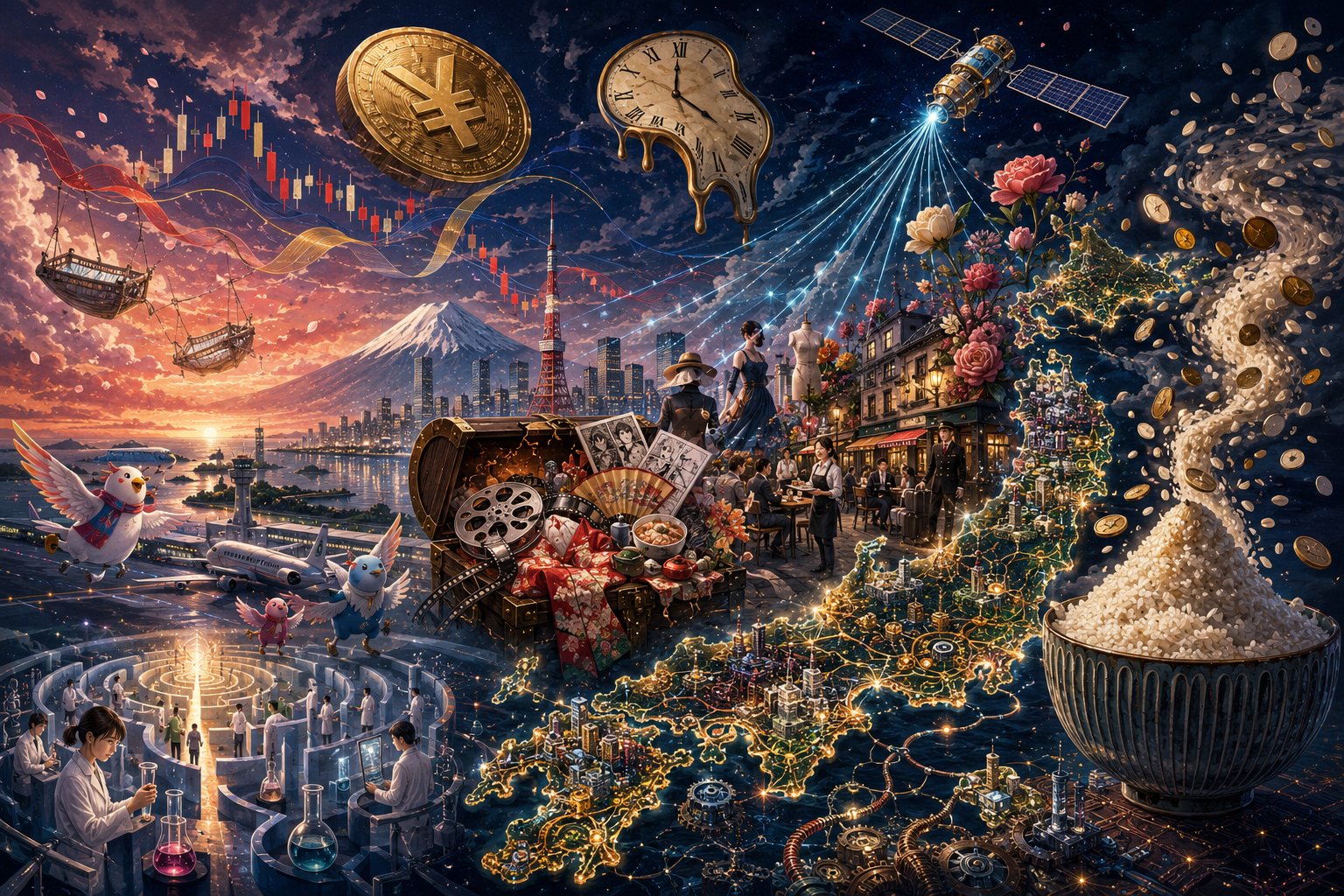
When we opened today’s edition, the stories did not feel separate for very long. Currency pressure bled into political tension. Satellite ambition touched disaster resilience. A culture fund became a cracked chest of unfinished dreams. Rice prices rose out of the kitchen and into politics. Birth numbers sounded like statistics, yet felt like a clock running down in the next room. To paint such a day with plain realism would have been possible. It would also have been inadequate. So we chose surrealism — not as escape, but as a more honest way of seeing.
Surrealism is often misunderstood as a style of strangeness for its own sake. It is something more serious than that. Historically, it was an attempt to widen reality. André Breton and the writers and artists around him believed that dreams, chance, desire, instinct, fear, and unconscious association belonged to the real world just as much as tables, streets, and governments did. Surrealism did not want to abandon reality. It wanted to rescue the parts of reality that ordinary reason was too narrow to notice.
That makes it especially useful for a newspaper page like today’s. The stories are solidly factual: yen policy, direct-to-device satellites, the Cool Japan Fund, services PMI, SoftBank and Toyota, rice inflation, Noto recovery, clinical trial reform, low births, and regional technological fitness. Yet each story is also shaped by unseen forces — mood, fear, delay, memory, aspiration, policy drift, structural inertia, private desire, demographic time. Surrealism is one of the few visual languages built to show that kind of invisible weather.
Surrealism began as a revolt of the eye after the collapse of certainty
The movement emerged from the wreckage of Europe after World War I. A civilization that had described itself as rational, progressive, and enlightened had marched itself into mechanised slaughter. Dada answered that collapse with mockery and refusal. Surrealism followed by searching for another frontier: the unconscious. If public reason had failed so catastrophically, perhaps the night-mind had something urgent to say.
The poet Guillaume Apollinaire used the word “surrealism” in 1917, but the movement’s program was announced most clearly in Breton’s 1924 manifesto. Breton prized automatic writing, dream transcription, irrational juxtaposition, and forms of creation less censored by conscious control. Sigmund Freud’s writing — especially The Interpretation of Dreams — mattered enormously here. Dreams were no longer dismissed as meaningless static. They were understood as coded expressions built from condensation, displacement, symbol, desire, and fear.
Once artists took that idea seriously, ordinary reality became unstable in the best possible way. A clock could melt. A room could fill with sky. A train could come out of a fireplace. A bowler hat could conceal an abyss. A lobster might speak to a telephone. Such images were not nonsense. They were arguments in pictorial form: what appears stable is not stable; what seems separate is not separate; what looks ordinary is full of pressure from below.
Dalí’s clocks, Magritte’s calm disturbances, Ernst’s accidents
Salvador Dalí gave surrealism one of its most famous emblems: the melting clock in The Persistence of Memory. Time becomes soft, vulnerable, psychological, almost edible. René Magritte was quieter but no less radical. He used ordinary things — a pipe, an apple, a suited man, a cloud — and shifted them just enough to expose the instability between word and object, picture and thing, inside and outside. Max Ernst embraced frottage, collage, and the fertile role of accident. Joan Miró scattered signs like a private constellation. Yves Tanguy invented dream topographies with no obvious geography at all.
What they shared was not a single look but a method of contact. In dreams, distant things sit side by side without apology. The finance page and the kitchen table are in the same room. State policy and childhood fear drink from the same glass. The news often works this way even when the page design tries to keep everything tidy. Today’s image allows the hidden adjacency to surface. The melting clock touches demographics and policy delay. The floating yen coin hangs over household feeling. The satellite speaks to Rakuten, but also to islands, mountains, storms, and the problem of distance itself.
It also matters that surrealism was never only a male parade of great names. Artists such as Leonora Carrington, Remedios Varo, Dorothea Tanning, and Claude Cahun widened the movement into territories of metamorphosis, identity, domestic unease, feminine magic, and inward theatre. Their work reminds us that surrealism is most powerful when it becomes plural — when it is not just shock, but atmosphere, not just spectacle, but an ecosystem of associations. That wider surrealism is closer to what a newspaper art choice needs.
Japan had its own surrealist current — and it arrived early
Surrealism did not stay in Paris. It arrived in Japan relatively early and found receptive ground. In the late 1920s and 1930s, painters, poets, critics, photographers, and designers began translating and reinventing its ideas. Fukuzawa Ichirō brought back elements of European avant-garde practice. Koga Harue built one of the most distinctive dream-worlds in modern Japanese painting, where machinery, sea, city, and private vision meet. Takiguchi Shūzō became a crucial critical and poetic voice for Japanese surrealism. Related energies moved through poetry, design, photography, and the broader avant-garde.
Japanese surrealism was never just imported costume. It absorbed its own pressures: accelerated modernisation, urban loneliness, technological fascination, the pull of empire, and the tightening atmosphere of the 1930s. Dreams in Japan did not look exactly like dreams in Paris. The imagery often carried its own tensions of machinery and memory, sea and city, silence and speed. In wartime, experimental freedoms narrowed sharply, but the surrealist impulse did not vanish. It resurfaced after the war in avant-garde art, photography, film, theatre, and later visual cultures that kept faith with displacement, fragmentation, metamorphosis, and poetic misfit.
That history is one reason surrealism still feels natural in a Japanese editorial context. Japan knows how to stage the collision of precision and strangeness. It knows how to make technology feel haunted, and how to let the ordinary acquire a mysterious glow. A nation of railway timetables, convenience stores, anime worlds, robotics, Shōwa memory, and tectonic uncertainty hardly needs to be taught how reality can become uncanny. It lives near that threshold already.
- The giant yen coin: market anxiety made monumental.
- The melting clock: time pressure in currency, demographics, and reform.
- The satellite beaming threads of light: Rakuten’s network dream and the politics of national infrastructure.
- The broken treasure chest: culture policy, ambition, leakage, and unfinished value.
- The bowl of rice becoming a storm: household pain, inflation, and old systems under stress.
- The clinical maze: speed, trust, and complexity in medical reform.
- The illuminated map of Japan: regional capability, innovation networks, and uneven futures.
Why surrealism fits today’s ten stories
The beauty of today’s edition is that each story belongs to a different desk, yet all of them behave as if they were secretly family. The yen story is finance, but it is also emotion and national posture. The satellite story is telecoms, but also resilience, geography, and strategic autonomy. The Cool Japan Fund story is culture, but also balance-sheet disappointment and the old puzzle of how a state monetises “soft power.” Services PMI suggests life returning to domestic demand, while also hinting at labour shortage and cost pressure. The SoftBank–Toyota story looks like a market ranking, yet it doubles as a struggle over Japan’s self-image: hardware discipline or AI-era daring?
The rice story starts in the supermarket and ends in politics. The Noto Pokémon airport story is charming by design, yet underneath it lies the serious grammar of recovery, memory, and regional encouragement. Clinical trial reform is about health policy, but also trust in institutions and the pace at which hope can travel. The birth story is a demographic headline, but it lives in apartments, wages, marriages, schools, and futures imagined or postponed. The prefectural innovation story maps patents and capabilities, yet what it really reveals is uneven destiny — why some places compound and others stall.
Surrealism is right for such a page because it shows what the stories share: invisible force. A newspaper ordinarily separates stories into neat rectangles. Reality does not. Rice prices and land rules, low births and housing costs, satellites and depopulation, culture policy and investment philosophy, patents and regional income all run into one another below the visible surface. Today’s art choice makes that underground river visible.
Explaining surrealism in a slightly surrealist way
Surrealism is what happens when the objects of the day refuse to stay in their assigned seats. The yen climbs out of the business page and floats into the sky. The rice bowl grows weather. A demographic chart learns how to whisper in the hallway at night. A laboratory becomes a maze because procedure feels like a maze. A satellite becomes a spider and the country becomes a constellation. A treasure chest of culture spills reels, fans, fashion, food, and policy memos all over the floor. The dream does not lie. It exaggerates until the truth can no longer hide.
That is why the dramatic quality of today’s image works. It is not melodrama for its own sake. It is faithful to the felt pressure of the day. When currency unease becomes large in public consciousness, it deserves a huge coin. When time feels abnormal, a hard clock deserves to become soft. When the cost of rice seems to move from the bowl into the whole political atmosphere, a grain-storm becomes accurate in a way a simple chart cannot be.
The Japan.co.jp view
We did not choose surrealism because it is fashionable, nor because it is easy shorthand for “strange.” We chose it because the current Japanese moment is full of rational numbers and irrational feelings at once. Policy is technical, yet its consequences are intimate. Data is precise, yet the lived meaning of the data is ghostly, delayed, emotional, and sometimes absurd. In such a moment, realism can describe the surface while failing to catch the pressure underneath. Surrealism gives that pressure a body.
It is also important that surrealism is not only an art of anxiety. It is an art of possibility. It can reveal fear, but it can also reveal hidden connection and latent hope. In today’s image, the glowing map of Japan is the clearest sign of that. Regional capacity still exists. Scientific reform still points toward light. Recovery can still be playful. Even the broken treasure chest of culture still contains things worth saving. The point of surrealism is not to say that reality has become impossible. It is to say that reality has become dense enough to require a deeper language.
That is why art belongs in a newspaper at all. Not to decorate facts, but to deepen them. Today’s surrealist image is not an ornament to the edition. It is a visual editorial — a way of showing, at a glance, the emotional weather system running beneath the page.
Reader’s guide
| Item | How to read it |
|---|---|
| Today’s art choice | Surrealism. It binds ten apparently separate stories into one dream-logic composition. |
| Core art-historical idea | After World War I, artists such as Breton, Dalí, Magritte, and Ernst used dreams, chance, and the unconscious as artistic method. |
| Japan connection | Surrealism reached Japan early and developed through figures such as Fukuzawa Ichirō, Koga Harue, and Takiguchi Shūzō. |
| Why it fits today | Because today’s stories are all shaped by invisible forces that visibly change daily life. |
| The Japan.co.jp view | Surrealism is not mood alone. It is one of the most honest ways to picture the twists and tensions of Japan in 2026. |
Sources and references
This article draws on André Breton’s Manifesto of Surrealism, the early use of the word by Guillaume Apollinaire, Freud’s The Interpretation of Dreams, and public museum materials from Tate, MoMA, The Met, and Japanese museums and archives on modern and avant-garde art.
- André Breton, Manifesto of Surrealism (1924).
- Guillaume Apollinaire and the early history of the term “surrealism” (1917).
- Sigmund Freud, The Interpretation of Dreams (1900).
- Tate, The Met, and MoMA timelines and collection essays on Surrealism.
- Japanese museum and archive materials on modern Japanese avant-garde art.