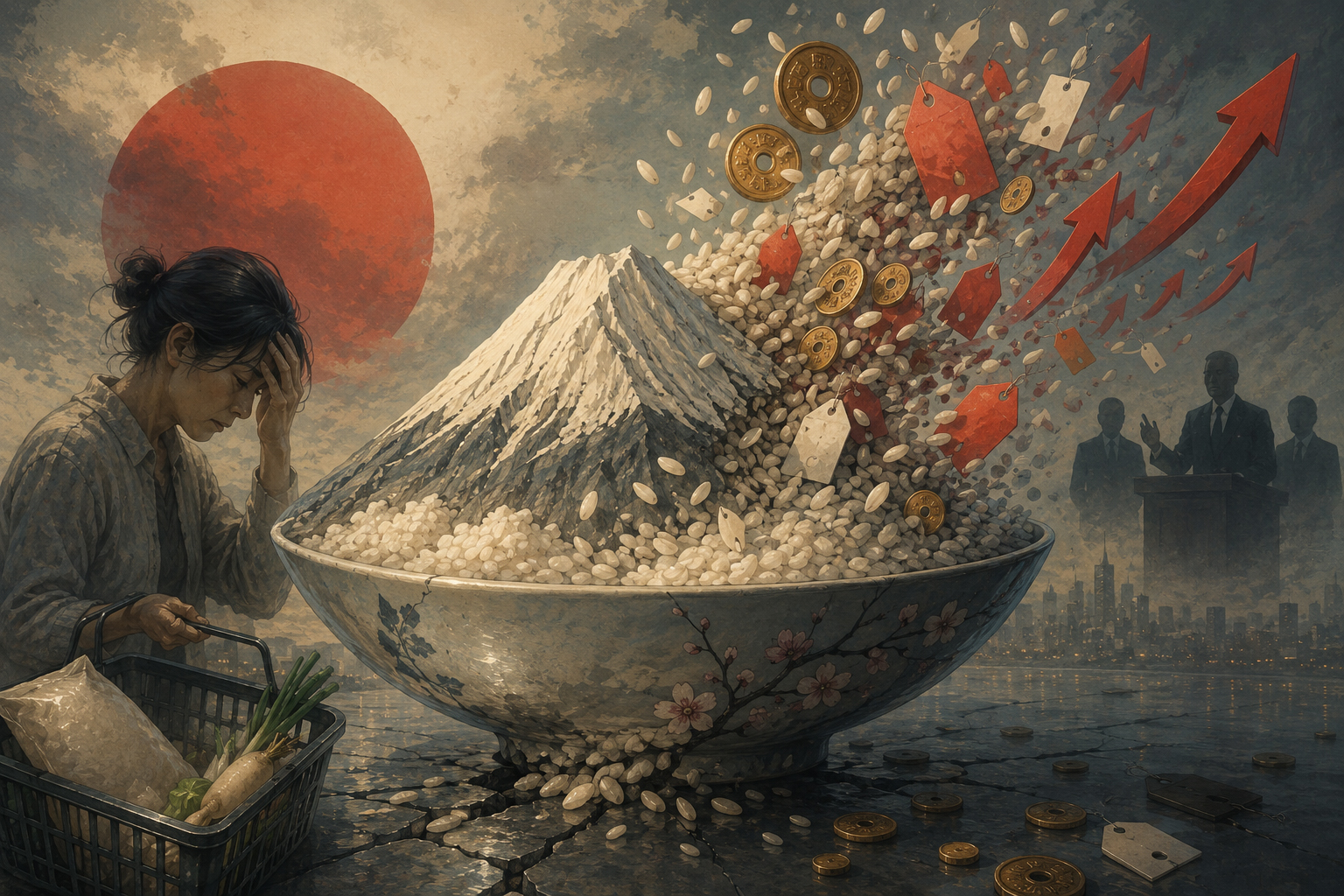
Rice is not just a grain in Japan. The word gohan means both cooked rice and a meal itself. A bowl of white rice connects the family table, school lunches, bento boxes, shrines, paddies, harvest rituals, and postwar politics. When the price of rice rises, it is never only a grocery story. It is a warning that one of Japan’s oldest social contracts is under strain.
The rice-price crisis of 2025 and 2026 is a household problem, an inflation problem, and a political problem. Reuters reported that by May 2025, the price of a five-kilogram bag had more than doubled to above ¥4,000. The government released emergency stockpiles and tried to push rice more quickly onto supermarket shelves. But this story does not end in the warehouse.
The recent shock began with the 2023 heatwave, which reduced quality and lowered the amount of marketable white rice available after milling. Panic buying followed the August 2024 Nankai Trough megaquake advisory. Inbound tourism and revived restaurant demand added pressure. Yet beneath all of that sits something older: Japan’s rice system was designed to protect farmers by controlling supply, supporting prices, and tightly regulating farmland. That system now has to feed a shrinking, aging country under climate stress.
Inflation in a rice bowl
The rice market is unusually sensitive because demand does not move quickly. People may buy cheaper meat, skip a restaurant, or delay a purchase. But rice sits at the center of daily eating for many households. Nippon.com has noted that a supply-demand shift of roughly 200,000 tons can matter greatly because it sits within the normal range of private-sector inventories. After milling, the per-person daily difference can look tiny, yet it can alter shelf availability and prices.
The emergency stockpile release worked as a pressure valve. Reuters reported in June 2025 that average retail prices fell below ¥4,000 per five kilograms after the government changed the distribution route and stockpiled rice reached retailers. But that was treatment, not cure. Japan still had to ask why the supply shock became so severe, why official signals lagged, why production could not respond faster, and why land and labor remain so hard to mobilize.
Rice inflation is politically dangerous because it is intimate. It is not a chart on a central-bank slide. It is printed on a supermarket shelf tag. When wages lag and the staple food doubles, households do not experience “transitory pressure.” They experience a broken promise.
Why rice becomes politics
Japan’s modern rice politics begins in the postwar land reforms. The landlord system was dismantled, tenant farmers became owner-farmers, and the countryside was stabilized. This was a social achievement and a political achievement. Smallholder farmers became a foundation of rural democracy and, over time, an organized support base for the Liberal Democratic Party.
But the success created a shadow. Rules meant to protect the small farmer slowed consolidation. Agricultural cooperatives became distribution networks, financial institutions, service providers, and political organizations. Protecting the rice price became a way to protect the village, the cooperative, and the vote.
Reuters Breakingviews has argued that rice is now a direct threat to Prime Minister Sanae Takaichi’s inflation-control promise. High rice prices helped batter the previous government, and they remain explosive because they sit at the crossing of urban household pain and rural political loyalty. If rice is too cheap, farmers suffer. If rice is too expensive, voters suffer. Population decline makes that bargain harder every year.
The old safety valve called gentan
Japan’s acreage-reduction policy, known as gentan, began in 1970. It was a response to surplus. After years of food insecurity, production rose, diets diversified, and rice consumption declined. The state faced the problem of too much rice. Rather than let prices fall sharply, it paid farmers to reduce table-rice production or shift land to other crops.
The Tokyo Foundation has described the system as a supply-restriction arrangement designed to prevent excess rice from depressing prices. In the short term, it helped manage rural incomes. In the long term, it trained the system to value scarcity.
That is why the current crisis is so revealing. A policy built to prevent oversupply can become dangerous when the country needs resilience. When heat damages quality, tourism demand returns, and panic buying empties shelves, a system that has spent decades controlling production cannot quickly expand.
A country where farmland does not move easily
The deeper story is land. In Japan, farmland cannot simply be bought and sold like ordinary residential land. The Cropland Act reflects the postwar ideal that those who cultivate farmland should own it. Sales, transfers, and conversions generally involve permissions through local agricultural committees and other processes. The purpose was to prevent speculation and protect farmland for farming.
That purpose still matters. Japan should not allow farmland to disappear into random development or absentee speculation. But in a shrinking, aging society, protection can become paralysis. An owner may want to sell. A younger farmer may want to expand. A local company may want to cultivate. Yet ownership, zoning, inheritance, committees, qualifications, and local consensus can lock land in place even when the land is underused.
East Asia Forum has described the 2023 reforms allowing broader corporate ownership of agricultural land under certain local requests as a possible first step. But the Cropland Act remains the central structure, and the path from reform headline to usable farmland is slow. Japan does not only need to protect farmland. It needs to make sure farmland reaches the people who will actually farm it.
Editor’s note: what a Toyama family home shows
From the publisher’s personal experience with a family home in Toyama, agricultural land cannot be easily sold to new farmers or new users. Japan is sticking to old rules — like rice itself. But population decline means new standards must be put forward. The goal should not be to preserve paperwork for its own sake. The goal should be to preserve the capacity to grow food, maintain land, and pass regional life to the next generation.
JA, rural finance, and votes
No account of Japanese rice politics can avoid JA, the agricultural cooperative system. JA is not simply a crop distributor. It is a financial network, an insurer, a supplier, a service organization, and a political machine embedded in local life.
For decades the bargain made sense. Higher rice prices supported farmers. Cooperatives retained volume, deposits, and influence. The LDP gained an organized rural base. But the demographics are turning. Farmers are aging. The number of rice farmers has shrunk. Urban consumers outnumber the rural base, and young households feel the price of rice more than the romance of rice policy.
That does not mean rural Japan should be abandoned. It means old protection is no longer enough. If the goal is food security, Japan needs younger full-time farmers, agricultural corporations, new entrants, foreign labor where needed, water-management technology, robotics, drones, better data, and distribution reform. The village cannot be saved by freezing it in the 1970s.
The taboo of imported rice
When domestic rice becomes expensive, imported rice reenters the argument. Reuters has reported that Japan’s market remains heavily shielded by levies, but high domestic prices have made foreign rice more visible. The government’s 2026 agriculture white paper also warned that a sharp rise in private-sector imports could affect domestic production.
This is not an easy question. Imported rice can help consumers and serve as an emergency valve. But if imports crush domestic demand, paddies may disappear, rural water systems may weaken, and a landscape that performs flood control, biodiversity, and cultural functions may be lost. Rice is food, but rice paddies are also infrastructure.
Japan needs a middle path. It should not pretend that import barriers alone guarantee food security. Nor should it casually dismantle domestic production. The practical answer is land mobility, larger and more capable domestic producers, transparent pricing, emergency import flexibility, support for vulnerable households, and stable school-lunch procurement.
The Reiwa Rice Riot: fear before policy
A 2026 paper analyzing social and mass media called the 2024 shortage controversy the “Reiwa Rice Riot.” The phrase matters because rice moves emotionally. Empty shelves, stockpile rice, online complaints, politician remarks, and supermarket price photos spread faster than official explanations.
Food panic is reflexive. People see rice disappearing and buy more. Shelves empty further. Photos of empty shelves spread. More households buy. Even if total supply is not catastrophic, trust breaks. In rice policy, communication is not decoration. It is infrastructure.
The government’s problem was not only that prices rose. It was that the public was not convinced early enough that rice would be available, affordable, and fairly distributed. When a staple food becomes a trust crisis, statistics arrive late.
Who is agricultural reform for?
Agricultural reform is often spoken in urban language: scale, productivity, consolidation, corporate ownership, trade. Rural people hear other words: graves, water, neighbors, festivals, inheritance, and family land. A paddy is not a factory line. It cannot simply be relocated.
That is why reform must be careful. But careful cannot mean frozen. If elderly farmers leave, heirs live far away, fields go idle, and young farmers cannot obtain land, the system is failing its original purpose. Rules designed to protect farmland must be judged by whether farmland is actually used.
The objective should not be freedom to liquidate farmland. It should be freedom to move farmland to the next steward. Communities can identify core paddies, consolidate use rights, prevent reckless conversion, welcome capable new farmers, and allow agricultural businesses where they strengthen production rather than replace the community.
Japan.co.jp view
Rice inflation is a whole-country story in miniature. Weather, tourism, inventory rules, earthquake fear, import policy, the LDP, JA, acreage reduction, farmland law, aging farmers, and population decline all sit in one bowl.
Japan has survived by being sticky about rice. But stickiness and rigidity are not the same. In an era of population decline, climate stress, and household inflation, old rules alone will not fill the bowl. To protect rice, Japan must protect the ability to grow it. That means land must move, young farmers must enter, production must adapt, and consumers must be able to afford the staple food.
The bowl of rice is small. The question inside it is large: can Japan reform an old rural bargain before it breaks at the dinner table?
Reader guide
| Question | Answer |
|---|---|
| What is happening? | High rice prices are hitting households and politics, while emergency stockpile releases have only partly eased the pressure. |
| Short-term causes | Heat damage, lower quality harvests, panic buying after the Nankai Trough advisory, tourism demand, and distribution lag. |
| Long-term causes | Acreage reduction, cooperative politics, Cropland Act restrictions, slow land mobility, labor shortages, and population decline. |
| Political meaning | Rice prices are felt directly in household budgets and can quickly become a judgment on government competence. |
| Japan.co.jp view | To protect rice, Japan must move farmland and production capacity toward the next generation, not merely preserve old rules. |
Sources and references
This article draws on Reuters, Nippon.com, the Tokyo Foundation, East Asia Forum, public material on Japan’s Cropland Act, and 2026 research on the so-called “Reiwa Rice Riot.”
- Reuters Breakingviews: 2026 analysis of rice prices, acreage controls, cooperatives, and LDP politics.
- Reuters: Explainer on the surge in Japan’s rice prices, the 2023 heatwave, panic buying, tourism demand, and inventory shortages.
- Reuters: Reporting on retail rice prices falling below ¥4,000 per 5kg after emergency stockpile releases.
- Nippon.com: Review of rice price pressures, white-rice yields, demand shifts, and Japan’s emergency stockpile rules.
- Tokyo Foundation: Historical critique of Japan’s rice acreage-reduction policy.
- East Asia Forum: Overview of Cropland Act restrictions, corporate ownership reform, abandoned farmland, and agricultural productivity.
- arXiv: Research on media and social-media emotion during the “Reiwa Rice Riot.”