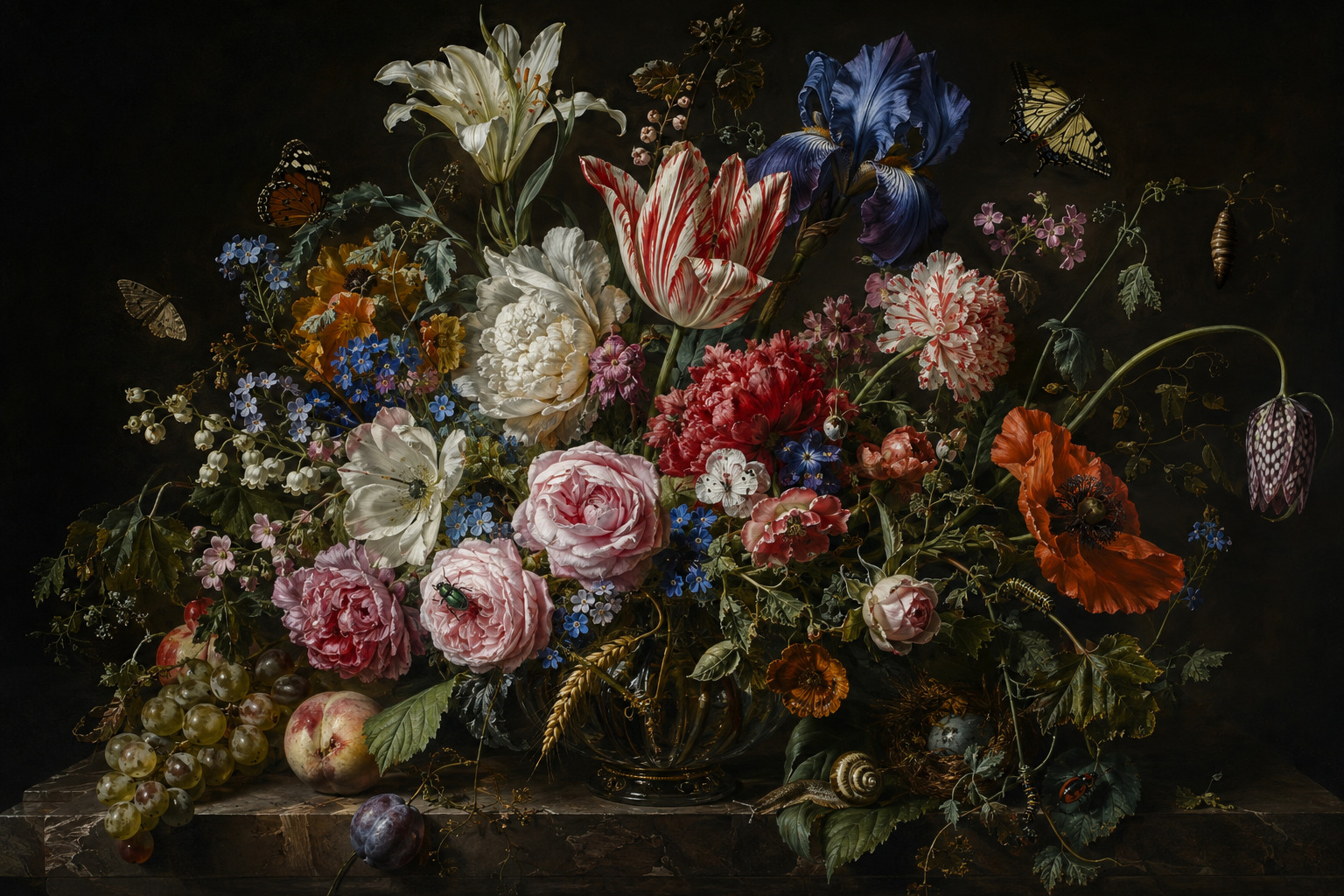
The most important material in this painting may not be oil. It may be time. Rachel Ruysch’s Still Life with Flowers on a Marble Tabletop gathers more than ten flower species into a blue glass vase, even though the blossoms open at different points in the growing season. Roses, poppies, irises, carnations and bindweed share a moment that nature does not provide.
The painting is dated 1716 by the artist’s inscription. It measures only 48.5 by 39.5 centimeters, smaller than the visual abundance suggests. The Rijksmuseum identifies it as oil on canvas, object SK-A-2338, acquired in 1908 with support from the Vereniging Rembrandt. Its image is marked public domain.
Accuracy in Every Part, Invention in the Whole
An “impossible bouquet” can suggest fantasy. Ruysch’s achievement is almost the reverse. She did not need to invent impossible species. She rendered individual petals, stems, leaves and insects with enough specificity to make them recognizable, then assembled those truthful observations into a scene no single sitting could supply.
The Rijksmuseum says her extensive study of living and prepared flowers made such precision possible. Its broader account of her practice adds visits to Amsterdam’s botanical garden, books and botanical prints, specimens in her father’s collection and drawings made to preserve her observations. The painting is therefore not a transcription of one bouquet placed before an easel. It is a construction from accumulated encounters.
“Impossible bouquet” is an editorial description, not the museum’s subtitle. Nor does the public object record supply a complete botanical checklist with the flowering period of every depicted species. The documented claim is narrower: the bouquet includes more than ten species whose different blooming times would make the arrangement difficult to assemble in life.
The Insects Change the Painting’s Scale
From a distance, the flowers create mass, color and silhouette. Up close, insects break that first impression into a series of small discoveries. The Rijksmuseum describes insects among the blossoms and notes elsewhere that Ruysch painted flowers, snakes, snails and insects with detail that often allows them to remain identifiable today.
The interpretive effect is powerful. A viewer who searches for a beetle or winged insect stops treating the bouquet as one decorative object. Leaves become platforms and shadows become possible hiding places. The painting begins to resemble a miniature habitat, although that phrase describes a way of seeing, not a scientific classification assigned by the museum.
It is tempting to give every flower and insect a fixed emblematic meaning. The museum’s object record does not do that for this painting, and this report does not convert it into a codebook. Mortality, abundance and the passage of time are plausible associations within flower still-life traditions, but they remain interpretation unless connected to evidence for this particular work.
Four Ways Into the Painting
- Read the bouquet first as a single silhouette
- Choose one flower and follow its stem through the arrangement
- Search for insects and notice how they redirect the eye
- Return to the whole and imagine the seasons compressed inside it
An Artist Raised Beside Specimens
Ruysch was born in The Hague in 1664 and grew up in Amsterdam. Her father, Frederik Ruysch, was a professor of anatomy and botany who developed preservation methods and assembled an extensive collection of botanical, zoological and anatomical specimens. The Mauritshuis says Rachel drew and painted objects from that collection and, at about 15, was permitted to train with Willem van Aelst, a leading Amsterdam still-life painter.
The background helps explain her access to plants and preserved material, but it should not flatten her into a scientific illustrator. Ruysch adapted her work to patrons and the art market. Across a long career she moved among forest-floor scenes, garlands, small hand-tied bouquets and elaborate arrangements in classical vessels. Botanical knowledge became painting through decisions about light, color, balance and desire.
Her success was not a modern rediscovery imposed on an obscure career. In 1701 she became the first woman admitted to Confrerie Pictura, the artists’ and art lovers’ society in The Hague. In 1708, Elector Palatine Johann Wilhelm appointed her a court painter. According to the Rijksmuseum, she continued living with her family in Amsterdam while sending the Düsseldorf court one painting a year for nine years.
The 1716 bouquet belongs to a mature professional career. Ruysch had royal patronage, an international market and a public reputation during her lifetime. Poems praising her work were gathered and published in 1750, an honor the Rijksmuseum and Mauritshuis describe as unprecedented for a Dutch artist.
Observation Is Not the Opposite of Artifice
A botanical illustration often isolates a specimen so its structure can be studied. Ruysch does something different. She crowds forms together, partly conceals some flowers, sends stems outward and lets tiny creatures interrupt the display. Identification remains possible, but it is made to coexist with drama.
That is why the contradiction in the painting matters. The bouquet is not less truthful because it could not be assembled on one day. Its truth belongs to another scale: repeated observation across time, preserved in studies and reorganized so the eye can encounter several seasons at once.
| Artist | Rachel Ruysch (1664–1750) |
|---|---|
| Title | Still Life with Flowers on a Marble Tabletop |
| Date and medium | 1716; oil on canvas |
| Dimensions | 48.5 × 39.5 centimeters |
| Collection | Rijksmuseum, Amsterdam |
| Object number | SK-A-2338 |
| Image rights | Public domain, according to the museum record |
The painting asks for two kinds of attention at once. Stand back, and Ruysch gives you a bouquet with the confidence of a single event. Move closer, and that unity dissolves into seasons, specimens, studies and insects. Nature supplied every part. The painter supplied the time in which they could meet.
- Rijksmuseum: Still Life with Flowers on a Marble Tabletop (date, signature, medium, dimensions, object number, flowers, insects, differing flowering periods and public-domain status)
- Rijksmuseum: Rachel Ruysch (family background, botanical research, drawings, changing formats, Confrerie Pictura and court appointment)
- Mauritshuis: Rachel Ruysch (1664–1750) (biography, Frederik Ruysch’s collection, training with Willem van Aelst, technique and contemporary standing)
- National Museum of Western Art, Tokyo: 2025 exhibition checklist (Japanese; official Japanese rendering ラーヘル・ライス and a separate 1689 work titled 花卉)
This article is based primarily on collection and biographical material from the Rijksmuseum and Mauritshuis available by the morning of August 31, 2026 JST. “Impossible bouquet” is an editorial description, not an official subtitle. The published object record does not provide a complete identification of every flower and insect, a fixed symbolic meaning for each element or a study-by-study reconstruction of the painting’s preparation, so this report does not assert those details. The hero image is an AI-assisted editorial illustration, not the museum’s public-domain image of the original painting.