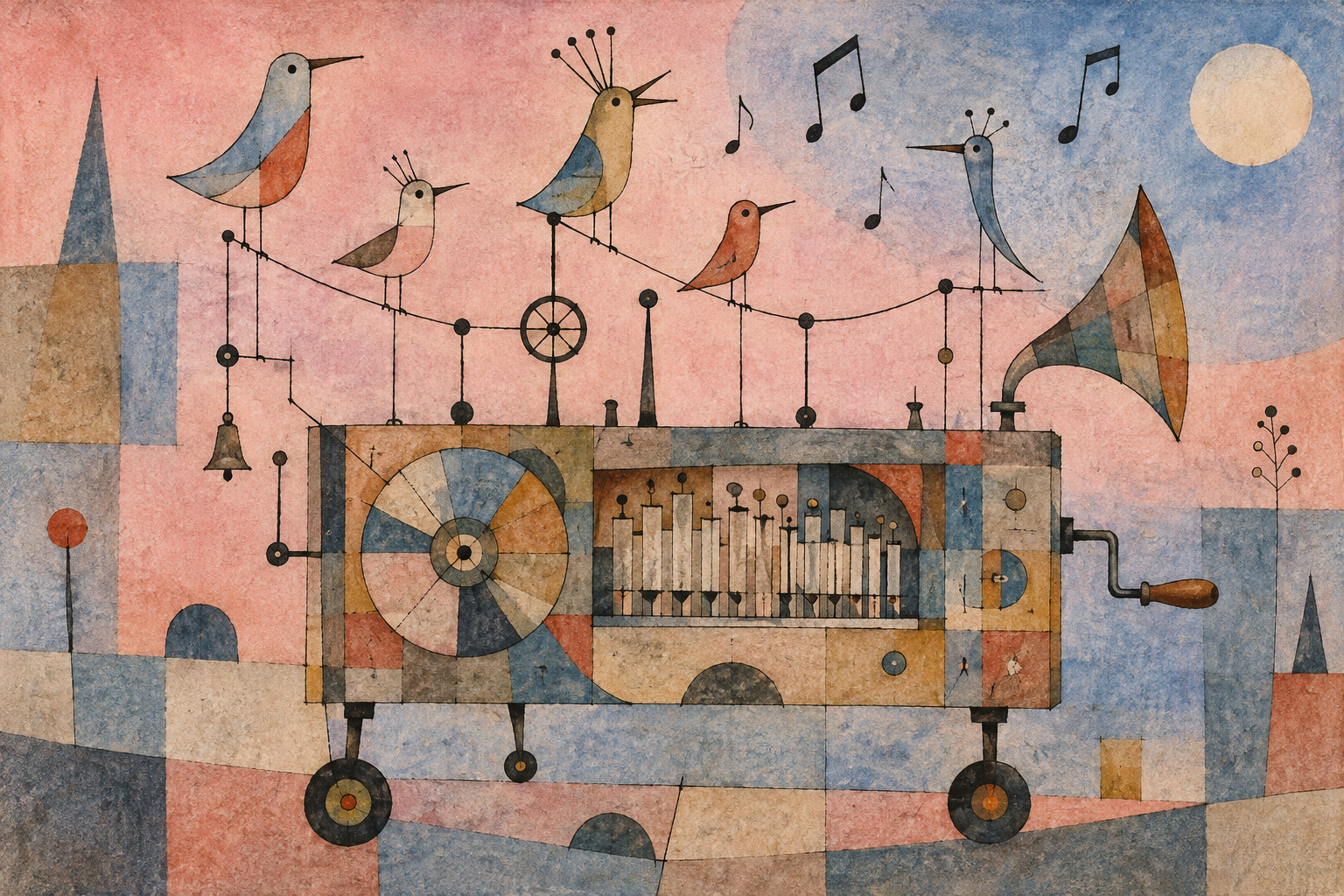
The handle is the detail that changes everything. At first, Paul Klee’s Twittering Machine can look like a gathering of improbable birds: spindly, expressive and faintly comic. Then the eye follows their support to a crank on the right. What appeared to be a little concert acquires an operator, even though no operator is shown.
Made in 1922, the work is held by the Museum of Modern Art in New York. Its German title is Die Zwitscher-Maschine.[1] For today’s art choice, the invitation is to linger over a question the picture keeps open: are these creatures making music, or is something making them perform?
Open MoMA’s image and collection record for Twittering Machine. The illustration heading this article is an AI-generated response to Klee’s style, not a reproduction. The observations below concern the original work.
A chorus that refuses to settle
Four birdlike figures occupy the original’s lower middle, leaving a surprisingly large expanse above them. Their heads sit at different heights. One stretches upward; another droops. A coiling neck and a sharply pointed beak suggest different kinds of movement. Very little anatomy is needed to make these marks seem animated.
That animation is unstable. The thin supports can be read as legs, wires or both. The body is difficult to separate from the apparatus. Looking becomes a sequence of small corrections: creature, component, creature again. The image does not allow the comforting distinction between a living bird and a machine beside it.
MoMA reads the space below as a possible trap.[1] Yet interpretation need not become a code assigning one fixed meaning to every mark. The apparatus is more disturbing because it remains partly illegible.
Its absent operator matters, too. A handle is an invitation to imagine a hand. The viewer supplies the action that the picture withholds, becoming mentally involved in whatever the machine might do. The image’s apparent delicacy offers no exemption from that involvement.
A line made indirectly
Klee’s line can look spontaneous, but spontaneity is not the whole account of its making. Oil transfer is an indirect drawing process. In its discussion of another Klee work, the Yokohama Museum of Art explains how tracing an existing drawing onto another sheet produces a distinctive roughness, with pressure and rubbing also leaving uneven marks.[3]
This is a useful lens for looking at the scattered dark traces around the birds. They are part of the surface’s activity. A drawing need not consist only of intentional outlines against a neutral background; contact between materials can become visible, too. The result can appear both constructed and vulnerable.
The connection to the subject is suggestive. A picture of a mechanism has itself passed through a procedure that mediates between the artist’s hand and the final surface. Yet transfer should not simply be equated with industrial mass production. Here, an indirect method makes particular, irregular marks. The process complicates the opposition between mechanical procedure and individual touch.
Japanese museums have given this material question sustained attention. The National Museum of Modern Art, Kyoto’s 2011 Klee exhibition focused on how his works were physically made. Its account notes that he maintained a catalogue of his work from 1911 onward, recording methods as well as titles.[4] The dreamlike image and the methodical worker belong to the same artist.
Music without a soundtrack
Music was embedded in Klee’s life. The Zentrum Paul Klee’s biography identifies his father as a music teacher and his mother as a singer; it also records his youthful hesitation between music and painting.[5] The institution’s archive includes scores he played from and a violin.[7] These facts make the musical invitation of the picture more than an attractive metaphor.
They do not, however, turn its birds into a score. A tall vertical may suggest a sustained note; a sharp angle may suggest an accent. Neither tells us a pitch or duration. A viewer may imagine chirping, metallic friction, shrieking or some uncomfortable mixture. The painting organizes the desire to hear without resolving what should be heard.
In a preview of a research volume on Klee and music, editor Thomas Gartmann emphasizes questions of form and proportion. He also reports Pierre Boulez’s skepticism about a sonic realization of Twittering Machine.[8] The relationship between the arts can therefore be structural or imaginative without being a literal translation from one medium into another.
This distinction preserves something valuable. If a soundtrack settled the birds’ voices for us, it would remove part of the uncertainty. In silence, each viewer discovers what kind of sound they expect from a body that might also be an instrument.
The date of the image, and the dates of its displacement
The work belongs to Klee’s Bauhaus years. MoMA’s biographical account dates his teaching there to 1921–31, followed by a post in Düsseldorf. The Nazis dismissed him in 1933, and he moved to Bern. Earlier, he had served in the German army during the First World War without seeing action at the front.[6]
These circumstances form a history around the image; they are not a master key to it. A work made in 1922 cannot responsibly be described as a documented prediction of the persecution that followed. Its later treatment and its original meaning are related questions, but they require different evidence.
MoMA’s provenance record traces the work from the artist to Berlin’s Nationalgalerie in 1923, through confiscation as “degenerate art” in 1937, and onward through dealers to MoMA’s acquisition on October 14, 1939.[1] Keeping those events distinct avoids turning the picture’s entire history into one moment of persecution.
Provenance changes how we understand a museum object. The picture did not simply drift into a celebrated collection. Its passage involved the forcible removal of art from a public institution. That history deserves to remain visible even when the image is encountered as an appealing arrangement of lines and colors.
A Japanese encounter with the machine
There is a specific Japanese connection. The National Museum of Modern Art, Tokyo records a pencil-on-paper work by 古賀春江, Koga Harue, copying Klee’s Last Snow and Twittering Machine. Its Japanese catalogue title uses 《さえずる機械》 for the latter.[2] This is tangible evidence of one Japanese artist’s engagement with Klee, rather than a generalized claim about national taste.
The record does not by itself establish which reproduction Koga consulted or precisely what he wanted to learn. Those questions should remain open. Still, copying directs attention to the work as a set of decisions: where a line bends, how a form is balanced, how little is needed for a creature to appear. Reception can begin with that intimate labor of looking.
Who turns the handle now?
A contemporary reader may connect the image with automated voices and the technology of expression. That is a present-day comparison, not an intention being assigned retrospectively to Klee. The useful question is about agency: when something seems to speak or sing, what do we know about the mechanism directing it?
The picture offers no simple answer in favor of nature or against machines. Its figures remain stubbornly different from one another. They can look comic and exposed at the same time. Their irregularity may suggest persistence, or make their dependence on the apparatus feel more painful. Both responses can emerge from the same few lines.
| Item | Artwork information |
|---|---|
| Artist | Paul Klee (1879–1940) |
| Title | Twittering Machine (Die Zwitscher-Maschine) |
| Date | 1922 |
| Medium | Oil transfer drawing, watercolor and ink on paper; gouache and ink borders on board |
| Dimensions | 64.1 × 48.3 cm, as currently catalogued by MoMA |
| Collection / object number | The Museum of Modern Art, New York / 564.1939 |
Try looking once more at the birds while temporarily ignoring the crank. Then return to the handle. Notice how a single component alters the scene. Klee’s uneasy music begins in that shift: not as an audible tune, but as the moment when our own imagination starts the machine.
- MoMA: Twittering Machine, object record and provenance
- The National Museum of Modern Art, Tokyo: Koga Harue’s copies after Klee
- Yokohama Museum of Art: Klee’s oil-transfer technique
- The National Museum of Modern Art, Kyoto: Paul Klee—Art in the Making (2011)
- Zentrum Paul Klee: biography
- MoMA: Paul Klee, German Expressionism archive
- Zentrum Paul Klee: collection and archive press kit (2025)
- Zwitscher-Maschine: Thomas Gartmann on Klee and music (2020 book preview)
Based on museum and research materials checked through September 17. Close looking and contemporary comparisons are Japan.co.jp interpretation.