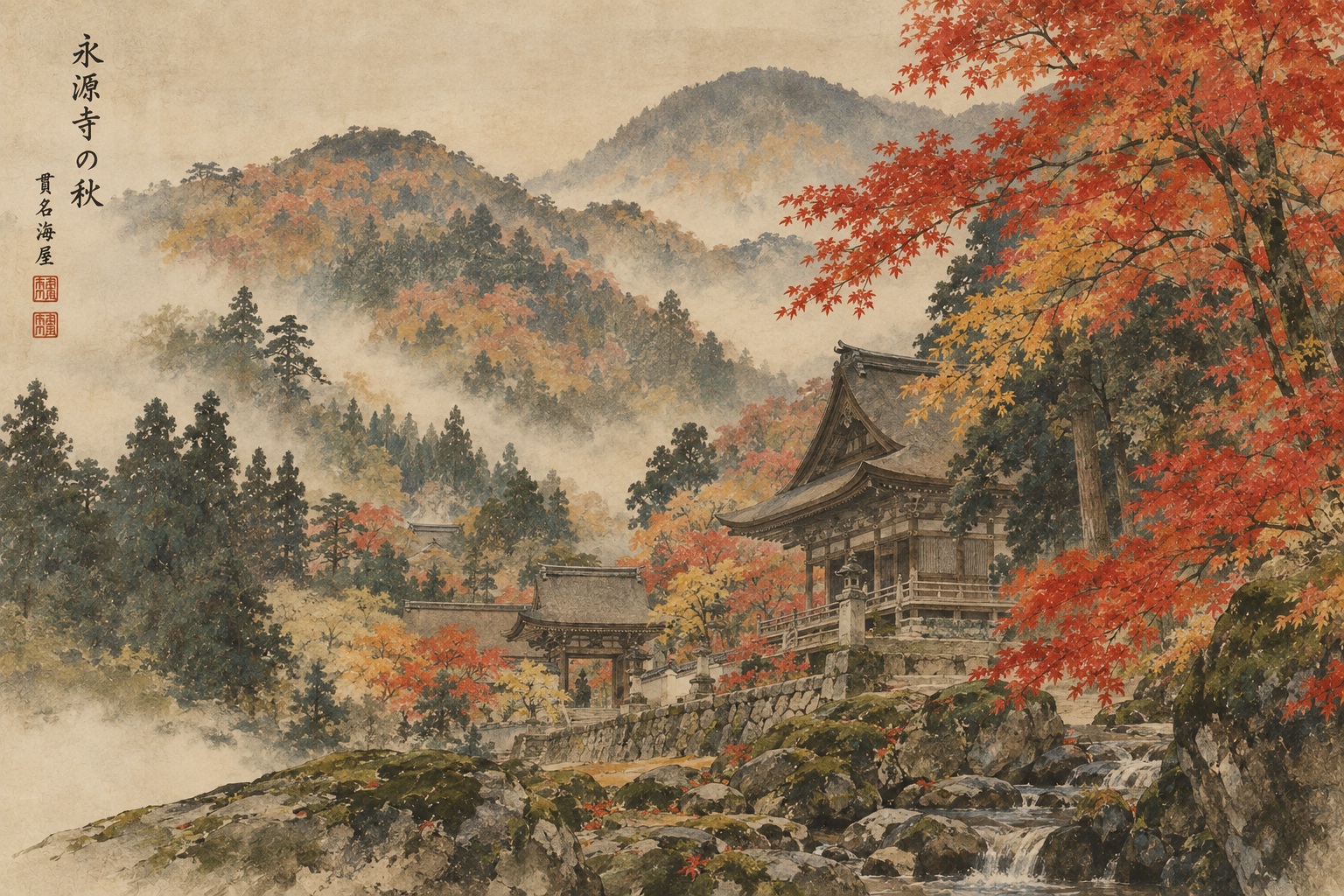
There is more than one way to paint autumn. You do not need to fill the page with red leaves.
Nukina Kaioku’s Autumn Landscape at Eigenji, painted in 1833, is a small hanging scroll in ink and color on silk. The Metropolitan Museum of Art gives the image dimensions as only 30.2 by 17.8 centimeters. Yet the space feels much larger. Mountains recede, trees and architecture establish scale, and the painting seems to hold cool air between one brush mark and the next. The Met lists the work as Public Domain under its Open Access program.[1]
Kaioku and Suo: one literatus, several names
Japanese sources identify the artist as Nukina Kaioku, read ぬきな・かいおく. He is also widely known by his later art name, Nukina Suo.
The National Diet Library authority record uses “Nukina, Kaioku, 1778–1863.” Reference records drawing on Japanese literary archives give his personal name as Tsutsumu, courtesy names including Kunishige and Shizen, and additional studio or art names such as Suo, Hochiku Sanjin and Sanken-do.[2][3]
For an Edo-period literatus, a name was not necessarily one fixed public identity. Different names could mark scholarly, artistic and later-life identities.
Born in Awa, formed in the world of letters
A Tokushima museum publication places his birth in 1778 in what is now central Tokushima, the second son of an Awa-domain retainer. The family name Nukina was later adopted from an ancestral surname.[4]
That provincial origin matters. Kaioku would eventually become part of Kyoto’s scholarly and artistic world, but he began outside the capital’s established circles.
He was not simply a painter
Japanese reference sources describe Kaioku as a Confucian scholar accomplished in both calligraphy and painting. In Kyoto he ran a calligraphy school known as Shijuku, and later reputation placed him among the great calligraphers of the late Edo period.[3]
This matters because “literati painting” is not merely a visual style.
The literati ideal treats poetry, calligraphy, painting, scholarship and cultivated conversation as related expressions of one mind. Kaioku’s landscapes therefore belong to a broader intellectual practice.
From Kano training toward Nanga
Japanese reference records say Kaioku first studied Kano-school painting and later moved toward Southern-school or Nanga painting.[3]
The Kano school had dominated elite Japanese painting for centuries. Nanga, by contrast, looked toward Chinese literati painting and valued poetic resonance, brushwork and cultivated amateur ideals over institutional polish.
Japanese Nanga was never simply Chinese painting transplanted to Japan. It became a hybrid culture of Chinese models, Japanese places, poetry, publishing, collecting and networks of scholars in Kyoto and Osaka.
The point is not merely to paint a place accurately
A literati landscape is not a topographic survey.
Mountains may be rearranged. Buildings may be reduced. Distance may be exaggerated. The question is how the viewer’s mind travels through the image.
Autumn Landscape at Eigenji works that way. The eye moves from the nearer trees and rocks toward architecture and then into distant mountain space. The object is physically small, but the visual journey is long.
Why Eigenji?
The Metropolitan Museum titles the work Autumn Landscape at Eigenji.[1]
That does not mean the scroll should be treated as a documentary record of exactly what Eigenji looked like in 1833. Literati landscapes often begin with a real place but reorganize it through memory, Chinese pictorial conventions and poetic association.
The more useful question is how Kaioku transformed the idea of a temple in autumn into a mental landscape.
1833, on the eve of the Tenpo crisis
Kaioku painted the scroll in Tenpo 4, or 1833. Japan was moving toward the difficult years of the Tenpo famine and a period of intensifying social strain.
There is no secure evidence that this intimate autumn scene should be read as direct political allegory.
But Kaioku was already a mature scholar in his mid-fifties. For literati painters, retreat into landscape did not always mean indifference to the world. Landscape could also create intellectual distance from it.
The following year: Lake Biwa through four seasons
The Met also owns Kaioku’s 1834 Lake Biwa in Four Seasons, a pair of six-panel screens.[5]
The museum describes the idealized landscape as rooted in Chinese painting traditions while noting that Kaioku’s subtle color modeling creates volume and depth in a way that suggests awareness of Western pictorial techniques.[5]
That observation complicates the stereotype of the literati painter as someone looking only backward. Kaioku was working with inherited forms while remaining visually alert to other ways of constructing space.
Restraint is not conservatism
The color in Autumn Landscape at Eigenji is deliberately restrained.
Contemporary image culture rewards saturation, contrast and immediate recognition. Kaioku does almost the opposite.
The painting requires proximity. The viewer has to follow brush density, faint color, speed of line and the breathing room between forms.
Its intelligence lies partly in refusing to reveal everything at once.
Calligraphy and painting shared the same body
Any account of Kaioku that ignores calligraphy misses a central part of his art.
The National Diet Library holds records for works and reproductions including Nukina Suo Gyosho Shikan and his calligraphic transcription of the Red Cliff Rhapsody.[6][7]
In literati practice, a line used to draw a tree and a line used to write a character were not separate disciplines. Both depended on pressure, rhythm, speed and breath.
That helps explain why Kaioku’s landscapes can feel controlled without feeling stiff.
What he passed to the next generation
Kaioku also mattered as a teacher.
The Metropolitan Museum notes that some sources identify Nukina Kaioku as an early teacher of Hine Taizan, while the later painter-calligrapher Murata Kokoku is also described as having studied with Kaioku when young.[8]
His legacy therefore moved through pedagogy as well as surviving objects.
The Kyoto literati network
Kaioku belonged to the same broad intellectual Kyoto in which figures such as Rai San'yo and Urakami Shunkin circulated.
Poetry gatherings, calligraphy, painting, antiquarian collecting, travel and scholarship were interconnected activities. The Met’s description of Shunkin’s 1833 Wintry Landscape with Trees places him in the literary circle around Rai San'yo and emphasizes his combined practice of poetry, calligraphy, music and connoisseurship.[9]
Seen in that context, a landscape painting becomes a record not only of scenery but of a social world built around cultivated looking.
Why this painting fits the October 9 edition
Japan.co.jp’s October 9 edition moves from 2nm semiconductors and AI data centers to neutrino astronomy, koji genetics, shrinking communities, regional transport and artists’ rights.
Kaioku’s scroll does not illustrate those subjects directly.
What connects it is method: observation, restraint, structure and adaptation. Kaioku uses an inherited visual language without merely repeating it. He strips the scene down until relationships become visible.
That makes the work unexpectedly compatible with an edition largely concerned with Japan adapting old systems to new pressures.
Autumn is not only a metaphor for decline
Autumn landscapes are often read through impermanence and loss.
This painting offers something quieter.
As summer density recedes, the structure of the mountains becomes clearer. Foliage thins. Distance opens.
Autumn is also the season in which hidden form becomes visible.
That is why this work belongs on October 9. A news edition contains too much movement. Kaioku gives the eye a slower instrument.
The practical importance of Public Domain
For Japan.co.jp, the work has another important advantage.
The Metropolitan Museum marks the image Public Domain and states that its Open Access public-domain images and data may be used for commercial and noncommercial purposes without permission or fee.[1]
Image rights are not a minor issue in cultural journalism. Some historically important works are difficult or costly to reproduce.
Kaioku’s scroll is therefore a strong Art Choice both editorially and practically.
It lasts because it does not shout
Kaioku is not as globally famous as Hokusai. He does not occupy the travel-poster imagination of Hiroshige or the decorative recognition of Rinpa.
His reward is different.
The painting asks for time.
Mountain, tree, temple, ink and pale color remain separate but never compete for dominance.
Nearly two centuries after 1833, the scene still feels cool and spacious. Kaioku leaves the viewer with something increasingly rare: room to think.
Sources and references
- The Metropolitan Museum of Art, Nukina Kaioku, Autumn Landscape at Eigenji, 1833.
- National Diet Library, authority and bibliographic record for Nukina Kaioku / Nukina Suo.
- National Diet Library Reference Collaborative Database, Nukina Kaioku biography and names.
- Tokushima Prefectural Museum Friends publication on Nukina Suo’s Awa origins.
- The Metropolitan Museum of Art, Nukina Kaioku, Lake Biwa in Four Seasons, 1834.
- National Diet Library, Nukina Suo Gyosho Shikan.
- National Diet Library, Nukina calligraphy of the Red Cliff Rhapsody.
- The Metropolitan Museum of Art, Hine Taizan biography and connection with Nukina Kaioku.
- The Metropolitan Museum of Art, Urakami Shunkin, Wintry Landscape with Trees, 1833.
Reporting and verification cutoff: October 7, 2026. The Metropolitan Museum records the English title as Autumn Landscape at Eigenji. This article uses 「永源寺秋景」 in Japanese as a practical rendering, not as a claim that it is the definitive historical Japanese title. The painting is not treated as a literal topographic record of Eigenji in 1833.