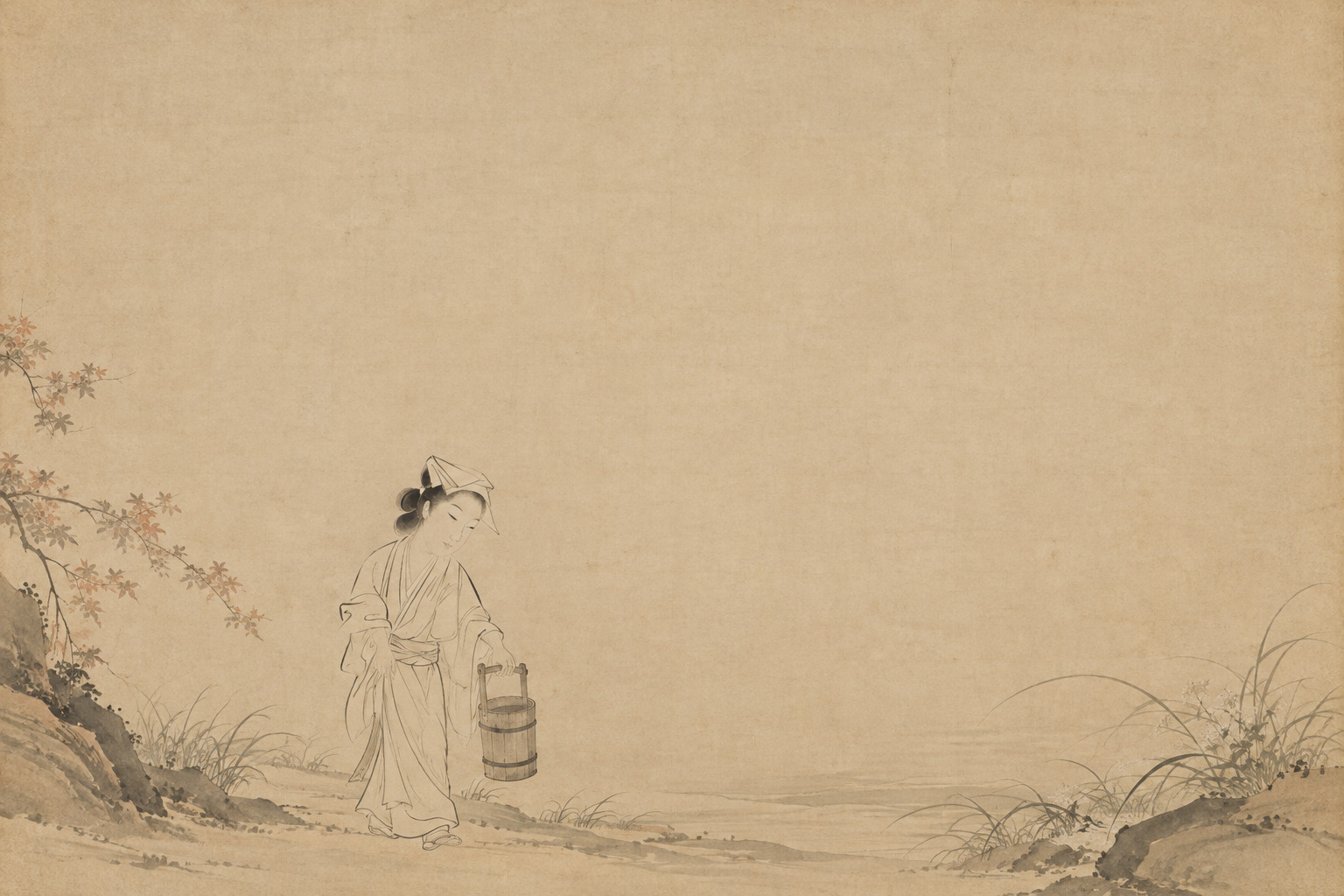
The bottom of the bucket breaks. Water disappears. The moon disappears with it. Yet Maruyama Ōkyo never paints the moon at all. In Lady Chiyono, dated 1773, the largest presence in the composition is absence: a vast vertical field of paper above a woman caught immediately after a small domestic object has failed. [1]
The Metropolitan Museum of Art describes the work as a hanging scroll in ink and color on paper, with most of the composition deliberately left blank. It also notes something especially revealing about Ōkyo's decision: although he had mastered more three-dimensional and realistic effects, here he does not use shading to construct pictorial depth. [1]
The story is about enlightenment through the disappearance of a moon reflected in water. The moon is missing. The water is missing. Enlightenment itself cannot be illustrated as an object. Ōkyo therefore makes the viewer complete the event.
The moon does not fall. Its reflection disappears
In the legend presented by the Met, Chiyono is carrying water in an old bucket and sees the moon reflected on its surface. The bottom suddenly gives way. The water drains out and the reflected moon vanishes. At that moment, she understands that what she had taken as fixed reality—and even the self she had taken as stable—was as insubstantial as the image held together by the bucket. [1]
The physical moon has not vanished from the sky. What disappears is the moon she had been looking at in the water. That distinction is the engine of the story.
Ōkyo's painting operates the same way. He does not show the moon and ask us to admire it. He removes it and lets memory generate it. He does not paint water and ask us to follow its surface. He lets the absence of water become the event.
Leaving most of the picture empty is composition, not omission
The painted image is 95.9 centimeters high and 38.9 centimeters wide. Chiyono occupies a relatively small area toward the bottom of a tall scroll. The upper field is radically open. [1]
A more explanatory painting could have placed a full moon above, a stream beside her and a reflective bucket below. Ōkyo chooses the opposite. Location, landscape, atmospheric setting and even night itself are stripped away.
The Met emphasizes that this was not because the painter lacked illusionistic skill. He knew how to create realistic volume and had studied approaches associated with Western pictorial space. In this work he declines to use those effects. [1]
The result is psychological pressure through subtraction. We are denied almost every descriptive cue except the figure and the failed bucket. The less the scene tells us about where we are, the more attention falls on what has just changed.
Ōkyo was a master of looking, not a painter who could not fill the page
Maruyama Ōkyo (1733–1795) is central to the history of eighteenth-century Kyoto painting because he made direct observation—shasei—a foundation of finished art. Kyoto National Museum traces him to a farming family in Anao village in Tanba, in present-day Kameoka, and says he entered the studio of Ishida Yūtei in his mid-teens. He studied Chinese painting traditions, Western techniques and older Japanese art while developing a lucid naturalistic style. [2]
Kyoto National Museum's educational account makes an important distinction. Artists had long sketched from life, but such studies often remained preparatory. Ōkyo brought observed form much more directly into completed paintings, studying birds, animals, fish and plants from many angles. [3][8]
That history changes how we read the blankness of Lady Chiyono. This is emptiness chosen by a painter who knew how to look closely and describe what he saw.
Four years earlier, he created white herons by not painting their bodies
Ōkyo's White Herons of 1769 offers another example of active non-painting. The Met explains that the bodies of the white birds are left as untouched paper, defined by soft surrounding wash rather than by conventional outlines or white pigment. [5]
The white of the heron is literally the paper that the brush has avoided. Absence becomes representation.
In Lady Chiyono, that strategy expands from the body of a bird to nearly the entire surrounding world. Blankness can carry what is not physically present: missing reflection, missing water, missing landscape, even the difficulty of visualizing an interior realization.
In the same year, Ōkyo could make water violently present
Another Met work provides a striking contrast: Rock and Waves, also dated 1773. There, water is anything but absent. It collides with stone, breaks upward and becomes energy in ink. The museum describes it as part of Ōkyo's long study of rocks and water in motion. [6]
In one year, the same artist could make water crash across a screen and also make the disappearance of water the center of a hanging scroll.
That comparison is useful because it prevents a simplistic definition of shasei as copying visible reality. Observation supplies knowledge. Composition decides what knowledge the finished work needs.
Who was Chiyono? The legend is clearer than the biography
The figure's historical identity requires caution.
The Met's object record presents Chiyono as a high-born woman, daughter of Adachi Yasumori, who married Kanezawa Sanetoki and later became a nun. [1]
Japan's National Diet Library Collaborative Reference Database, drawing on a Kamakura City Library reference investigation, records a more complicated tradition. Chiyono or Chiyono-u is associated with the Buddhist names Muchaku Nyodai and Mugai Nyodai, but sources disagree about whether she was the wife of Hōjō Akitoki or, in another account, Sanetoki. [4]
The Met itself explicitly warns that the biographies of Chiyono and the prominent nun Mugai Nyodai became entangled over the centuries, producing chronological contradictions. [1]
The safest historical formulation is therefore that Ōkyo painted a medieval Zen legend attached to the figure called Chiyono. The power of the legend is real; the genealogy behind its heroine is not completely settled.
The identity blurs, but the bucket story survives
That instability is almost strangely appropriate to the painting. Names, lineages and husbands shift in later records, but the image of a bucket losing its bottom and a reflected moon disappearing persists.
The Met suggests that an eighteenth-century viewer could have recognized the incident and the famous poem associated with it even though Ōkyo did not write the explanation into the empty field of the scroll. [1]
The work therefore depends on cultural memory. For a viewer who knows the story, blank space is activated immediately. For a viewer who does not, the figure first appears almost stranded in empty paper. Learn the legend and look again: the missing moon suddenly becomes visible precisely because it is absent.
The difficulty of painting enlightenment
Enlightenment is not a visual object. In the Chiyono story, the world does not physically transform; her relation to what she sees transforms.
That creates a fundamental problem for a painter. A halo would make enlightenment look supernatural. An exaggerated facial expression would reduce it to emotion. A giant moon would turn the symbol into the subject.
Ōkyo's solution can be read as a refusal to illustrate the insight itself. He shows the moment after the support for the illusion has failed. The bucket has given way. The water and its image are gone. The upper paper remains blank.
This is an interpretation grounded in the composition rather than a documented statement of the artist's intention. But because the Met explicitly identifies the massive blank field as one of the work's defining features, that field cannot reasonably be treated as neutral background. [1]
Blankness is not automatically “Zen emptiness”
Japanese art is too often explained with the phrase “the beauty of empty space.” Used carelessly, the phrase can flatten different works into the same idea. It would also be too easy to equate every unpainted area in this scroll directly with the Buddhist concept of emptiness.
What can be said more precisely is that blankness has a narrative function here. It occupies the place where a reflection has disappeared and where conventional scene-setting has been refused.
The paper gives the viewer time to imagine what was there a moment earlier. In that sense it holds past image and present absence simultaneously.
Ōkyo's observational revolution outlived him
Kyoto National Museum notes that Ōkyo became so influential that contemporaries complained the painting of Kyoto had all begun to look like one style. His observational approach shaped the Maruyama school, fed into the Shijō tradition through artists such as Goshun, and became part of the foundation on which modern Kyoto painting and later nihonga developed. [2][3]
Lady Chiyono is therefore slightly paradoxical within the reputation of its maker. A painter famous for making observed reality newly important removes most of the visible world.
But looking closely and leaving things out are not opposites. Close observation can tell an artist exactly what is necessary and what can be abandoned. In Ōkyo's later Fish in Summer and Autumn, growth, seasonal change and the directional movement of fish are rendered with close specificity. Precision and emptiness are two different answers from the same disciplined eye. [7]
Ōkyo in 1773
Born in 1733, Ōkyo was about 40 when he made Lady Chiyono, already entering the mature period of a career that had made him one of Kyoto's most sought-after painters. [1][2]
The same-year Rock and Waves proves that he could use ink explosively and materially. His subjects ranged across figures, animals, flowers, birds, fish and landscapes. Method changed with subject.
Seen in that context, Lady Chiyono is more interesting than a generic “Zen painting.” It is a religious legend handled by a painter trained in observation and illusionism who deliberately removes conventional depth and description when confronted with an experience that cannot be represented as a physical object.
Today the scroll is at the Met—and its image is public domain
The Metropolitan Museum of Art holds the scroll in its Asian Art department. It entered the collection in 2020 as a gift from the Mary and Cheney Cowles Collection and carries object number 2020.396.33. It is not currently on view. [1]
The Met marks the image Public Domain. Under the museum's Open Access framework, public-domain object images and data may be reused without permission or fee for commercial and noncommercial purposes. [1]
That is one reason this 1773 work can function so powerfully as today's art choice. A painting built around unpainted space can now be examined, published and taught from anywhere in the world at digital scale without placing another barrier between viewer and object.
We see the moon that Ōkyo refused to paint
Very little happens visibly in Lady Chiyono. One woman. A broken bucket. Delicate lines and color. An enormous amount of paper.
Learn the story, and the blank paper changes. Water appears in memory. A reflected moon appears. Then both vanish again.
The viewer creates the missing image and loses it. Ōkyo produces that double movement while painting almost none of it.
The moon has not fallen out of the sky. The world has not collapsed. Only the bottom of an old bucket has failed.
And yet that small break is enough to change the way the entire world is seen. The silence of Lady Chiyono begins there.
Sources & documents
- The Metropolitan Museum of Art: Maruyama Ōkyo, Lady Chiyono, 1773
- Kyoto National Museum: Maruyama Ōkyo at 290—life drawing as the basis of his art
- Kyoto National Museum: Dictionary—Ōkyo and shasei painting
- National Diet Library Collaborative Reference Database: Chiyono / Muchaku Nyodai / Mugai Nyodai biographical traditions
- The Metropolitan Museum of Art: Maruyama Ōkyo, White Herons, 1769
- The Metropolitan Museum of Art: Maruyama Ōkyo, Rock and Waves, 1773
- The Metropolitan Museum of Art: Maruyama Ōkyo, Fish in Summer and Autumn, 1785
- Kyoto National Museum collection database: Maruyama Ōkyo and Goshun, Sketching Scroll