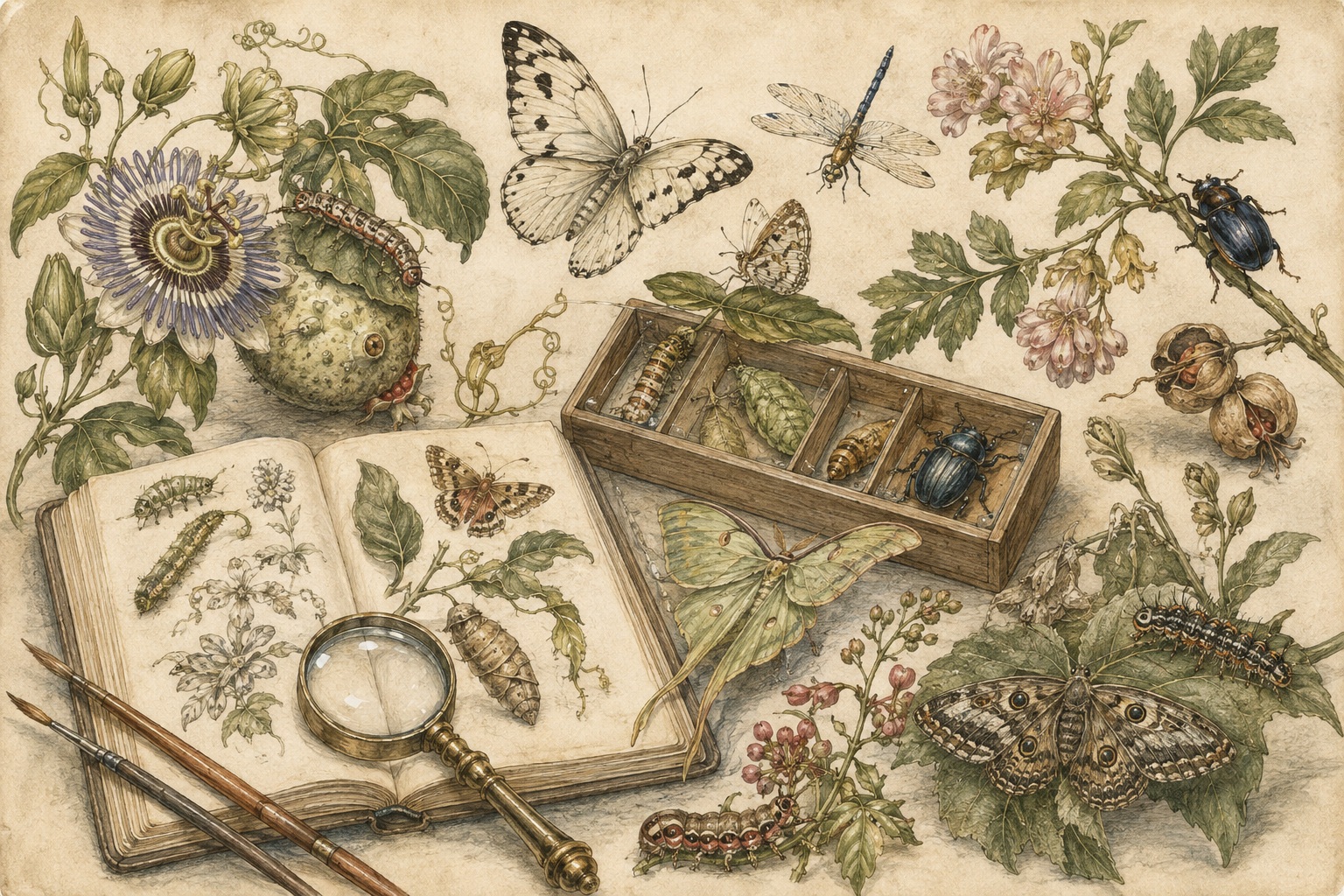
Why would a hydrogen edition look to a seventeenth-century illustrator of insects?
The answer is simpler than it first appears. Maria Sibylla Merian did not depict nature as a heap of isolated objects. She depicted it as a web of relationships. Flowers were not merely decorative blossoms; they were host plants. Insects were not ornamental fluttering shapes; they were living beings in the middle of metamorphosis. A picture was not only a beautiful design. It was a record of observation.
Japan’s hydrogen story deserves that same way of seeing. A train by itself does not explain a hydrogen economy. A pipeline by itself does not explain it either. Nor does a carrier ship, a turbine, a subsidy mechanism or a port. Hydrogen only becomes intelligible as a connected system linking production, transport, storage, end use, policy support, logistics, local demand and social acceptance.
In that sense, Merian’s visual language is not just “old-time scientific illustration.” It is a disciplined way of teaching the eye to identify things, sort their relationships and understand how life—or in this case energy—moves through a system. There are few historical artists more appropriate for a hydrogen edition that wants to feel like a field guide to an emerging energy ecosystem.
Born into print culture, she moved from flowers to insects and from ornament to observation
Maria Sibylla Merian was born on April 2, 1647 in Frankfurt. Her father, Matthäus Merian the Elder, was one of seventeenth-century Europe’s most important engravers and publishers. After his early death, her mother married the flower painter Jacob Marrel, and the young Merian grew up in that workshop world.
This matters because Merian did not begin as a “scientist” in the modern sense. She began as someone trained to draw, mix color, prepare copper plates and understand printed books. She learned both how to represent what she saw and how to circulate that representation.
The Natural History Museum explains that she became skilled in watercolor and print preparation at an early age and, by around thirteen, was already rearing silkworms and observing metamorphosis. Her interest in insects did not arise merely from the decorative convention of adding butterflies to flowers. It began in amazement at life changing form.
That is one reason she stands apart from many still-life painters of the period. They often rendered flowers and insects with dazzling precision, but Merian made a further leap. She asked where the insect came from, what it ate and what it would become.
The flower books and the caterpillar books: beautiful, but not merely beautiful
Merian married Johann Andreas Graff at eighteen and moved to Nuremberg, where she helped support the household by teaching embroidery and painting. Between 1675 and 1680 she published Neues Blumenbuch, or The New Book of Flowers, a model book widely used in embroidery, decoration and craft.
If one stopped there, Merian might look like a superb supplier of floral designs. But the next stage of her career changed the history of natural history illustration.
Between 1679 and 1683 she published the two volumes of Der Raupen wunderbare Verwandelung und sonderbare Blumennahrung, usually called The Caterpillar Book. The radical feature of this work was that she did not show a butterfly or moth in isolation. She placed egg, caterpillar, pupa and adult on or around the plant the species actually used as food.
As the Getty’s exhibition essay explains, each image was organized around a single plant, with different stages of metamorphosis arranged within that botanical setting. This was not merely a pretty insect picture. It was, in a very early sense, an ecological plate.
Merian’s work helped challenge older ideas that insects emerged spontaneously from mud, rotting fruit or decaying meat. The Natural History Museum notes that her careful records of metamorphosis offered observation-based evidence against spontaneous generation.
Before ecology had a name, she learned to picture relationships
Today we speak easily of ecosystems and ecological interdependence. In Merian’s world, those frameworks were not yet formalized. Yet she repeatedly visualized relationships: insect and host plant, metamorphosis and time, even forms of parasitism.
The Natural History Museum notes that when a pupa produced flies or wasps instead of the butterfly or moth Merian expected, she recorded such “false changes,” perhaps one of the earliest scientific observations of insect parasitism. The crucial point is methodological. She did not look at a specimen as an isolated thing. She looked at it as something enmeshed with other lives.
That way of seeing is precisely why Merian works so well as the aesthetic logic for a hydrogen edition. Hydrogen is not one machine competing against another machine. It is a set of linked stages—green hydrogen production, liquefaction, pipelines, carrier ships, cold-energy recovery, fuel cells, subsidy mechanisms, regional hubs and demand formation. If those relationships cannot be seen, the news becomes a pile of fragments.
Leaving her husband, building a studio, making science a woman’s business
Merian’s life was also unusually independent for a woman of her time. She separated from her husband and moved with her daughters to the Dutch Republic. Getty explains that by the late 1680s and early 1690s, she and her daughters Johanna Helena and Dorothea Maria were based around Amsterdam, where the three women worked together in a studio.
This matters because Merian’s achievement was not simply the story of one lone genius. Her daughters were assistants, artists and later stewards of her legacy. Getty notes that after Merian’s death, Dorothea published a third volume of The Caterpillar Book and helped sustain the circulation of her mother’s work.
So Merian’s career was also a family workshop, a publishing enterprise and a female intellectual business. Observation, painting, printmaking and sales all belonged to one interconnected practice.
That is another reason she fits a hydrogen edition so well. Her life was not a single-object story. It was a network story.
1699: at age 52 she sailed for Suriname to see living nature for herself
One reason Merian remains extraordinary is that in 1699, at the age of fifty-two, she and her daughter Dorothea Maria sailed to the Dutch colony of Suriname. Getty notes that she financed the expedition by selling many of her possessions. For a woman in the late seventeenth century, this was an astonishing act of self-direction.
What she wanted was not a dead specimen in a cabinet. She wanted live tropical subjects—moving insects, damaged leaves, ripe and overripe fruit, humidity, climate and relationship itself.
The result was the 1705 publication Metamorphosis Insectorum Surinamensium. Birds, snakes, lizards, spiders, butterflies, moths, fruit and flowers appear not as an inventory but as a living environment full of drama.
Merian did not sentimentalize nature into a harmless paradise. As Getty’s account emphasizes, the Suriname images contain vivid butterflies and voracious caterpillars, but also predatory spiders, reptiles and the richer violence of tropical life. Beauty, hunger, danger, reproduction and death coexist on the same sheet.
Seeing Merian honestly means seeing empire and extraction too
A modern appreciation of Merian should not stop at admiration. Her work was made within the violent world of Dutch colonial Suriname.
The Natural History Museum’s essay on hidden figures stresses that early modern natural history depended heavily on slavery and colonial networks. Merian was not outside that structure. Movement, collecting and local knowledge in Suriname relied on the labor and knowledge of Indigenous people and enslaved Africans, many of whom remain unnamed in the historical record.
The museum also points out elsewhere that Merian recorded how enslaved women used the so-called peacock flower to end pregnancies. That detail shows how observation of plants could touch not only botany, but also colonial violence, women’s bodily autonomy and acts of resistance.
So Merian’s natural history is not an innocent Eden. It is beautiful, but it also carries the asymmetries of empire, trade, labor and knowledge extraction.
This complexity is relevant to energy reporting now. Hydrogen should not be described only as futuristic and clean. It too has geography, logistics, subsidies, local burdens, labor and environmental context. To learn from Merian properly is to see not only the beautiful plate but also the structure behind it.
She had the spirit of a field notebook before Darwin
More than a century before Charles Darwin sailed on the Beagle, Merian was already practicing the core gestures of observational science: collecting, comparing, recording and revising. She did not possess modern evolutionary theory, and later science corrected some of her mistakes.
Getty notes, for example, that later scientists criticized her famous tarantula image for depicting the wrong number of hummingbird eggs. But that image also captured, with unusual directness, the violence and vitality of tropical life.
Merian’s significance lies not in never having been wrong. It lies in her power to decide what was worth observing, and then to convert that observation into an image and text others could use. Hers was the self-directed intelligence of a scientific culture that had not yet been fully professionalized.
It may be more accurate to call her not Darwinian but pre-Darwinian: committed to looking at change in the field, rather than relying only on inherited categories.
Why Merian is so right for the fifteen hydrogen images
For Japan.co.jp’s August 10 hydrogen edition, the fifteen story images use a Merian-inspired scientific-naturalist visual language. That is not a nostalgic gimmick. It is editorially useful.
A hydrogen railway vehicle from JR East and Iwatani starts to read less like a cold industrial object and more like a specimen within a larger energy habitat. JFE’s green-hydrogen direct-reduced iron can be pictured almost like a botanical section in which reaction pathways feel like growth. Kawasaki’s pipeline, liquefied-hydrogen carrier, Kobe fuel-supply system, Suntory’s Hakushu project, fuel-cell vessels, drones and senior mobility all become legible parts of one emerging ecosystem.
In a Merian-like composition, pipelines can be ordered like vines, valves and tanks can be distinguished almost like fruiting bodies or seeds, and hydrogen molecules can be arranged with the patience of an engraved plate. The result is often clearer than the generic glossy blue CGI so common in hydrogen marketing. Instead of saying “this is futuristic,” the image says, “this is what this thing is, how it fits, and why it matters.”
It dissolves some of the vagueness readers often feel around the phrase “hydrogen society” by replacing spectacle with the calm order of a specimen sheet. It is the opposite of yet another generic blue-future rendering.
- It shows relationships rather than isolated machines: production, transport, use and policy support can be read as one system.
- It brings specimen-plate order: even many technical components remain identifiable and calm.
- Botanical line work clarifies machinery: pipes, valves, cylinders and molecules can read almost like organs in a living system.
- It handles time well: just as Merian showed egg, larva, chrysalis and butterfly, hydrogen can be shown across stages of production, movement and use.
- It favors restrained seventeenth-century composition: less hype, more observational seriousness.
- It turns the edition into a field guide: the whole hydrogen package begins to feel like a guide to a new energy ecosystem.
Her most modern lesson: art and science do not have to be enemies
Looking at Merian reminds us that the strict boundary between art and science is partly a later habit. Beauty is not the enemy of truth. In the best cases it is one of truth’s delivery systems.
Merian used attractive composition to catch attention and then made the viewer stay for the detail. That is also how publishing works. You first persuade the reader to look. Then you help the reader understand.
The same problem exists in journalism every day. Even the best policy explanation fails if nobody wants to enter it. Yet imagery that becomes pure spectacle also fails, because the underlying fact thins out. Merian remains useful precisely because she balanced seduction and precision.
Her plates are rich without becoming cluttered, exact without becoming dead, decorative without losing informational force.
The daughters and the afterlife of the work
Merian died in 1717, but her work did not end with her. Getty explains that Dorothea Maria published a third volume of The Caterpillar Book and helped continue the circulation of the Suriname material, while Johanna Helena pursued her own career as a flower painter.
This continuation matters. It keeps Merian from becoming only a myth of singular genius. She was also the center of a collaborative structure of making, preserving and republishing knowledge.
She observed, drew, engraved, sold, reissued and transmitted. In that sense she managed the whole life cycle of knowledge itself.
Why she is the right Art Choice for today
Maria Sibylla Merian was chosen for the August 10, 2026 hydrogen edition not because old scientific illustration is charming, though it is. She was chosen because she began with careful looking—and because she refused to see things in isolation.
In her work, insects cannot be understood without plants, metamorphosis cannot be shown without time, and beauty cannot be separated from observation. Hydrogen is much the same. A carrier ship alone does not make a future. Neither does a subsidy, a regional demand cluster or a pipeline. The relationships matter.
That is why this edition’s fifteen images prefer the integrity of a specimen plate to the sheen of generic futurism. Pipes become vine-like, tanks become fruit-like, molecules become seed-like and trains, ships and drones become species within a new technological habitat.
Maria Sibylla Merian and the Art of Scientific Observation.
Observation is more than looking. It is learning what connects to what, how change unfolds and where a system is trying to go.
A seventeenth-century woman artist-naturalist already knew that. Which is why she still feels alive in a hydrogen edition now.
1647 Maria Sibylla Merian is born in Frankfurt.
1650s After the death of Matthäus Merian the Elder, her mother marries Jacob Marrel; Merian grows up in a workshop environment shaped by flower painting and print culture.
Around age 13 She begins observing silkworms and insect metamorphosis.
1665 She marries Johann Andreas Graff.
1670 The family moves to Nuremberg, where she teaches painting and embroidery.
1675–1680 She publishes Neues Blumenbuch.
1679 and 1683 The two volumes of her caterpillar book appear, integrating host plants and insect life cycles.
Late 1680s–1691 She leaves her husband and later establishes a studio in Amsterdam with her daughters.
1699 At age 52 she sails to Dutch Suriname with Dorothea Maria.
1705 Metamorphosis Insectorum Surinamensium is published.
1717 She dies; her daughters help preserve, extend and circulate her work.
August 10, 2026 Japan.co.jp selects Merian as the Art Choice for its hydrogen edition and applies a Merian-inspired scientific-naturalist visual language across fifteen story images.
Reporting notes and principal sources
This article was prepared as the Art Choice feature for Japan.co.jp’s August 10, 2026 hydrogen edition. Historical discussion is based mainly on museum and research-institution materials. The argument connecting Merian’s observational method to the hydrogen edition’s visual language is an editorial interpretation by Japan.co.jp, not a historical claim about Merian’s own intentions.
- Getty: Maria Sibylla Merian & Daughters: Women of Art and Science
- Natural History Museum: Maria Sibylla Merian: Metamorphosis unmasked by art and science
- Natural History Museum: Hidden figures: Forgotten contributions to natural history
- Natural History Museum: Nature and fertility (including discussion of the peacock flower)
- Royal Collection Trust: Pomegranate and Menelaus Blue Morpho Butterfly
- Natural History Museum: Women artists