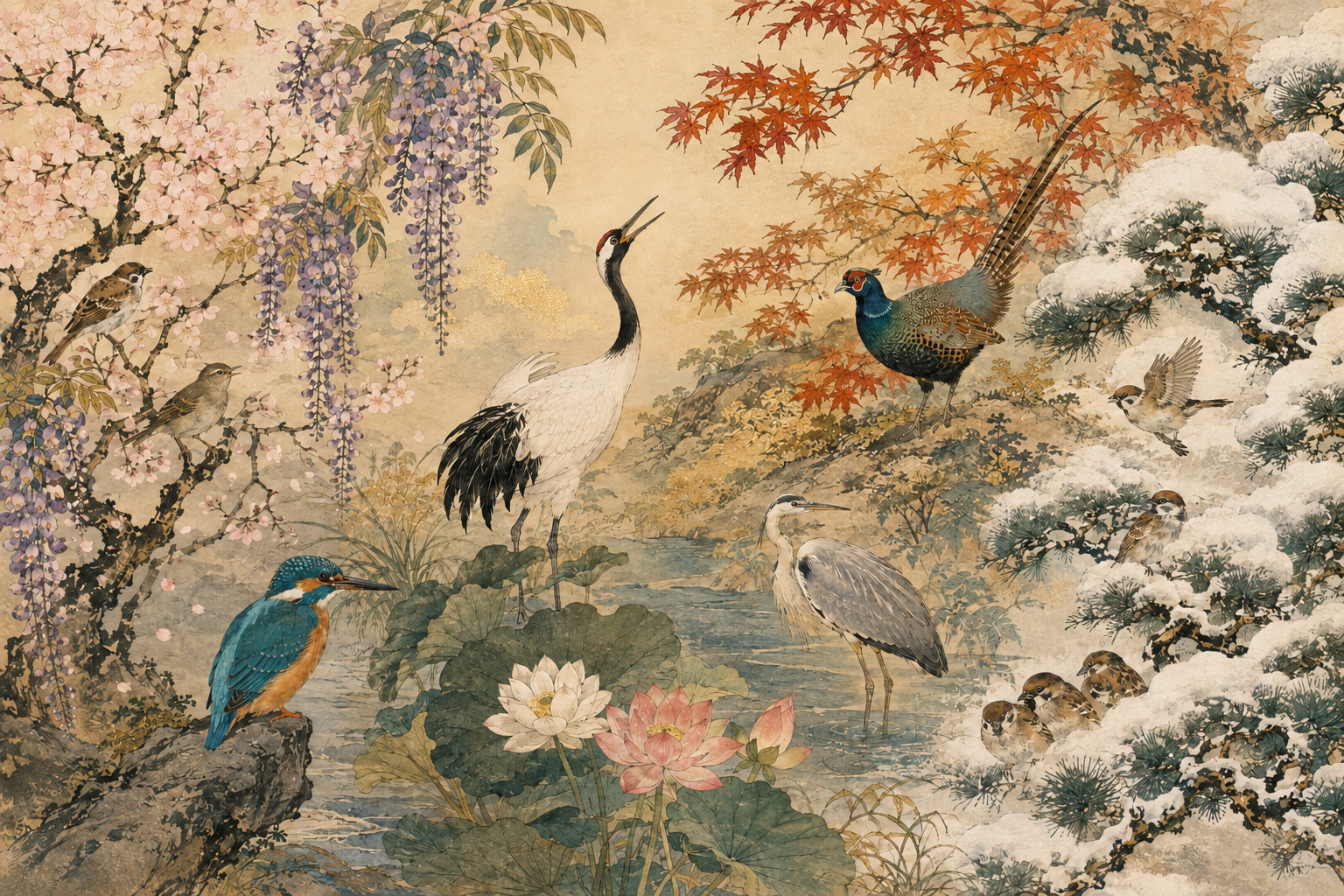
A bird is hardest to paint in the instant before it moves. Its weight has already shifted. The claws tighten by a fraction. The head turns while the body remains still, and the empty air beside the branch suddenly feels like part of the animal. Kōno Bairei understood that the credibility of a bird does not begin with feathers. It begins with intention.
That is why his finest bird-and-flower images feel quiet without feeling frozen. An owl does not decorate a tree limb; it occupies the darkness around it. A small bird among plum blossoms is not merely a seasonal emblem; it is a tense arrangement of feet, tail, eye and branch. The plant bends, the bird answers, and the blank paper becomes weather.
Bairei stands at a hinge in Japanese art. Born in Kyoto in 1844, he learned painting under the Tokugawa order and reached maturity as the Meiji state rebuilt institutions, markets and categories. He inherited the Maruyama–Shijō commitment to observing life, then carried it into public education, a large private atelier and illustrated books made through sophisticated woodblock collaboration. His “reinvention” of bird-and-flower art was not a rejection of tradition. It was the re-engineering of tradition for a new world.
Before “Nihonga” Had a Name
Bairei was born twenty-four years before the Meiji Restoration and nearly four decades before “nihonga” came into use as a category contrasting Japanese-style painting with Western-style yōga. He did not begin as a defender of a neatly bounded national tradition. He began inside Kyoto’s plural painting culture.
In 1852, at nine, he entered the studio of Nakajima Raishō, a painter connected to the Maruyama lineage. Maruyama Ōkyo had made direct observation—shasei—a defining discipline in eighteenth-century Kyoto painting. Observation did not mean photographic copying. It meant studying the structure and behavior of the visible world closely enough that brush shorthand would remain convincing.
After Raishō’s death in 1871, Bairei studied with Shiokawa Bunrin, a leading Shijō-school painter. The Shijō idiom had joined Maruyama naturalism to literati brushwork, poetry and elegant abbreviation. From this double inheritance Bairei gained two complementary tools: a scrutinizing eye and permission to leave things out.
Kyoto After the Court Departed
The political transformation that created modern Japan also struck Kyoto’s artistic economy. As the emperor and central institutions moved to Tokyo, courtly and aristocratic patronage contracted. Buddhist institutions had already been damaged by early Meiji anti-Buddhist policies. Painters who had relied on temples, elite households and inherited networks faced a diminished market.
Kyoto’s response linked art to industry. Designs were needed for ceramics, lacquer, textiles and other export crafts; exhibitions created new systems of reputation; schools promised to make visual knowledge teachable. Artists did not simply preserve old painting in isolation. They helped rebuild the city’s economy of making.
The Kyoto City history of modern nihonga describes painters supporting themselves with designs for crafts during this disruption. As industry recovered, commissions and exhibitions returned. Bairei’s career belongs to that reconstruction. A painted bird could still hang in an alcove, but its lines could also become a lesson, a printed page, a pattern resource and a portable image circulating through new markets.
What “Bird-and-Flower” Really Means
The English phrase can sound like a narrow genre: birds placed beside attractive plants. In East Asian art, kachō-ga belongs to a much larger field that includes insects, fish and other creatures, as well as seasons, habitats and poetic associations. A subject may carry auspicious meaning, evoke a classical verse, mark a month or simply reward close attention to living form.
The relationship matters more than the inventory. A kingfisher requires water even when the stream is only implied. A waterbird makes reeds feel cold. A heavy owl changes the apparent strength of a branch. Flowering and fruiting tell us when the encounter occurs; posture tells us what may happen next.
Bairei retained these cultural associations, but the persuasiveness of his animals comes from behavior. He varies the angle of heads, the spread of toes, the compression of bodies in cold and the extension of wings in flight. Species are not interchangeable ornaments. They inhabit the page differently.
| Visual element | What Bairei observes | What it does in the picture |
|---|---|---|
| Feet and claws | How a species grips, wades or rests | Gives weight to the body |
| Head angle | Attention, alarm, hunting or repose | Creates a psychological center |
| Branch or reed | Flexibility, season and habitat | Turns support into counter-movement |
| Feather masses | Structure before surface detail | Keeps the bird legible at a glance |
| Empty paper | Air, distance, weather and pause | Lets the living form breathe |
The Album of One Hundred Birds
Bairei’s best-known printed project is Bairei hyakuchō gafu, commonly translated as the Bairei Picture Album of One Hundred Birds. The Metropolitan Museum dates its three polychrome woodblock-printed books to 1881–84. The title announces abundance, but the books are not a modern field guide arranged around measurements, ranges and diagnostic plumage.
They are an artist’s library of encounters. Wild and domesticated, familiar and exotic birds appear in settings that teach composition as much as identification. A student can study how a neck turns, how a dark wing is broken by a dry-brush edge, how foliage frames a small body, and how a double-page opening creates time between one side and the other.
The printed book also changes scale and audience. A unique hanging scroll reaches one owner and a limited circle of viewers. A woodblock book can be issued in multiple impressions, handled, copied, carried and exported. The codex turns looking into sequence: the reader moves from bird to bird, season to season, and solution to solution.
A Print Is a Collective Work
Calling these pages “prints by Bairei” is correct but incomplete. Meiji illustrated books emerged through a division of expert labor. The artist supplied designs; block cutters translated brush marks into relief matrices; printers controlled registration, moisture, pressure and color; publishers financed, organized and sold the result.
The great achievement is that the printed line often retains the temperament of a brush. A taper, a broken ink edge and a soft wash have to be reconstructed through carved wood and successive impressions. The cutter cannot mechanically trace every mark: a painted gradient must be understood as a printable event. The printer must make color present without burying the breathing surface of the paper.
This collaboration complicates the modern fantasy of the solitary master. Bairei’s authorship shaped the image, but craft knowledge made it multiply. The book was not a lesser copy of painting. It was another medium with its own intelligence.
Bairei Kachō Gafu and the Four Seasons
Bairei kachō gafu, published in 1883 and later reissued, organizes bird-and-flower imagery through the seasons. The National Diet Library’s digital presentation includes such pairings as plum and jay, camellia and duck, tea with starling and wren, reeds with a hawk, sweet osmanthus with an owl, cotton with crane, and cabbage with magpie.
Cabbage matters. It is cultivated, ordinary and visually complex: overlapping leaves gather light and weight. By placing birds among both canonical blossoms and useful plants, Bairei keeps the genre connected to the observed world rather than enclosing it in a garden of inherited symbols.
Seasonal organization also trains memory. The student learns not just the anatomy of a bird or flower, but which forms coexist, how winter scarcity alters a composition and how spring growth changes the balance of line and color. Nature becomes a calendar of relationships.
The School and the Studio
In 1880 the Kyoto Prefectural School of Painting opened inside the Kyoto Imperial Garden. Kyoto’s official history calls it Japan’s first public art school. Bairei and other painters were appointed as teachers. The institution would evolve, through later schools, into today’s Kyoto City University of Arts.
The public school represented a radical administrative idea: traditions previously transmitted through family lineages and ateliers could be sorted into curricula, demonstrated to groups and tied to civic renewal. Students practiced unpitsu—copying a teacher’s model to learn brush movement—alongside sketching from life, copying old paintings, and studying theory and history.
Bairei also taught through his private academy. The two systems were complementary. Public schooling widened access and standardized instruction; the private studio offered close correction, professional networks and the sustained formation of an artistic identity. Bairei’s printed manuals extended both systems into the student’s hands.
The Teacher Whose Students Changed Japanese Painting
Kyoto memory calls Takeuchi Seihō, Kikuchi Hōbun, Taniguchi Kōkyō and Tsuji Kakō the “Four Great Ones” of Bairei’s school. Each developed a distinct practice rather than merely repeating a house style. That outcome may be the best evidence of Bairei’s teaching.
Seihō became one of modern Kyoto’s defining artists, absorbing a wide range of Japanese and Western approaches while maintaining startling sensitivity to animals. Hōbun became celebrated for bird-and-flower painting and especially cherry blossoms. Kōkyō and Kakō carried other aspects of Bairei’s forceful and disciplined brushwork. Kawai Gyokudō, another important pupil, helped carry the lineage into the national world of modern nihonga.
The influence is therefore not a straight line of copied birds. Bairei transmitted a method: observe closely, understand old brush vocabularies, adapt them rather than worship them, and make the picture structurally alive. His students could travel beyond him because the method was stronger than a fixed manner.
1844 Bairei is born in Kyoto.
1852 He begins study with Nakajima Raishō.
1871 After Raishō’s death, he studies with Shiokawa Bunrin.
1880 Kyoto Prefectural School of Painting opens; Bairei teaches.
1881–84 Bairei hyakuchō gafu appears in three printed books.
1883 Bairei kachō gafu presents seasonal pairings.
1895 Bairei dies as Kyoto hosts the Fourth National Industrial Exhibition.
20th century His pupils become central to modern Kyoto painting.
Was This Western Realism?
Bairei is often described as adding a touch of Western realism. The phrase is useful only if handled carefully. Meiji artists certainly encountered imported images, scientific illustration, perspective and new expectations of visual accuracy. But close observation was not a Western gift to Japanese art. Maruyama Ōkyo’s life-based practice, natural-history painting and long traditions of studying plants and animals predated Bairei’s career.
The modern element lies in combination and purpose. Bairei’s pictures could satisfy older poetic taste while also answering new demands for legibility, instruction, reproducibility and public exhibition. He could intensify volume or spatial coherence without abandoning the expressive line and emptiness of the Kyoto tradition.
“Reinvention” is therefore better than “Westernization.” He did not replace one visual system with another. He adjusted an inherited ecology of brush, paper, subject and apprenticeship so it could survive new institutions and audiences.
How to Look at a Bairei Bird
- Find the center of weight. Is the bird settled, leaning, landing or preparing to leave?
- Follow the gaze. The eye often activates space outside the printed frame.
- Compare the bird’s contours with the plant’s lines: compact against flexible, curved against broken.
- Notice where ink becomes dry, wet, dense or absent.
- Cover the bird mentally and ask what season the plant and atmosphere imply.
- Then restore the bird and see how behavior transforms botanical description into a scene.
This method resists a common mistake: treating kachō-ga as decorative wallpaper. Decoration is not an insult; these works are exquisitely designed. But design is carrying knowledge. The apparent ease of a small bird on a branch is the last stage of many decisions about anatomy, ecology, rhythm and printing.
The Productive Tension Between Accuracy and Life
A scientifically identifiable bird can still feel dead in art, while a loosely rendered bird can feel alive. Bairei works between those outcomes. Anatomical knowledge gives his abbreviations authority; calligraphic movement prevents description from becoming taxidermy.
His pages are not neutral records. They crop, pair and dramatize. A plant may be bent more emphatically to answer the bird. A silhouette may be simplified so it reads through a limited palette. Empty space may exaggerate isolation. These are not failures of truth. They are pictorial arguments about what makes a creature present.
That distinction matters in an age saturated with high-resolution wildlife photography. A camera can stop a wing at a fraction of a second. Bairei’s line can join several moments—the gathered body, anticipated leap and remembered flight—inside one form.
Why Bairei Matters Now
His career answers a question that every culture faces during technical change: how can inherited knowledge enter a new system without becoming either a relic or a costume? Bairei’s answer was institutional as well as aesthetic. Teach it. Print it. Put it into circulation. Let students contest and extend it.
He also demonstrates that attention is not passive. To draw a bird is to study how a body negotiates gravity, weather and habitat. To compose bird and flower is to recognize dependence: perch and claw, fruit and beak, reed and water. Long before “ecological art” became a phrase, kachō-ga made relationship its basic grammar.
There is humility in that grammar. The human figure is usually absent. The page does not require nature to become scenery behind us. It asks us to enter a world already occupied by other kinds of attention.
The Branch Still Holds
Bairei died in 1895, the year Kyoto hosted the Fourth National Industrial Exhibition—an event symbolizing the city’s effort to unite culture, production and modern public display. He did not live to see the full achievements of the painters he trained or the eventual international museum life of his printed books.
Yet his system endured. A design made in Kyoto could pass through cutter, printer and publisher, cross an ocean, enter a library and teach someone more than a century later how a bird grips a branch. His pupils converted the lesson into new schools of modern painting. Digital collections now return the pages to worldwide circulation by another technology he could not have imagined.
The final measure of Bairei’s art is not that the bird looks “real.” It is that the branch seems to register the bird’s weight, the surrounding air seems briefly alert, and we feel that one second later the page may be empty.
Reporting notes and principal sources
Dates and institutional history are drawn from museum, library and Kyoto City sources. Transliterations vary: this article uses Kōno Bairei, Takeuchi Seihō, Kikuchi Hōbun, Taniguchi Kōkyō and Tsuji Kakō. Interpretive passages about motion, emptiness and ecology are Japan.co.jp analysis.
- National Diet Library Image Bank: Bairei’s bird-and-flower album
- Metropolitan Museum of Art: Bairei Picture Album of One Hundred Birds, 1881–84
- Sainsbury Institute: Bairei, Raishō and observation from nature
- Kyoto City: guide to the history and networks of modern Kyoto nihonga
- Kyoto National Museum: Bairei’s training, teaching and modern viewpoint
- Kyoto National Museum: Bairei and major pupils
- Kyoto National Museum collection search: works by Kōno Bairei