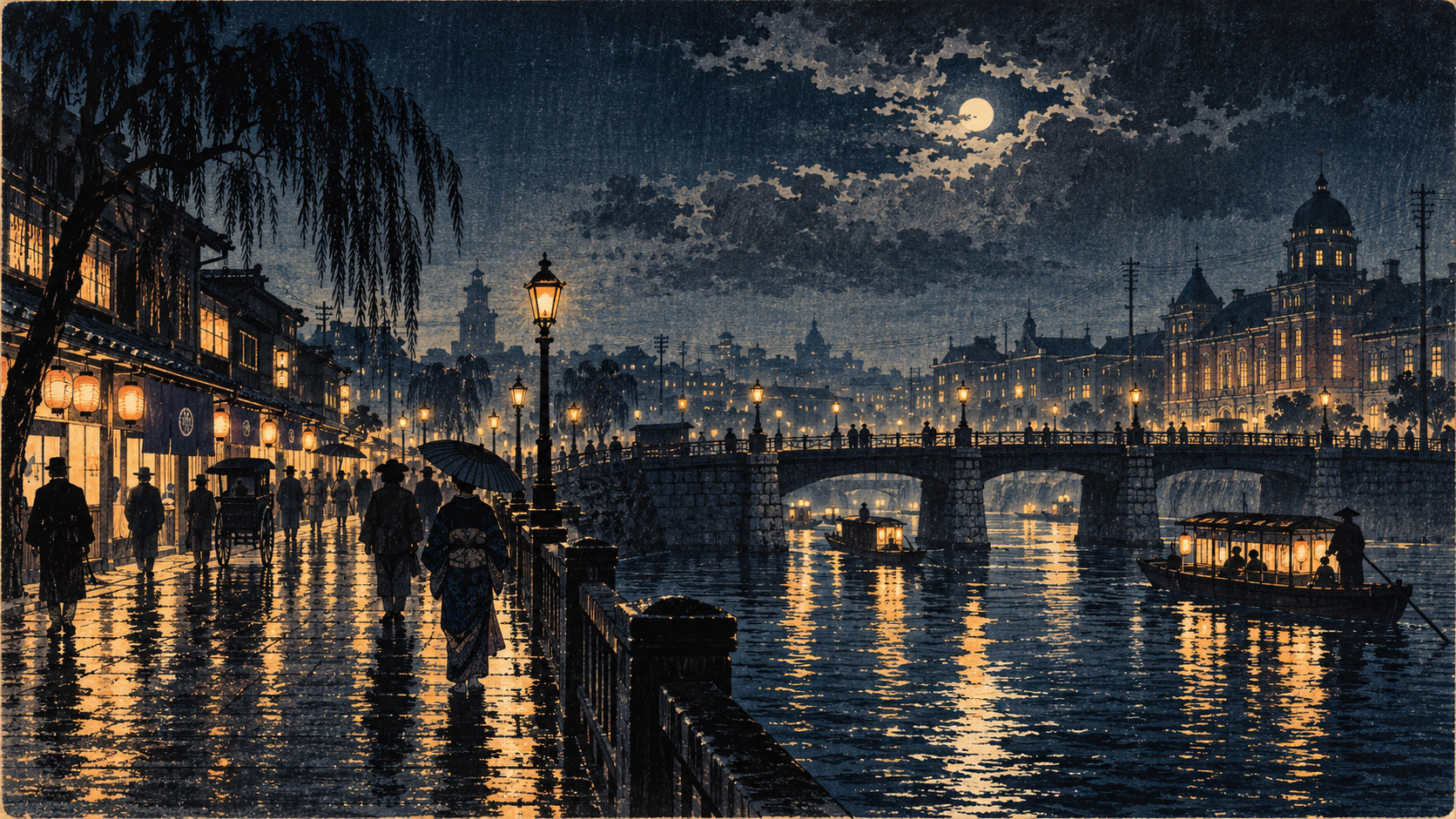
View the authenticated original: Night View at Nihombashi Bridge — Edo-Tokyo Museum / Tokyo Museum Collection
A city learning to see itself after dark
The city in Kobayashi Kiyochika’s Night View at Nihombashi Bridge belongs to an extraordinary historical interval. By 1881, Edo had become Tokyo, yet the old waterways, bridges and habits of urban life had not simply vanished. Instead, new forms of illumination transformed how the city could be seen. Kiyochika’s woodblock print makes darkness active. Light falls onto a small part of the urban fabric and leaves the rest in a suggestive hush. For today’s Art Choice, Japan.co.jp has selected this documented historical work rather than treating a contemporary AI-generated nightscape as an original print.
The authenticated artwork
The Japanese title is 日本橋夜, romanized here as Nihonbashi Yoru; the official English collection title is Night View at Nihombashi Bridge. It is a single woodblock print dated 1881, measuring 25 by 36.7 centimeters, by Kobayashi Kiyochika and published by Fukuda Kumajirō. Tokyo Museum Collection identifies the holding institution as the Edo-Tokyo Museum and the catalog number as 10200188. The official collection record also labels the image public domain. “Tokyo After Dark,” the phrase used for this editorial feature, is not a historical title or alternate attribution. Maintaining that distinction is essential: the artwork, its catalog record and a modern essay about it are three different things.
The instant when Edo became Tokyo
The Meiji Restoration did not replace one city with another overnight. After Edo was renamed Tokyo in 1868, its familiar landscape remained interwoven with new railways, telegraph networks, gas lamps, brick buildings and steam-powered transport. Tokyo was becoming a testing ground for what modern Japan might look like, but modernization was not a clean erasure. A bridge could still carry centuries of commercial memory while leading toward a future of machinery and new urban rhythms. Kiyochika’s prints are unusually compelling because they look at this mixed city rather than a pure fantasy of either tradition or progress.
A witness shaped by the fall of the shogunate
Born in 1847, Kiyochika came from a world associated with the Tokugawa regime. The Smithsonian’s study of his career recounts his experience as a minor shogunal retainer and his return to Tokyo in 1874 after a period away. The city he found was disorientingly different. That biographical tension matters. In the prints, technology appears not only as spectacle but as a disturbance in familiar light and space. To paint a newly illuminated street at night was also to examine what had become newly obscure.
Why the prints were called light-ray pictures
Kiyochika’s views of Tokyo are known as kōsenga, often rendered in English as “light-ray pictures.” Their innovation came from an encounter between traditional Japanese woodblock printing and Western-inspired approaches to light, volume and spatial depth. Rather than flattening every object into clear daylight, Kiyochika used lanterns, gaslight, moonlight, smoke and reflections to make uncertainty part of the image. It is an aesthetic of partial revelation. Modern light lets viewers see a little more—and also makes them conscious of the darkness beyond it.
The bridge as a historical stage
Nihonbashi had long been a commercial and geographical center of Edo. It was famously associated with the starting point of the five major highways, and waterways carried goods and people through the city’s daily life. That history gives Kiyochika’s subject special force. Here is a site deeply connected to the premodern capital, pictured in the age when Tokyo was acquiring new technologies and new ambitions. The view is neither an unchanging monument nor an entirely new city. It is an old place undergoing the experience of modern time.
Small figures in a newly anonymous metropolis
One of Kiyochika’s most affecting choices is to let people retreat into silhouette. Faces cease to dominate; bodies become dark presences moving through an expanse of weather, architecture and artificial light. Smithsonian curators have noted this atmospheric anonymity in his city prints. Such figures can seem solitary even among others. This is why the night views feel surprisingly modern. The artist catches something recognizably urban: the experience of moving through a populous city without fully knowing the lives around us.
The wider series and its abrupt ending
Between 1876 and 1881 Kiyochika created a celebrated body of Tokyo views. A Smithsonian exhibition account states that he completed 93 of a projected 100 works before a devastating fire in 1881 effectively brought the series to an end. The coincidence is poignant. A project dedicated to recording a changing city was interrupted by a force capable of remaking whole neighborhoods in an instant. Kiyochika later produced other kinds of prints, including satirical and war-related works; it would be misleading to reduce his entire career to nocturnes alone. Yet the night cityscapes remain his most distinctively modern achievement.
A real print and a newly generated illustration
This edition also includes a separate AI-generated editorial image inspired by Kiyochika’s treatment of light and shadow. It is not Night View at Nihombashi Bridge, does not reproduce the object, and must not be credited as an original work by the artist. Readers should consult the public-domain reproduction on the official Tokyo Museum Collection object page for the authenticated image. The distinction is part of the story. In an era when images can be imitated almost effortlessly, precise attribution and provenance remain central to responsible art journalism.
What the night still tells us
Tokyo’s bridges now sit within a city of expressways, glass towers and electrical grids unimaginable in 1881. Yet its night remains legible through tiny islands of light: a train window, a streetlamp, a reflection on water, the silhouette of someone going home. Kiyochika makes us look at those fragments rather than the skyline alone. His print suggests that modernization is never just a list of inventions. It is a change in the way people perceive their world—and in the shadows they carry from an older one. That is why this modest woodblock print still feels like a contemporary portrait of Tokyo.
Sources and supporting documents
- 東京都立博物館・美術館収蔵品検索「日本橋夜」1881年・江戸東京博物館所蔵
- Tokyo Museum Collection, Night View at Nihombashi Bridge
- 東京都立博物館・美術館収蔵品検索「隅田川夜」1880年
- The Metropolitan Museum of Art, Fireworks at Ikenohata (1881)
- Smithsonian, Kiyochika: Master of the Night
- Smithsonian National Museum of Asian Art, Kudanzaka at Night in Early Summer
- Tokyo Museum Collection, Hazy Moonlight at Ushimachi, Takanawa