Why Kikuchi Yōsai’s Zenken Kojitsu Is the Right Art Choice for October 8
Kikuchi Yōsai was more than a painter of historical figures. He was a researcher of costume, objects, gesture and setting who turned historical inquiry into vivid human scenes. That makes him an unusually strong Art Choice for Japan.co.jp’s Oct. 8, 2026 edition, whose stories range from judo and bugaku to disaster response, regional life, AI and robotics.
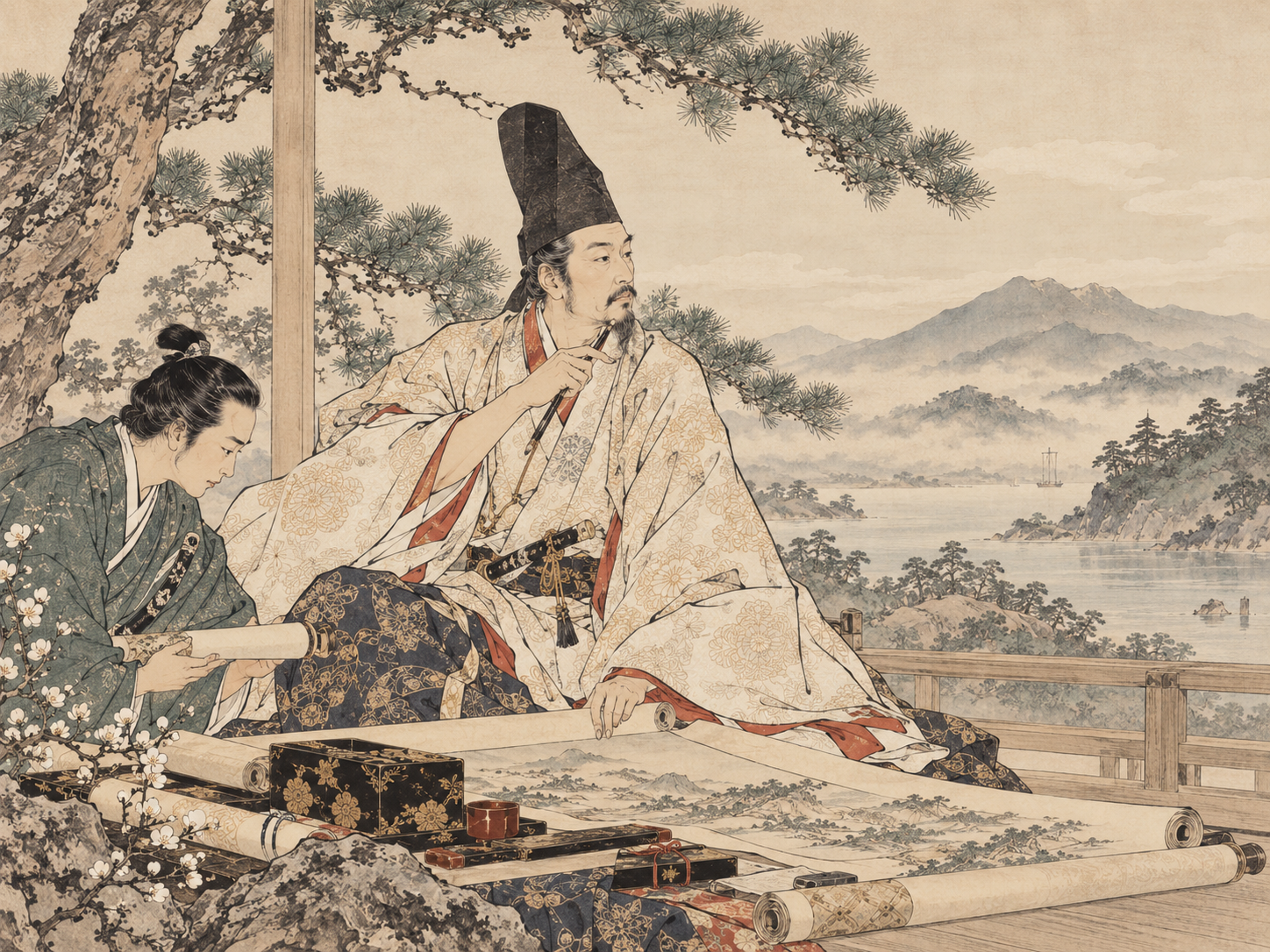
If Japan.co.jp were to give an entire daily edition a single visual language, Kikuchi Yōsai would be an unusually logical choice for Oct. 8. Not merely because he was a historical painter, but because he built history through bodies: how a figure stands, how clothing falls, how gesture implies action, how objects and costume make a scene believable. That makes him a remarkably adaptable artist for an edition whose selected stories depend so heavily on human movement—judo, padel, eSports, bugaku, regional community life, disaster response and even high technology.
This Art Choice page therefore centers not on one isolated “masterpiece,” but on Yōsai’s great long-term project Zenken Kojitsu. The title is often rendered as something like “Illustrated Biographies of Wise and Loyal Figures of the Past,” but that still understates what it is. The work is a large-scale visual compendium of historical Japanese figures—from antiquity through the medieval period—accompanied by short biographical texts. The Tsuruga City Museum explains that the work includes 571 figures ranging from antiquity to the Northern and Southern Courts era.
A samurai official who became a systematic painter of history
Yōsai was born in Edo in 1788 into the household of a Tokugawa shogunate foot soldier. According to the Nerima Art Museum, his personal name was Takeyasu and his common name was Ryōhei. He served the shogunate’s West Bailey guard for 24 years from adolescence while studying painting from the Kanō-school artist Takada Enjō and learning from multiple lineages beyond a single school style.
After leaving official service in 1825, he devoted himself to painting. The critical point is not simply that he liked historical themes. Official museum commentary repeatedly emphasizes the depth of his research. The Shizuoka Prefectural Museum of Art says he investigated historical texts, studied clothing and furnishings, traveled through the Kyoto and Kinai region visiting old temples and shrines, and copied books and ancient objects held by distinguished families. In other words, his images do not merely look old; they are built from deliberate visual evidence.
Zenken Kojitsu became a visual archive of historical Japan
Yōsai did not produce Zenken Kojitsu quickly. Nerima Art Museum states that he began work in 1836, published the first two volumes in 1843 and completed the full ten-volume project in 1868, when it was presented to Emperor Meiji. Tsuruga City Museum likewise describes it as a major publication issued over more than twenty years.
The result was more than a picture book. It was a visual archive of historical type: an illustrated reference for clothing, posture, weaponry, ritual bearing and exemplary biography. Nerima Art Museum explicitly notes that the work was widely used as a model for Meiji-period history painting. That alone makes Yōsai more than a late-Edo specialist. He helped teach modern Japan how to picture its own past.
That is the core reason he works for Oct. 8. Yōsai created a disciplined way of translating research into legible scenes. Japan.co.jp now needs a disciplined way of translating modern news into a coherent visual edition.
Why he fits this particular October 8 slate so well
The accident of this day’s selection is that it aligns almost perfectly with Yōsai’s strengths. Sports stories are the most obvious example. Judo, women’s padel and eSports all depend on decisive bodily tension. Yōsai’s figures do not merely pose; they hold the suggestion of the next movement. That makes his style surprisingly useful for action.
Cultural stories are an even stronger fit. The Nezu Museum’s bugaku costume exhibition and the Onmyoji immersive concert both depend on historically credible dress, ceremonial space and the relationship between body and performance. Yōsai’s deep attention to costume, courtly bearing and the visual vocabulary of historical Japan makes him far more suitable than a generic “old Japanese” style.
Community and public-affairs stories also benefit. Dual-location living, digital transformation in Rifu, or prepositioned disaster toilets after the Kumamoto earthquake all require group scenes rather than isolated symbolic objects. A history painter knows how to organize a group: who occupies the center, who stabilizes the composition, how labor and authority appear in the same space. That is one reason chronicle painters continue to feel editorially useful.
The most revealing test is modern technology
Yōsai’s line was not made for robotic hands, distributed GPU systems or predictive AI in medicine. That is exactly why the pairing is interesting. A 19th-century discipline of fine line, restrained mineral color and figure-centered composition can pull modern technology away from generic futurist glow and back into human relation.
A 20-degree-of-freedom robot hand, for example, becomes more compelling when set against the memory of a human craftsman’s hand. A distributed GPU-genomics story becomes a scene connecting researchers, information and invisible infrastructure. Panasonic’s AI health-monitoring story gains force when shown not as a floating device but as a relationship among patient, observer and barely perceptible signs. Yōsai was a painter of people, but also a painter of relations among people, objects and meaning.
Yōsai should not be reduced to ideology alone
Modern summaries often present Yōsai as a painter of loyal retainers and an artist sympathetic to imperial restoration thought. That is not false. Shizuoka’s museum notes his deep knowledge of kokugaku learning and his earnest imperial loyalty. But that framing is too narrow if it becomes the whole story.
His larger significance lies in method. He transformed the making of historical images by combining textual research, site visits, observation of old objects and yūsoku-kojitsu study. In other words, before he was a painter with a political bent, he was an organizer of visual evidence. That is why he mattered to Meiji historical painting and why his influence could pass through pupils such as Matsumoto Fūko and Watanabe Seitei.
| Category | Detail |
|---|---|
| Artist | Kikuchi Yōsai (菊池容斎) |
| Dates | 1788–1878 |
| Personal name / common name | Takeyasu / Ryōhei |
| Training | Studied under Takada Enjō of the Kanō school; also learned from multiple styles |
| Major project | Zenken Kojitsu, 10 volumes with 571 historical figures and biographical texts |
| Timeline | Started 1836; first installment published 1843; completed 1868 |
| Meiji recognition | Received the imperial title “Nihon Gashi” in 1875; honored at the First National Industrial Exposition in 1877 |
| Pupils | Matsumoto Fūko, Watanabe Seitei and others |
A historical painter who can become the face of an edition
A daily edition needs more than a set of unrelated illustrations. It needs a shared visual rhythm. Yōsai offers one: disciplined figures, controlled gesture, careful objects, limited but elegant color and compositional clarity. That rhythm is flexible enough to hold sports, business, science, community reporting and culture in the same frame without making everything look mechanically identical.
That flexibility is one reason he feels fresh for Japan.co.jp rather than dutiful. His work can carry action, not just solemnity. It can credibly serve a bugaku or Onmyoji story, but it can also reinterpret robotics or AI without collapsing into cliché. And where the contrast is sharpest—Shuji Mukai and Gutai—the collision between Yōsai’s controlled line and Mukai’s fields of signs may produce one of the most stimulating images in the whole edition.
The Art Choice judgment
Yōsai satisfies the editorial preference for a historically important artist who died before 1910. More importantly, he meets the stronger test: there is a genuine edition-level reason to use him. His art is built from researched figures, meaningful movement, costume intelligence and scene-building. Those are exactly the qualities the Oct. 8 story slate needs.
That is why this Art Choice is not simply decorative. It functions as a small editorial thesis. Yōsai became famous by picturing the people of Japan’s past. On Oct. 8, 2026, the same method can become a lens for picturing Japan’s present.
- This Art Choice page treats Zenken Kojitsu as the defining project rather than narrowing the page to a single isolated picture.
- The expected image filename is todays-art-choice-kikuchi-yosai-zenken-kojitsu-2026.jpg.
- The edition-wide art direction can be summarized as: “Inspired by Kikuchi Yōsai — fine Edo/early-Meiji ink linework, restrained mineral color, historically informed figures, strong gesture and expressive movement, translated naturally into contemporary subjects.”
Primary sources
- Shizuoka Prefectural Museum of Art digital archive: artist biography for Kikuchi Yōsai.
- Nerima Art Museum collection database: chronology and career of Kikuchi Yōsai.
- Tsuruga City Museum collection database: explanation of Zenken Kojitsu.
- National Diet Library Search: bibliographic entry for the Meiji 1 (1868) edition of Zenken Kojitsu.
- Shizuoka Prefectural Museum of Art entry for Mongol Invasion picture, including Yōsai biography.
- Shizuoka Prefectural Museum of Art entry for Prince Naka no Ōe and Nakatomi no Kamatari, including Yōsai biography.