Kawabata Ryūshi (川端龍子, 1885–1966) is Japan.co.jp’s art choice for September 26. His interest in paintings that could command an exhibition space offers a strong starting point for thinking about color, movement and the encounter between an image and its audience.[1][3]
A career that crossed painting traditions
According to the Ryūshi Memorial Museum’s chronology, the Wakayama-born artist studied Western-style painting, traveled to the United States in 1913 and turned to Japanese-style painting after returning. He left the Japan Art Institute’s membership in 1928; Seiryūsha’s founding declaration and first exhibition followed in 1929.[1]
Ota’s cultural association describes his forceful large-format work and his advocacy of kaijō geijutsu, art conceived for the exhibition space.[3] The useful question is not simply how large a painting is, but how it addresses people within a shared room.
Blue shadows and yellow light
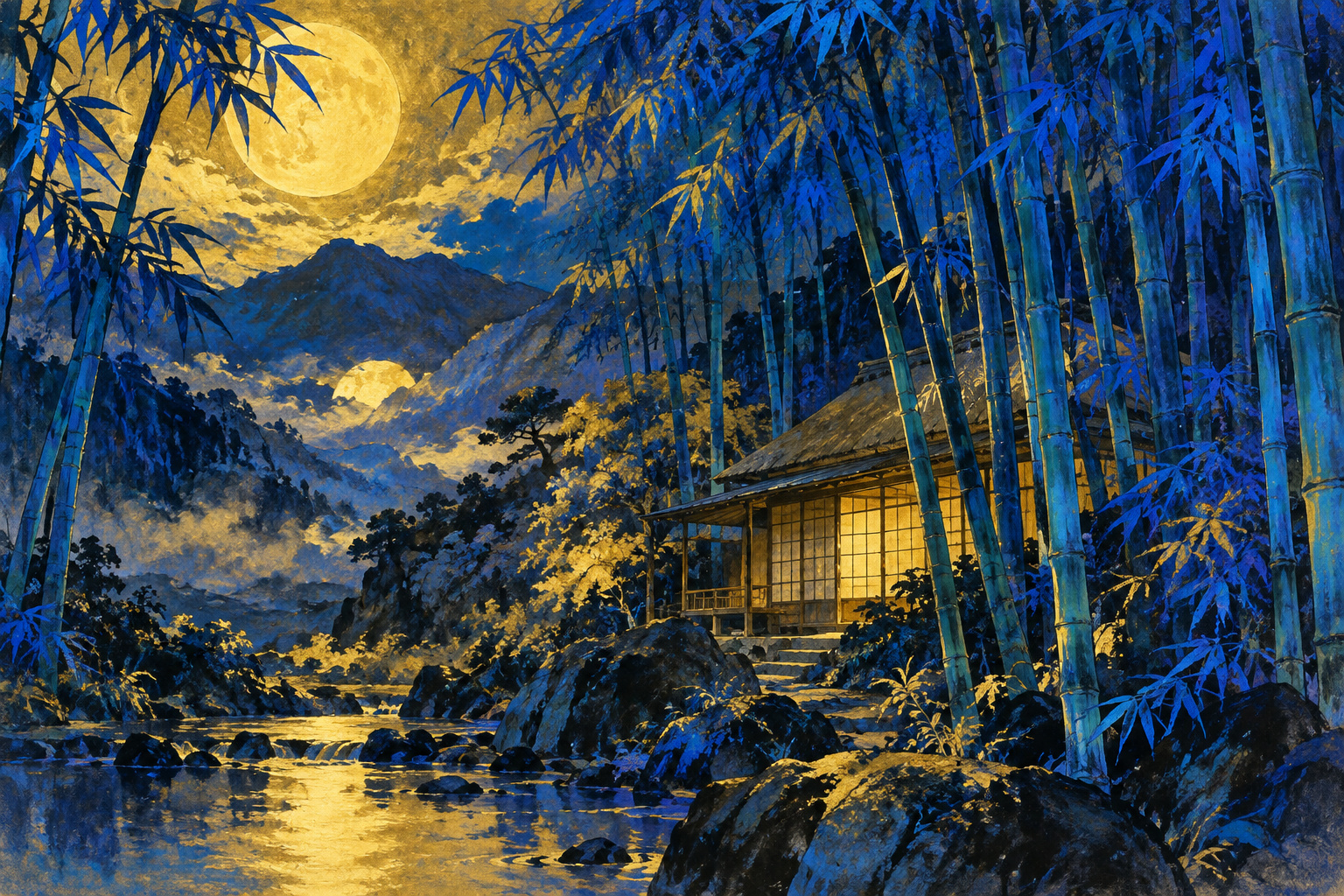
A quieter point of entry is the Metropolitan Museum of Art’s Komachi’s Residence (小町屋敷), a 1918 hanging scroll in ink and color on silk. The Met interprets its rich blue as evening shadow and bright yellow as moonlight around a hut in bamboo.[2]
For this edition, the attraction lies in the tension between those colors. A still setting need not produce a passive image: the eye moves between illumination and shadow, constructing a sense of distance and atmosphere.
The Met connects the title with legends of the poet Ono no Komachi, while explicitly noting the need for further research.[2] The painting should therefore not be treated as a verified depiction of her actual home.
More than monumental scale
This hanging scroll need not stand in for the scale of Ryūshi’s later large works. Looking at it alongside his interest in exhibition space instead suggests a broader approach: color can direct attention within an intimate scene as well as across a commanding composition.
His surroundings offer another route into the work. Ryūshi Park in Tokyo’s Ota ward preserves the home and studio he designed.[4] They provide a setting for considering artistic production alongside the spaces of daily life, rather than treating boldness as the artist’s only characteristic.
A visual direction for today’s edition
Our editorial illustrations draw on contrasts of color and forceful lines as a visual starting point. Basketball movement, railway recovery and industrial production lend themselves to broad shapes and directional brushwork. Agricultural research and community stories call for attention to plants, people and the places they inhabit.
These are editorial connections made for this edition, not claims that Ryūshi addressed the particular events in today’s reports. The aim is to invite readers into each subject without turning ordinary life into spectacle.
The edition’s images are AI-generated illustrations inspired by Ryūshi. They are neither his works nor documentary images of the news. The museum sources below offer a route back to the artist’s own paintings and their historical context.
