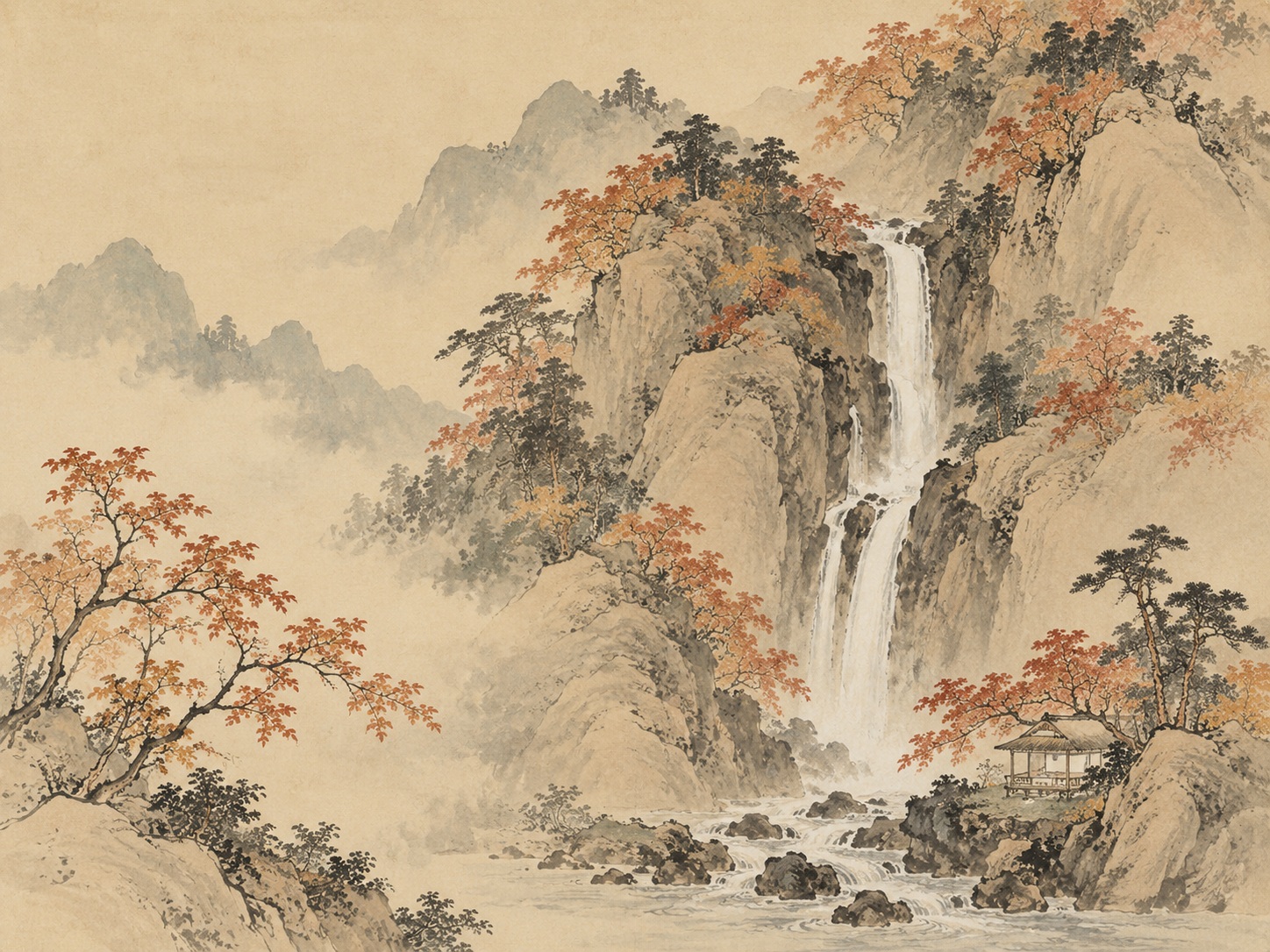
The waterfall does not announce itself. It retreats into the mountains, a narrow pale line descending between rocks and trees. In the foreground, crystalline forms are assembled from ink strokes. Around them, short blue-green marks and small pink dots flicker like botanical notation. Autumn does not cover the mountain in a single blaze. It arrives gradually.
Ike Gyokuran’s Autumnal Landscape with a Waterfall—catalogued in Japanese by The Metropolitan Museum of Art as Shū sansui-zu senmen, “Autumn Landscape fan painting”—dates to the second half of the 18th century. It was painted in ink and color on paper as a fan and later mounted as a hanging scroll. The image measures 19.1 by 52.3 centimeters. The Met designates the work Public Domain.[1]
From a Gion tea shop into the literati world
Gyokuran was born in Kyoto. Her family name was Tokuyama and her given name was Machi. Japanese biographical sources date her birth to 1727 and identify her mother Yuri and grandmother Kaji as respected waka poets. The family operated the Matsuya tea shop in Gion, placing the young artist inside a culture where poetry, calligraphy, hospitality and conversation were part of ordinary life.[2]
Her mother Yuri studied waka under Reizei Tamemura and left her own poetry collection. Gyokuran therefore did not enter the arts only after marrying a famous painter. Brush, verse and social exchange were already part of the household that formed her.[3]
Yanagisawa Kien, then Ike Taiga
Gyokuran studied painting with the early Nanga artist Yanagisawa Kien and later with Ike Taiga, whom she married in the early 1750s. Kien already belonged to the cultural network surrounding her mother and grandmother. The Met emphasizes that Gyokuran painted before her marriage; Taiga’s influence was substantial, but it was influence on an existing artist, not the beginning of her artistic identity.[4]
Taiga became one of the defining figures of Japanese Nanga. Kyoto National Museum describes his achievement as a synthesis: Chinese printed painting manuals, Japanese traditions and even Western methods were absorbed into a free and highly personal style.[5]
Gyokuran lived beside that experiment, but reducing her to “Taiga’s wife” misses the more interesting history. She had her own poetic education, calligraphic practice, patrons and surviving works.
What was Nanga?
Nanga, or Japanese literati painting, developed from admiration for Chinese scholar-painter culture. The ideal was not technical realism alone. Painting, calligraphy, poetry and cultivated personality were understood as connected forms of expression.
The Met describes Nanga artists as painters who sought to revive ideals of Chinese literati culture within a Japanese environment. Brushwork therefore mattered not only because it represented an object, but because the movement of the brush itself carried character.[6]
Gyokuran inhabited that culture as a painter, poet and calligrapher. Later images of the couple famously show Taiga playing the shamisen while Gyokuran plays the koto and the two exchange verse. Kyoto National Museum has noted how powerfully such later anecdotes shaped their legend.[7]
A fan becomes a mountain world
The first challenge of this picture is its shape. A fan widens dramatically toward the top and narrows toward the base. It does not behave like a rectangular field.
Gyokuran turns that constraint into depth. Rocks and trees expand laterally while the center opens toward a recessed valley and waterfall. The arc of the fan becomes the sweep of a mountain range. The small sheet seems to contain space beyond its edges.
Autumn arrives as dots, not as a blanket of color
The Met’s description points to a deliberate contrast between soft brush lines and angular, dark, calligraphic strokes. Short blue-green touches mark evergreen foliage; pink dots indicate deciduous trees changing color.[1]
Color does not model every leaf. It functions almost like seasonal punctuation. The viewer completes the forest from scattered signs.
Why the rocks look like calligraphy
The rocks contain both melting, flexible contours and abrupt, dark strokes. Their force comes less from geological accuracy than from the visible movement of the hand.
That is one reason Gyokuran’s training in poetry and calligraphy matters. In the literati tradition, the line that writes a character and the line that constructs a mountain are relatives. Speed, pressure, dryness and rhythm carry meaning in both.
Learning China, painting a Japanese autumn
Nanga painters relied heavily on Chinese models and imported painting manuals. Taiga, for example, studied manuals such as the Eight Varieties of Painting and the Mustard Seed Garden Painting Manual. The Met identifies Chinese-derived “Mi dots” and hemp-fiber strokes in his work.[8]
That does not make Gyokuran’s landscape a mere imitation of China. Imported visual language was translated through Kyoto experience. The blue-green and pink marks belong simultaneously to East Asian literati vocabulary and to an intensely local memory of autumn.
A marriage that sometimes became collaboration
Gyokuran and Taiga occasionally collaborated. Kyoto National Museum’s 2018 Taiga retrospective included paired and collaborative works bearing both names, among them landscape sets and combined painting-calligraphy projects.[9]
Women artists were not absent from Edo-period Japan, but art history often recorded them through male relatives or teachers. Gyokuran’s relationship with Taiga is essential context, yet it should not erase the female poetic network that formed her or the independent decisions visible in her brushwork.
Moving beyond the old language of “feminine style”
Older art history often reduced women painters to adjectives such as “soft,” “graceful” or “feminine.” Gyokuran has frequently been described in that vocabulary.
This fan resists that simplification. Some passages are delicate, but the rock structure on the right is assertive and dark. Sharp contour and tiny color marks coexist. It is more useful to ask how the brush creates space than to turn the artist’s gender into a stylistic category.
Gion was part of the artwork’s ecosystem
Gyokuran and Taiga lived near Gion Shrine, today’s Yasaka Shrine, east of the Kamo River. The Met says they built a small house and studio there.[1]
Gion was a zone of pilgrimage, tea shops, entertainment, poetry and constant urban movement. Literati culture did not exist only in secluded studies. It also depended on social spaces where people met, composed verse, exchanged pictures and performed cultivated identities.
The absence of a visible human figure
Many literati landscapes include a tiny scholar, hermit, boat or pavilion. In Gyokuran’s autumn fan, human presence is minimal.
That changes the picture. The waterfall is not a famous place to be identified. It becomes a visual path into depth. The viewer supplies the missing traveler.
How the work reached New York
The Met records the object as 1975.268.95, part of the Harry G. C. Packard Collection of Asian Art, acquired through gift and purchase in 1975. The painting is not currently on view, but its image is available through the museum’s Open Access program as Public Domain.[1]
That openness matters. A fragile fan painting that cannot remain permanently displayed can still be studied at high resolution around the world. The digital image does not replace the object, but it makes the brushwork available beyond the museum gallery.
Why choose this painting for October 6?
This is not a spectacular autumn panorama. There is no wall of red foliage and no famous Kyoto landmark.
Instead, evergreen blue-greens remain while small red marks appear among them. Change and continuity occupy the same mountain. Autumn becomes a process, not an event.
Gyokuran herself has undergone a similar art-historical change in visibility: from “wife of Ike Taiga” toward recognition as a painter, poet and calligrapher in her own right.
The waterfall is thin. The colors are restrained. Yet the world inside the fan is large. That quiet expansion is precisely why Gyokuran belongs in an October Art Choice.
Sources and references
- The Metropolitan Museum of Art, Autumnal Landscape with a Waterfall — object record, curatorial description and Public Domain status.
- Kodansha Digital Japanese Biographical Dictionary entry for Ike Gyokuran — reading, birth date, names and biography.
- Kodansha biographical entry for Yuri, Gyokuran’s mother and one of the “Three Women of Gion.”
- The Met, Peony and Bamboo — Gyokuran’s early literati environment, Yanagisawa Kien and Taiga.
- Kyoto National Museum, The Genius of Ike no Taiga — Taiga, Nanga and the Taiga-Gyokuran artistic circle.
- The Met, The Poetry of Nature — Nanga and the Japanese revival of Chinese literati ideals.
- Kyoto National Museum essay on the 2018 Taiga exhibition and the later image of Taiga and Gyokuran.
- The Met, Spring Clouds Arising from the Gorge — Chinese painting manuals and literati brush vocabulary in Taiga’s work.
- Kyoto National Museum, 2018 Taiga exhibition checklist — works by Tokuyama Gyokuran and collaborative works with Taiga.
Reporting cutoff: October 4, 2026. Japanese sources commonly date Gyokuran to 1727–1784 while The Met uses 1728–1784; the discrepancy is stated rather than silently normalized. The Met explicitly labels the featured image Public Domain.