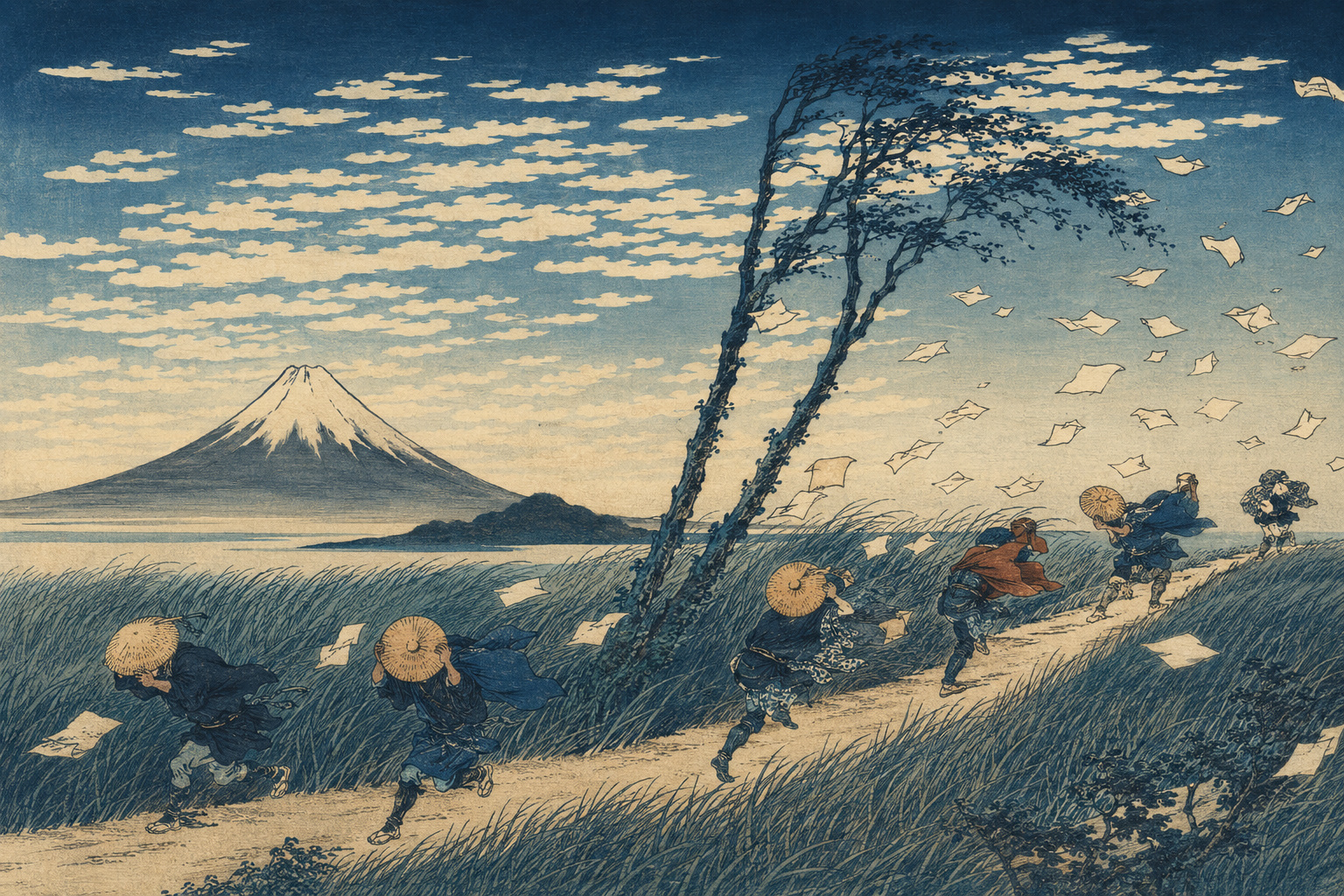
Hokusai's most important mark in this picture is the one he never made. No ribbon, ray or cartoon line stands for wind. The air remains blank. Yet the print is so aerodynamically convincing that viewers can reconstruct the gust from evidence: the angle of a branch, the lifted hem of a robe, a hat already beyond reach and sheets of paper climbing into the sky.
The Japanese title is 『冨嶽三十六景 駿州江尻』 (Fugaku sanjūrokkei: Sunshū Ejiri), by Katsushika Hokusai (1760–1849). The Agency for Cultural Affairs' Cultural Heritage Online dates the Tokyo Fuji Art Museum impression to about 1830–32 and describes it as a multicolor woodblock print measuring 24.2 by 36.2 centimeters. The Edo-Tokyo Museum dates its impression to 1831–34 and measures it at 25.8 by 38 centimeters. Such differences are not errors: surviving impressions can belong to different printings and may have been trimmed.
A choreography of consequences
The great tree leans across the upper left corner, establishing a directional force before the eye reaches a single person. Beneath it, the Tokaido road curves in a broad S. The travelers do not repeat one pose. One grips a hat. Another bends from the waist. A third braces into the weather while clothing and baggage pull away. Their differences keep the scene from becoming a decorative pattern.
The loose sheets are both narrative detail and visual score. Their white rectangles punctuate the open sky, transforming empty space into an active field. Follow them from the road upward and the eye performs the gust. Hokusai does not simply illustrate objects in motion; he makes looking itself move.
Comedy enters through lost control. These are ordinary travelers, not mythic heroes conquering nature. Their preparations—clothes, hats, walking staffs, bundled possessions—are suddenly inadequate. Yet the humor never strips them of dignity. They keep going. The print recognizes a universal humiliation: the instant weather converts a composed adult into someone chasing a piece of paper.
The mountain that refuses the weather
Mount Fuji is easy to miss at first. It is small, pale and distant, placed near the center beyond the road and figures. Once found, however, it reorganizes the image. The tree, people, hats and papers register a few violent seconds. Fuji introduces a duration longer than any traveler can experience.
This is a favored Hokusai reversal. In Under the Wave off Kanagawa, the wave dominates the foreground while the mountain survives as a small triangular form. At Ejiri, the danger is harder to draw because it has no body. The broad, cloudless air becomes the medium of the threat, while the mountain's unbroken contour supplies the counterweight.
Calling Fuji “calm” should not turn it into a sentimental moral. The mountain does not protect the travelers or promise that the wind will pass. Its stillness is visual, not benevolent. Hokusai allows human inconvenience and geological permanence to occupy the same sheet without making either one unreal.
Ejiri was a junction, not an empty countryside
Sunshū is an old name for Suruga Province. Ejiri-juku stood in what is now Shimizu Ward, Shizuoka City. The Japan Heritage project operated by Shizuoka and Fujieda identifies it as the eighteenth post station on the Tokaido. The town had grown around Ejiri Castle, associated with the Takeda clan, and prospered through trade and craft production.
The Tomoe River and the port at its mouth connected the road to maritime transport. Materials for the construction of Sunpu Castle traveled along the river, while Shimizu served as a shipping base for goods bound for Edo. The figures in Hokusai's print therefore belong to an environment defined by circulation—of people, cargo, information and images.
The Yamanashi Prefectural Museum places the imagined view west of the post town, looking from southwest toward northeast. That does not make the print a topographical photograph. Hokusai could select, compress and reposition a path, shrine, water and tree to make the design work. A precise modern viewpoint has not been established beyond dispute, and the picture's truth lies as much in bodily experience as in cartographic correspondence.
Why landscape prints became a mass market
By the early nineteenth century, Japanese travel culture had created an audience ready for images of places. The National Diet Library traces the expansion to political stability, improved roads and lodging, wider currency circulation and the growing economic capacity of commoners. Travel had increased from the early eighteenth century; by the Bunka and Bunsei eras, 1804–30, it had become a boom.
Guidebooks, route maps, gazetteers and travel narratives let places circulate before travelers arrived. Landscape prints served both memory and desire. Someone who had walked the Tokaido could recognize its rhythms; someone unlikely to make the journey could travel by looking. Hokusai's series met that market while transforming what a “famous view” could be. A road in bad weather could matter as much as a celebrated temple.
Thirty-six Views of Mount Fuji was issued when Hokusai was in his seventies. Fuji worship was vigorous in Edo, where devotional associations known as Fuji-kō organized worship and pilgrimage. The Sumida Hokusai Museum credits not only the artist's powers of invention but the strategy of publisher Nishimuraya Yohachi. The first 36 designs were successful enough for ten more to follow, leaving a 46-print series with its original title.
Blue technology changed the distance
The series also arrived during a revolution in color. The synthetic pigment known in Japan as bero-ai or Berlin blue—Prussian blue—was developed in Europe in the early eighteenth century and entered regular ukiyo-e use around 1829. Its intensity, stability and suitability for gradation expanded the ways printers could represent sky and water.
The National Diet Library notes that roughly ten designs in Hokusai's series are primarily blue aizuri prints. Ejiri is not one of those monochrome works: it includes greens, browns and colors in the clothing and road. But blue contours and atmospheric gradation govern its temperature. According to the Yamanashi Prefectural Museum, the outlines of the first 36 designs were printed in blue, while the ten added designs used black.
This color history complicates the easy label “traditional Japanese blue.” The pigment was a product of transcontinental exchange, developed in Europe, imported through Asian trade and converted by Edo publishers, carvers and printers into a new visual language. The quiet distance at Ejiri is partly the result of global chemistry.
One Hokusai, many hands
A woodblock print is not a solitary painting reproduced after completion. Hokusai supplied the design. Specialist carvers translated lines into blocks. Printers registered the blocks and controlled pigment, moisture, pressure and gradation. The publisher commissioned, financed, marketed and distributed the result. The Sumida Hokusai Museum presents this division of labor as fundamental to ukiyo-e prints.
That process helps explain why impressions differ. Lines wear as a block is used. Colors and gradations change between batches. Sheets are cut by later owners. Museum dimensions therefore identify particular objects, not a Platonic original. The public-domain image used here is tied to the Edo-Tokyo Museum impression and should retain that credit even though Hokusai's copyright has long expired.
| Element | Visible action | Compositional effect |
|---|---|---|
| Tree and leaves | Branches bend; leaves detach | Establishes direction and force |
| Hat and papers | Possessions escape into open sky | Accelerates the eye and implies the next second |
| Travelers | Bodies crouch, grip and brace | Turns weather into physical empathy |
| Road | Curves from foreground into distance | Connects momentary chaos to continuing travel |
| Mount Fuji | Keeps an intact contour | Places geological time behind human time |
An old master's calculated exaggeration
Hokusai was born in 1760 near Honjo Warigesui, in the area now around Kamezawa in Tokyo's Sumida Ward. The Sumida Hokusai Museum says he debuted as an ukiyo-e artist at the traditional age of 19 and continued working until his death at 90, a career of roughly seven decades. He moved among actor prints, illustrated books, drawing manuals, privately commissioned prints and paintings, repeatedly changing names and styles.
The famous Fuji series was therefore not youthful discovery. It was late-career concentration. Observation and exaggeration reinforce each other at Ejiri: because Hokusai understood the separate reactions of cloth, paper, trees and bodies, he could align them more clearly than a literal snapshot would. The scene feels true because it has been decisively edited.
A gust reconstructed in photography
Canadian artist Jeff Wall made the print's afterlife explicit in A Sudden Gust of Wind (after Hokusai) (1993). His monumental color transparency shows four people scattered across a flat landscape as papers fly through the air. Tate describes it as an homage to Hokusai shaped by cinematic methods; its account says Wall photographed outside Vancouver over five months and digitally collaged multiple images.
The connection is more profound than quotation. Both works manufacture an event that appears accidental. Hokusai's incident required the coordinated labor of designer, carver and printer. Wall's apparent instant required performers, repeated photography and digital construction. The invisible wind exposes the visible architecture of image-making.
Japan.co.jp: a one-minute viewing exercise
- Ignore Fuji first: Trace only the objects that have surrendered to the gust.
- Follow the white sheets: Notice how blank paper animates blank sky.
- Return to the mountain: Ask why the smallest stable form now feels heaviest.
- Imagine the next second: Decide which object will leave the frame and which traveler will recover.
A joke measured against a mountain
The print remains funny because bodies have not changed as much as technologies have. We still lose papers, invert umbrellas and grab hats too late. Hokusai does not need costume or geography to make that recognition immediate. He begins with embarrassment and expands it into an account of time.
Fuji offers no rescue and no explanation. It merely waits beyond the road. That restraint keeps the image from becoming a slogan about human smallness. The travelers' problem is temporary but real; the mountain's endurance is immense but distant. By granting full attention to both, Hokusai turns a roadside mishap into one of the most exact pictures ever made of how a moment feels.
Sources
- Cultural Heritage Online: Thirty-six Views of Mount Fuji: Ejiri in Suruga Province (Japanese title and readings, artist, date, medium, dimensions and commentary; Japanese)
- Tokyo National Museum: Thirty-six Views of Mount Fuji: Ejiri in Suruga Province (oban nishiki-e classification, period and object number; Japanese)
- Tokyo Museum Collection: Ejiri in Suruga Province (Edo-Tokyo Museum impression, publisher, date, dimensions and public-domain status; Japanese/English)
- Yamanashi Prefectural Museum: Sunshū Ejiri (location, viewing direction and visual account; Japanese)
- Yamanashi Prefectural Museum: Hokusai's Thirty-six Views of Mount Fuji (publisher and blue versus black outlines; Japanese)
- Japan Heritage “Journey through Suruga”: Ejiri-juku (post-station number, castle town, Tomoe River and Shimizu port; Japanese)
- Sumida Hokusai Museum: Hokusai and Hiroshige—Their Thirty-six Views of Mount Fuji (Fuji-kō, Berlin blue, publisher and 46-design series; Japanese)
- Sumida Hokusai Museum: Look, Find and Discover Hokusai (Hokusai's career and collaborative print production; Japanese)
- National Diet Library: The birth of famous-place prints (travel boom, landscape prints, multicolor printing and Prussian blue; Japanese)
- Tate: Jeff Wall, A Sudden Gust of Wind (after Hokusai), 1993 (later influence)
- The Metropolitan Museum of Art: Ejiri in Suruga Province (composition, date, medium and public-domain image)
Japan.co.jp checked sources available through 11:30 p.m. JST on September 2, 2026. Japanese titles, readings, place names and technical terms were verified in Japanese records from cultural agencies, public museums and local-government bodies. Dates and dimensions are given as object-specific institutional records rather than collapsed into a false single value. The exact modern viewpoint and publication sequence of the design remain unsettled; visual interpretations are Japan.co.jp analysis.
Image rights: Katsushika Hokusai, Thirty-six Views of Mount Fuji: Ejiri in Suruga Province (Edo-Tokyo Museum). Source: Tokyo Museum Collection. Public domain. Retain the source credit when publishing.