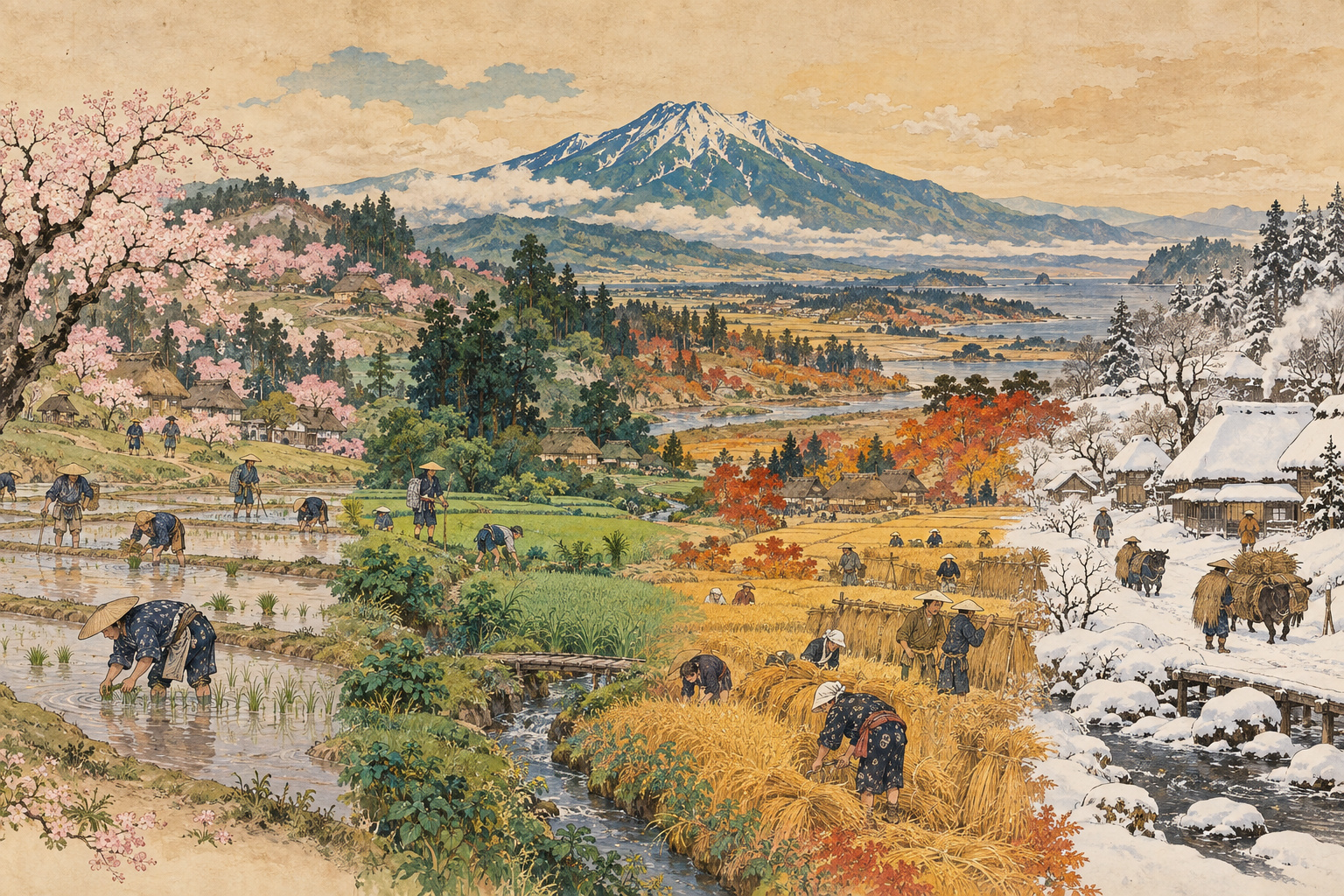
A harvest is the visible end of a much longer story. Before food reaches a market, someone has prepared, tended, waited and worked. Hirao Rosen’s painting of farming through the four seasons makes that accumulated time its subject. For an Aomori Sunday Edition, it offers a way of looking beyond the finished product to the people whose work sustains a place.
Rosen, who lived from 1808 to 1880, was a Hirosaki painter and scholar. The work selected here is catalogued as Shihon tansai shiki nōkō no zu, which we render descriptively as Farming Through the Four Seasons. It is a pair of six-panel screens, rather than one six-panel screen.[2]
The object behind the title
The Agency for Cultural Affairs database identifies the medium as light colour on paper and dates the work broadly to the Edo period. Each screen measures 175 centimetres high and 372 centimetres wide. Those dimensions matter: this is a substantial object unfolding across space, not an illustration originally designed to fit a small page.[2]
| Work | Catalogue information |
|---|---|
| Artist | Hirao Rosen, 1808–1880 |
| Japanese title | 紙本淡彩四季農耕の図 |
| Date and medium | Edo period; light colour on paper |
| Format | Pair of six-panel folding screens |
| Dimensions | Each screen: 175 × 372 cm |
| Collection | Hirosaki City Museum; owned and managed by Hirosaki City |
| Designation | Hirosaki City-designated Tangible Folk Cultural Property, January 4, 1966 |
Catalogue details: Hirosaki City and the Agency for Cultural Affairs database.[1][2]
Hirosaki’s account values the screens in two related ways: as a work by a major local painter and as evidence of regional agricultural practice. It also identifies a commission from Rosen’s son-in-law, a member of the Mikami family. The work belongs to a social relationship as well as to a history of painting.[1]
Look at the bodies doing the work
In the detail reproduced on the city’s website, small figures bend, stand and handle implements. Some work in a line; others occupy separate patches of the picture. The restrained colour allows changes of posture and gesture to remain legible. This is a reading of that published detail, rather than a claim to have examined the complete screens in person.[1]
A productive way to begin is to follow movement before attempting to name every task. Which actions seem solitary? Which depend on several people? How does the repeated bend of a body establish rhythm? Viewed this way, the figures become the organising subject of the landscape, rather than incidental decoration.
That interpretation has limits. A painting selects and arranges. It cannot, by itself, tell us the full economic circumstances of everyone represented or establish how typical each depicted practice was. Its historical usefulness grows when visual evidence is compared with tools, documents and other records.
A merchant’s son becomes a painter and writer
The Aomori Prefectural Library’s biographical account places Rosen’s birth in a fish merchant’s household in Hirosaki’s Konya-machi. In 1837 he passed the family business to his younger brother and concentrated on painting and writing. His interests encompassed historical inquiry, local geography, folklore and kokugaku, the study of Japanese texts and traditions.[3]
The prefectural museum’s introduction to its 2013 Rosen exhibition describes an education extending across painting, Chinese learning and poetry. It also points to closely observed albums of plants and birds. His attention moved between the act of drawing a thing and the effort to understand it.[4]
Placed within that larger practice, the farming screens become more than an attractive seasonal subject. They suggest how knowledge of a locality can take visual form: bodies, implements and repeated tasks brought into a composition that a viewer can revisit.
An established theme, a local work
Agricultural scenes arranged through the seasons already had an established place in Japanese painting. A National Institutes for Cultural Heritage account notes the many farming screens produced during the Edo period. Discussing a work by Kanō Tan’yū, it connects such imagery with the shogunate’s emphasis on agriculture.[8]
That context is useful, but it does not establish Rosen’s intention. A familiar subject can serve different purposes for different patrons and audiences. The question here is how the broad theme became a record of local work, and how an inherited pictorial form could accommodate observation of a particular region.
The folding-screen format also rewards a change in pace. A small digital image compresses a large object into a glance. Knowing its scale encourages a slower imagined encounter: moving from a group of workers to another activity, then stepping back to consider the whole.
Curiosity across the strait
Rosen’s curiosity extended beyond Tsugaru. Hirosaki Municipal Library’s introduction to his manuscript Yōi meiwa describes an 1855 journey to Matsumae and Hakodate, where he encountered foreign ships and their crews. His illustrated account drew on observation and on information gathered from other people.[5]
The library also cautions that his descriptions reveal prejudice and unease alongside curiosity. That makes him a more historically situated observer than the flattering image of an entirely detached recorder. Paying attention does not remove the assumptions through which a person interprets what is seen.
It is a useful consideration when returning to the farming screens. We can admire their attention to life while remembering that an artist’s record is also an artist’s construction. Observation and interpretation are intertwined.
The observer and the storyteller
Another museum work reveals the breadth of Rosen’s imagination. The catalogue for Inō mononoke roku, a tale of supernatural encounters, explains that his illustrations were made in 1870, while the text and pictures were brought together as a book in 1885, after his death.[6]
The distinction between those dates prevents a misleading attribution of an 1885 act of painting to a man who died in 1880. More broadly, it reminds us that the maker of a record of farm labour also pictured a world of uncanny stories. A single label such as “realist” would leave too much out.
The collection account for his Tōjin-zu byōbu further notes that Rosen trained pupils who became leading figures in Tsugaru painting during the Meiji period. His legacy therefore includes teaching and transmission, as well as the objects bearing his name.[7]
Why these screens belong in this edition
The link with this edition’s apples, grapes, food and embroidery is editorial, not a claim that those modern industries are depicted in the work. What connects them is sustained attention to making and growing: the knowledge held in repeated actions, and the labour easily hidden by a finished product.
Read alongside a harvest story, the screens invite questions about time. Read alongside a craft feature, they invite questions about hands and learned skill. They make room for a regional history that is not only a sequence of famous people and events, but also the recurring work of keeping a community fed and clothed.
Hirosaki City Museum lists a closure for exhibition changes from September 7 through October 2, 2026, covering this edition’s September 27 date. Readers can begin with the city’s catalogue entry and published detail; a future display of the original should be checked with the museum.[9]
“Painted from life” is useful here as a description of the work’s documented attention to farming, not as proof that every passage was painted outdoors in front of its subject. Rosen’s achievement is to make the ordinary work of a year worth looking at again. The harvest becomes a beginning for the viewer: an invitation to notice everything that came before it.
Sources and further reading
- Hirosaki City: designation and interpretation of the farming screens
- Agency for Cultural Affairs database: title, medium, dimensions and format
- Aomori Prefectural Library / Museum of Modern Literature: Rosen biography
- Aomori Prefectural Museum newsletter: the 2013 Rosen exhibition
- Hirosaki Municipal Library: Yōi meiwa manuscript and scholarly introduction
- Cultural Heritage Online: Inō mononoke roku
- Cultural Heritage Online: Tōjin-zu byōbu and Rosen’s pupils
- National Institutes for Cultural Heritage / Japan Search: agricultural imagery in Edo-period painting
- Hirosaki City Museum: September–October 2026 closure notice
