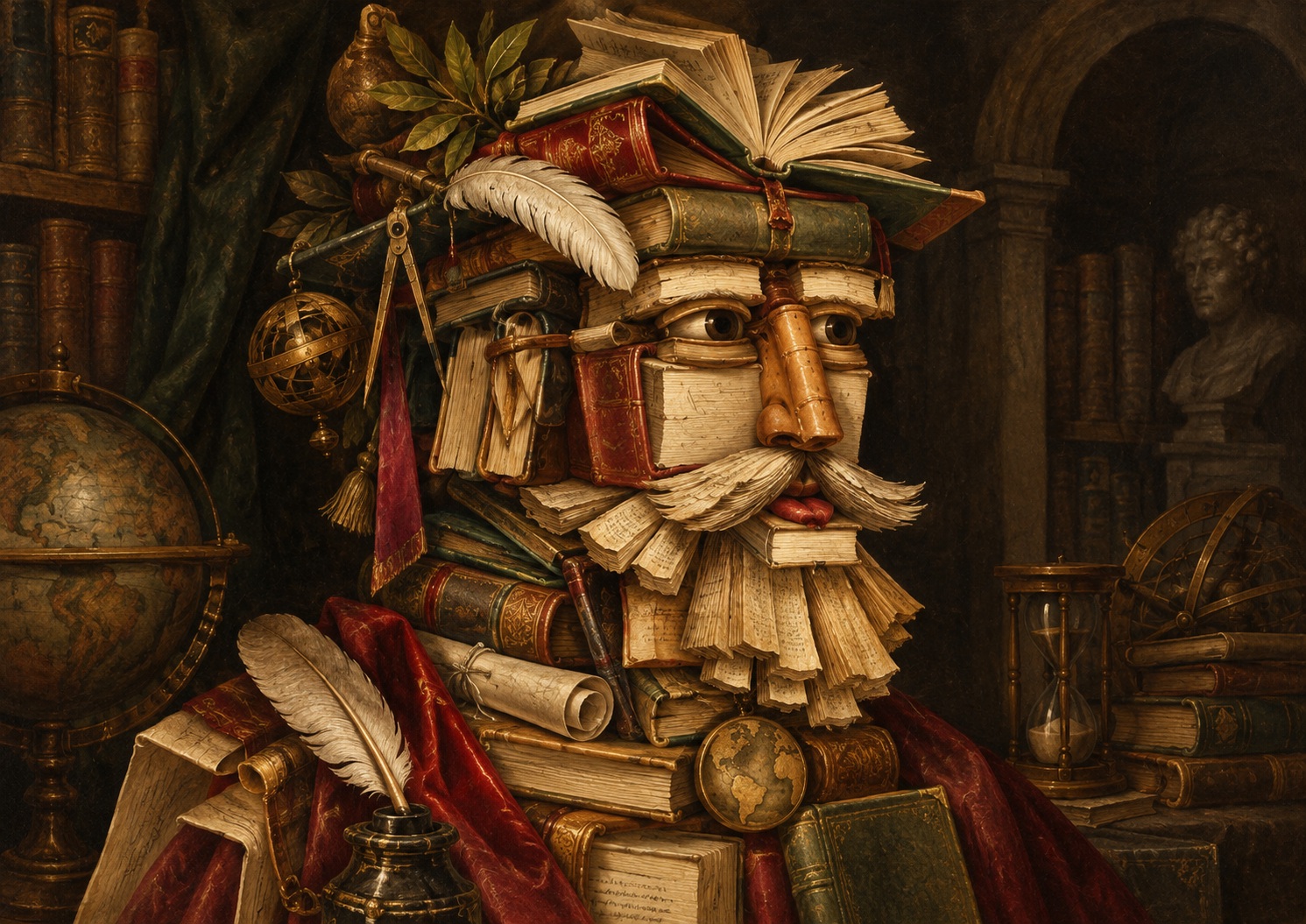
His hair is made of pages. His forehead is an open book. Bindings and page blocks become cheeks, chest and clothing. Thin paper markers turn into fingers. Even the beard seems to unravel from the edges of books.
Giuseppe Arcimboldo’s The Librarian performs a trick that does not wear out: once the viewer sees a man, the man turns back into a pile of books; once the books are seen, the face returns.
The Swedish Historical Museums’ Skokloster Castle catalog dates the oil-on-canvas painting to roughly 1562–1566?, at about 98 by 71 centimeters. It identifies the sitter as probably Wolfgang Lazius (1514–1565), a scholar and collector attached to the Habsburg court who served Emperor Ferdinand I as official historian and was deeply involved in court collections and libraries. [1]
A portrait that avoids painting the person
Ordinary portraiture begins with resemblance. Arcimboldo starts somewhere else.
He paints the things associated with a person and makes those things become the person. Fruit, vegetables, fish, flowers, animals and tools could all become human heads. In The Librarian, the raw material is books.
Japan’s National Museum of Western Art described Arcimboldo’s signature works as allegorical portraits made by unexpectedly combining motifs such as fruit, vegetables, fish and books. Its 2017 exhibition checklist officially listed this painting as The Librarian, on loan from Skokloster Castle. [2] [3]
Each book remains legible as an object. Step back, however, and a torso appears. Pages become skin and hair. Bindings become structure. Narrow strips of paper begin to behave like fingers.
This is not a man holding books.
It is a man who has become his books.
Wolfgang Lazius really was a man of books
If the identification is right, the visual pun is unusually precise.
The Austrian National Library describes Lazius as a professor of medicine at the University of Vienna and official historiographer to Emperor Ferdinand I. He traveled through libraries, monasteries and archives on imperial assignments, researching the history of the dynasty and its territories. Three major research journeys brought substantial quantities of books and source material back to Vienna. [4]
The Austrian Academy of Sciences presents him as an unusually wide-ranging scholar: physician, university rector, court historian, imperial doctor, pioneer of Austrian cartography and collector of historical manuscripts. His work included an early history of Vienna, a 1561 atlas-like project on the Austrian lands and early publication of material from the Nibelungenlied. [5]
Books were not props in Lazius’s life. They were the machinery of his profession.
Is Arcimboldo praising him or making fun of him?
That is where the painting becomes sharper.
Skokloster catalogs it as a portrait caricature and describes it as part of a group of early court works depicting members of the emperor’s entourage as a form of sophisticated diversion. Related professional portraits include The Jurist and The Cook. [1]
In a 2005 peer-reviewed study, library historian K. C. Elhard argued that the usual interpretation — simply mocking librarians or intellectualism — may be too narrow. In the context of Renaissance book culture, the target may instead be the materialistic collector who values owning books more than reading them. [6]
That interpretation changes the joke.
There are plenty of books, yet almost no knowledge is visible. Titles cannot be read. Contents disappear. What overwhelms the viewer is binding, paper, volume, accumulation — books as possessions.
But that remains an interpretation, not a solved code. Lazius was a working scholar, historian and cartographer, not merely a vain collector. Arcimboldo’s image can simultaneously flatter the breadth of his learning and tease the man who appears physically buried under it.
In 1562, a Milanese artist entered the Habsburg court
Arcimboldo was born in Milan; modern institutional sources vary between 1526 and 1527 for his birth year, while his death in 1593 is secure. His early work included stained-glass designs, fresco work and tapestry designs in Milan and nearby cities. [2]
In 1562 he was summoned to the Habsburg imperial court in Vienna, serving Maximilian II and later working for Rudolf II in Prague.
His court duties extended beyond easel painting. He designed festivals, costumes and entertainments, worked on inventions and helped acquire art and curiosities. The National Museum of Western Art has described him as something closer to a court “director” of spectacle than a painter with one narrow job. [2]
The Librarian belongs to the early years of that transformation.
Why would a court enjoy a portrait made of books?
Late-sixteenth-century European courts were intensely interested in collecting and classifying the world. Kunstkammer collections brought together rare animals, minerals, scientific instruments, antiquities, exotic objects and artworks.
New trade routes and geographic discoveries were expanding the stream of objects and information available to European elites. To possess, order and interpret that variety was itself a performance of knowledge and power.
Arcimboldo’s paintings fit that culture unusually well. His Four Seasons assemble seasonal plants and produce into human heads; his Four Elements assemble creatures and materials into allegorical figures. The National Museum of Western Art emphasizes that their strangeness was intertwined with knowledge, symbolism and imperial ideology rather than being mere nonsense. [2] [9]
The Librarian moves the same logic from nature into culture. Instead of assembling the natural world, Arcimboldo assembles the technology of knowledge.
The library itself was changing in Lazius’s century
The Austrian National Library frames Lazius within a larger transformation.
Printing, historical writing, genealogy, heraldry and scholarship were becoming increasingly important to dynastic government. The court library was evolving from a treasury containing precious books into an infrastructure of knowledge and cultural memory. [4]
That makes Arcimboldo’s human pile of books more than a professional gag.
The sixteenth century was producing more texts, more collections, more catalogs and more reasons for rulers to turn knowledge into institutional power. If one wanted to draw that new condition as a person, a body built entirely out of books was not an absurd choice.
In 1648 the painting stopped being a joke and became war booty
The painting’s second life began in violence.
In 1648, during the final phase of the Thirty Years’ War, Swedish troops under Hans Christoph von Königsmarck attacked Prague and seized major parts of the imperial collections. Skokloster and the Swedish Historical Museums record The Librarian as having been taken from Prague as war booty. Königsmarck is listed among its former owners. [1] [7]
The work later entered Swedish aristocratic collections and eventually Skokloster Castle, where it remains today.
The change in setting must also have changed the joke. At the Habsburg court, viewers may have known exactly whom the books represented and understood private references that are now lost. In Sweden, removed from that social circle, the painting increasingly became simply the extraordinary image of a man made of books.
From unfashionable oddity to ancestor of Surrealism
Arcimboldo did not remain central to the history of painting after his death.
Skokloster notes that The Librarian and its other Arcimboldo masterpiece, Vertumnus, spent decades in relative obscurity. A late-nineteenth-century art historian regarded the pair as historically interesting but artistically inferior. [7]
The twentieth century reversed the judgment.
The National Museum of Western Art notes that artists including Max Ernst and Salvador Dalí helped rediscover Arcimboldo in the first half of the twentieth century. A face assembled from things, a single image that can be read in incompatible ways, and the collapse of ordinary categories suddenly looked less like a Renaissance eccentricity and more like a predecessor to Surrealist visual logic. [2]
A sixteenth-century court joke had found a new audience because modern art had changed the questions viewers asked of it.
The Librarian came to Tokyo
Japanese audiences have had a direct encounter with the painting.
From June 20 through September 24, 2017, the National Museum of Western Art in Ueno staged Japan’s first major Arcimboldo retrospective. The official checklist placed The Librarian, from Skokloster Castle, in the section titled “Depictions of Professions and the Beginning of Caricature.” [2] [3]
The exhibition attracted 365,562 visitors. It brought together Arcimboldo’s major oils, drawings and contemporary objects to reconstruct the intellectual world in which his composite portraits were made. [2]
So The Librarian is not merely a curiosity hidden in a Swedish castle. In the summer of 2017 it hung in Tokyo before hundreds of thousands of museum visitors.
Why it feels like a 450-year-old meme
The painting works remarkably well on a small screen.
First you notice books. Then a face. Or first a face, then books. The perceptual flip is almost instantaneous, and once it happens, the viewer wants to show someone else.
That speed resembles the mechanics of a modern visual meme. But The Librarian refuses to stay at the level of a one-line joke.
Owning books versus reading them. Knowledge versus status. Courtly vanity. The explosion of print culture. The collector’s desire to possess the world. The cruelty of defining a person entirely through a profession.
The joke opens quickly. The questions arrive later.
- 5 seconds: “That man is made of books.”
- 30 seconds: Pages, bindings, bookmarks and book blocks start turning into anatomy.
- 1 minute: The probable sitter turns out to be an actual historian and collector whose career revolved around books.
- 3 minutes: The image starts oscillating between compliment and satire.
- 5 minutes: The uncomfortable question arrives: do we read to know, or collect knowledge partly to construct an identity?
A masterpiece whose digital image can actually be reused
There is also a practical reason this is an unusually good Today’s Art Choice for an online newspaper.
The Swedish Historical Museums’ collection record marks the media for The Librarian with a Public Domain Mark, stating that copyright in the work has expired and the image is free to use. The page’s metadata is released under CC0. The museum encourages attribution to the artist when known. [1]
Image credit: Giuseppe Arcimboldo, The Librarian, c. 1562–1566?, oil on canvas, Skokloster Castle / Swedish Historical Museums (SHM). Media: Ola Myrin. Public Domain Mark.
The books have no readable contents
Look once more.
We cannot really read the titles. We cannot read the pages. Almost none of the knowledge supposedly contained in this enormous pile is accessible to us.
And yet we immediately decide that this must be an intellectual.
That may be the painting’s most modern trick.
A court viewer in the 1560s and a reader scrolling Japan.co.jp in 2026 do not bring the same assumptions to the image. But the boundary between possessing knowledge and appearing knowledgeable remains unstable.
Arcimboldo made a man out of books.
More than 450 years later, the books are still reading us.
- Swedish Historical Museums / Skokloster Castle, The Librarian object record
- National Museum of Western Art, Tokyo, Arcimboldo exhibition, 2017
- National Museum of Western Art, 2017 Arcimboldo exhibition checklist — The Librarian
- Austrian National Library, Wolfgang Lazius and the imperial library
- Austrian Academy of Sciences, Wolfgang Lazius (1514–1565)
- K. C. Elhard, “Reopening the Book on Arcimboldo's Librarian,” Libraries & Culture 40(2), 2005
- Skokloster Castle, Prague 1648 and the Arcimboldo paintings in Sweden
- Skokloster Castle’s Collections
- The Metropolitan Museum of Art, Infinite Jest: Caricature from Leonardo to Levine
