First, Identify the Object Correctly
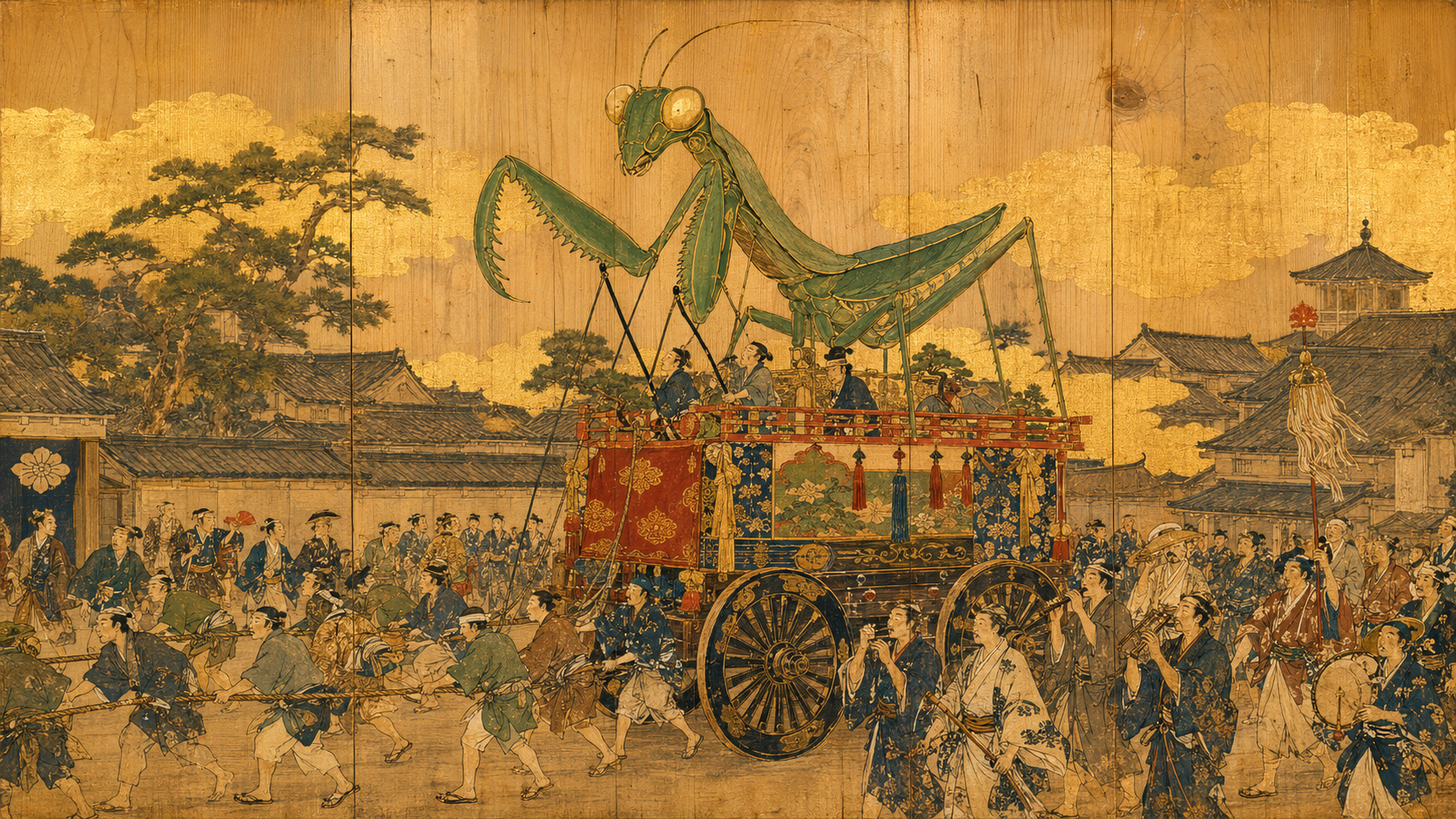
The British Museum catalogues this work with disarming plainness: “painting; door.” It is not a hanging scroll, folding screen or framed picture. It is a sugido-e, an image painted on a door made from Japanese cryptomeria, commonly called cedar. At 173.5 centimeters high and 94.5 centimeters wide, it is close to the dimensions of a standing person. A viewer originally met the festival at the scale of architecture, while entering, leaving or turning through a palace room.
| Object fact | What the record says |
|---|---|
| Subject | Tōrō-yama, a praying mantis on an ox cart; the reverse shows Hoshō-yama and Fujiwara no Yasumasa in armor |
| Artist | Attributed to Kanō Atsunobu (1639–1718), Kanō school—the attribution should not be rewritten as a signed certainty |
| Date and place | 1674–76, made in Kyoto |
| Medium | Painted cryptomeria door, or sugido-e |
| Collection | British Museum, 1958,1011,0.22; acquired in 1958 and currently not on display |
The word “attributed” matters. Museum attributions weigh style, documentary evidence, workshop practice and comparison; they can change. Kanō commissions were often collective products of disciplined ateliers. Admiring the work does not require turning a careful scholarly judgment into a signature that the object does not have.
How to Read the Strange Animal
Begin with scale. A praying mantis is normally held in the hand; here it rules the roof of an ox-drawn court vehicle. The creature’s triangular head, raised forelegs and long body make an immediately legible silhouette. The cart brings circles, weight and forward direction. Animal and vehicle stage a collision between tiny life and overwhelming momentum.
The image is funny because the proportion is absurd. It is tense because the mantis appears ready to strike. It is prestigious because the vehicle is a goshoguruma, an ox cart associated with court nobility. Those tones coexist. Edo-period spectators did not have to choose between entertainment and moral meaning. Festival art worked by making an idea spectacular enough to remember.
The painting does not itself move. It records a float whose identity depends on imagined and actual motion. A raised foreleg implies the next beat; a wheel implies the next rotation. When the door moved on its hinge, the architectural support added another kind of animation. The picture of a moving machine was itself mounted on a movable object.
“The Mantis’s Axe”: A Parable Reversed
Tōrō is a literary reading of the characters for praying mantis. The float’s central phrase is tōrō no ono—“the mantis’s axe.” In a classical Chinese parable transmitted in Japan, a mantis lifts its bladelike forelegs to oppose the wheel-ruts of an advancing great cart. Ordinarily the lesson is caution: know the limits of your strength; reckless defiance cannot stop superior force.
Kyoto turns the warning inside out. The insect’s hopeless gesture becomes an emblem of bravery. The float does not pretend the mantis can win. It asks whether courage can retain meaning even when defeat is likely. That transformation—from ridicule to admiration—is the key to the work.
| Layer | Meaning |
|---|---|
| Natural mantis | A small predator whose folded forelegs resemble blades |
| Chinese parable | A warning against opposing a force beyond one’s power |
| Kyoto legend | A tribute to Shijō Takasuke’s valor against the Ashikaga army |
| Festival machine | The “weak” creature grows monumental and visibly moves |
| Painted door | A temporary street spectacle becomes durable palace imagery |
The Warrior Behind the Insect
The Tōrō-yama Preservation Association dates the story to the Nanbokuchō era, when rival Northern and Southern courts divided Japan. Court noble Shijō Takasuke, born in 1292 and resident in the neighborhood later associated with the float, fought Ashikaga Yoshiakira’s forces at Otokoyama and died in 1352. His resistance was compared to the mantis challenging the cart.
Tradition says that in 1376 a fellow resident, the immigrant Chin Uirō Tainen Sōki, placed a large mantis model on the Shijō family’s ox cart and joined the procession. The name Uirō is significant in Kyoto cultural memory: the Chin family had continental roots and became associated with medicine and the confection later called uirō. The preservation association carefully presents this as received history—“it is said”—and so should we. Festival origins are often a braid of document, local memory and legitimizing legend.
What is secure is the strength of the neighborhood’s identification. A political death became an insect, the insect became a machine, and the machine became a town’s public self-portrait. That chain is how festivals carry history: not as a textbook chronology, but as a form rebuilt by hands.
Why a Court Painter Painted a Town Festival
The Kanō school was Japan’s most enduring professional painting organization. Founded as a Kyoto atelier by Kanō Masanobu in the fifteenth century, it served shoguns, aristocrats, temples, shrines and wealthy merchants for more than three centuries. Its workshops could handle intimate ink pictures and enormous architectural programs. In castle and palace rooms, painting was not applied decoration after the fact; it helped define the status, rhythm and use of space.
Kanō Atsunobu—also known as Kanō Juseki—lived from 1639 to 1718 and participated in major palace painting projects. The British Museum dates this door to 1674–76 and links it to a set thought to have been made for the Nyoin Gosho, the residence of retired empress Tōfukumon’in within the imperial palace grounds. Other surviving doors in the series show Kikusui Hoko, Taishi Yama, Ayagasa Hoko, Tenjin Yama and more.
This choice of subject matters. Gion Matsuri’s floats were made and maintained by urban neighborhoods; the painted set carried their street pageantry into an imperial residence. The festival thus crossed social and spatial boundaries—from merchant streets to palace architecture, from brief July performance to year-round image. It would be too simple to call that appropriation or mere documentation. It is evidence that Kyoto’s civic festival belonged to the city’s elite visual imagination as well as its neighborhood ritual life.
A Door Has a Reverse Side
On the other face is Hoshō-yama, represented through the armored figure Fujiwara no Yasumasa. Hoshō-yama recalls the tale in which Yasumasa breaks a branch of plum from the imperial grounds for the poet Izumi Shikibu. In modern festival culture it is associated with matchmaking. A single slab of wood therefore holds two neighborhood narratives: the mantis’s martial resistance and a courtly warrior’s daring act of love.
We cannot know from the catalogue alone exactly how every original viewer interpreted the pairing. Yet the format demands comparison. Opening the door could conceal one image and reveal the other. Courage changes register—from battlefield loyalty to romantic audacity; from monstrous insect-machine to armored human figure. The reverse is not trivia. It proves why a digital crop of the mantis, however memorable, is only half the artwork.
From Palace to Temple to London
The British Museum says the doors were later moved to Shōren-in and Rinkyū-ji; the latter was incorporated into the Shugakuin Imperial Villa. Such movement was not exceptional in early modern Kyoto. Buildings, rooms and painted fittings could be dismantled and reassigned. The Imperial Household Agency records that in 1682 the Kyakuden from Tōfukumon’in’s Nyoin Palace was moved to Shugakuin as her memorial.
The museum purchased this door from Walter Weinberger in 1958 with a contribution from the Art Fund. Today it belongs to the Department of Asia and is not on display. That last fact should shape practical expectations: the collection page is a research doorway, not a promise that a visitor can see the object in a gallery.
Provenance is part of interpretation. The work began as imperial architecture, passed through religious and villa settings, entered the art market and reached a national museum in Britain. Each move changed who could see it, what counted as its “front,” and whether it functioned as door, decoration, document or museum object.
Fire, Loss and the Long Sleep of Tōrō-yama
The painted door predates several of the float’s disasters. The preservation association records destruction during the Ōnin War in 1468, revival of the procession in 1500, another loss in the Great Tenmei Fire of 1788 and a new ox cart in 1802—the cart that survives. The Kinmon Incident and accompanying fire of 1864 destroyed part of the float. It then became a yasumi-yama, a “resting float” absent from the procession.
In 1876 the ox cart was adapted for indoor display, keeping memory visible even when full procession was impossible. A preservation association formed in 1978. Reconstruction of the cart and mechanical mantis was completed in 1979; new textiles followed; in 1981 Tōrō-yama returned to the procession after 117 years.
The seventeenth-century painting therefore gained a second historical role. It is art, but it is also evidence that the mantis-and-cart design existed long before the objects now on the street. Images, inventories, older mechanisms and neighborhood testimony together made revival possible. A tradition is not unbroken because every material survives. It survives because people preserve enough knowledge to begin again.
| Year | Tōrō-yama’s changing life |
|---|---|
| 1352 | Shijō Takasuke dies fighting Ashikaga forces |
| 1376 | Traditional first appearance of the mantis on the Shijō ox cart |
| 1674–76 | The British Museum door is painted |
| 1788 / 1802 | Destroyed in the Tenmei fire; surviving ox cart newly made |
| 1864 | Partly burned during the Kinmon Incident; long period as a resting float follows |
| 1978–81 | Preservation association, reconstruction and return to procession |
How the Modern Mantis Dances
The present mantis dates from the revival and was made by seventh-generation karakuri puppet master Tamaya Shōbei. During adjustment in the Yoiyama period and in the July 17 procession, it raises its sickle forelegs and opens its wings. The wheels of the imperial cart also turn as part of the mechanism. Among today’s Gion Matsuri yamahoko, Tōrō-yama is the only one with this full karakuri identity.
Motion changes the moral. A static mantis can symbolize resistance; a moving mantis performs it repeatedly. Each lift of the forelegs renews the challenge, and each rotation of the wheels reenacts the enormous force the tiny creature confronts. Children understand the drama before learning the proverb. Mechanical art becomes a teaching device.
An Edo-period predecessor mantis also survives as a Kyoto-designated cultural property and is displayed at the neighborhood headquarters during Yoiyama. Old and new should not be confused. The historical mechanism is protected; the revival mechanism works. Their division of labor allows age and action to coexist.
The Float Is Still Acquiring Art
Revival did not mean returning to a single frozen year. Tōrō-yama’s procession hangings are a modern ensemble of hand-painted yūzen by Living National Treasure Hata Tokio. Because the neighborhood had once been home to yūzen dyers, the commission connected revival to local craft history. Hata studied resistance to sunlight and friction for textiles that would work outdoors, not merely hang in a controlled gallery.
The front, side and rear hangings show cranes, peacocks, auspicious birds and gardens. The 1999 mizuhiki, “Auspicious Tachibana and Praying Mantis,” completed the set after more than twenty years of work. Mechanical puppet, 1802 cart, twentieth-century textile and fourteenth-century legend now move as one. Authenticity here is not sameness of date. It is fidelity to a civic practice through intelligent renewal.
The Larger Festival: Disease, Purification and Splendor
Gion Matsuri traces its origin to a goryō-e held at Shinsen-en in 869 during epidemic disease. Sixty-six halberds represented Japan’s provinces as rites sought to pacify destructive forces. The observance became an official festival in 970. Over centuries, Kyoto’s neighborhoods developed the yamahoko as spectacular structures of fūryū—rare materials, startling forms, music and performance offered within a sacred civic ritual.
Tōrō-yama participates in the Saki Matsuri, the Early Festival. The float procession moves through the city before the shrine’s mikoshi procession, ritually preparing and purifying the route. Calling it a “parade” describes what the eye sees but not all that the event does. The mantis is public entertainment, historical memorial, neighborhood identity and a participant in a rite born from fear of epidemic death.
How to See It on July 16 and 17, 2026
July 16 is the final and fullest night of Saki Matsuri Yoiyama. Tōrō-yama is assembled in Tōrō-yama-chō, on Nishinotōin-dōri south of Nishiki-kōji. The association says the float is normally visible from its construction on July 13 through the July 17 procession. During Yoiyama, visitors may see the old mantis in the headquarters and, when adjustment is taking place, watch the modern mechanism being tested.
| When | What to look for |
|---|---|
| July 16, Yoiyama | The mantis silhouette above lanterns; the Edo predecessor at the neighborhood headquarters; Hata Tokio’s textiles at close range |
| July 17, 9:00 AM onward | The Saki Matsuri procession; raised forelegs, opening wings and rotating cart wheels |
| Before photographing | Check local signs. Headquarters displays, religious spaces and private interiors may have different rules |
| At the British Museum | Use the online record for research; the painted door is currently not on display |
Kyoto’s official 2026 guide lists Saki Matsuri Yoiyama for July 14–16 and the procession at 9:00 a.m. on July 17. Crowds and summer heat are serious. Carry water, follow pedestrian controls, avoid blocking doorways and remember that the neighborhood is hosting a living rite, not operating a theme park.
Why This Work Matters Now
The British Museum door fixes a passing festival into wood, yet everything in it argues for motion. The cart rolls. The mantis raises its blades. The door swings. The festival returns each July. Even the artwork itself traveled—from palace to religious settings to museum collection.
Its deepest lesson is that smallness and powerlessness are not identical. The mantis cannot defeat the cart, but it can create an image strong enough to outlive warriors, fires and political regimes. Kyoto enlarged that image, engineered it, dressed it in new art and taught successive generations to make it move.
Look past the delightful oddity and the work becomes a compact history of Japan: a Chinese parable translated into local memory; civil war transformed into civic ritual; merchant festival art admitted to palace rooms; an early modern door scattered by architectural change; a burned float rebuilt by a neighborhood; old craft renewed through modern engineering. The mantis dances because tradition is not an object that simply survives. Tradition is a decision, made again, to set the wheels turning.
Sources and Further Reading
- British Museum: painting; door, 1958,1011,0.22 — object type, subject, attribution, date, medium, dimensions, provenance, acquisition and display status.
- British Museum: related Gion Festival door — evidence for the larger series of float subjects.
- Ritsumeikan University Art Research Center: Gion Festival Digital Museum — digital reconstruction and catalogue of the painted-door group.
- Tōrō-yama Preservation Association: About the Float — official history, chronology, mechanism, Edo mantis, textiles and location.
- Gion Festival Floats Association: Tōrō-yama — the float within the Saki Matsuri and its karakuri.
- Kyoto City Official Travel Guide: Understanding Gion Matsuri — float history and iconography.
- Kyoto City Official Travel Guide: 2026 Yoiyama and Procession Guide — July 14–17 schedule.
- Yasaka Shrine: History — 869 epidemic rite and the official festival in 970.
- Metropolitan Museum of Art: The Kanō School of Painting — atelier history, patrons and architectural painting.
- Daigoji: Newly Found Sugido-e — Kanō Atsunobu/Juseki and the courtly role of painted cedar doors.
- Imperial Household Agency: Shugakuin Imperial Villa — transfer of Tōfukumon’in’s Kyakuden in 1682.