What Is Happening in Kyoto Tonight?
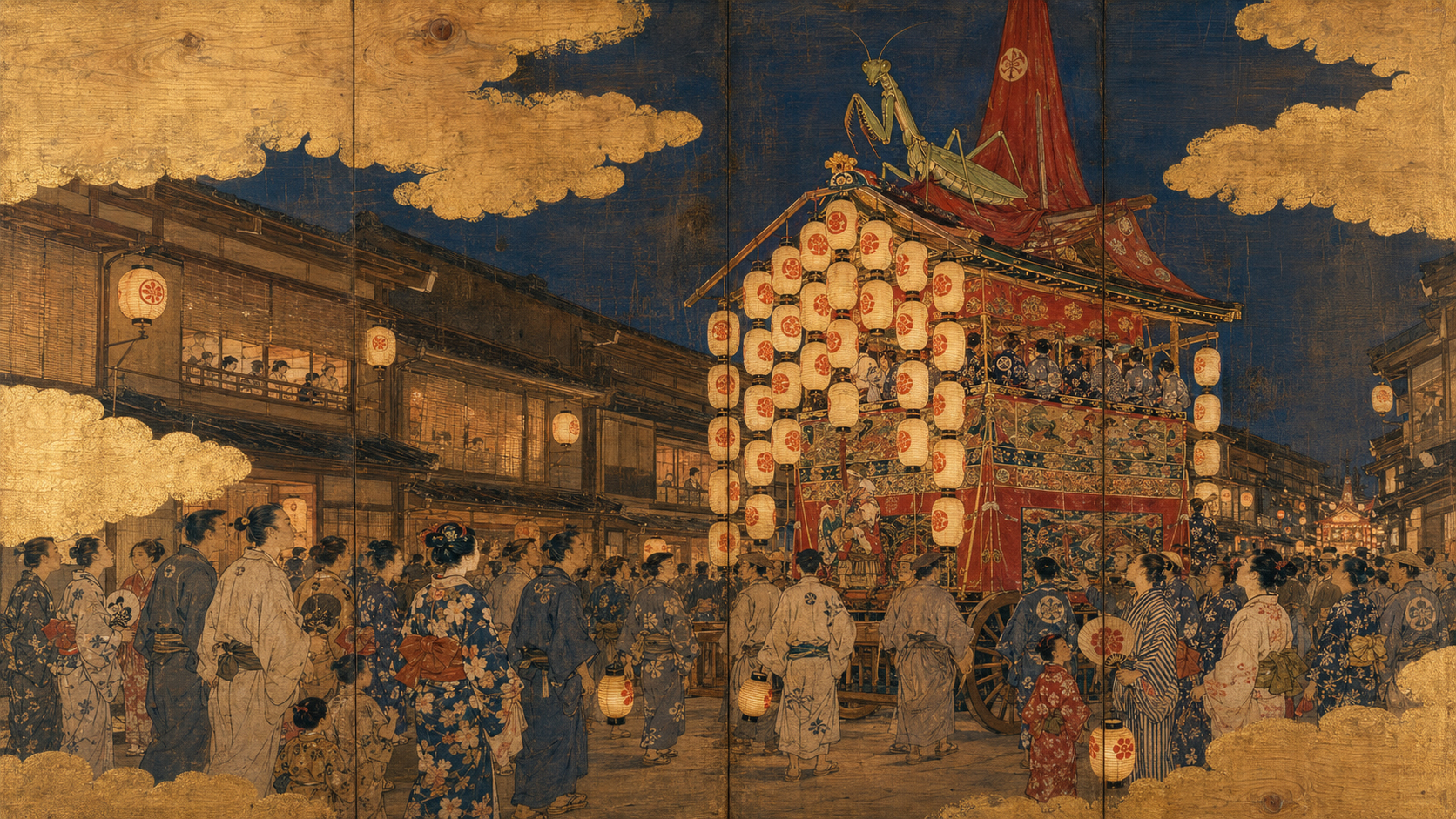
Walk west from Shijo-Karasuma into Muromachi, Shinmachi, Rokkaku, Nishikikoji and Ayanokoji streets, and the daytime traffic city becomes a ritual landscape on foot. Rows of lanterns outline the floats. Neighborhood headquarters display sacred figures and the textiles normally fitted to the floats. Children's calls, the metallic kon-chiki-chin of gongs, flutes, drums and lines for protective amulets create a different acoustic world on every narrow block.
Kyoto Prefectural Police plans call for parts of Shijo and Karasuma streets to become pedestrian roads, generally from around 6 to 11 p.m., on July 15 and 16. One-way foot traffic is imposed on some smaller streets. Those two dates bring the dense street-stall atmosphere. The Latter Festival's Yoiyama generally has neither a large pedestrian zone nor the same concentration of stalls, offering a calmer encounter with the floats, townhouses and music.
Is Yoiyama One Night or Three?
Strictly speaking, July 16 for the Early Festival and July 23 for the Latter Festival—the nights immediately before the processions—are Yoiyama. The preceding nights are Yoiyoiyama and Yoiyoiyoiyama. Modern guides commonly use “the Yoiyama period” for all three nights, July 14–16 and July 21–23. Neither usage is wrong, but knowing the distinction makes Japanese schedules easier to decode.
| Date | Common name | What to expect in 2026 |
|---|---|---|
| July 14 | Yoiyoiyoiyama | All 23 Early floats, displays and lanterns; usually easier to walk |
| July 15 | Yoiyoiyama | Pedestrian roads and stalls create one of the busiest nights |
| July 16 | Yoiyama | Peak atmosphere; late-night Hiyori Kagura prayers for fair weather and safety |
| July 17 | Early procession and Shinko-sai | Twenty-three floats by day; shrine mikoshi travel to their temporary abode at night |
| July 21–23 | Latter Yoiyama period | Eleven floats and a quieter ritual atmosphere without the big stall festival |
| July 24 | Latter procession and Kanko-sai | Procession by day; the mikoshi return to Yasaka Shrine at night |
The Festival Lasts All of July
Reducing Gion Matsuri to “the float parade on the 17th” removes its religious skeleton. The festival begins with Kippu-iri rites on July 1, then moves through the float-order lottery, float building, mikoshi purification, the sacred child's shrine visit, Yoiyama, two processions, the departure and return of the mikoshi, and finally the Ekijinja Nagoshi-sai purification on July 31. Preparation, welcoming deities, housing them, sending them home and clearing pollution form one month-long narrative.
The yamahoko procession is spectacular, but the floats are not the mikoshi that carry Yasaka Shrine's deities. One explanation of their ritual function is that the floats collect harmful spirits and pollution, cleansing the city before the mikoshi pass. On the evening of July 17, three mikoshi leave Yasaka Shrine for the Otabisho on Shijo-Teramachi. They return during Kanko-sai on July 24. Only by placing the “moving museum” of daytime beside the mikoshi procession at night does the festival's architecture become visible.
869: Disease Was Medical, Political and Spiritual
Gion Matsuri traces its origin to the Gion Goryo-e of 869. In a period of epidemics and disaster, people believed that vengeful spirits of those who had died unjustly, or epidemic deities, could bring catastrophe. The imperial court erected 66 halberds, representing the provinces of the realm, at Shinsen-en and sent mikoshi from Gion Shrine to pacify the danger.
Dismissing this merely as superstition misses its social work. A society without germ theory still needed to mourn the dead, make political responsibility visible, gather the community and restore order. Goryo-e was a religious ceremony and a civic technology for processing fear. From around 970 it became an annual observance, gradually absorbing performance and visual invention.
How Kyoto's Townspeople Turned Ritual into Urban Art
During the Muromachi period, merchants and artisans known collectively as machishū gained wealth and took responsibility for the floats of their neighborhoods. Their competition was not only about height. Sacred figures that staged classical tales, metalwork, carving, textiles and music expressed a town's resources and taste. Fūryū—the pursuit of surprising, splendid design and performance—made each float both a vessel for the sacred and a statement of civic identity.
The procession stopped in 1467 amid the Ōnin War. Thirty-three years later, in 1500, townspeople restored 36 floats. Major fires in 1708 and 1788 and the fighting around the Imperial Palace in 1864 destroyed many structures and treasures, yet neighborhoods rebuilt around surviving figures and ornaments. Tradition does not mean that one physical object survived untouched. It is a continuous series of decisions about what to remember, who will carry the cost and skills, and how to build again.
Seeing the Light: Lanterns Draw Architecture in Darkness
Yoiyama does not flood the floats with uniform stadium lighting. Round komagata lanterns are arranged in vertical and horizontal rows, tracing a float's façade against darkness. Repeated points of warm light pass through paper; only pieces of woodwork and textile emerge. This light, which withholds as much as it reveals, creates a form distinct from the brilliant daytime procession.
The audience does not watch a single stage. It walks from neighborhood to neighborhood: the vertical mass of a great hoko, figures on a smaller yama, the hull of Fune Hoko, the dance and canopy of an umbrella float. Begin at a distance with the silhouette. Then enter the neighborhood display to see the sacred figure and textiles, read the story, and return outside. In that loop, decoration becomes narrative.
Listening: Kon-Chiki-Chin Is Not One Endless Song
Gion Bayashi is played on gongs, flutes and drums. Kon-chiki-chin imitates the gong's sound, but the musicians are not repeating one universal melody. Hoko and large wheeled yama with musical ensembles possess multiple pieces, with patterns and tempos for different stages of movement. In narrow streets, one neighborhood's music overlaps another; turn a corner and the sonic layers rearrange.
Late on July 16, musicians perform Hiyori Kagura as they travel toward the Otabisho and, in the case of Naginata Hoko, Yasaka Shrine, praying for fair weather and a safe procession. Festival sound is first an offering, not background entertainment. It represents long rehearsal and intergenerational teaching. Stand a little away and hear the gong decay against townhouse walls: the music and the urban space are one instrument.
Byōbu Matsuri: Private Art Becomes Neighborhood Memory
During Yoiyama, some old families and businesses remove the street-facing latticework of their machiya and arrange folding screens, hanging scrolls and decorative arts where passersby can see them. This custom is called Byōbu Matsuri, the Folding-Screen Festival. There is no single entrance or unified exhibition. One discovers it while walking Shinmachi, Muromachi, Rokkaku and neighboring streets. For a few nights, private rooms become galleries belonging to the street.
The floats are called “moving museums” because their decorations exceed the category of ordinary festival equipment. Textiles originating in China, Korea, India, Persia and Europe coexist with works copied or reinterpreted in Japan. Cloth that reached Kyoto through international trade was cut and given new ritual life as a float's front or side hanging. Yoiyama punctures the idea of Japanese culture as something produced only inside Japan. It shows Kyoto as a city that collected, edited and re-signified the material world.
The Chimaki Is Not Food
The chimaki offered by float neighborhoods is a protective amulet made of bamboo leaves; it is not edible. It is connected to the legend of Somin Shōrai, whose hospitality toward a deity in a traveler's form earned protection from epidemic disease for his descendants. Kyoto households and businesses hang it above an entrance for a year, then return it and receive a new one.
Children's rhythmic calls offering chimaki and other talismans are a signature sound of Yoiyama, but the exchange is more than souvenir retail. It helps neighborhoods finance the observance and gives a younger generation roles, language and belonging. Popular chimaki sell out. Receive one from an official float neighborhood or Yasaka Shrine, understand that it cannot be eaten, and ask how it should be displayed and returned.
Twelve Tons Held Together with Rope
A large hoko rises about 25 meters and can weigh roughly 12 tons during the procession. Its timber frame is secured by a technique called nawagarami: straw rope is wrapped around joints without a single nail. Rope is not a quaint substitute for modern hardware. The bindings flex with vibration and distortion, while allowing the structure to be dismantled and rebuilt. Their patterned knots show that engineering and ornament were never separate categories.
The floats come apart after the festival. Because they are rebuilt every year, knowledge survives not only in drawings but in hands, eyes, calls and sequence. Shortages of rice straw, fewer craftspeople and neighborhood residents, storage and repair costs, dangerous heat and crowd pressure are modern threats. Safeguarding the heritage means maintaining the relationships that assemble, play, welcome and clean up—not placing a finished object in storage.
Early and Latter Festivals: Restoring the Story's Rhythm
Historically, the processions were divided between the Early Festival on July 17 and the Latter Festival on July 24. They were combined in 1966, partly in response to modern traffic, and all floats paraded on the 17th through 2013. The Latter Festival returned after 49 years in 2014. That year, Ōfune Hoko also returned to the procession in full float form after 150 years. Taka Yama followed in 2022 after an absence of roughly two centuries.
This was more than historical reenactment. It restored the temporal logic of welcoming deities in the Early Festival and sending them home in the Latter Festival. It also created two experiences for visitors. Choose July 15 or 16 for stalls and concentrated energy; choose July 21–23 to study lanterns, displays and townhouses with greater quiet. Walking both reveals that a single festival needs exuberance and restraint.
How to Be a Good Visitor in 2026
| Situation | Best practice |
|---|---|
| Getting there | Leave cars and bicycles behind; use subway, Hankyu trains and foot. Follow one-way routes and staff instructions |
| Timing | Consider just after sunset or later in the evening. Study a few neighborhoods deeply rather than racing through all 34 |
| Heat | Kyoto remains hot and humid after dark. Carry water, rest, identify air-conditioned refuge and leave the crowd if unwell |
| Food | Do not eat while walking. Use designated space, carry rubbish out and never block a doorway or private land |
| Photography | Ritual, residents and children have priority. Avoid tripods, flash and holding one position for a long time |
| Displays | Read each neighborhood's notices and respect photography bans, boarding conditions and amulet hours |
Yoiyama takes place in a residential district. A visible townhouse room is not permission to enter beyond the published boundary. The lanes are not a stage set; they are doorways and workplaces. Kyoto's official 2026 guidance asks visitors to use public transport, prevent heat illness, obey police and safety staff during crowding, keep bicycles out of participant areas, avoid eating and drinking while walking, and respect the local community.
Intangible Heritage Does Not Mean “Never Change”
The float ceremony became an Important Intangible Folk Cultural Property of Japan in 1979 and entered UNESCO's Representative List of the Intangible Cultural Heritage of Humanity in 2009. In 2016 it was incorporated into the broader Japanese element “Yama, Hoko, Yatai, float festivals,” grouping 33 events. What is protected is not only old cloth and timber, but the neighborhood organizations, craft, music, ritual and knowledge that move from person to person.
That is why Yoiyama's most important things are difficult to photograph: the person checking lanterns, the craftsperson tightening rope, the senior teaching a musical phrase, the family preparing amulets, the stewards managing traffic and the people returning the road to ordinary life next morning. The lantern rows are beautiful because they make thousands of hidden roles briefly visible.
Tonight, it is not the spectators who “take over” Kyoto. An ancient wish to quiet disease, the pride of merchants who rebuilt after war, fabrics that traveled across continents and work repeated by hand every year temporarily move a modern street into another time. To learn Yoiyama is to stop consuming a spectacle and begin asking what the city is keeping alight.
Sources and Further Reading
- Kyoto City Tourism Association: 2026 Yoiyama and Float Procession Guide — dates, 23 and 11 floats, visitor guidance.
- Kyoto Prefectural Police: 2026 Gion Matsuri traffic restrictions.
- Kyoto Travel: Gion Matsuri Festival — origin and month-long ritual structure.
- Kyoto Travel: Understanding Gion Matsuri — rope construction, screens and ceremonies.
- Yasaka Shrine: Gion Matsuri origins and principal rites.
- Gion Festival Float Federation: institutional history.
- Kyoto City: Cultural History of Gion Matsuri — townspeople and the 1500 revival.
- Central Japan Railway: Kyoto Gion Matsuri Guide 2026 — floats, chimaki and the two festivals.
- UNESCO: 2009 inscription decision for the Kyoto float ceremony.
- UNESCO: 2016 inscription decision for Yama, Hoko, Yatai float festivals.
- Kyoto National Museum: Gion Festival screens.
- Kyoto's official tourism media: floats, nawagarami and ritual meaning.
- Interview with Yasaka Shrine and the Float Federation — safeguarding challenges.