A Museum Without Walls—or Closing Time
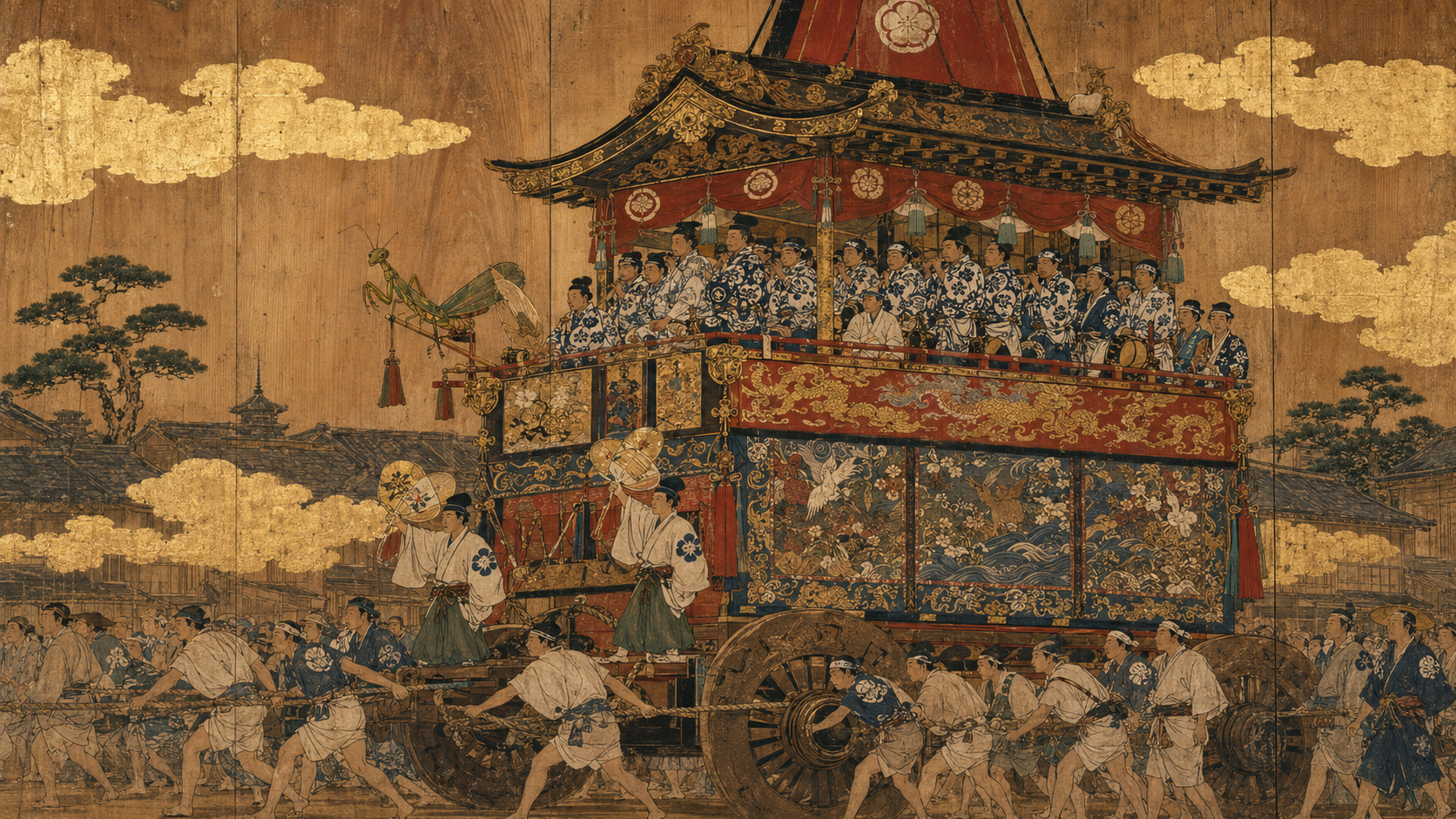
When a float advances along Shijo Street, the eye first encounters its mass: a hoko rising roughly 25 meters, a shining finial, horizontal bands of textile, a great front hanging, side carpets and the long rear panel called a miokuri. Gold-ground paintings, carving and metal fittings occupy the roof. Musicians perform inside while wheels and rope-bound joints absorb the road. Nothing stands still. Sound, speed, sun, wind and spectators continually alter the work.
The museum metaphor conveys the density of masterpieces, but the differences matter. There is no single director and no unified acquisition policy. Each float neighborhood accumulated donations, purchases, commissions and repairs across centuries. The objects exist for a festival; aesthetic appreciation is only one of their functions. In many cases an old original rests indoors while an exacting reconstruction works in the procession. The useful question is not simply “Is this old or new?” but “How do original, reconstruction and continuing use support one another?”
Anatomy of a Yamahoko
| Part | Function and how to look |
|---|---|
| Hokogashira and shingi | The finial and tall central pole; a moon, halberd or chrysanthemum identifies the neighborhood and invites sacred presence |
| Roof, gable and ceiling | A concentration of painting, carving, lacquer and metalwork; much is visible only by looking upward |
| Mizuhiki | Narrow horizontal textile bands around the upper body, often carrying continuous narratives or auspicious beasts |
| Maekake | The large front hanging—the float's face and the first textile seen from a distance |
| Dōkake | Side hangings visible for longer as a float passes; repeated patterns and large scenes work especially well here |
| Miokuri | The tall rear hanging, leaving the final image as the float moves away |
| Goshintai | Sacred figures from myth, Noh, war tales and classical stories that make each yama's narrative visible |
| Rails and metal fittings | Protect edges and joints while engraving waves, clouds, birds and fantastic animals into the structure |
Kesōhin means objects hung or fitted to dress the float and often refers specifically to the maekake, dōkake, mizuhiki and miokuri textiles. Cloth becomes architecture, narrative painting and a surface of civic wealth. Look at the front, sides, back and underside of the roof. The best method is to study details in the neighborhood displays during Yoiyama, then find them again within the moving whole.
From a Sign for Spirits to a Total Art of Fūryū
The starting point was not art appreciation. In 869, a goryō-e ritual erected 66 halberds to pacify epidemic disease. As the observance became annual, medieval Kyoto developed signs for sacred presence, wheeled and carried structures for stories, dance and music. When commercially powerful machishū—urban merchants and artisans—took responsibility for floats during the Muromachi period, neighborhoods competed in arresting design and performance.
Fūryū in this context means more than contemporary “elegance.” It was the art of astonishing the public with rare materials, foreign patterns, theatrical constructions, dress and music. The number of floats may have reached 58 in the mid-15th century. The Ōnin War stopped the procession, but townspeople restored 36 in 1500. Fires destroyed them again; neighborhoods rebuilt. The collection grew not in a straight line but through loss, rebuilding, donation and changing taste.
Yama and Hoko: Form Directs the Eye
A great hoko has enormous wheels, a roof and a long central pole. It carries musicians and is pulled by roughly 40 to 50 people. A kaki-yama traditionally places a sacred figure and a pine representing a mountain on a platform carried on shoulders. A hiki-yama is a large wheeled yama whose roof makes it resemble a hoko. Boat floats and umbrella floats enrichingly refuse the simple binary.
Form changes how art is staged. The broad faces of a hoko reward bold carpets and metalwork legible from far away. A small yama presents a sculptural instant at close range. A boat moves the eye from prow to stern; an umbrella float centers dance and moving cloth. Before asking which object is most famous, ask how structure directs a viewer's body and gaze.
Kyoto's Textiles Were a Map of the World
Alongside Nishijin weaving, the floats carry Chinese brocade and embroidery, Korean wool weaving, Indian chintz and carpets, rugs from western and central Asia, and European tapestry. These objects did not all arrive in the same era or by the same route. Attributions have changed with research, and it is unsafe to call every “foreign carpet” Persian.
What matters is that Kyoto did not preserve imported cloth untouched on a wall. Artisans cut it, backed it, edged it and edited it to a float's dimensions and story. Christian and Greek epic imagery entered a festival of Yasaka Shrine devoted to protection from epidemic disease. Whether owners fully understood an image's original theology or not, they prized rarity, technique, color and figuration. Culture grows here through translation, not purity.
Koi Yama: Cutting the Trojan War into Nine Pieces
Koi Yama's principal story is Chinese: the carp that succeeds in climbing the Dragon Gate waterfall becomes a dragon. A huge wooden carp, white hemp suggesting water and wave-patterned metalwork embody ambition and success. Around this East Asian story, however, hangs a tapestry woven in 16th-century Brabant, in present-day Brussels. Its subject comes from the Iliad and is understood as King Priam of Troy and Queen Hecuba worshipping an image of Apollo.
The neighborhood cut one large wool tapestry into nine pieces. Major scenes became the miokuri and two side hangings; the upper and lower borders became mizuhiki; four remnants were recombined as the front. Reversed B marks identifying Brabant-Brussels remain. A rectangular European wall hanging became the skin of a three-dimensional Japanese mountain staging the Dragon Gate.
Cutting a rare tapestry can shock a modern conservator, but reuse may also be why it survived in distant Kyoto. The original is an Important Cultural Property. Reconstruction work began in 1982, and reconstructed textiles now participate in the procession. Comparing original and replacement in the neighborhood display reveals that preservation does not simply stop use; it distributes different jobs between objects.
Kanko Hoko: Genesis Rolls Down Shijo Street
Kanko Hoko takes its name from the Chinese story of Lord Mengchang escaping Hangu Pass by having someone imitate a cock's crow. Yet its historic front hanging is a 16th-century Belgian tapestry illustrating Genesis 24, the search for Isaac's wife. Rebecca's generosity at the well appears within an elaborate European figural composition.
The textile served as Kanko Hoko's front from the early 18th century and became an Important Cultural Property. A reconstruction was completed in 2005; during the festival the neighborhood displays old and new together upstairs. A Japanese float named for a Chinese tale carries a scene from the Hebrew Bible woven in Belgium. Museum categories might call that mixture incoherent. The float turns mixture into its organizing principle.
Tsuki Hoko: Maruyama Ōkyo Rewards Those Who Look Up
Tsuki Hoko layers craftsmanship into nearly every surface. Maruyama Ōkyo painted the gold-ground flowers and plants under its roof in 1784. The ceiling holds a fan-scattered sequence based on all 54 chapters of The Tale of Genji. A rabbit carved in the gable is traditionally attributed to Hidari Jingorō; shell motifs cover the metal fittings. Outside are hangings derived from a 17th-century Mughal Indian medallion carpet, other Indian and Turkish-associated rugs, and modern textiles by Minagawa Gekka.
No single “masterpiece” governs this ensemble. An 18th-century painter, 19th-century metalwork and embroidery, imported carpets, 20th-century textile art and present-day reconstructions occupy the same field. Ōkyo's painting is under a roof: a visitor who never looks up misses it. Float viewing is less a checklist of famous names than training the body to look above, below, inside and out.
Sculpture as a Frozen Film
The sacred figures of smaller yama turn decisive moments into sculpture. Jōmyō Yama selects an episode from The Tale of the Heike at the Battle of Uji: the warrior monk Ichirai leaps over the head of Jōmyō. A small wooden wedge supports Ichirai in midair while arrows pierce the bridge below. The gravity-defying composition compresses battlefield speed into a stopped image.
Tōrō Yama uses a giant praying mantis riding an ox cart to embody the proverb of “the mantis's axe,” or brave resistance against overwhelming force. The mantis's wings, sickles and neck move, as do the cart's wheels—the only surviving yamahoko with this kind of full mechanical figure. The float disproves the idea that old ritual art is necessarily still. Contemporary textiles by Living National Treasure Tokio Hata add yūzen dyeing to machinery and carving.
Tradition Includes New Art
The artistic history did not end in the Edo period. Ashikari Yama uses Nihonga painter Kayo Yamaguchi's monumental lion, Stare, as a front hanging completed in 1986, and his Cranes as a 1985 rear hanging. In the 1990s it added side tapestries based on Ogata Kōrin's Irises. Minagawa Gekka on Tsuki Hoko and Tokio Hata on Tōrō Yama are further evidence that modern makers continually add layers to old ensembles.
Reconstruction is creative work too. Conservators study weave, fiber, color and damage, then make cloth that should evoke the old appearance while surviving procession. A perfect copy is impossible. Decisions enter: which historical state to reproduce, how to interpret faded color, where modern material is necessary and which hand process must remain. A reconstruction is not a fake. It is a working cultural asset that lets an original rest while the ritual form continues.
Conservation Means Designing Use and Rest
Sunlight, rain, humidity, folding, vibration and friction from fittings threaten textiles. Yet a ritual object loses part of its meaning if it can never serve. Neighborhoods answer the contradiction by displaying an original in controlled or sheltered conditions and sending a reconstruction into the street. Exposure is limited, condition recorded, and broken threads, lifting metal yarn, linings, borders and attachment points repaired.
The unit of conservation is larger than one cloth. The timber frame is assembled and dismantled annually with nawagarami rope binding and no nails. A major hoko can require a total labor force on the order of 180 people across assembly, procession and dismantling. If the network of builders, residents, musicians, pullers, curators, conservators and donors stops, the objects may survive but the festival cannot move. That is why 29 tangible floats and the intangible float ceremony receive distinct forms of protection.
Who Collects—and Who Curates?
In an ordinary museum, specialists govern acquisition, research and display. Here neighborhood preservation associations hold objects and operate the festival, consulting experts when they repair, commission or exhibit. Donors' hopes, neighborhood rivalry, recovery after disaster and the taste of each era have collectively produced a centuries-long “collection policy.”
The arrangement is both strong and vulnerable. Works are protected intensely because they embody local pride, but population decline, project costs, insurance, storage and succession bear heavily on small communities. Cultural-property status, grants, scholarship and donations help. Ultimately, however, the system still needs people willing to understand the festival as their responsibility.
How to Look in 2026: Slow Yoiyama, Fast Procession
| Where and when | What to study |
|---|---|
| Early Yoiyama, July 14–16 | Displays for 23 floats; compare originals and reconstructions, sacred figures and metal fittings at close range |
| Early procession, 9 a.m. July 17 | The instant art moves, turns and becomes whole in music and changing light |
| Latter Yoiyama, July 21–23 | Eleven floats with fewer stalls; study Koi Yama, Jōmyō Yama, the Kannon Yama pair and Ōfune Hoko |
| Latter procession, 9:30 a.m. July 24 | The reverse route; watch rear hangings and the forceful tsuji-mawashi turns |
| Float building | Nawagarami, timber and wheels before decoration—the structure beneath the art |
Instead of “completing” all 34 in one day, choose three and see each in three states. First read its story and inspect originals at the neighborhood headquarters. Then examine structure and placement outside. Finally watch the procession, when cloth takes wind, fittings catch light and figures meet the city. Photography, admission, boarding and display rules vary by neighborhood. Access to art does not erase the boundaries of private property and ritual.
Beyond the “Moving Museum”
In 1962, 29 floats were designated Important Tangible Folk Cultural Property. The ceremony became Important Intangible Folk Cultural Property in 1979, entered UNESCO's Representative List in 2009 and in 2016 became part of Japan's grouped “Yama, Hoko, Yatai, float festivals.” Protection expanded from master objects toward the communities that make, use and transmit them.
“Moving museum” is an excellent invitation. But a museum would not normally place a masterpiece on a 12-ton vehicle in a street when rain is possible. At Gion Matsuri, movement, annual rebuilding, welcoming deities and neighborhood rivalry complete the meaning of the art.
The Trojan War of Koi Yama, Genesis on Kanko Hoko, Ōkyo under Tsuki Hoko's roof and the machinery of Tōrō Yama may seem mutually incompatible. The power to edit those incompatibilities into one ritual is precisely Kyoto's art. These floats are not pure specimens of Japanese culture. They are machines that keep turning things from the world into new life through neighborhood prayer and work.
Sources and Further Reading
- Kyoto Travel: Understanding Gion Matsuri — 34 floats, textiles, rope construction and ritual structure.
- Kyoto City Cultural History: Gion Matsuri Floats — structure, weight and labor.
- Agency for Cultural Affairs: Gion Matsuri Floats — 29 Important Tangible Folk Cultural Properties.
- Gion Festival Float Federation: institutional history.
- Museum of Kyoto: The Treasures of Koi Yama — tapestry imagery and nine-part adaptation.
- Agency for Cultural Affairs: Koi Yama decorative tapestry.
- Koi Yama Preservation Association: decorations and reconstruction.
- Kanko Hoko Preservation Association: Important Cultural Property front hanging.
- Gion Festival Float Federation: Tsuki Hoko — Maruyama Ōkyo and decorative arts.
- Kyoto City: A Close Look at Tsuki Hoko.
- Gion Festival Float Federation: Jōmyō Yama.
- Tōrō Yama Preservation Association: mechanical mantis and textiles.
- Ashikari Yama Preservation Association: historic and modern textiles.
- UNESCO: 2009 inscription of the Kyoto float ceremony.
- UNESCO: 2016 inscription of Yama, Hoko, Yatai float festivals.