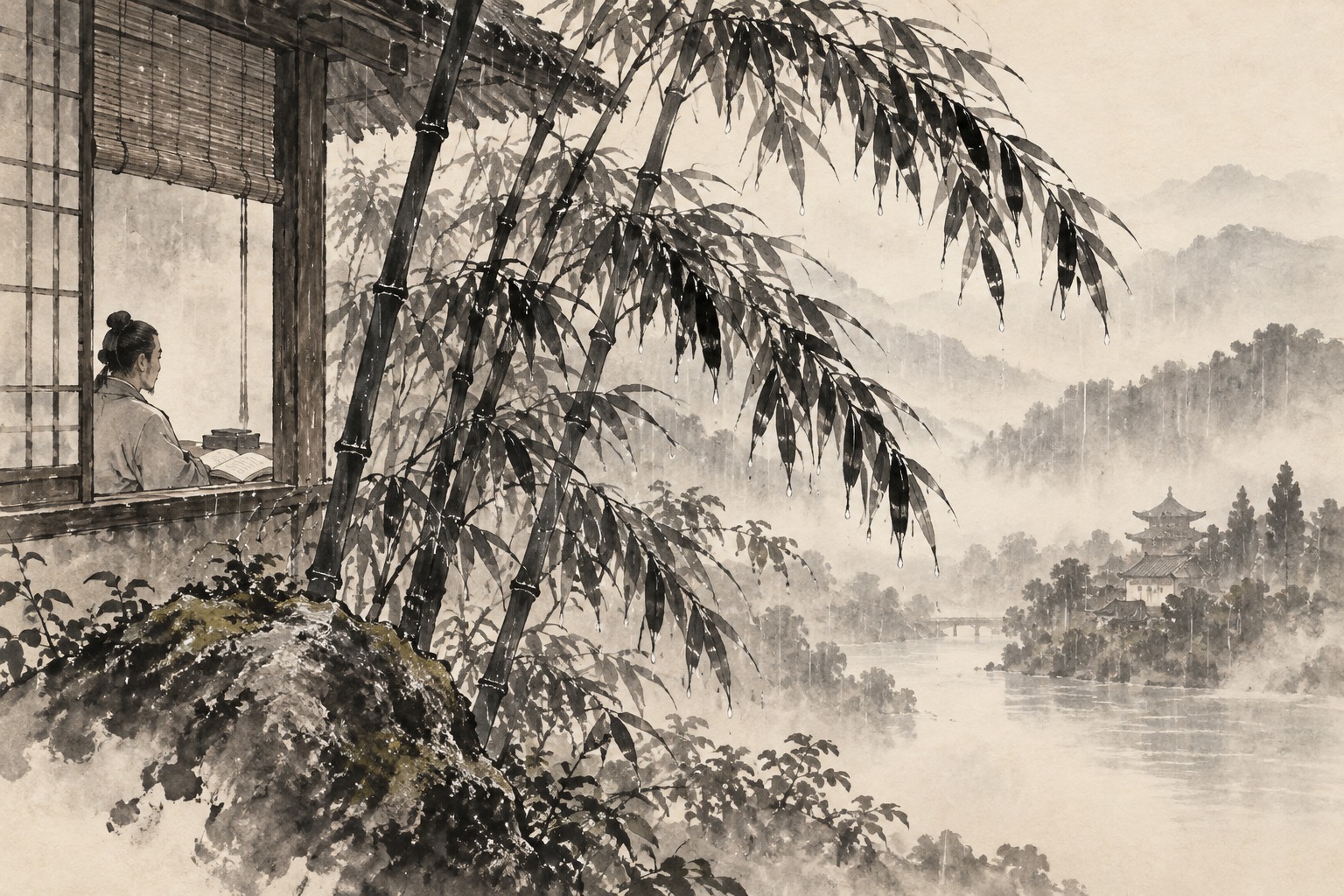
Rain can be felt in a painting without becoming its loudest subject. For September 24, Japan.co.jp chooses Gion Nankai’s Window onto Bamboo on a Rainy Day, an ink-on-paper hanging scroll dated by the Metropolitan Museum of Art to the first half of the eighteenth century.[2]
A scholar’s practice
Wakayama Prefectural Museum identifies Nankai as a Confucian scholar serving the Kii domain and an early literati painter. It describes his painting as self-taught and documents his achievement in poetry, calligraphy and painting.[1]
That combination invites us to look beyond the subject depicted. A brush can describe a plant, form a character and give shape to a thought. For a viewer, the relationship between those acts is as interesting as the finished image.
Looking through the ink
The Met highlights the finely drawn leaves, contrasting ink tones and small dots suggesting moss. Its account connects the layered bamboo with spatial depth and the plant itself with integrity and resilience.[2]
Try looking twice: first at the whole composition, then at a single leaf. Follow the changes in darkness and notice the spaces between forms. This is a way of spending time with the work, without requiring a single correct emotional response.
Finding strength in the rain
Our feature title is a contemporary reading. The painting offers a pause beside reports about weather and recovery, but it cannot stand in for the experiences of people affected by disaster.
Its connection with this edition’s science coverage is similarly modest: close attention matters. Looking carefully, comparing details and reconsidering an initial impression are useful habits for readers of both art and research. That is an editorial connection, not a claim that Nankai anticipated modern science.
For the accompanying illustrations, restrained gray washes and precise brushwork provide a shared visual direction. Those newly created images are interpretations inspired by Nankai; they are separate from the historical work.
View the original online
Explore the painting in the Met’s collection. The museum lists it as not on view at the time of checking.[2]
