A plum branch can become a line of architecture. A blossom can become a pause. In one design by Furuya Kōrin, flowers and angular branches form a loose vertical framework; beside it, a diagonal ribbon of plum cuts across a green field of interlocking lines. The subject remains recognisable, yet the eye begins to follow something beyond botany: direction, interval and the distribution of weight.
That transformation makes Kōrin (1875–1910) a revealing art choice for an edition concerned with fashion and textile invention. His designs ask how an observed form becomes a usable visual language. An especially accessible place to explore the question is Ume tsukushi, a plum-pattern book published in Kyoto by Yamada Unsōdō in February 1907. The National Diet Library’s catalogue records 24 plates, and its digitised copy allows readers to examine the work directly.[1][2]
Looking at the pattern before naming the flower
In the historical image reproduced below, the right-hand composition seems to straighten and bend its branches into a scaffold. Rounded blossoms interrupt the vertical movement. Some forms cluster together; others are separated by narrow lines and open ground. The result is neither a diagram of a tree nor a view of a garden. It is a relationship between shapes.
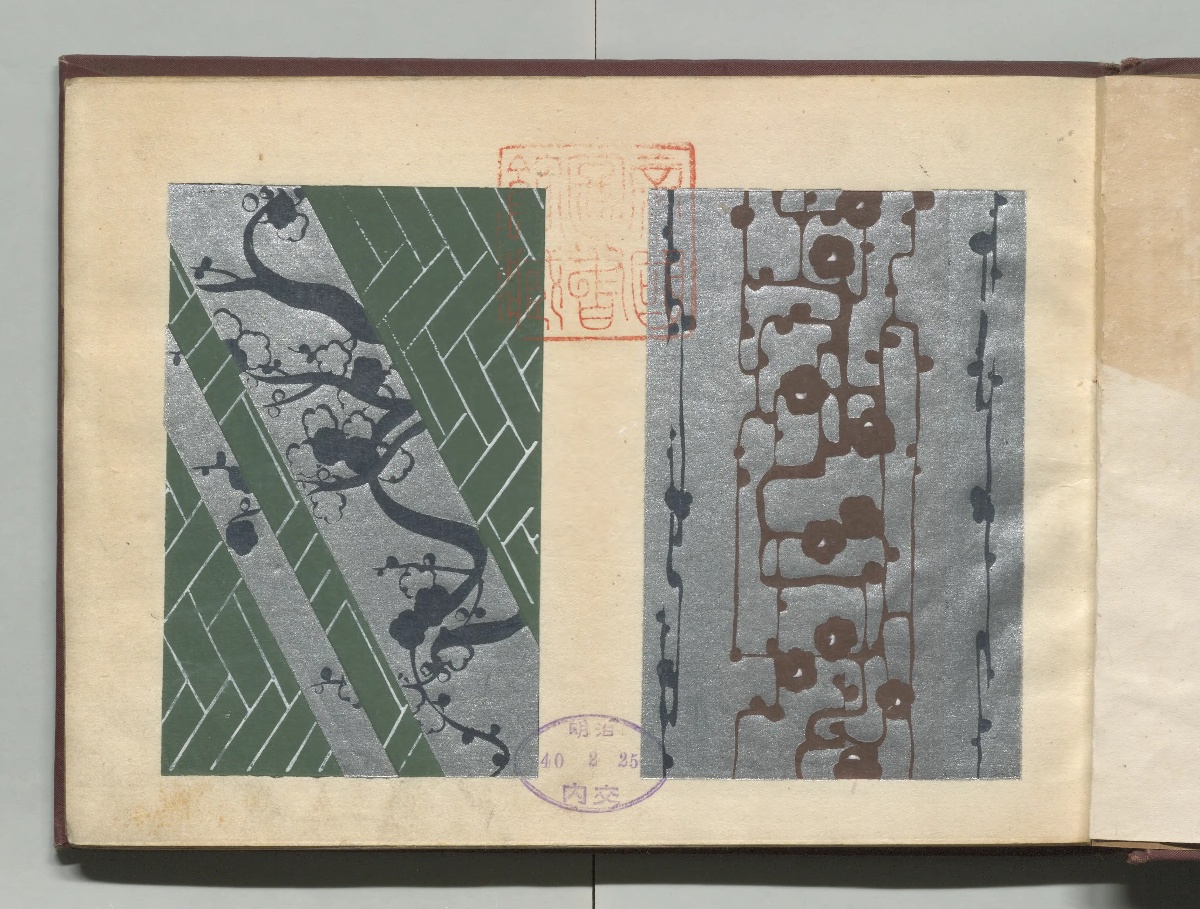
The left-hand design sets up a different rhythm. Fine pale lines fold across a green background, while a broad diagonal band carries dark, twisting branches. Its geometric ground and organic forms compete for attention. Follow the branch and the design feels fluid; follow the surrounding lines and it becomes a measured surface.
This is a close reading of the digitised image, rather than a claim about the artist’s stated intentions. The silvery appearance of parts of the scan does not establish which pigments or metallic materials were used. What the reproduction does let us examine is the organisation of contrast: thick against thin, crowded against spacious, oblique against upright.
A book is a different kind of design object
Looking at a single framed image can conceal what a pattern book does especially well. It puts alternatives within reach of one another. A reader turns a page, compares treatments and notices how much can change while the subject stays the same. The flower is a recurring point of reference; the arrangement is the experiment.
Such books also belong to a history larger than an individual artist. In its account of Rinpa and illustrated publishing, the National Diet Library discusses kosode-bon, Edo-period books of designs for clothing. It also explains that patterns associated with the name of Ogata Kōrin (1658–1716) cannot automatically be treated as his personal creations. Publishers and commercial fashion helped circulate the vocabulary.[3]
The distinction matters. Design history does not move only from one celebrated painter to the next. It also travels through reproducible images that people can select, adapt and compare. Furuya’s books make sense within that world of portable visual ideas.
Kyoto, publishing and the work behind flat colour
Unsōdō traces its beginnings to 1891, when Yamada Naosaburō established an art-publishing business in Kyoto. Its Japanese company history places the early enterprise at Teramachi Nijō and records a reorganisation in 1906. The publisher provides a concrete institutional setting for Kōrin’s 1907 book: these designs emerged through an established trade in illustrated art publications.[4]
The publisher’s account of woodblock production describes separate work on line and colour blocks, followed by skilled printing. That division of labour is worth keeping in mind when a design appears effortless. An expanse of apparently simple colour is also the outcome of making and using a printing surface.[4]
The general process does not tell us the exact number of blocks or the materials used for every image reproduced here. It does, however, help shift attention from the designer’s name alone to the practical intelligence required to turn an idea into a repeatable printed object.
Nor was Kōrin’s range confined to flowers. The Metropolitan Museum of Art holds his 1903 Sixteen Illustrations of Ancient Ceremonial Displays, an accordion-bound woodblock-printed book. Its subject introduces a different aspect of his work: the visual ordering of historical ceremonial settings. Plant forms and arrangements of objects could both become material for a designer’s attention.[5]
Beyond a convenient style label
The Museum of Fine Arts, Boston’s official shop offers one contemporary route into Kōrin’s work. Its description of a notecard set connects Japanese decorative traditions with French Art Nouveau. That is the shop’s interpretive framing; it should not be mistaken for an announcement of an exhibition.[6]
Unsōdō places a different emphasis on its modern collection of his plant designs, Furuya Kōrin: Kusabana Moyō. Its Japanese description stresses an originality distinct from both Rinpa and Art Nouveau.[7] The two descriptions suggest different ways of introducing the work: through resemblance, or through independence.
For the reader, neither label needs to settle the encounter. Look instead at what happens inside a particular composition. A stem supplies a curve, but a band changes its direction. A flower supplies a recognisable outline, but spacing turns it into punctuation. Style becomes easier to discuss when it follows observation rather than replacing it.
From plum branches to satellite images
The connection to present-day textiles is especially suggestive in JAXA’s announced collaboration with A-POC ABLE ISSEY MIYAKE. Antarctic imagery from the Shikisai Earth-observation satellite is being expressed through jacquard-woven jeans. A view obtained at a planetary scale enters the intimate scale of clothing.[8]
A separate contemporary point of comparison is LACMA’s exhibition devoted to Reiko Sudō and NUNO, which explores textile experimentation.[9] Seen alongside Kōrin’s printed designs, it invites attention to the relationship between an imagined surface and the materials and skills that make it possible.
These are comparisons made by this article, not evidence that either contemporary project descends directly from Kōrin. Their historical circumstances and technologies differ. The shared question is how a maker selects and reorganises information when moving between media. A plant does not become a pattern merely by being copied, any more than an observation of ice becomes woven cloth without decisions about structure.
A practical way to look
Try returning to the plum designs without first naming their subject. Look for the space between repeated shapes. Then follow the forms that disappear beyond an edge. Finally, attend to the ground: the areas that initially seem to contain nothing may determine the pace of everything else.
Repetition need not mean uniformity. A cluster can tighten, release and begin again. Asymmetry can provide balance without producing a mirror image. These are observations a reader can test on the page, rather than rules that need to be accepted on an expert’s authority.
It is also useful to distinguish the image of a possible textile from evidence of an actual manufactured cloth. A pattern book can prompt us to imagine a garment or furnishing; the design alone does not establish which products, if any, used it.
Kōrin’s brief lifetime ended in 1910. The 1907 volume survives as a dated historical object, but its visual problem remains open. How much of nature should a designer preserve, and how much must change before it takes on another life? In these pages, a plum branch answers by becoming both recognisable and unfamiliar. We still see the flower. We also begin to see the intervals that hold it in place.
Sources and methodology
Based on the National Diet Library’s original scans and catalogue, Japanese publisher documentation and official museum records. Close readings of designs and comparisons with contemporary projects are the article’s analysis. No interviews or quotations have been invented.
- National Diet Library: Ume tsukushi image collection
- National Diet Library: Ume tsukushi catalogue and digitised original
- National Diet Library: Rinpa and the transmission of designs through books
- Unsōdō: Japanese company history and woodblock production
- Metropolitan Museum of Art: Sixteen Illustrations of Ancient Ceremonial Displays, 1903
- MFA Boston official shop: Furuya Korin Notecard Box
- Unsōdō: Furuya Kōrin, Kusabana Moyō
- JAXA: Antarctic satellite imagery and jacquard-woven jeans, September 14, 2026
- LACMA: Textile Alchemy: The Art of Reiko Sudō & NUNO