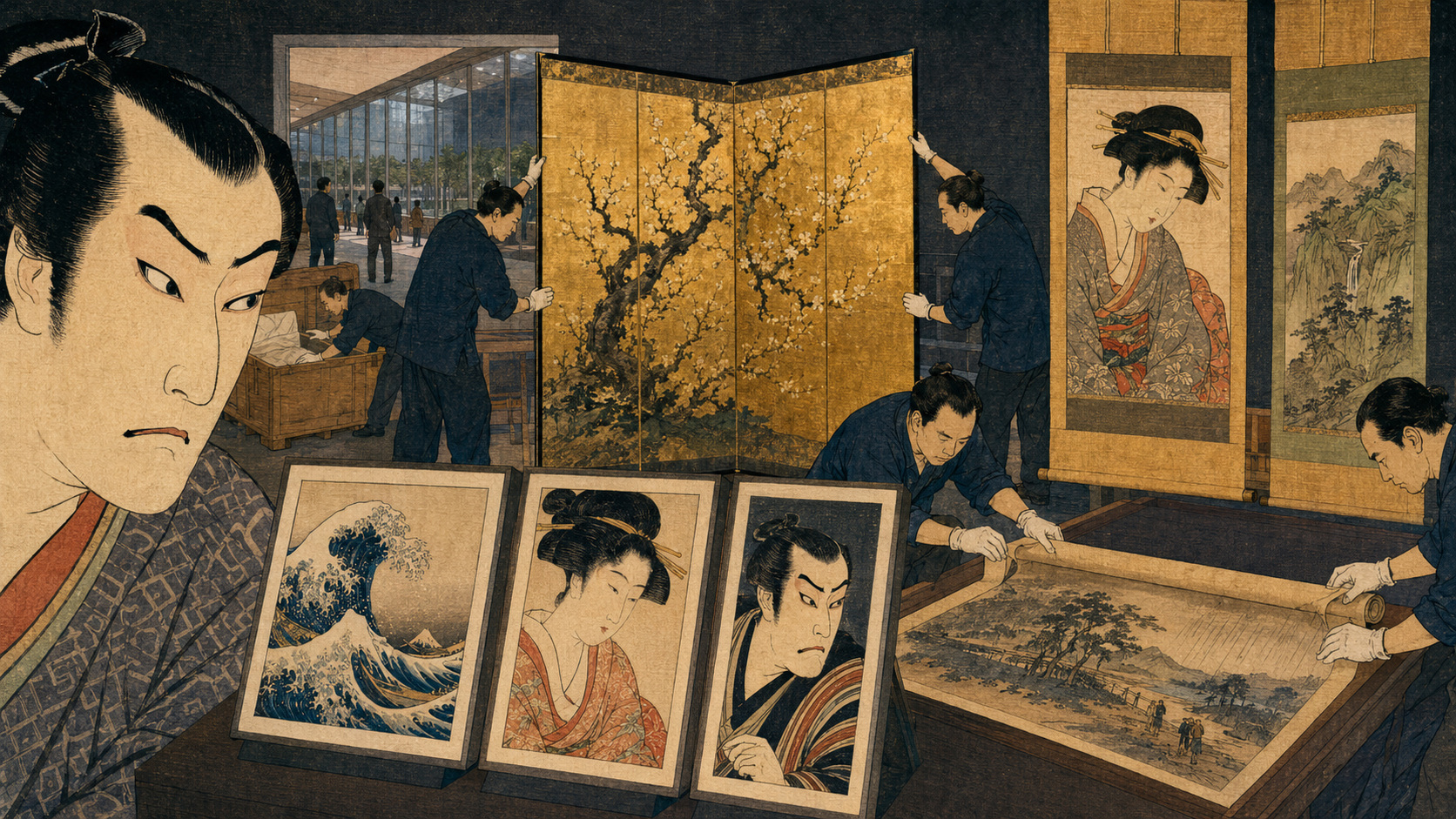
On opening morning, a visitor crosses the trees of Ueno Park and descends into Kunio Maekawa’s brick-red museum. Inside, paper printed in Edo, silk painted in Kyoto and gold-covered sliding doors that once formed part of a room stand before walls kept deliberately dim. They have “returned” from London. Yet they bring back more than the place where they were made. They carry a century or more of British accession numbers, catalogues, conservation, mistaken attributions and rediscovery.
Edo in Focus: Japanese Treasures from the British Museum, opening July 25 as a central exhibition of the Tokyo Metropolitan Art Museum’s centenary, runs through October 18. From the British Museum’s approximately 40,000 Japanese objects, it selects Edo-period folding screens, hanging scrolls, handscrolls and paintings, alongside more than 100 prints by eight canonical ukiyo-e designers.
Ōkyo, Utamaro, Sharaku, Hokusai, Hiroshige and Kuniyoshi supply the headline names. The deeper subject is not a ranking of masters. It is how art made in Japan accumulated in the British Museum, what it lost, what it preserved and what knowledge it carries home today. By making the history of collecting and recent research part of the display, the organizers ask viewers to look through beauty toward ownership, classification and care.
Eight Designers, One Print Capital
Treat the Edo period, 1603 to 1868, as one style and its visual revolutions disappear. Ukiyo-e was a medium refreshed at the speed of a city: a new actor in a role, a celebrated teahouse waitress, a flower-viewing crowd, rain on a road, a supernatural climax. Publishers commissioned images; designers drew them; cutters and printers converted them into products people could carry home.
| Artist | Representative work in the exhibition | A way in |
|---|---|---|
| Suzuki Harunobu | Lovers Walking in the Snow under an Umbrella, about 1767 | He refined full-color nishiki-e in the 1760s, layering color, embossing and poetry in intimate sheets. |
| Torii Kiyonaga | Cherry-blossom Viewing at Asukayama, about 1787 | Elongated groups turn fashionable bodies and urban leisure into one spatial rhythm. |
| Kitagawa Utamaro | Takashima Ohisa, about 1792–93 | Large-head portraits magnify distinctions of face and hand, making named urban women into stars. |
| Tōshūsai Sharaku | Segawa Tomisaburō II as Yadorigi, 1794 | In a brief career, the fixed pose of a role collides with the actor’s irreducibly individual face. |
| Utagawa Toyokuni I | Sawamura Sōjūrō as Ōboshi Yuranosuke, 1796 | Narrative, costume and celebrity become a legible visual system for the theater public. |
| Katsushika Hokusai | Under the Wave off Kanagawa, about 1831 | Imported blue, a geometrical wave and distant Fuji compress labor and nature into one instant. |
| Utagawa Hiroshige | Plum Garden at Kameido, 1857 | A violently cropped foreground and seasonal atmosphere turn a famous place into sensory memory. |
| Utagawa Kuniyoshi | Takiyasha the Witch and the Skeleton Specter, about 1845–46 | A three-sheet format becomes a giant stage for warriors, monsters and popular spectacle. |
This is not a ladder of simple progress. Harunobu’s quiet and Kuniyoshi’s theatrical scale answer different patrons and markets. Seen in sequence, the eight dismantle the idea of ukiyo-e as a single “Japanese-looking picture.” It was urban media assembled by publisher, designer, block cutter, printer, paper, pigment, censorship and buyer.
No Print Was Made by the Famous Name Alone
Exhibition labels naturally lead with the artist. A woodblock print, however, was collective manufacture. The publisher organized subject, capital and distribution. The cutter translated a paper design into cherrywood. The printer aligned successive color blocks. Blind embossing lifted fibers; mica made a ground glitter; graded wiping turned pigment into rain and air. Early and late impressions of one design can differ in color, density and precision.
Harunobu’s maturation of full-color nishiki-e around 1765 made chromatic complexity a competitive urban form. On Sharaku’s dark mica actor portraits, flesh and hands push out from an artificial night. In Hokusai’s Great Wave, stable imported Prussian blue gives ocean and sky unusual depth. Look beyond the signature—to color boundaries, hairline cutting and the relief of the paper—and anonymous craft becomes visible.
Paper and many organic colors are also vulnerable to light. A work listed as “not on display” in London is not necessarily minor; rest can be conservation. The opportunity to see more than 100 prints together is exceptional, but sensitive works may have limited display periods. Visitors should consult the official work list for rotations and changes rather than assume every promoted object appears throughout the run.
Britain’s Japanese Collection Did Not Begin with Japonisme
The British Museum was established in 1753 around the bequest of physician and collector Hans Sloane. His holdings already included Japanese sandals, a portable shrine and other objects gathered by the German physician Engelbert Kaempfer in late seventeenth-century Japan and acquired from Kaempfer’s family in 1723. Material made under tightly controlled contact with Europe therefore entered the museum at its birth.
The great expansion toward 40,000 objects came through the people and markets of the late Tokugawa and Meiji periods. The exhibition organizes that story around five figures. Their biographies complicate a one-way myth in which Britons simply “discovered” Japanese art. Japanese dealers, appraisers, artists making copies, diplomatic intermediaries and donors supplied the knowledge and transactions on which the collection depended.
A Surgeon, a Metallurgist, a Novelist and Two Curators
William Anderson, a surgeon who directed Japan’s Naval Medical College from 1873 to 1880, assembled more than 2,000 Japanese and Chinese paintings. The British Museum bought them in 1881, and Anderson produced a descriptive historical catalogue in 1886. It became an important foundation for the Western study of Japanese painting, but later research has revised some attributions. A collection is not a final answer; it is an archive of changing hypotheses.
William Gowland arrived in 1872 to work as a metallurgist at the Osaka Mint. He surveyed burial mounds, became known as a founder of modern Japanese archaeology and collected bronze bells, haniwa and stone tools. His career shows how art, industrial expertise, archaeology and the modern state met inside collecting.
Arthur Morrison was a British novelist who never visited Japan but built a major art collection through networks and the market. The museum bought part of his print holdings in 1906; Sir William Gwynne-Evans purchased his painting collection and donated it in 1913. Distance did not prevent books and commerce from editing an authoritative image of “Japanese art.”
Augustus Wollaston Franks, a British Museum curator, helped secure the Anderson and Gowland groups and personally collected ceramics and netsuke. Laurence Binyon, both poet and curator, persuaded private owners to sell or give collections to the museum and published a catalogue of Japanese and Chinese prints in 1916. Together, they converted private attraction into public classification, scholarship and care.
A sixth figure threads through the show. Diplomat Ernest Satow once owned a print group purchased by the museum in 1909 that included 25 Sharaku and 24 Utamaro sheets. In 1879 he visited Hōryūji with Anderson and commissioned a copy of a mural the following year. In one life, diplomacy, collecting, documentation and preservation overlap.
Do Not Let “Homecoming” End the Ownership Question
In the later nineteenth century, the institutional and financial world of former daimyō households and temples changed dramatically as Japan rebuilt the state. Art markets were reordered. In Europe, Japonisme created intense demand and assigned new value to prints and decorative arts. Many British Museum objects carry purchase and donation records. That does not permit the collection to be flattened into either “looted” or “entirely unproblematic.”
Provenance has to be object-specific. From whom was the object acquired, when and for how much? Who owned it when it left Japan, and what export regime applied? Was it severed from architecture or an ensemble? How far back does the named ownership chain extend? Did mistaken authorship or outright forgery travel through the market with it? British Museum records often expose acquisition names, dates and registration numbers. In this exhibition, those labels can become evidence rather than clerical footnotes.
A temporary loan to Tokyo is not restitution or a transfer of title. At the same time, some works survived, were conserved or regained meaning because they were abroad and became subjects of international study. Both statements can be true. Gratitude for conservation must not erase provenance; scrutiny of provenance must not erase the work of conservators and scholars.
Utamaro’s Woman Reads a Letter
Kitagawa Utamaro’s Courtesan Reading a Letter, painted about 1804–06, was newly discovered in 2011. Only around 50 paintings by Utamaro are believed to survive, and this is among the largest. The exhibition marks its first return to Japan from Britain.
A printed Utamaro woman can exist in multiple impressions pulled from the same blocks. A painting’s line occurs once; pressure, speed and the meeting of ink with silk or paper remain singular. The letter opens another invisible world inside the picture. Who wrote it, what does it say, how has the reader’s expression changed? Utamaro withholds the information and deposits the story in the tilt of a body and placement of hands.
Hokusai’s Line Survived Because It Was Never Printed
The 103 drawings for Hokusai’s Great Picture Book of Everything were made in the 1820s–40s for an illustrated encyclopedia that was never published. In normal production, a finished design was pasted face down on a block and cut away as the line was carved. Non-publication paradoxically saved Hokusai’s working sheets.
Last publicly recorded at a Paris auction in 1948, the group disappeared for decades and resurfaced in 2019. The British Museum acquired all 103 in 2020 and showed them together in London in 2021–22. Eight make their first return from Britain for the Tokyo exhibition. An interrupted design process, stopped before manufacture, becomes a finished museum object some 180 years later. The institution has altered the category of the thing it preserves.
A Three-Meter Copy Remembers Hōryūji Before Fire
Sakurai Kōun’s copy of Hōryūji Golden Hall wall painting No. 9 was made in May 1880. At approximately 3.14 by 2.60 meters, it is a full-scale tracing. Satow and Anderson had recognized the mural’s importance during a December 1879 visit; Satow commissioned Kōun, and the copy entered the British Museum with Anderson’s collection in 1881.
The original mural was severely damaged by fire in 1949. A supposedly secondary copy became a primary record of a lost state. Stored folded in the museum for many years, it was rediscovered in 2007 by Princess Akiko of Mikasa while she researched her doctoral thesis. Beginning in 2017, British and Japanese conservation knowledge was combined to remount the huge, extremely thin work as a hanging scroll that could safely be opened.
Here the hierarchy of “original” and “copy” is overturned. When the original suffers, a faithful copy becomes a window into the past. That copy was forgotten in a foreign store, found by a Japanese researcher and made displayable through collaborative conservation. The exhibition’s entire story of movement fits inside one object.
Sliding Doors in Three Countries Recover a Room
Early seventeenth-century Kano-school bird-and-flower paintings began as architecture. Recent research connected the British Museum’s Birds and Flowers of Autumn and Winter, spring panels kept by the Miyakoshi family in Nakadomari, Aomori, and a painting of scholarly pursuits and immortals at the Seattle Art Museum. Rock, water, migrating geese and gold-and-silver ornament continue between London and Aomori. The Seattle scene was once painted on the reverse of the London doors before the faces were separated in the 1930s.
Miyakoshi Shōji, ninth head of the family, bought 18 door paintings in Tokyo in 1922 and installed them in the Shibōan villa. The British Museum has owned its panels since 1937; Seattle has owned the reverse faces since 1951. In Tokyo, works divided among Aomori, London and Seattle meet for the first time in about 150 years.
A museum encourages us to face a sliding door as a painting. Originally it opened and closed, directed bodies and seasons and contained two different pictorial worlds on opposite faces. The reunion is not simply a contest among beautiful fragments. It is a temporary, research-driven recovery of the room the fragments once made.
A Prince’s Ink Dot Becomes a Firefly
The 1881 Fireflies records cultural exchange as improvisation rather than ceremony. During a visit to Japan, Prince George—later King George V—placed dots in ink. Painter Kubota Beisen added wings and turned them into a swarm of fireflies, an example of the impromptu public performance called sekiga.
Asked for the author, a catalogue names prince and painter. The charm is not equality of technique. One person reads an apparently meaningless mark and gives it life. Cross-cultural exchange is not only the transfer of a completed treasure; sometimes it is the trust involved in handing an unfinished act to someone else.
One Hundred Years at Japan’s First Public Art Museum
The venue has its own history of passage. In 1921, Kyushu coal industrialist Sato Keitarō gave Tokyo Prefecture ¥1 million for an art museum—an amount the museum equates to roughly ¥4 billion today. On May 1, 1926, Shinichirō Okada’s Tokyo Prefectural Art Museum opened in Ueno as Japan’s first public art museum. Its grand stairs and colonnades earned it the nickname “temple of art,” while official salons and independent groups both displayed work inside.
The deteriorated original gave way in 1975 to Maekawa’s present building. Responding to a height limit in Ueno Park, he put about 60 percent of its floor area underground and arranged separate functions around an open plaza. Most of the art collection moved in 1994 to the Museum of Contemporary Art Tokyo, which opened the following year; the Tokyo Metropolitan Art Museum strengthened its identity as a platform for public-entry shows and major co-organized exhibitions. After a 2012 renovation, it defined its mission as a “doorway to art.”
It is fitting that the centenary is not narrated only through objects permanently owned by the institution. The museum has spent a century less as a sealed treasury than as a stage connecting maker and viewer, civic groups and international lenders. A temporary return from London makes that role visible.
Escaping the Masterpiece Checklist
- Before reading the title, look for paper, silk, gold, pigment and mounting.
- In a print, find registration, embossing, mica and grading—the cutter and printer behind the designer.
- Compare the singularity of a painting, a block-ready drawing and a multiply printed sheet.
- Read registration number, acquisition year, purchase or gift and previous owner as a route map.
- Whenever a label says “first homecoming,” ask when and why the work left Japan.
- Imagine doors and screens as architecture around a moving body, not framed pictures.
- Hold overseas preservation and incomplete provenance in view at the same time.
Rush between famous images and the exhibition becomes a stamp rally. If the Great Wave is familiar, stop looking at wave and Fuji; examine the rowers, cutting of the outlines and density of blue. Step back from Kuniyoshi’s skeleton and find the joins that turn three sheets into one stage. Before Utamaro’s reader, allow an illegible letter to remain silent.
Do not hurry past collector portraits and timelines as supplementary material. The route by which a picture reached London is another image made by this exhibition. It contains gaps. That is why a viewer can become more than a receiver of labels: distinguishing the known from the unknown is participation in research.
After the Second Crossing
Edo art was mobile from the beginning. Prints left shops for the city and traveled as souvenirs. Hanging scrolls were opened with the season and rolled again. Screens and doors furnished houses, then were sold, divided and installed elsewhere. After Meiji, the journey stretched across the sea to London.
In summer 2026, the works cross again. This is not a voyage that turns the clock back to Edo. Utamaro’s painting carries its 2011 rediscovery; Hokusai’s line, the 2020 acquisition; the Hōryūji copy, the 1949 fire and 2007 rediscovery; the doors, research that now joins Aomori, London and Seattle. Time does not reverse. It accumulates in layers.
A century ago, Sato created a public place in which Tokyo residents could encounter art. A century later, that place temporarily receives Japanese art entrusted to an overseas institution. The best response is not to stop at the emotion that “Japan’s treasures are home.” It is to keep asking, before the object, who made it, who moved it, who protected it, who speaks for it—and who accepts responsibility for its next hundred years.
Sources and references
Dates, admission, scope, first homecomings, work dates, the eight artists, collector biographies and the sliding-door reunion reflect the organizers’ official 2026 information. Object dimensions, acquisition routes, former owners and conservation histories were checked against the British Museum’s public catalogue. The assessment of “homecoming,” provenance and ways of looking is Japan.co.jp editorial analysis; it does not allege an illegal acquisition or an active restitution claim for any individual work.
- Tokyo Metropolitan Art Museum: official exhibition information
- Official exhibition site: English overview and visitor information
- Official exhibition highlights: works, collectors, eight print masters and reunited doors
- Tokyo Metropolitan Art Museum: official work list (PDF)
- Exhibition press office: tickets, audio guide and exhibition outline
- Tokyo Metropolitan Art Museum: centenary site
- Tokyo Metropolitan Art Museum: Sato Keitarō and museum history
- Tokyo Metropolitan Art Museum: Okada’s original building
- British Museum: Japanese galleries and collection
- British Museum: history of the Asia collection
- British Museum: William Anderson and more than 2,000 paintings
- British Museum: William Gowland
- British Museum: Laurence Binyon
- British Museum: Ernest Satow’s Sharaku and Utamaro prints
- British Museum: Edo-period sandals from Kaempfer and Sloane
- British Museum: Sakurai Kōun’s Hōryūji mural copy
- British Museum: rediscovery of Hokusai’s 103 drawings
- British Museum: Great Picture Book of Everything exhibition
- British Museum: Sharaku actor print with mica ground and publisher Tsutaya Jūzaburō
- Metropolitan Museum of Art: Harunobu and polychrome nishiki-e in 1765
- British Museum: Hiroshige, Edo, travel and nature