Snow has absorbed the noise. Beneath one umbrella, a man in black and a woman in white walk together. They do not embrace; their faces barely turn. Yet everything outside their shared circle seems to have fallen away. Suzuki Harunobu’s Lovers Walking in the Snow, made around 1767, is an ideal threshold for Edo in Focus: Japanese Treasures from the British Museum, the centennial exhibition that opened July 25 at the Tokyo Metropolitan Art Museum.
The Japanese title—Hyakka ryōran: Umi o koeta Edo kaiga, roughly “A Profusion of Blossoms: Edo Painting Across the Sea”—better conveys the display’s abundance. Through October 18, screens, hanging scrolls, handscrolls, paintings, archaeological objects and decorative arts join more than 100 prints centered on eight major ukiyo-e artists. The works were selected from a British Museum Japanese collection numbering about 40,000 objects. The show then travels to the Nakanoshima Museum of Art, Osaka, from October 31 through January 31, 2027.
Utamaro, Sharaku, Hokusai and Hiroshige may dominate the marquee. Harunobu is our Art Choice because his small sheet contains almost the entire journey: an Edo publishing economy, a technical revolution, urban desire, classical memory, collective labor and the long transformation of reproducible paper into museum “art.”
One distinction matters at the start. The exhibition’s language of satogaeri, or homecoming, describes temporary loans and first displays in Japan; it does not mean title has transferred. Each object also has its own provenance. The exhibition is strongest when it resists a single sentimental story and treats collectors, acquisitions, gaps, conservation and new research as part of what viewers have come to see.
Black, White and Snow: Reading Harunobu’s Lovers
The British Museum record describes the young couple as likened to the crow and the heron. His black and her white are more than a costume contrast. Deep ink, bare paper, restrained color and pressure in the printing turn two bodies into paired signs. Ai-ai-gasa, sharing an umbrella, carries an audible association with love. The scene may be a rendezvous; its melancholy has also encouraged readings of a michiyuki, the lovers’ journey that can end in separation or double suicide. Harunobu does not close the narrative. Weather and empty space finish it in the viewer’s mind.
His figures are slender, young and, by later standards of portraiture, curiously alike. Individual anatomy and facial expression matter less than the angle of a sleeve, the lean of a body, the umbrella’s circle and the interruption of footprints. Viewers who expect distinct physiognomy may find repetition. Those who attend to minute gesture discover a remarkably dense psychology.
In impressions of the design, blind embossing, or karazuri, gives snow and textiles a texture visible only as light moves across the sheet. An “original” print is therefore not one fixed image. Early and later impressions, worn blocks, changed pigments, re-cut blocks and different exposure histories all produce distinct objects from one design. Multiplicity is not a defect around the work; it is the condition of the medium.
1765: A Calendar Game Becomes a Color Revolution
Harunobu is often called the originator of nishiki-e, the full-color “brocade picture.” That is useful shorthand, but it can turn a network into a lone inventor. Earlier ukiyo-e had moved from black-line prints to sheets colored by hand, and then to benizuri-e, printed with a small palette such as red and green. Accurate registration, resilient paper, hard cherry wood, pigments and the skills to carve and print multiple blocks had accumulated over time.
The decisive catalyst was a culture of picture-calendar exchange in 1765. Japan’s lunisolar calendar alternated long and short months in a pattern that changed each year. Affluent Edo hobbyists and poetry-circle members commissioned elaborate egoyomi that concealed the year’s month numbers inside sashes, robes or decorative motifs. They traded and judged them at New Year gatherings. A Harunobu calendar in the British Museum hides numbers in a woman’s obi. The museum notes that about 150 designs by Harunobu are known from the full-color prints exchanged at parties in 1765 and 1766.
A private gift could justify better paper, additional color blocks, embossing and finer carving than ordinary shop stock. The patron was not merely a wallet; poetry, classical allusion and the puzzle of the calendar could make the commissioner a conceptual collaborator. Successful designs were then adapted for sale. Patron marks and calendar information might disappear, while Harunobu’s name appeared on a commercial state. Competition inside an elite circle had financed research and development; publishers carried its results into a broad urban market.
Why a “Harunobu” Could Never Be Made by Harunobu Alone
Ukiyo-e was not single-author production in the modern studio sense. A publisher conceived and financed a project, an artist supplied the drawing, a carver translated its lines into wood, and a printer layered water-based color on paper. The final preparatory drawing was pasted face-down on the key block and destroyed as the carver cut through it. Proofs from that block guided the carving of the color blocks. Registration notches called kentō aligned each sheet; a baren transferred the pigment one layer at a time.
A hairline, the rib of an umbrella and the edge of a robe testify to the carver. Hue, moisture, pressure, gradation and embossing testify to the printer. The publisher chose subject, format, price, quantity and distribution. Harunobu’s achievement remains profound, but it is clearer when described as the orchestration of an ecosystem: he translated mature crafts and new patronage into a coherent lyrical world.
| Participant | Primary responsibility | What survives on the sheet |
|---|---|---|
| Publisher | Concept, capital, censorship, edition and sales | Subject, format, quality and the direction of a series |
| Designer | Composition, block-ready drawing and proofs | Figures, story, rhythmic line and allusion |
| Carver | Key block and color blocks, usually in hard cherry | Hair-fine lines, patterns and the crisp edge of form |
| Printer | Pigment, registration, rubbing and special effects | Color, tone, gradation, embossing and paper texture |
Brocade on Paper: Richness Beyond the Number of Colors
The luxury of nishiki-e cannot be counted only in pigments. Thick, absorbent paper tolerated repeated printing and held water-based color. A block without pigment could emboss snow, fabric or petals. Mica could catch light. Gradation made weather and time inside a single plane. Different pressure turned black into silk, lacquer or a void.
Harunobu favored the medium-size chūban over the larger ōban associated with later masters. That intimacy is an advantage. The sheet asks to be held and read at the distance of a hand. Hidden calendar numbers, poems, costume patterns and tiny domestic objects reward proximity. Framed on a museum wall, ukiyo-e can look as though it was always fine art. In Edo it was also mobile urban media—bought, handled, exchanged and lived with.
Mitate: Dressing the Classics in Edo Clothes
Heian poetry, Chinese legend, Noh drama and Buddhist iconography repeatedly enter Harunobu’s contemporary rooms and streets. This practice of witty substitution is called mitate. A classical poet, immortal or bodhisattva reappears as an Edo beauty, a teahouse worker or a youth. An informed viewer recognizes two images at once; another can still enjoy fashion, season and romance.
Mitate is more than parody. It refuses to leave the classics at a reverential distance. Harunobu’s young women can simultaneously document contemporary taste and perform as Komachi, an immortal or a sacred being. Daily life and inherited culture, elegant learning and popular pleasure, realism and dream coexist in one little rectangle. That doubleness is why “charming” or “cute” cannot adequately contain him.
From Harunobu to Kuniyoshi: Eight Artists, a Changing City
This is not a Harunobu retrospective. By placing eight printmakers in sequence, the exhibition sketches about nine decades of change: from Harunobu’s private chūban lovers to Kiyonaga’s tall groups, Utamaro’s close faces, Sharaku’s tense actors, Toyokuni’s theater, Hokusai and Hiroshige’s landscapes, and Kuniyoshi’s colossal narratives. Format, face, subject, color and sales strategy change with the appetites of a metropolis of roughly one million people.
| Artist | Exhibition highlight | A key to looking |
|---|---|---|
| Suzuki Harunobu | Lovers Walking in the Snow, about 1767 | Chūban intimacy, black and white, early nishiki-e refinement |
| Torii Kiyonaga | Cherry-blossom Viewing at Asukayama, about 1787 | Elongated groups and urban leisure |
| Kitagawa Utamaro | Takashima Ohisa, about 1792–93 | The townswoman made into a close-up celebrity |
| Tōshūsai Sharaku | Segawa Tomisaburō II as Yadorigi, 1794 | The friction between actor and role |
| Utagawa Toyokuni I | Sawamura Sōjūrō as Ōboshi Yuranosuke, 1796 | Kabuki pose and the circulation of star identity |
| Katsushika Hokusai | Under the Wave off Kanagawa, about 1831 | Landscape, natural force and a global image |
| Utagawa Hiroshige | Plum Garden at Kameido, 1857 | Radical foreground cropping and urban season |
| Utagawa Kuniyoshi | Takiyasha the Witch and the Skeleton Spectre, 1845–46 | Triptych scale, the supernatural and printed theater |
First Homecomings and the Second Lives of Objects
One focus is work returning from Britain for display in Japan for the first time. Utamaro’s hand-painted Courtesan Reading a Letter, about 1804–06, is among the larger of the roughly 50 surviving paintings attributed to him. It was newly discovered in 2011. The Utamaro of mass-circulated prints and the Utamaro who painted a singular commissioned image belong to different economies even when the signature is the same.
Hokusai’s drawings for The Great Picture Book of Everything present a sharper paradox. These 103 preparatory designs were intended for an illustrated book that was never published. Had production proceeded, the drawings would have been pasted to wood and destroyed during carving. Because the project failed, they survived. Last publicly recorded at a Paris auction in 1948, they resurfaced in 2019 and were acquired as a group by the British Museum in 2020. Eight are shown in the Tokyo exhibition, their first return to Japan.
Maruyama Ōkyo’s Screen of Tigers Crossing a River, about 1781–82 and formerly in the collection of industrialist Hara Sankei, is another first homecoming. Sakurai Kōun’s 1880 copy of Mural No. 9 in the Hōryūji Golden Hall was made at the request of diplomat Ernest Satow. After fire damaged the original murals in 1949, the copy became evidence for lost color and form. Its rediscovery during Princess Akiko’s research in the British Museum shows that storage is not a graveyard; with a catalog, a question and a scholar, it can be a machine for recovering memory.
A tiny 1881 Fireflies was made when visiting Prince George—later King George V—placed ink dots on paper and painter Kubota Beisen added wings. It is an impromptu collaboration across language and nationality. Cultural exchange is not always driven by a masterpiece or a treaty; sometimes it starts as a joke with a brush.
Fusuma Divided Across Three Lands Meet After 150 Years
The exhibition’s most dramatic reconstruction joins early 17th-century Kano-school sliding-door paintings dispersed among three places. The British Museum’s Birds and Flowers of Autumn and Winter, Birds and Flowers of Spring preserved by the Miyakoshi family in Nakadomari, Aomori, and a painting of Chinese sages in the Seattle Art Museum are brought into one gallery. Recent research established that the London and Aomori flower-and-bird scenes continued one another, while the Seattle scene once occupied the reverse of the London doors.
The London fusuma was separated front from back in the 1930s; the autumn-and-winter side entered the British Museum in 1937. Miyakoshi Masaharu, the ninth head of the Aomori family, purchased 18 panels in Tokyo in 1922 and installed them in a detached residence called Shimu-an. Architectural surfaces had become marketable flat pictures and then moved into separate collections.
Reunion does not restore the original room or erase separation. Yet aligned rocks, water, geese, flowers and shared gold-and-silver decoration reveal relationships unavailable in isolated “masterpieces.” Provenance work is not clerical decoration on a label. It lets a broken image and a broken history become legible again.
The People Who Built a Japanese Collection in London
The British Museum was founded in 1753 around the collection of Sir Hans Sloane. Japanese material connected to Engelbert Kaempfer, the German physician who served the Dutch trading post at Dejima from 1690 to 1692, was already present in the founding collection. The story therefore begins nearly a century and a half before Japan’s mid-19th-century opening.
The great expansion came later, and the exhibition presents five figures in its formation. Surgeon William Anderson lived in Japan from 1873 to 1880, collected paintings and wrote on Japanese art. In 1881, the museum acquired his collection of more than 2,000 Japanese and Chinese paintings. Novelist Arthur Morrison never visited Japan but assembled prints and paintings through personal networks; portions entered through a 1906 purchase and a 1913 gift.
William Gowland worked at the Osaka Mint, studied kofun and collected haniwa, bronze bells and stone tools. Curator Augustus Wollaston Franks assembled ceramics and helped bring the Anderson and Gowland holdings into the institution. Poet-curator Laurence Binyon connected private collectors to the museum and played a central role in acquiring and cataloging prints. The collection was not the expression of one eye. It emerged from field experience, taste, markets, institutions and scholarship.
Open Ports, Japonisme and the Conversion into “Art”
After Japanese ports reopened to Western trade in the 1850s, prints, fans, ceramics, lacquer, textiles and metalwork flowed to Europe and North America. Japan’s pavilion at the 1867 Paris Universal Exposition gave many Europeans a formal encounter with its arts. By the 1870s, the term Japonisme described the fashion. Cropping, flat color, asymmetry and everyday subjects offered Impressionist and Post-Impressionist artists alternatives to established European composition.
But saying “the West discovered ukiyo-e” erases its first public. Edo already had a formidable commercial print market. Townspeople bought, pasted, exchanged and discarded images as fashion, celebrity news, erotica, travel fantasy and entertainment. European collectors did not create their value from nothing; they changed category and use. A cheap commodity or souvenir crossed the sea, entered a frame, was sorted by artist and acquired the aura of a museum masterpiece.
That conversion brought preservation and loss. Objects abroad escaped some earthquakes, fires, war, humidity and disposal. But books could be dismantled, fusuma stripped from architecture, fronts separated from backs and chains of ownership left unrecorded. “Rescue” cannot explain every case; neither can applying one history of coercive removal to every acquisition. Responsible interpretation begins object by object: who acquired it, when, from whom, under what conditions, and where the record falls silent. By making collection history visible, the exhibition creates a place to ask before praising or condemning.
To Preserve Color, a Museum Must Create Time Out of Sight
Nishiki-e color is not permanent. Eighteenth- and nineteenth-century Japanese prints often used light-sensitive plant dyes, including safflower reds and turmeric yellows. British Museum research has compared impressions in which edges protected by old mounts preserve color lost from exposed areas, and has used spectroscopy to identify materials and estimate display risk.
That is why paper exhibitions use low light, limit duration and rotate works. A dim gallery or a change of exhibits is not an inconvenience; it is a decision to pass color to future viewers. Digital images do not eliminate the problem. They can accurately document a print’s present appearance but cannot automatically reconstruct its first state. Comparative impressions, historical recipes, scientific analysis and explicit degrees of uncertainty are all needed.
What Public Looking Means in a 100-Year-Old Museum
The venue has its own history of changing art’s social place. In 1921, Kyushu industrialist Sato Keitaro donated ¥1 million. On May 1, 1926, the Tokyo Prefectural Art Museum opened in a European-classical building designed by Okada Shinichirō. Japan’s first public art museum, nicknamed the “temple of art,” gave official and independent art groups a common stage three years after the Great Kantō Earthquake.
It became the Tokyo Metropolitan Art Museum in 1943. Mayekawa Kunio designed the present complex, which opened in 1975; after its 2012 renewal, the institution articulated a mission as a “doorway to art.” A centennial exhibition of Japanese objects held in London therefore carries a double movement. Paper sold in Edo became research material and art in a national museum abroad; it now enters Japan’s oldest public art museum to be interpreted as shared civic culture.
Why Japan.co.jp Gave Today a Harunobu-Inspired Visual Rhythm
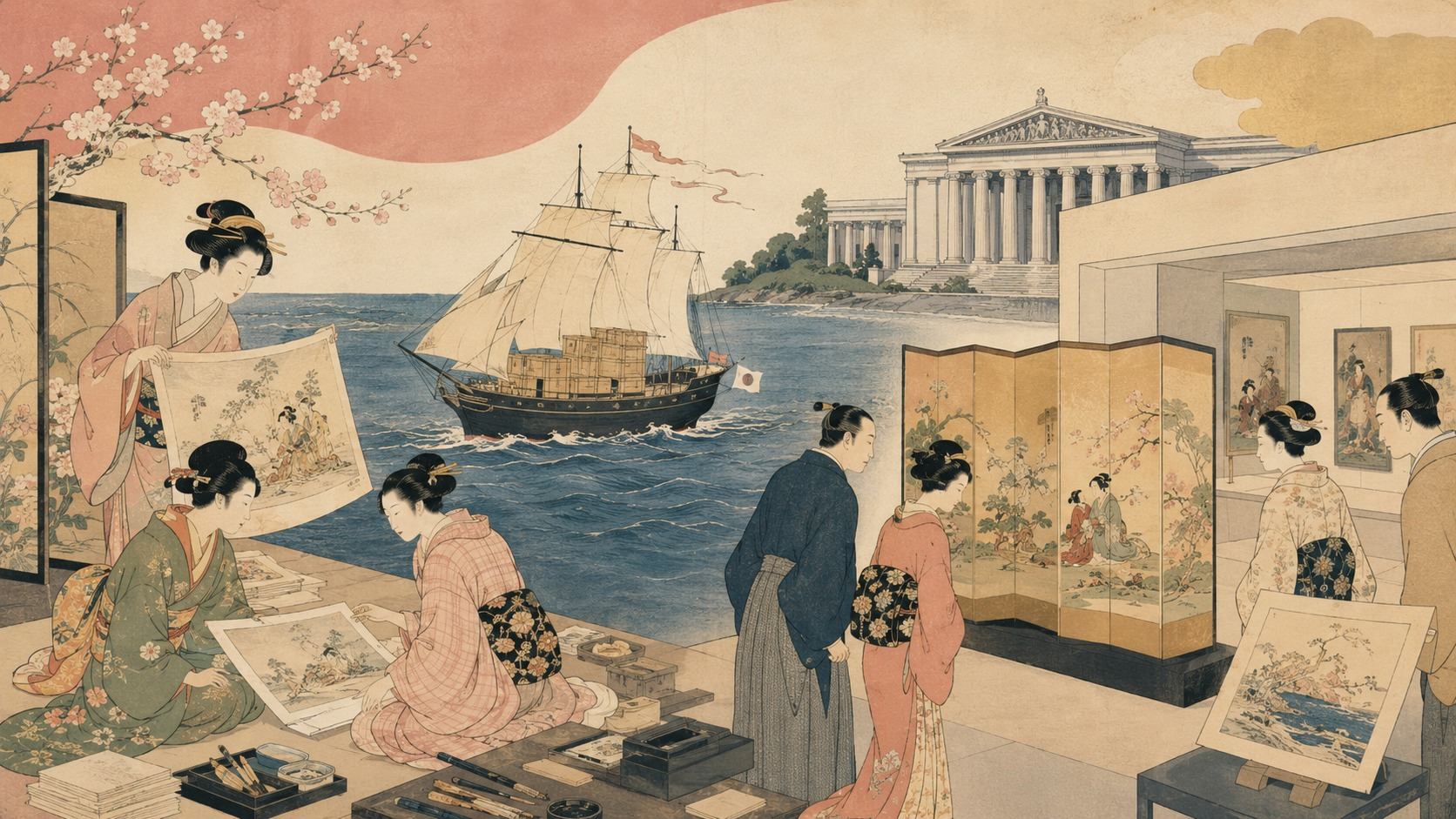
Today’s Japan.co.jp edition uses Harunobu-inspired nishiki-e imagery across its story illustrations. The purpose is not to paste an 18th-century costume onto 2026. Harunobu offers another way to organize attention: season, negative space, restrained contrast and relations among figures can invite a reader into an event without exhausting its meaning. Nishiki-e’s dependence on concept, drawing, carving, printing and distribution also resonates with contemporary news made across reporting, editing, design and technology.
“Inspired by Harunobu” is not “by Harunobu.” The generated images are neither evidence nor collection objects. When modern economics, science, business and policy are translated into Edo dress, the anachronism is a deliberate mitate. Captions that disclose the boundary are part of the ethical obligation incurred when the present borrows the past.
How to Look: Five Questions Before the Masterpiece
- See the object: Paper, silk, pigment, mount, joins, abrasion and fading record the life of the work.
- See multiple hands: For a print, imagine publisher, designer, carver, printer and commissioner.
- Rebuild the first setting: Fusuma belonged to a room, a scroll to an alcove, a print to a shop and a hand.
- Read the provenance: Who acquired it, when, through which market, purchase or gift? A gap is information too.
- Notice the present reunion: Research and loans among Japan, Britain and the United States made separated images newly intelligible.
Before Lovers Walking in the Snow, step back first and register the balance of black and white. Move closer for textile patterns, the paper’s relief and the unprinted snow. Then read the label: designed in Edo around 1767, this impression entered the British Museum in 1945 through Oscar Raphael’s bequest. Beauty and provenance do not compete. Held together, they summon the workshop, market, collector, wartime year, storeroom, conservation lab and international loan behind two quiet walkers.
What Returns Is Not an Intact Past
Edo in Focus does not recover a complete Edo. Colors changed, mounts changed, fusuma divided and every impression experienced a different owner and dose of light. Classification and scholarship conducted in London also fed back into Japanese art history. A traveling object returns not as untouched time but as matter enriched—and sometimes wounded—by movement.
Harunobu’s snow therefore asks for more than nostalgia. Because a print could be multiplied, it spread. Because it was paper, it suffered. Because it was merchandise, it crossed borders. Because it became art, it was conserved. All are conditions of the same sheet. The black-robed man and white-robed woman keep walking beneath their umbrella; Harunobu gives them no destination. Edo to London, London to Ueno, gallery to memory—the journey of the image has no final stop either.
Sources and Verification
This article uses the exhibition’s official site and Tokyo Metropolitan Art Museum materials for title, dates, venue, admissions, tour, highlighted objects and collection history. British Museum object records and research articles establish the Harunobu work, calendar-print context, workshop process, acquisition information and conservation science; Metropolitan Museum of Art and V&A scholarship provide comparison. “Homecoming” is the organizers’ language for temporary loans and first displays in Japan; we distinguish it from ownership transfer or restitution. Counts follow the official formulations “about 40,000” and “more than 100.” Rotations mean not every fragile work is necessarily visible throughout the run.
- Official exhibition site: Edo in Focus overview and visitor information
- Official exhibition site: highlights, objects and collection history
- Tokyo Metropolitan Art Museum: exhibition information
- Tokyo Metropolitan Art Museum: Museum History
- Tokyo Metropolitan Art Museum centennial: founding and Sato Keitaro
- British Museum: Harunobu, Lovers Walking in the Snow
- British Museum: Suzuki Harunobu biography and related objects
- British Museum: Harunobu picture-calendar and the 1765–66 exchanges
- British Museum: private and commercial states of Eight Parlour Views
- British Museum: how Japanese woodblock prints were made
- British Museum: fading and preventive conservation
- British Museum: Japan galleries and collection overview
- British Museum: rediscovery of Hokusai’s Great Picture Book drawings
- Metropolitan Museum of Art: Lovers Walking in the Snow
- Metropolitan Museum of Art: Harunobu’s 1765 picture-calendar
- Metropolitan Museum of Art: the four-part ukiyo-e collaboration
- Metropolitan Museum of Art: Japonisme
- V&A: Japanese woodblock prints and urban popular culture