Today’s Art Choice: Bertha Lum and an American Journey into Japanese Woodblock Printing
She did more than borrow the look of Japanese prints. Bertha Lum crossed the Pacific, learned the labor behind the image and built a career from fog, moonlight and story. Her achievement was genuine. So were the workshop hands behind it—and the limits of the dream of Asia she sold.
A woman carrying a lantern moves through blue fog. Above her, branches flatten into a dark lacework. The road does not lead toward perspective’s rational vanishing point; it slips sideways, behind trunks and shadow, toward a world that seems remembered rather than observed.
That is the emotional country of Bertha Lum: moonlit processions, snowy bamboo, children tugging kites into a patterned sky, spirits materializing from water. It is why her visual language fits stories about a child steering toward the sea, floodwater crossing a mapped boundary, or an older man walking out of isolation. Lum understood that a silhouette could carry feeling before it carried information.
She was also an American making pictures of Asia for audiences eager to imagine Asia. To admire the atmosphere without examining that position would be to see only half the print. Lum’s story is compelling because it contains apprenticeship and appropriation, collaboration and self-invention, technical humility and commercial mythmaking at once.
The fair that opened a door—or became a useful origin story
Bertha Boynton Bull was born in Tipton, Iowa, in 1869. Retellings often begin at Chicago’s World’s Columbian Exposition of 1893, whose Japanese pavilion, garden and displays offered American visitors a concentrated encounter with Japanese objects. Later biographies connect Lum’s fascination to the fair. The Library of Congress gives the firmer formulation: she encountered Japanese woodblock prints while studying at the Art Institute of Chicago.
The distinction matters. Great careers are often compressed into conversion scenes—a fair, one print, a revelation. Lum’s formation was slower. She studied design at the Art Institute in the 1890s and returned for figure drawing in the early 1900s. She read art journals and absorbed the design principles associated with Arthur Wesley Dow, whose influential book Composition taught artists to organize line, mass and color rather than merely imitate nature.
Chicago already stood inside a web of Japonisme. Japanese prints had transformed European and American ideas about cropping, asymmetry, empty space and flat color. Lum did not discover an untouched tradition. She entered a trans-Pacific traffic in objects and ideas that had been underway for decades—and decided that reproducing its surface was not enough.
A honeymoon becomes an apprenticeship
In 1903, after marrying Burt F. Lum, the artist went to Japan on their honeymoon. She wanted to know how a color print was actually made. Instruction was not readily offered to a foreign woman. Accounts describe her searching for tools and guidance, returning home with cutting equipment and fragments of knowledge rather than a complete system.
She returned in 1907 and found more exacting teachers. Library of Congress research identifies the woodblock carver Igami Bonkotsu and printer Nishimura Kamakichi among the craftspeople with whom she studied and worked. The names are crucial. They restore human beings to a story too easily written as a solitary Westerner unlocking a Japanese secret.
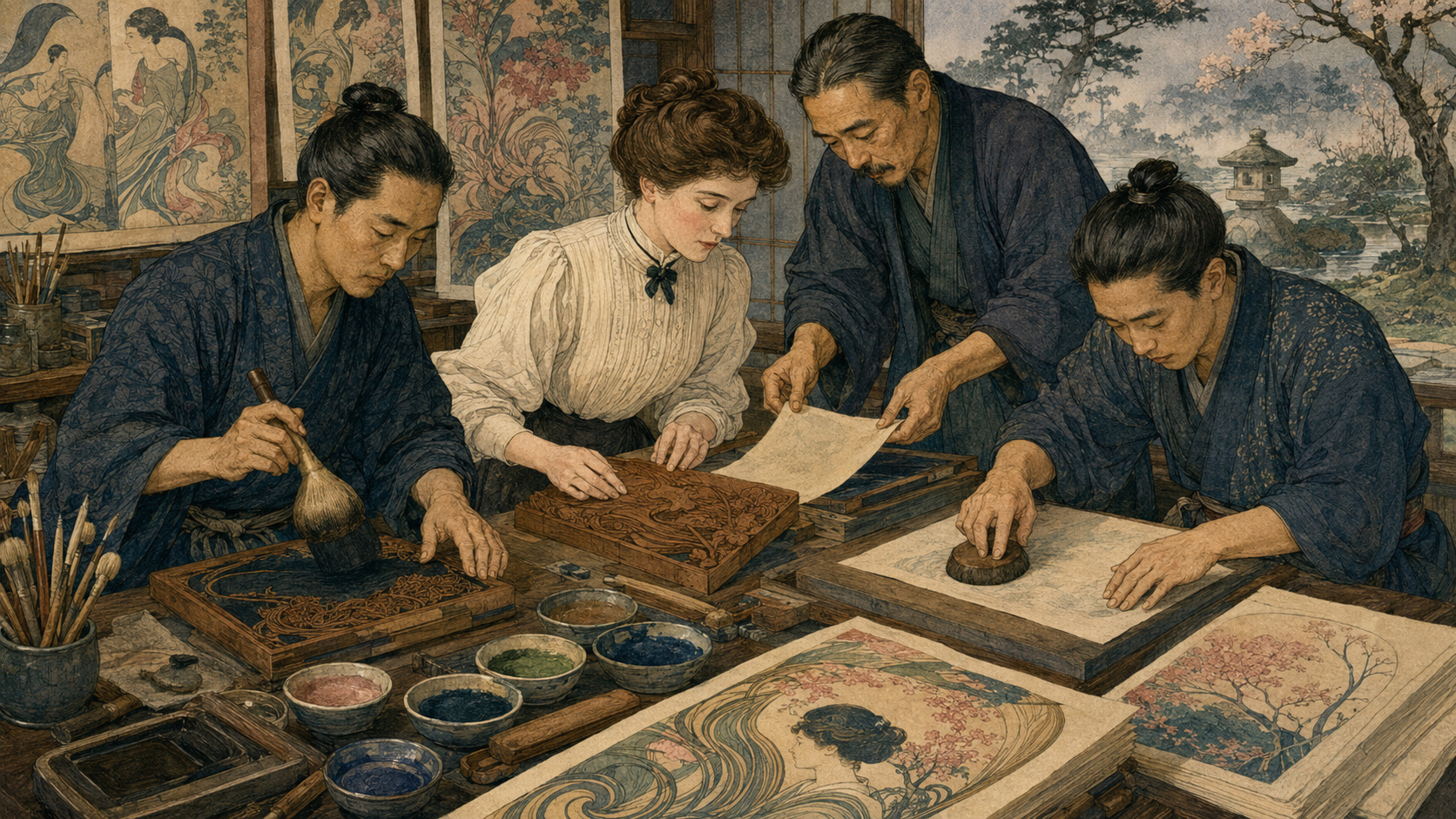
Japanese color woodblock production was not simply a technique held in one artist’s hand. It was a chain of specialized intelligence: design, carving, color separation, registration, paper, moisture, pigment and pressure. Lum’s seriousness lay partly in recognizing that the beautiful image was the residue of a disciplined social process.
A print was never made by one pair of hands
In the classic ukiyo-e publishing system, the designer supplied a drawing. A carver pasted or transferred it face-down to cherrywood and cut the key block, sacrificing the original drawing as the knife preserved its lines. Separate blocks carried separate colors. The printer dampened handmade paper, brushed water-based pigment and paste onto the block, aligned the sheet against registration marks called kento, and rubbed its back with a baren.
Every choice was physical. Too much moisture spread an edge; too little weakened color. A slight misregistration produced a halo. Gradation—bokashi—depended on brushing pigment so that one color dissolved into paper or another tone. The apparent softness of mist was the outcome of pressure, timing and repetition.
Lum learned to cut and print and, for a period in America, performed much of the work herself. The Society of Arts and Crafts in Boston recognized her as a master craftsman in 1908. On later Japanese visits she again employed specialist carvers and printers. Authorship therefore changed from print to print. A responsible label should ask not only “by whom?” but “designed, carved, printed and published by whom?”
A foreign artist inside a changing print world
Lum’s apprenticeship occurred as Japanese print culture itself was changing. The Meiji state had industrialized, wars and empire were remaking East Asia, photography and lithography competed with woodblock publishing, and export markets encouraged images that met foreign expectations. “Traditional Japan” was already a modern product.
Two overlapping movements would soon redraw authorship. Shin-hanga renewed the publisher-led division of designer, carver and printer while targeting collectors at home and abroad. Sōsaku-hanga artists argued for “self-drawn, self-carved, self-printed” work as an expression of individual authorship. Lum fits neither category cleanly. She sometimes embodied the self-making ideal, yet also relied on the workshop division she had traveled to learn.
In 1912 she became, according to the Library of Congress, Brooklyn Museum and Amon Carter Museum, the only foreign artist included in the Tenth Annual Art Exhibition at Ueno Park. Some secondary retellings turn this into “only woman.” The authoritative records support “only foreigner,” a distinction worth keeping. The honor still signals that Japanese judges recognized more than tourist imitation.
Mist, moonlight and the grammar of suggestion
Lum’s mature designs favor compressed space, long vertical trees, diagonal weather and figures whose faces matter less than their movement. Her blues and greens do not describe a measured atmosphere; they tune the scene. A yellow window or lantern then becomes an emotional event.
Japanese precedent supplied asymmetry, flat pattern, silhouette and the eloquence of unprinted paper. Art Nouveau supplied its own sinuous contour and belief that line could unify every element of a design. The two were already historically entangled: European Art Nouveau had absorbed Japanese composition, then returned that transformed language to artists working across the Pacific.
Lum’s best prints do not divide neatly into an “Eastern” technique and “Western” style. Their looping trees, decorative skies and poised figures are products of circulation. Yet their emotional pitch is hers: less the crowded metropolitan world of Edo ukiyo-e than a modern nocturne in which the visible world is always about to become folklore.
One road could lead to Nikkō—or Carmel
The Amon Carter Museum’s Road to the Forest of 1916 is nearly monochrome: dark trunks rise through blue night while cottage windows burn yellow. Museum research notes that Lum attached several titles to impressions, including Carmel Cottages and Road to the Forest at Nikko. A road could thus be read as California or Japan.
That uncertainty may reveal the design’s deepest strength. Lum was not always recording a stable place. She made a portable atmosphere. A title could anchor it for a particular market, and the viewer supplied the rest. The Carter curator suggests that changing titles may have helped Lum address different collectors and shifting American attitudes toward Japan; that remains an interpretation rather than proven intent.
But the inscriptions expose the commercial life of mystery. “Japan” could be added by language even when it was not visually necessary. The dream was not only felt. It was packaged, numbered, priced and sold.
Ghosts and the pleasure—and danger—of an imagined Asia
Works such as Spirit of the Sea, Fox Woman and The Procession made Lum famous for supernatural suggestion. Folklore gave her a vocabulary of thresholds: water and shore, human and animal, living and dead. It also matched a Western market that often preferred Asia timeless, mysterious and spiritually saturated.
That preference is Orientalism in its everyday visual form—not necessarily hostility, but a habit of turning diverse societies into a contrasting dream for Western needs. Lum’s Japan can seem untouched by factories, mass politics, colonial violence or the ordinary noise of Taishō modernity. Wonder becomes selective.
It would be equally misleading to dismiss the work as costume. Lum traveled repeatedly, submitted herself to technical instruction and sustained professional relationships. Her images are neither transparent documents of Japan nor empty thefts. They are authored fantasies made possible by real cultural exchange and unequal structures of looking. Both truths have to remain visible.
Women, craft and a route around the academy
At the turn of the twentieth century, American women artists faced restricted professional training, patronage and institutional recognition. Printmaking and the Arts and Crafts movement created an alternate route: the handmade object could be serious art, domestic-scale production could become professional practice, and exhibitions by craft societies could confer authority.
Lum’s designation as a master craftsman mattered in that landscape. So did the example of other women who worked between Japan and the United States, including Helen Hyde, who also learned Japanese color printing and built a market around images of women and children. Later artists such as Elizabeth Keith and Lilian Miller would negotiate related questions of travel, workshop collaboration and cultural position.
This was not uncomplicated liberation. Craft could be feminized and ranked below painting; marriage and family shaped the mobility available to women; Japanese workshop workers could vanish behind the Western designer’s signature. Lum nevertheless made a durable international career by treating a supposedly decorative medium as a place of intellectual and technical ambition.
From Japan to China, and beyond one influence
Lum moved to China in 1922 and studied Chinese methods, broadening an art history that too often fixes her forever at a Japanese gate. Her book Gods, Goblins, and Ghosts appeared that year, joining text and image in the storytelling world she had cultivated. Later work incorporated Chinese subjects and different print procedures; the Amon Carter Museum dates her last known print to a 1937 appearance in The Peking Chronicle.
This movement complicates the label “Japoniste.” Lum was a mobile American artist working through several East Asian traditions, family circumstances and markets. She was also living during imperial expansion and revolution. The serenity of her prints should not be mistaken for the serenity of the history around them.
She died in Genoa, Italy, in 1954. By then modernism’s histories had largely moved elsewhere, and her reputation faded. Museums now hold enough work to reconstruct a more expansive career: the Smithsonian’s Robert O. Muller Collection, the Library of Congress, Brooklyn Museum and Amon Carter among them.
Why her images speak to today’s Japan stories
Lum’s visual language is especially powerful when a story turns on a boundary. Floodwater ignores a line on a hazard map. A wheelchair crosses dry sand toward surf. A retired worker enters a warm room from a cold street. A child studies the veins and roots of a plant. In each case, a path or threshold does narrative work.
That does not make her art documentary evidence for present-day Japan. Japan.co.jp’s accompanying images are new editorial illustrations inspired by formal traits—layered silhouettes, patterned weather, restrained color and luminous focal points. They do not imitate a specific Lum print, reconstruct an actual scene, or claim that her romantic vision represents contemporary Japanese life.
The distinction protects both journalism and art history. A style can help readers feel uncertainty, solitude or agency. It cannot substitute for photographs, maps, scientific data or the testimony of people in the story.
How to look at Lum now
Begin with the object. Look for the small evidence of process: the grain of paper, a color crossing another color, a softened edge, the repeated pressure that makes moonlight appear effortless. Ask which tasks Lum performed and which were performed by carvers and printers. If the museum does not know, let that absence remain a question.
Then look at the frame around the image. Who titled it? Where was it sold? What did an American buyer believe “Japan” should look like? What was happening outside the picture? Admiration becomes more durable, not less, when it can survive those questions.
Finally, allow the print to work. The yellow window in Road to the Forest is still warm. The sea spirit still appears to rise out of pigment and paper. Critical history need not drain enchantment from an image; it can show how enchantment was built, whose hands built it, and why viewers wanted it.
A journey best understood as a relationship
The simplest biography says that Bertha Lum saw Japanese prints, went to Japan and mastered their method. The more interesting history refuses that clean line. Her first encounter is partly legend; her mastery passed through named and unnamed teachers; her individual signature rested at times on collaborative labor; her imagined Japan could cross an ocean simply by changing a title.
None of that diminishes the work. It places the work in motion. Lum listened closely enough to technique to change her hands, and confidently enough to change the tradition she received. Her prints moved Japanese workshop knowledge through American Arts and Crafts networks and helped Western audiences encounter an art form as a process, not merely an exotic surface.
Today the mist should not hide the people inside it. See the artist, the carver, the printer, the publisher and the buyer. See Japan, America and later China. See the longing for a timeless world, then remember the modern world that produced that longing. Only then does Lum’s moonlight become fully visible.
Reporting notes and principal sources
Museum dates and titles sometimes conflict: notably, some older catalog text gives 1879 for Lum’s birth while current Smithsonian, Library of Congress and Amon Carter records give 1869. This report follows the converging current records. Interpretations of Orientalism and marketing are identified as analysis rather than documentary fact.
- Amon Carter Museum: “Road to Japan,” biography, Japonisme and critical context
- Amon Carter Museum: Road to the Forest, object record and inscriptions
- Library of Congress: Kites, study and 1912 exhibition note
- Library of Congress: Lum, Igami Bonkotsu and Nishimura Kamakichi
- Library of Congress: Japan and the West, artistic cross-fertilization
- Library of Congress: The Procession
- Library of Congress: Frost
- Library of Congress: Junks in Inland Sea
- Smithsonian National Museum of Asian Art: Spirit of the Sea
- Smithsonian National Museum of Asian Art: Shrine Gate
- Smithsonian American Art Museum: Point Lobos
- Brooklyn Museum: On the River and workshop division of labor
- Amon Carter Museum: Bertha Lum artist record
- Library of Congress: Asia
- Library of Congress: Balls (1922)