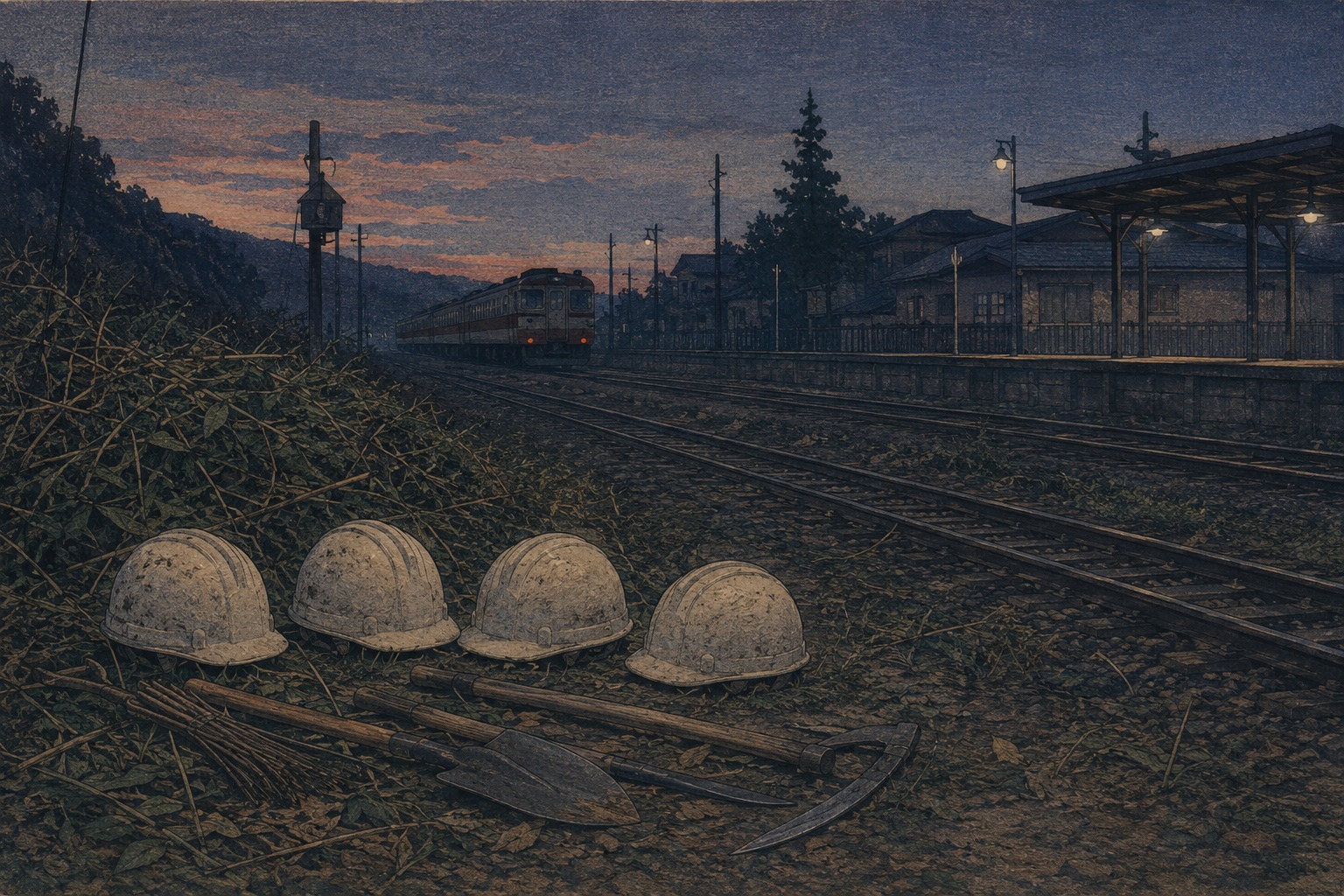
A railway lookout gave an all-clear. Moments later, the driver of an express entering Shin-Kanuma Station saw four workers still on the track and initiated an emergency stop. The train could not stop in time. At about 10:46 a.m. on August 20, four men engaged in herbicide-spraying work inside the station were struck by Tobu Railway's Spacia X No. 2 and later pronounced dead.
What the official record establishes
Tobu Railway's initial release says four employees of a contractor were spraying herbicide inside Shin-Kanuma Station when they came into contact with the Tokyo-bound Spacia X No. 2. About 50 passengers were aboard. No passenger or crew member was reported injured. Service between Shin-Tochigi and Shimo-Imaichi was suspended and resumed at 3:22 p.m.
The Japan Transport Safety Board records the event as a railway personal-injury accident. Its summary says the driver saw personnel on the track while entering the station, took emergency stopping action, and made contact with four of them. The site is listed at kilometer 66.848 from Tobu-Dobutsu-Koen Station. Investigators were dispatched to examine the train, the site and the operating and work procedures.
Tochigi Prefectural Police are also investigating, including the possibility of professional negligence resulting in death. A criminal investigation considers legal responsibility. The transport board's mandate is to determine causes and prevent recurrence. Neither process had assigned responsibility at the article's cutoff.
The all-clear that was not safe
In Tobu's preliminary briefing, several people had lookout duties. One intermediate lookout was positioned about 315 meters down the line from the work site. The driver reportedly understood a lookout's signal to mean that everyone had cleared the track. After entering the station, the driver saw four workers still below platform level and applied the emergency brake.
Tobu said communication among three people with monitoring roles may have broken down, allowing an all-clear before everyone had reached safety. Critical details remain unresolved: who was responsible for the final head count, what each person saw and heard, how the signal was relayed, whether radio or other equipment functioned, and whether every required step was completed.
How workers are protected while trains keep moving
When maintenance is performed beside an active railway, workers need a dependable way to know when a train is approaching and enough time to reach a designated safe place. Dedicated lookouts monitor train movements and warn the work group. Where curves, platforms or other obstructions limit sight distance, intermediate lookouts may relay the warning.
This system uses people as a safety barrier while seeking redundancy through multiple checks. More personnel do not automatically create more safety. If roles, read-backs and final authority are unclear, each person can assume that somebody else completed a check. A system can then produce an organizational “yes” even though no one verified the underlying fact.
The deadly meaning of a routine railway term
Japanese railway organizations use the term shokusha jiko—literally a contact-with-train accident—for incidents in which workers or other railway personnel are hit by rolling stock. The administrative wording sounds restrained. The consequences are often fatal.
After worker deaths elsewhere in 2023 and 2024, the Japan Transport Safety Board issued guidance stressing pre-work briefings, dedicated lookouts, agreed warning methods, required equipment and confirmed refuge locations. Reports published in 2025 described cases in which a lookout was not dedicated to lookout duties or no dedicated lookout was placed, so workers did not receive an approaching-train warning.
Those earlier accidents do not prove what happened at Shin-Kanuma. They show why lookout, communication and positive confirmation are recurring safety layers in railway maintenance—and why investigators examine the system around an error, not only its final visible act.
A century-old route and a three-year-old flagship
Tobu's Nikko Line opened in 1929, helping connect metropolitan Tokyo with Nikko. Shin-Kanuma became a gateway not only for commuters but for visitors traveling into the historic and mountainous interior of Tochigi. Today all limited expresses serving the Nikko and Aizu direction stop there, according to Tobu's own tourism material.
Spacia X entered service on July 15, 2023, as Tobu's flagship limited express between Asakusa and Nikko and Kinugawa. Its six accommodation types, cafe counter and design references to Edo culture and Nikko were central to Tobu's effort to renew the tourist journey. By May 2026, the company said the trains had carried two million passengers.
The polished train depends on work that passengers rarely see: maintaining rail, signals, overhead systems, station structures and vegetation. Herbicide spraying is not merely cosmetic. Vegetation management protects sight lines and access to equipment and can reduce fire and inspection hazards. The accident exposed the dangerous proximity between this essential labor and trains operating to a public timetable.
Responsibility across a contracting chain
Tobu's written release identifies the four victims only as employees of a contracting company. Railway maintenance can place the infrastructure owner, prime contractor, subcontractors, work supervisors, lookouts and individual workers inside one safety system while leaving them in different corporate organizations.
Those boundaries cannot be allowed to fragment operational information. The party running trains and the party conducting work must share an exact understanding of who may enter the track, who watches, who orders evacuation and who gives the final all-clear. The Kanto District Transport Bureau warned Tobu to investigate underlying factors, secure railway safety and promptly report preventive measures.
Questions the investigation must answer
| Issue | Evidence required |
|---|---|
| Command | Who held final responsibility for confirming that every worker had cleared? |
| Communication | What passed among the primary lookout, intermediate lookout and work supervisor, and in what sequence? |
| Position and sight lines | Could each person see the train or work group required by the procedure? |
| Procedure | Were Tobu's described eight work-routine steps completed and recorded? |
| Redundancy | Was there any independent barrier capable of rejecting a mistaken all-clear? |
| Management | How were training, qualification, fatigue, supervision and contractor safety controlled? |
Do not reduce four lives to “human error”
In the first hours after a disaster, simple explanations are attractive. A mistaken signal and failed communication describe part of the emerging sequence. They do not yet explain why the error was not detected, why four workers remained exposed, or why no other barrier prevented the train from entering their work area.
A final transport-safety report may take time. Meanwhile, Tobu and its contractors have an immediate responsibility to inspect comparable work, preserve records and explain interim protections. Investigators must follow the evidence beyond the last person in the chain to the design of the chain itself.
The four men killed at Shin-Kanuma were doing work that kept a celebrated tourist railway operating. Honoring them requires more than repeating “safety first.” It requires proving that an all-clear can carry only one meaning: every person has actually reached safety.
- Japan Transport Safety Board: Shin-Kanuma accident record
- Tobu Railway: initial accident release
- JTSB: preventing worker–train contact accidents
- TV Asahi: briefing, regulatory warning and investigation timeline
- Tobu Railway: official Spacia X history
- Tobu Railway: company and Nikko Line chronology
Editorial note: Information is current through noon JST on August 23. The JTSB investigation remains open; cause and responsibility are undetermined. The victims' names, precise employer, individual lookout assignments, signal method, communications records and work manual were not confirmed in primary materials and are not stated as fact. Japan.co.jp did not directly interview the families, Tobu Railway, contractors, police, regulators or investigators.