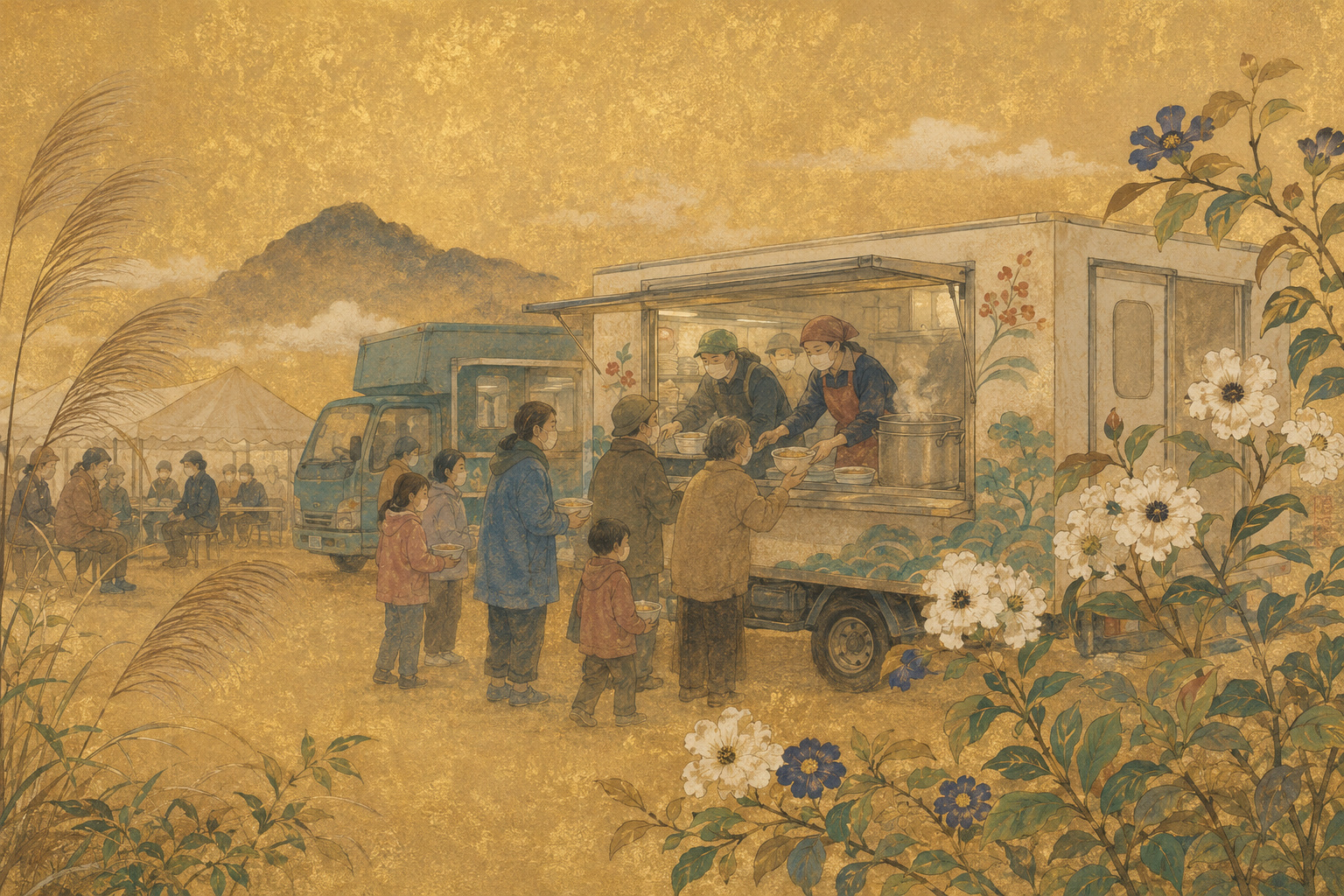
Emergency food has two different jobs. In the first hours after a disaster, food has to arrive at all: bottled water, shelf-stable bread, packaged rice, canned food and instant noodles that can move fast without a functioning kitchen. Days later, the problem changes. People are no longer merely surviving the event; they are living in evacuation centers, sometimes without home kitchens, normal utilities or reliable transport. Tochigi Prefecture’s planned kitchen-truck agreement is aimed at that second problem.
This is an agreement for mobile cooking capacity, not simply food procurement
The counterparty is the Japan Food Truck Business Management Council, a general incorporated association established in December 2022 and based in Chiyoda, Tokyo. Its chair is Junji Yamaguchi. The organization has been building agreements with local governments so that member kitchen-car operators can be coordinated for disaster deployment instead of relying only on spontaneous volunteer arrivals.
The advantage of a kitchen car is embedded in the vehicle itself. Commercial cooking surfaces, heat, some water and sanitation equipment, refrigeration and serving capability can move together. If a school kitchen is flooded or a community center loses utilities, a truck can potentially create a temporary cooking point in a safe parking area.
That does not make stockpiled food obsolete. In the first phase of a disaster, roads may be blocked and fuel, water and ingredients unavailable. Shelf-stable emergency food is more reliable when logistics are broken. Mobile kitchens become especially useful as access returns and shelter stays begin to last long enough that meal quality affects health.
Noto changed how Japan talks about shelter meals
The 2024 Noto Peninsula earthquake exposed the gap between delivering calories and sustaining people through prolonged evacuation. Roads and water systems were damaged for extended periods. Japan’s Ministry of Agriculture, Forestry and Fisheries moved millions of packaged food and drink items into the disaster logistics system, but it also coordinated restaurant operators that deployed kitchen cars to provide hot meals.
Official records show kitchen-car support serving gyudon, udon, curry and other meals in Wajima, Suzu, Nanao, Anamizu and Noto. When heavy rain struck the region again in September 2024, mobile food operations returned with curry, miso soup, udon and other freshly prepared dishes.
The Cabinet Office later summarized the benefit in practical terms: kitchen cars helped diversify menus and deliver hot food, often in batches of several hundred meals. The lesson was not that packaged food had failed. Packaged food had done the critical first job. The gap was what came next.
Japan’s government-run D-TRACE registry records that members of the same council now preparing to sign with Tochigi served a combined 140,000 meals in Noto earthquake and flood support between February 2024 and February 2025.
The Cabinet Office now publishes a model kitchen-car agreement
In December 2024, the Cabinet Office revised its shelter-operation guidelines after the Noto experience. The document goes further than general encouragement: it includes a model “Agreement on the Implementation of Emergency Meal Preparation Using Kitchen Cars.”
The model is operational. A municipality can request kitchen-car meal service at shelters; in an emergency the request may begin orally or by telephone and be followed in writing. The provider is expected, within the limits of normal business operations, to prioritize cooperation. The model calls for hygiene controls, food-allergy information and measures to avoid foodborne illness. The public authority is also expected to consider priority passage for vehicles used in the response.
Costs are addressed as well. The model allows ingredient, fuel and labor costs to be incorporated into meal charges based on reasonable pricing and consultation between the parties. Cabinet Office materials for municipalities separately explain that meal costs, utilities and labor associated with kitchen-car feeding can qualify as disaster-relief expenses under applicable conditions.
None of those clauses should automatically be attributed to Tochigi before the September 9 agreement text is public. They show the national template Tochigi is entering, not the exact wording it will sign.
Japan created D-TRACE because officials did not know what vehicles existed
Noto revealed a logistics problem beyond food. Kitchen cars, toilet cars, laundry cars and trailers proved useful, but public agencies did not have a reliable national inventory of where those assets were, who owned them or whether they could deploy to a disaster zone. Officials had to ask operators one by one after the earthquake.
The Cabinet Office responded by launching the Disaster Response Vehicle Registration System on June 1, 2025. D-TRACE allows vehicles and coordinating organizations to be registered in advance so disaster authorities can search for assets and request support based on actual needs.
That may be more important than the hardware. A food truck that exists but cannot be contacted, fueled or matched to a shelter is not usable capacity. A database can turn a scattered private-sector fleet into something planners can assign.
Tochigi has already learned that many municipalities may need food at once
The prefecture has direct experience with large-scale emergency feeding. During the October 2019 East Japan Typhoon, severe flooding affected communities across Tochigi. The Disaster Relief Act applied in 21 municipalities. Tochigi’s official disaster record shows that 14 municipalities carried out “food provision through cooking and other means,” including Utsunomiya, Ashikaga, Tochigi, Sano, Kanuma, Nikko and Oyama.
That history matters because a regional disaster can create simultaneous demand. If multiple cities are improvising separate truck searches after roads are flooded, coordination time becomes part of the emergency.
Tochigi already uses a mixed preparedness model: physical stockpiles held by the prefecture and municipalities are supplemented by “distribution stockpiles” available through agreements with private businesses. In August 2026, the prefecture and its municipalities also formalized a broader mutual-assistance framework for dispatching support during large disasters. Kitchen-car capacity fits into the same layered system.
The prefecture has already put warm food into its disaster plan
Tochigi revised its Regional Disaster Management Plan on March 25, 2026, incorporating lessons from Noto and other recent events. The revision emphasizes shelter conditions, including comfortable toilets, sleeping environments and meals.
When evacuation becomes prolonged, the plan calls for attention to menu diversity, appropriate food temperature, nutritional balance and people with medical or other dietary restrictions. It also points to dietitian involvement and monitoring of both food distribution and evacuee health.
That makes the proposed September agreement more than a standalone partnership. It is a procurement and logistics mechanism for a shelter-quality standard the prefecture has already decided it wants to reach.
What a kitchen car brings—and what it still needs
A typical commercial kitchen truck may carry cooking equipment, work surfaces, water tanks, sinks, refrigeration, ventilation and handwashing facilities. The key word is mobile: much of a small kitchen’s physical infrastructure can be moved to an intact parking lot instead of rebuilt inside a damaged facility.
But a truck is not an infinite self-contained restaurant. It still needs ingredient resupply. Water tanks empty. LPG or generator fuel runs out. Refrigeration consumes power. Wastewater and food waste have to go somewhere. Safe parking and vehicle access are mandatory.
A disaster plan therefore needs to treat the truck as one module in a supply chain rather than a magic box.
Six conditions that turn a kitchen truck into disaster infrastructure
| Requirement | Why it matters | What should be decided before disaster |
|---|---|---|
| Access | Flooded or blocked roads can make a truck useless | Staging points, priority passage, alternate routes, receiving staff |
| Water, fuel & power | Cooking, handwashing, heating and refrigeration depend on them | Refill points, fuel types, generators, water/wastewater connections |
| Food logistics | Onboard ingredients cannot sustain multi-day feeding | Suppliers, regional depots, refrigerated transport |
| Hygiene & allergies | Foodborne illness can compound a disaster | Health-department coordination, labeling, temperature controls, hand hygiene |
| Meal counts & needs | Shelter populations change and dietary needs differ | Reporting systems, special diets, support for home evacuees |
| Payment & records | Volunteer goodwill alone cannot sustain long deployments | Meal prices, ingredient/fuel/labor costs, invoicing and activity records |
Hygiene is harder during a disaster, not easier
Cooking equipment alone does not create a safe food service. Disasters combine water shortages, power loss, heat or cold, dust, crowding and disrupted waste collection. Safe operations still require handwashing, raw-food controls, temperature management, cleaning, separation of dirty and clean work, wastewater handling and timely distribution after cooking.
The Cabinet Office model agreement specifically includes hygiene and food-allergy considerations. That is important because an evacuee with an allergy or medical diet may have fewer alternatives than in ordinary life. If “this is all we have” becomes the rule, missing ingredient information can become a medical risk.
What Tochigi’s final agreement will require on these points remains unknown until the text is published.
The biggest payoff may arrive on day four, not hour four
Immediately after a major event, speed and quantity dominate. Shelf-stable stockpiles and push-type deliveries are essential. As days pass, repetitive low-variety food can create a different set of problems: inadequate protein or vegetables, excessive salt, difficult textures for older adults, or food that people with disease-related restrictions simply cannot eat.
Kitchen cars can bridge the gap between emergency rations and a fully restored large-scale food system. They can be assigned in units of hundreds of meals, moved as shelter populations change, and serve different menus at different locations.
There is also a less measurable benefit. A hot-meal point is a place where residents and relief workers meet. Home evacuees may arrive for food and reveal unmet needs. Staff can notice an older person who has stopped eating or a family that lacks supplies. Meal distribution can function as a contact point as well as logistics.
But a few kitchen cars cannot feed a mass evacuation
A disaster involving tens of thousands of evacuees cannot be sustained by a handful of trucks. Even if a vehicle can serve several hundred portions per meal, breakfast, lunch and dinner across multiple shelters require fleets, replacement crews, ingredient distribution and scheduling.
That is why national guidance does not present kitchen cars as the single answer. School lunch kitchens, central kitchens, catering companies, restaurant associations, emergency cooking equipment and stored food all remain part of the system.
The agreement’s strongest contribution may therefore be time. Instead of building a phone list after disaster strikes, the prefecture can establish a coordinator in advance, combine that relationship with D-TRACE and place mobile cooking capacity inside a broader reception-and-support plan.
Other prefectures explicitly link kitchen cars to preventing disaster-related deaths
Kanagawa Prefecture’s January 2026 agreement with the same council is instructive. Kanagawa said the purpose was to improve shelter living conditions “from the perspective of preventing disaster-related deaths” as evacuation becomes prolonged. Miyagi has a similar prefecture-level agreement that allows it to request kitchen-car feeding at shelters after a large disaster.
Chiyoda City’s agreement with the council covers cooking, distribution and related work at evacuation centers. The wording varies by government, but the structural change is the same: meal support becomes something public authorities can request under a standing framework, rather than support that arrives only if volunteers organize it independently.
The real test begins after the September 9 signature
A signed agreement does not prove a truck can reach an actual shelter. The next step is exercise: Can the vehicle fit into the designated parking area? Is there a usable water source? Does generator exhaust affect the shelter? How long does 300 meals take? Where does the line form? Who reports the next meal count?
The public side also needs dietary information. Infants, older adults, people with swallowing difficulty, allergies, diabetes or kidney disease cannot be reduced to one “meal count.” Tochigi’s disaster plan already points toward dietitian involvement; the dispatch system has to connect that health information to the people actually cooking.
D-TRACE registration, prefecture-municipal mutual-aid plans, the council’s contact network and field exercises must work together. That is the point at which a festival food truck becomes disaster infrastructure.
2019: Fourteen Tochigi municipalities provide cooked-food assistance after the East Japan Typhoon.
January 2024: Noto Peninsula earthquake; mass packaged-food support is supplemented by kitchen-car hot meals.
December 2024: Cabinet Office revises shelter guidance and publishes a model kitchen-car agreement.
June 2025: D-TRACE disaster-response vehicle registry begins operation.
March 2026: Tochigi revises its disaster plan to emphasize nutritionally balanced, appropriately heated meals.
September 2, 2026: Tochigi announces the planned agreement with the kitchen-car council.
September 9, 2026: Signing ceremony scheduled at the prefectural government.
Designing the meal before the disaster
Preparedness used to be easy to count in boxes: how many days of water, how many packets of rice, how many cans. Those numbers remain indispensable.
Post-Noto policy adds another question. What will an evacuee eat after the emergency becomes daily life? Is the food warm? Is it nutritionally varied? Can an elderly resident chew it? Can someone with an allergy identify what is inside? Is the person cooking exhausted after a week?
Kitchen trucks are not a universal answer. They are constrained by roads, fuel, water, staffing, refrigeration and logistics. Their strength is different: they allow private cooking capacity that exists in ordinary communities to be converted, through prearranged rules, into public emergency capacity.
As of September 4, Tochigi’s agreement is still five days from signature. The meaningful measure will come later: how many usable trucks the prefecture and municipalities know they can call, where those trucks can be staged, how quickly they can produce meals and whether the system has been rehearsed.
If that work follows the ceremony, the next hot bowl served after a Tochigi disaster will not have to depend on luck or a volunteer convoy finding the right shelter. It can be part of the plan.
Sources & Reporting Notes
- Tochigi Prefecture, announcement of disaster kitchen-car agreement ceremony — Primary September 2, 2026 announcement: signing ceremony scheduled for September 9 with the Japan Food Truck Business Management Council.
- Tochigi Prefecture, 2026 revision of the Regional Disaster Management Plan — Local policy response to lessons from the Noto Peninsula earthquake and other disasters.
- Tochigi Prefecture, summary of disaster-plan revisions — Adds emphasis on warm, nutritionally balanced food and improved shelter conditions.
- Tochigi Prefecture, Record of the 2019 East Japan Typhoon Disaster — Records Disaster Relief Act assistance in 21 municipalities and food/cooking assistance in 14 municipalities.
- Tochigi Prefecture, disaster stockpiles and support information — Explains the prefecture’s combination of physical stockpiles and private-sector supply agreements.
- Cabinet Office, Shelter Operation and Evacuation-Life Support Guidelines — December 2024 revision, including a model kitchen-car disaster agreement with provisions on requests, hygiene, allergens, access and costs.
- Cabinet Office, shelter living-environment policy portal — Official gateway to shelter-quality guidance, model agreements and food-support materials.
- Cabinet Office, disaster-response vehicle registry — D-TRACE system launched June 1, 2025 after Noto exposed the lack of advance information on kitchen cars, toilet cars and similar assets.
- D-TRACE, Japan Food Truck Business Management Council case — Government registry case says member trucks served 140,000 meals in Noto earthquake/flood support from February 2024 to February 2025.
- Ministry of Agriculture, Forestry and Fisheries, Noto earthquake response — Official record of push-type food support and deployment of restaurant-sector kitchen cars for hot meals.
- MAFF, September 2024 Noto heavy-rain response — Examples of hot meals delivered by kitchen cars after the subsequent Noto flooding.
- Cabinet Office, Disaster Management White Paper 2026 — Post-Noto shelter reforms emphasizing warm food, toilets, bathing and mobile support assets.
- Kanagawa Prefecture, kitchen-car disaster food agreement — A prefectural precedent linking kitchen-car deployment with shelter quality and prevention of disaster-related deaths.
- Miyagi Prefecture, kitchen-car disaster agreement — Another prefectural agreement with the same organization.
- Chiyoda City, kitchen-car disaster agreement — Confirms council chair Junji Yamaguchi’s name and a municipal agreement covering cooking and distribution.
This article was checked against public material available by 2:24 AM JST on September 3, 2026. As of the September 4 edition, Tochigi’s signing ceremony with the Japan Food Truck Business Management Council was scheduled for September 9 and the prefecture had not published the agreement text. The article therefore attributes only the broad scope—kitchen-car meal preparation and related disaster support—to Tochigi itself. Detailed provisions on requests, hygiene, allergy information, priority access and costs are identified as terms in the Cabinet Office’s national model agreement or examples from other governments, not confirmed Tochigi clauses. Junji Yamaguchi’s official romanization/reading is supported by Chiyoda City’s primary release. The 140,000-meal figure is limited to the February 2024–February 2025 period reported in D-TRACE.
Image rights: © 2026 Japan.co.jp. AI-assisted editorial illustration. Reproduction or reuse without permission is prohibited. For licensing, see the contact page.