- The missing link between AI and a moving machine
- What TDK has committed—and what it has not
- A sensor smaller than the intelligence it enables
- Why physical AI needs more than cameras
- From ferrite to the cassette to the hard drive
- Acquisitions broadened the technology portfolio
- The difficult part is manufacturing at scale
- Ojiya is also a regional industrial story
- What competitors and customers will measure
- The five questions to revisit in 2029 and 2031
The missing link between AI and a moving machine
Artificial intelligence can plan a robot’s next movement, but a motor still has to move the right distance and a controller must know whether it did. A sensor—not the headline-making processor—often provides that piece of reality. It measures the position of a shaft, a changing magnetic field or the current flowing through equipment, then converts a physical condition into information a system can use.
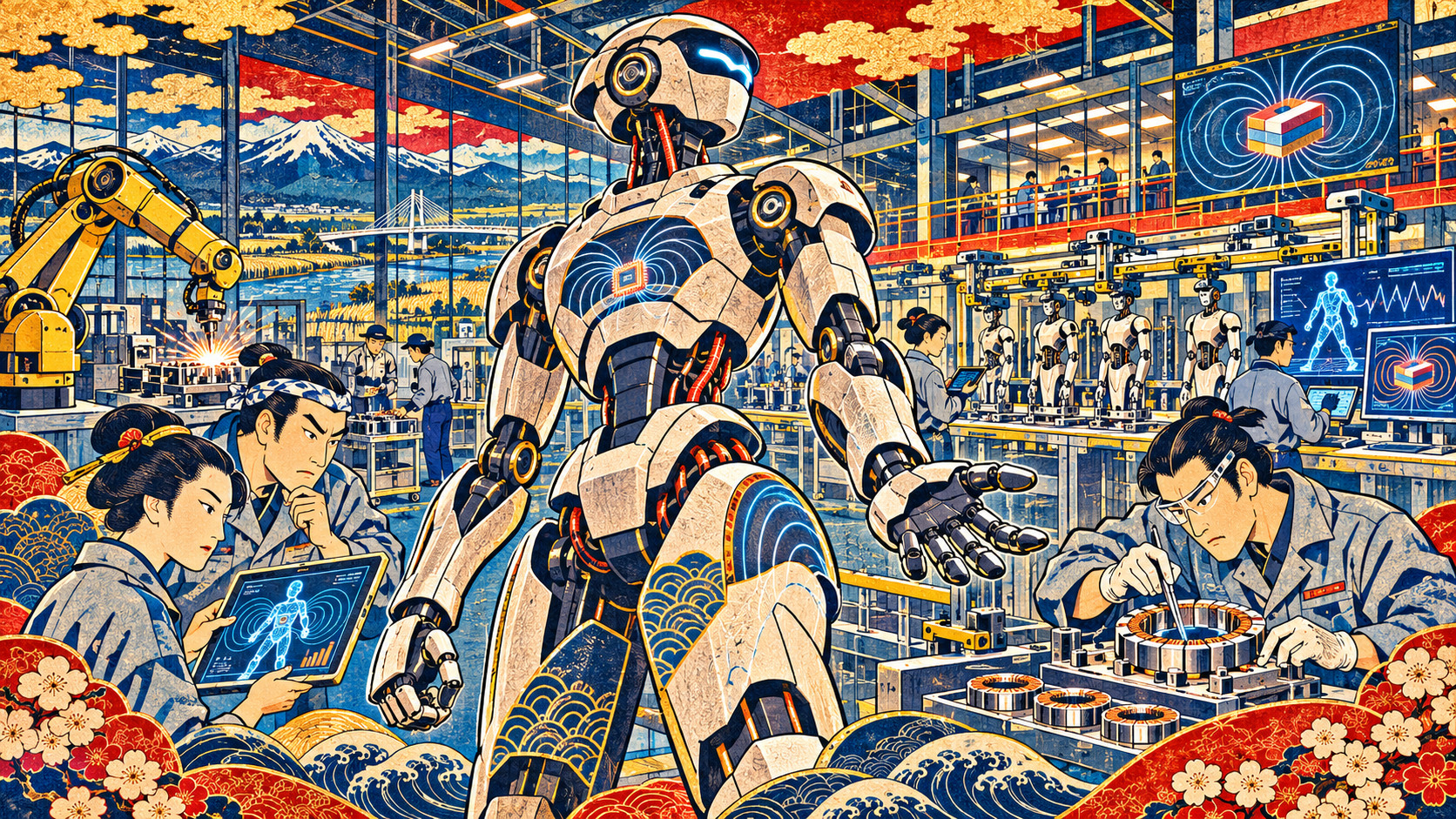
On October 30, 2026, TDK Corporation announced plans to invest approximately ¥100 billion in its Shinano River Techno Factory in Ojiya, Niigata Prefecture. The objective is to strengthen development and build full-scale manufacturing for advanced tunnel magnetoresistance, or TMR, sensors. The company explicitly tied the decision to “Physical AI”: intelligent systems operating in robotics, automation and physical infrastructure.
This is not a report of ¥100 billion in sensor orders, nor a factory already producing the new devices. Operations are scheduled for 2029. What makes the decision unusually revealing is the company behind it: TDK has spent decades learning to handle magnetism, from recording tapes to hard-drive heads. It now believes that expertise can supply the senses of another generation of machines.
What TDK has committed—and what it has not
The October release identifies a planned investment of around ¥100 billion at TDK Shinano River Techno Factory, situated in Ojiya City. TDK lists a site of 173,335 square meters and building space of 132,075 square meters, with TMR sensor products designated as the principal activity. The stated operating target is sometime during 2029.
TDK had already announced the establishment of the factory on June 1, 2026. That earlier announcement described a sensor-business expansion and said precise production capacity remained under consideration. October therefore marks a more specific capital decision rather than the first unveiling of the site.
Local television reporting on November 2 added that the plant uses a former JS Foundry site, that TDK is planning a two-factory arrangement with Asama Techno Factory in Nagano, and that the company aims to double production by 2031. The report also referred to a plan for approximately 200 employees by the 2029 startup. Those details are attributed to the local report; they should not be mistaken for every item being set out in the shorter October TDK release.
A sensor smaller than the intelligence it enables
TMR stands for tunnel magnetoresistance. In simplified terms, two magnetic layers separated by an exceptionally thin insulating barrier produce different electrical resistance depending on their relative magnetic orientation. The change can be read as a useful electrical signal. In an engineered device, this permits precise observation of magnetic-field variations.
By pairing a magnetic target with a rotating part, designers can use magnetic sensing to infer position or angle. The magnetic field created by current can also be used in suitable current-sensing designs. These are established classes of application, not proof that TDK’s future Ojiya products have achieved any particular customer specification.
TDK emphasizes compactness, low energy use and fast response, including relevance to next-generation power semiconductors. Equally prominent is its own packaging technology. A sensor that works in a lab must survive thermal cycles, vibration, electromagnetic interference and the manufacturing variations of large production runs. Performance on paper is only part of the product.
Why physical AI needs more than cameras
Public discussion of AI often revolves around models and accelerator chips. A factory robot, however, faces constraints that do not disappear when its software improves. Motion has inertia. Gears have tolerances. Motors heat up. A position estimate can drift, and a control system can act on a faulty reading.
Magnetic sensing belongs to a wider set of inputs that includes cameras, inertial sensors, force feedback and encoders. It is not a universal substitute for them. In some applications it offers an attractive combination of small form factor, robustness and electrical efficiency. In others, competing technologies may be better suited. Each motion-control design depends on the environment, accuracy required and system economics.
The relevant commercial question is therefore specific: where can a higher-performance TMR sensor reduce size, power or complexity enough to justify its price? The October announcement does not provide independent comparative test results, named customers or committed shipment quantities. Those will matter more than broad market slogans.
From ferrite to the cassette to the hard drive
TDK was founded in 1935 to commercialize ferrite, the magnetic ceramic that emerged from pioneering Japanese research associated with Yogoro Kato and Takeshi Takei. In the decades that followed, the company applied magnetic materials to electronic components and, famously, to recording media. Japanese-made cassette tapes became one of its most recognizable consumer products.
Its deeper advantage was not ownership of a cassette brand but the ability to engineer magnetic materials and manufacture them precisely. When hard disk drives became central to computing, magnetic-head technology demanded detection of exceptionally subtle magnetic signals at tiny scales. That discipline proved useful in a world beyond recording.
In its 2016 annual report, TDK described an effort to repurpose TMR elements developed for disk-drive heads. The account recalls a small group of three people, including veteran engineers, working through prototypes and demonstrations before the market matured. In 2015, the company began mass-producing TMR magnetic sensors for automotive applications. The 2026 investment is a continuation of a long technical migration, not an overnight pivot prompted by a new AI buzzword.
Acquisitions broadened the technology portfolio
Organic development was only part of TDK’s sensor strategy. In 2016 it acquired Micronas, which brought expertise in Hall-effect magnetic sensing and access to automotive customers. TDK’s own high-sensitivity TMR capability and Micronas’s Hall technologies addressed different needs within magnetic field measurement.
The company subsequently expanded its broader sensor range, completing its acquisition of InvenSense in 2017. The resulting portfolio spans magnetic, inertial, pressure and other sensing capabilities. TDK’s 2024 Sensor Systems presentation describes an organization built to combine these technologies rather than sell components in isolation.
That history helps explain why packaging and system-level design matter in the new investment. Industrial customers buy reliable measurements integrated into complicated machines. A range of compatible sensor products and application engineering can be as important as a single record sensitivity figure.
The difficult part is manufacturing at scale
An exquisitely sensitive prototype is not automatically a viable industrial part. Scaling production introduces challenges involving thin-film consistency, semiconductor-style processes, assembly, calibration, yield and testing. Even small differences between units can become expensive in automotive or industrial deployments.
TDK’s October announcement stresses a combination of high-performance TMR sensing and proprietary packaging. Packaging affects how a chip withstands temperature and mechanical stress, how it connects to surrounding circuitry and whether customers can manufacture with it efficiently. Investing in capacity without mastering those details would solve only part of the problem.
The company has not published a complete breakdown of the ¥100 billion by machine type, year or product program. Nor does the announcement specify a precise capacity in devices per month or a verified expected return on investment. It would be misleading to convert the headline investment directly into sensor units or robot shipments.
Ojiya is also a regional industrial story
The choice of Ojiya matters independently of the technical case. A new high-value manufacturing operation can support specialist employment, demand for local suppliers and the retention of industrial skills. Ojiya City included an October 30 statement by Mayor Etsuo Miyazaki in its official release index, expressing expectations for economic benefits and cooperation with TDK.
Local reporting identifies the site with former JS Foundry facilities and gives an employment plan for the years preceding startup. Reusing an industrial location is a different proposition from creating an entirely new regional cluster. The eventual benefits will depend on actual hiring, training, procurement and whether investment continues after the plant begins running.
The planned relationship with the existing Asama facility in neighboring Nagano adds another layer. Technical know-how and production volume do not transfer by announcement alone: process validation and worker expertise must be developed. It will take years to judge whether the two-site structure delivers the resilience and scale the company seeks.
What competitors and customers will measure
TMR is one of several possible sensing approaches. Hall-effect sensors, anisotropic magnetoresistance, giant magnetoresistance and optical or mechanical encoders compete or complement one another according to application. A customer will weigh resolution, energy consumption, temperature drift, electromagnetic immunity, packaging, qualification and total cost—not a single marketing adjective.
For electric drives and power-electronics systems, speed and isolation requirements may be decisive. In a robot joint, angle accuracy and environmental reliability could dominate. These are examples of possible design priorities, not confirmed contracts for the Ojiya plant.
TDK must also contend with the ordinary risks of a major factory investment: slower-than-expected adoption, evolving requirements, equipment lead times, startup yield and competitive prices. The broad prospect of growing automation does not ensure a particular margin or market share for any one supplier.
The five questions to revisit in 2029 and 2031
First: will the Shinano River facility begin operations on the announced 2029 schedule? Second: which specific TMR devices, ratings and use cases will enter mass production? Third: how much output can the plant deliver at acceptable yield? Fourth: what jobs and supply-chain business actually remain in Ojiya? Fifth: can the group substantiate the longer-term production-expansion ambitions cited in local reporting?
Answers will emerge through product releases, customer qualifications, investment disclosures and the actual operations of the plant. The public does not yet have enough information to conclude that all the projected capacity will be used or that any particular robot manufacturer will be a customer.
The surprising continuity is what makes this story more than an investment announcement. A company created around magnetic ceramics, then known to generations of music listeners through tapes, is preparing to read magnetic fields for machines that respond to the world. In physical AI, the least glamorous component may be the one that tells a powerful computer what is really happening.
Sources and reporting method
Document-based reporting using TDK primary releases and historical filings, supplemented by clearly attributed reporting from Niigata. Information reviewed through November 3, 2026. Future investments and production targets are not verified outcomes.
- TDK: strategic investment in TMR sensors, October 30, 2026
- TDK: establishment of Shinano River Techno Factory, June 1, 2026
- TDK: history and magnetic-material innovation
- TDK: annual report 2016, origins of TMR sensing
- TDK: 2017 annual report, sensor acquisition strategy
- TDK: 2024 Sensor Systems presentation
- TDK: May 2026 investor meeting presentation
- Ojiya City: October 30 mayoral statement listing
- NST Niigata television: local factory and employment reporting
- TDK: October 30 English-language corporate announcement