In a city famous for pottery, folk song and its old castle streets, the future of local culture is being tested through a surprisingly practical change: two familiar events will become one.
Tamba-Sasayama, in Hyogo Prefecture, will hold the first Tamba-Sasayama City Festival of Arts and Culture from November 17 to 23. The municipality is bringing together its traditional city art exhibition and its citizens' cultural festival—two institutions that have served different kinds of creativity. The plan was already published on the city's website September 1, and a new municipal announcement dated October 20 spelled out the November program. This is an upcoming event, not a festival that has already begun.
What changes when a city combines an exhibition and a festival?
The old municipal art exhibition was a place to submit work, seek recognition and encounter other people's paintings, photographs, calligraphy, ceramics and crafts. The citizens' festival encompassed a different kind of participation: music, dance and performances created through regular meetings and rehearsals.
Putting both beneath a single umbrella may bring their audiences into contact. A family attending a dance performance might discover an unfamiliar ceramic artist; an exhibitor could become a listener at a folk-music performance. That is the promise. There is no published outcome data yet showing that the reorganization has attracted younger artists or increased attendance.
A week of works, followed by a day on stage
Works will be exhibited at Tamba-Sasayama Civic Center, 191 Kurooka, from November 17 to 22, generally from 9:30 a.m. until 4 p.m. The final day's display closes at 2 p.m. A special category runs November 20–22. The city says an awards ceremony is planned for 11 a.m. on November 22.
The program then shifts to the city's Den'en Symphony Hall at 41 Kitashinmachi on November 23. Performances run from 12:30 to 4 p.m., with free admission. The municipality lists 12 participating groups spanning folk song, traditional Japanese dance, hula, karaoke, folk music and contemporary dance. Among them are Min'yō Tanzankai, Fujika-kai, the city's disability karaoke club, and cotonova studio. Those varied traditions are part of the news: the event is not confined to a narrow definition of fine art.
A castle town that remembers through song
It is easier to appreciate the experiment when the city is seen as more than an attractive weekend destination. Sasayama Castle was built in 1609 under Tokugawa Ieyasu's direction, and the surrounding town developed as a regional center. Cultural identity here reaches from the built landscape to the songs that describe it.
In 2015, the area's Decansho-bushi folk-song tradition received Japan Heritage recognition through a story about the preservation of community memories. The municipal heritage account describes a repertory recording places, products and changing everyday life. That is an unusually useful comparison for the new festival: cultural continuity does not mean keeping every performance or gathering unchanged. It depends on people finding reasons to keep participating.
The pottery tradition that repeatedly reinvented itself
Tamba ware, one of Japan's Six Ancient Kilns, has roots in the late Heian and early Kamakura periods. Originally shaped around utilitarian vessels and older kiln technologies, the regional industry adopted climbing kilns, new throwing techniques and glazes, later adapting its products to the needs of changing markets. Its history includes both periods of commercial hardship and renewed appreciation through the folk-craft movement.
Tamba joined the wider Six Ancient Kilns Japan Heritage designation in 2017. The city's two heritage stories—pottery and Decansho folk song—provide a historical frame for a present-day question. How should a community celebrate its cultural inheritance without trapping it in the past?
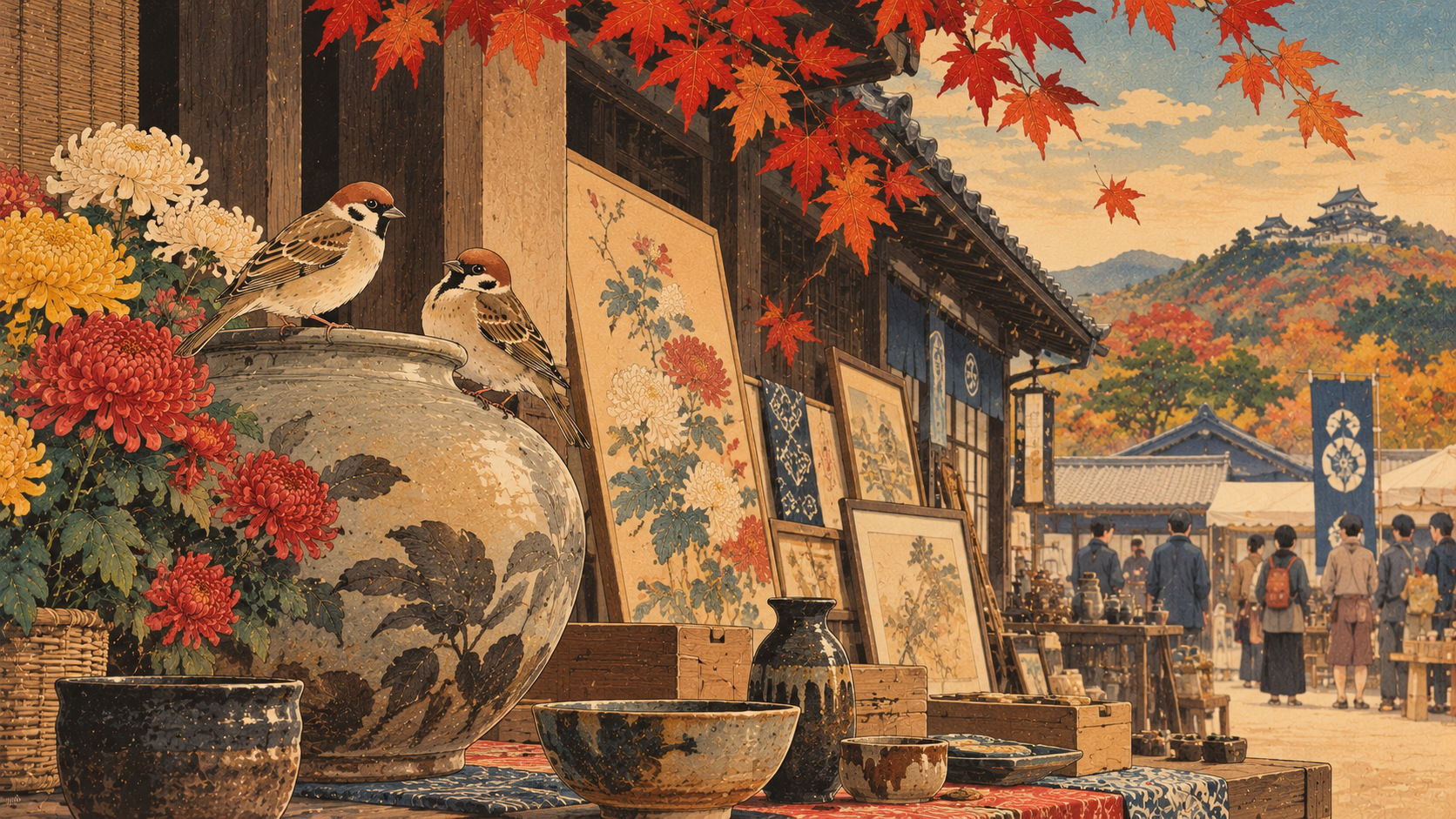
The answer may begin with something as small as a ceramic bowl on an exhibition table, or a traditional melody performed alongside a modern dance. But the municipal announcement does not identify the particular bowls, makers or prizewinning works that will appear. An editorial illustration of pottery and birds should not be mistaken for a documentary view of the coming exhibition.
A more welcoming festival needs more than a new name
The city has introduced advance online submission for the exhibition, with a November 2 deadline. Applicants must still meet the separate arrangements for bringing in artwork and paying the entry fee. In-person submission is scheduled for November 8–9; the special category has its own November 19 arrangements. The distinction matters for participants, particularly those traveling from outside the city.
Combining activities also raises practical questions. Will younger residents feel they have a genuine place in the program? Will visitors understand that the gallery and the stage are in different buildings? Could a single festival broaden awareness while inadvertently losing some of the intimacy of the older gatherings? None can be settled from a promotional announcement. They merit follow-up reporting after the doors open.
Japan's regional cultural challenge
Across Japan, many communities are trying to sustain local participation as demographics change. Community arts are sometimes treated as a tourism asset, but they perform another function: they give people who may never be professional artists a reason to make something, learn from others and appear before an audience.
That distinction is central to the Tamba-Sasayama story. The most meaningful measure of success will not be whether a new festival gets a catchy title, but whether people who previously felt outside the arts become participants—and whether long-standing participants recognize their own traditions in the new setting.
A November gallery may contain works made at kitchen tables, in small workshops or after ordinary working days. The festival's opportunity is to place those works in conversation with a community that knows how to adapt: a pottery center that changed its kilns and products over the centuries, and a castle town that keeps retelling its history through song.
Visitor details
| Program | Dates and venue |
|---|---|
| Art exhibition | November 17–22, 9:30 a.m.–4 p.m. (ends 2 p.m. November 22), Tamba-Sasayama Civic Center |
| Special exhibition category | November 20–22, same venue |
| Stage performances | November 23, 12:30–4 p.m., Den'en Symphony Hall; admission free |
Schedules and participation arrangements are from the municipality's published program. Confirm any changes with the organizer before traveling.
Sources and reporting notes
Based on the city’s September 1 notice and October 20 release. The festival takes place in November; participation outcomes are not yet known. No independent interviews were conducted.