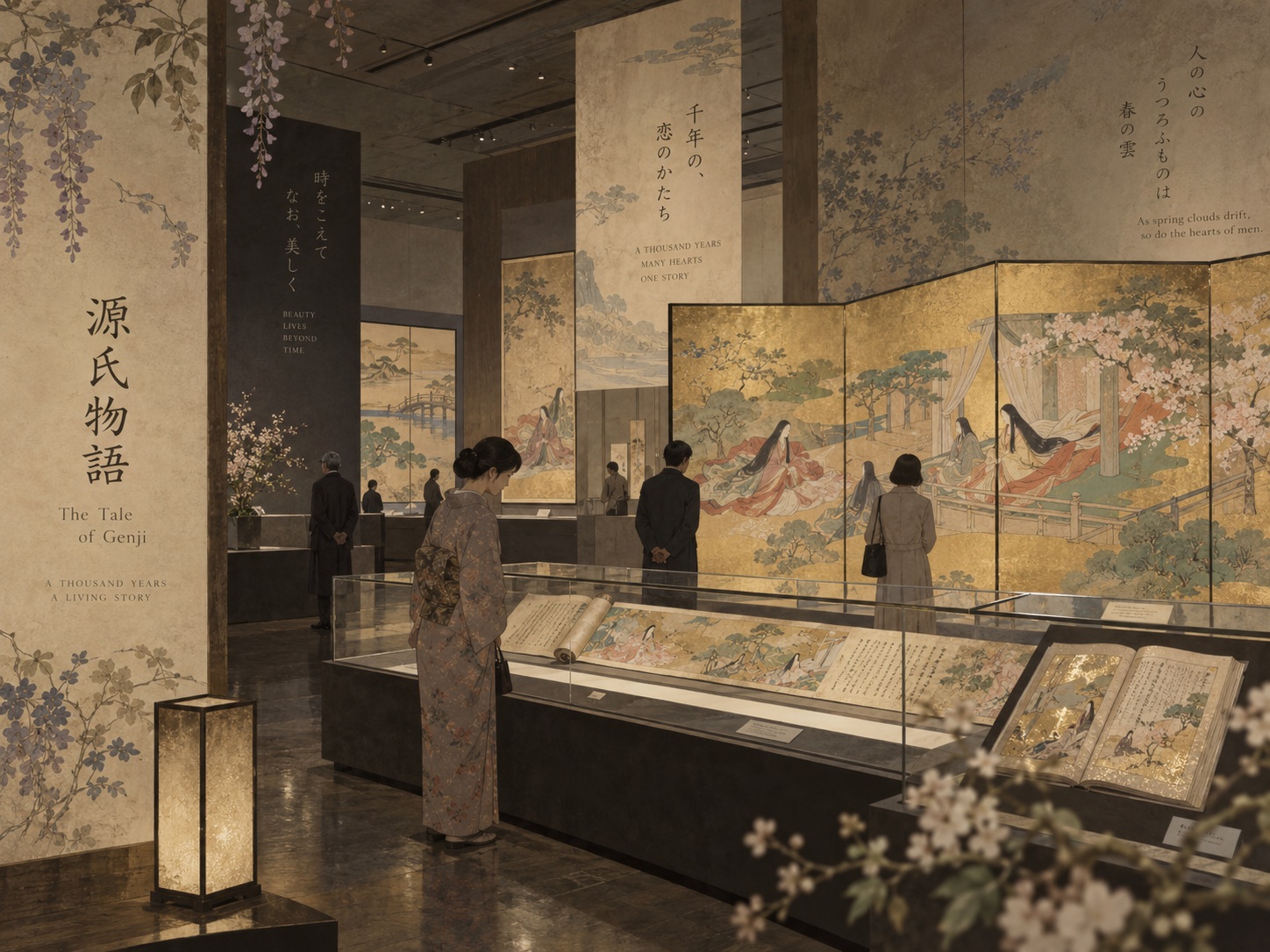
A literary work written around a thousand years ago became far more than a book. It became paintings, calligraphy, wedding furniture, lacquerware, Noh drama, folding screens and modern Japanese painting.
Kyoto National Museum opened its special exhibition The Tale of Genji: Radiant Culture of the Japanese Imperial Court on October 6. Running through November 29, the exhibition brings together roughly 250 cultural properties across the Kyoto and Tokyo presentations, including the National Treasure Genji Monogatari Emaki, manuscripts connected with Fujiwara no Teika’s textual tradition, the so-called Moriyasu version of the illustrated scroll, decorative arts and material related to Noh.
A book became a cultural operating system
The Tale of Genji was written by Murasaki Shikibu in the mid-Heian period. Its central world is the imperial court, and its narrative follows Hikaru Genji and an extraordinary range of women, families and political relationships through love, ambition, loss and aging.
The exhibition is not simply about literary history. It shows how the story escaped the page. Scenes became paintings. Motifs became lacquer design. Characters and emotional episodes entered Noh. Manuscripts and commentary transformed the text into a canon. Over centuries, Genji became a shared visual and cultural vocabulary.
The National Treasure Genji scroll is the oldest surviving visual Genji
One of the exhibition’s central works is the National Treasure Genji Monogatari Emaki. Kyoto National Museum describes it as the oldest surviving illustrated work based on the tale and one of the supreme achievements of Japanese handscroll painting.
The images are small — a little over 20 centimeters high — but extraordinarily dense. Architecture, layered color, facial conventions and tightly controlled composition carry psychological meaning. The scroll is not merely an illustration explaining the words. It creates a parallel emotional language.
Fujiwara no Teika helped stabilize the text
A work does not become a classic only because it is written. It must also be copied, compared, edited and taught.
From the Kamakura period onward, Genji texts were organized and annotated. Kyoto National Museum explains that this process of textual stabilization and commentary strengthened the work’s authority as a classic. The exhibition includes manuscripts associated with the textual tradition edited by Fujiwara no Teika.
Murasaki Shikibu herself became an image
Much of Murasaki Shikibu’s life remains uncertain, but she was educated in literature and served Shoshi, daughter of Fujiwara no Michinaga. Her diary and the many later portraits of her show how the author herself became part of Genji’s cultural afterlife.
Later generations did not simply preserve her biography; they constructed an image of “Murasaki Shikibu” suitable to their own ideas about literary genius and court culture.
The “phantom” Moriyasu scroll
Another major component is the Genji Monogatari Emaki known as the Moriyasu version. Because sections are divided among collections in Japan and overseas, the complete form is difficult to reconstruct, leading to its reputation as a kind of “phantom” Genji scroll. Kyoto National Museum displays scenes from its own holdings, including “Aoi.”
Genji became a marker of courtly literacy
By the medieval period, knowledge of Genji had become bound up with cultural authority. Imperial excerpts, commentaries and Genji paintings reflected more than literary enthusiasm. They demonstrated sophistication and connection to court tradition.
Works such as the Carriage Dispute screens attributed to Tosa Mitsumochi belong to this world in which reading Genji signaled cultural legitimacy.
Sometimes the characters disappear entirely
Genji also entered decorative art through what is called rusumoyo, or “absent-person motifs.” Instead of depicting Genji or another character, an artist could show a carriage, plant, bridge or object associated with a famous scene. A viewer familiar with the story would understand the reference.
It is an extraordinarily sophisticated visual shorthand: art that assumes the audience already knows the text.
Genji became part of marriage furniture
As the tale became required cultural knowledge among court and warrior elites, it also entered elite marriage customs. Kyoto National Museum explains that copies of Genji could accompany a bride, while book cabinets and wedding furnishings were decorated with Genji themes.
The National Treasure Uji incense box from the Hatsune wedding furnishings is one example of literature transformed into material status and family ritual.
Sotatsu turned Genji into monumental decoration
From the Momoyama and Edo periods, Genji painting expanded beyond album leaves and handscrolls into large folding screens and architectural surfaces.
The exhibition includes the National Treasure Sekiya and Miotsukushi Scenes from The Tale of Genji by Tawaraya Sotatsu, with the Miotsukushi screen shown during the first half of the Kyoto run.
By this point, Genji imagery was not only narrative. It was also celebratory decoration associated with marriage, longevity and refined interiors.
Noh changed the emotional grammar
Noh works including Aoi no Ue, Nonomiya, Yugao and Genji Kuyo reinterpret characters and episodes through the medieval aesthetics of yugen and memory. Kyoto National Museum treats this encounter between court culture and Noh as one of the major branches of Genji reception.
The Kyoto venue reconstructs Genji-Noh stage environments using recreated costumes, with Aoi no Ue in the first half and Tamakazura in the second.
Noh turns narrative into memory
Noh rarely works like straightforward dramatization. Figures from the past often return as spirits, recounting memory and unresolved emotion. Genji characters are therefore transformed again, filtered through medieval religious thought and the aesthetics of haunting, absence and recollection.
Modern painters still needed Genji
The exhibition concludes with modern interpretations. Matsuoka Eikyu’s Princesses of Uji is presented as a work that studied the National Treasure handscroll tradition and transformed that knowledge into large-scale modern nihonga.
Genji had become more than a subject representing Heian life. It became a way for modern painters to ask what Japanese painting itself should inherit from the past.
Why is Genji so reusable?
One reason is visual abundance: blossoms, autumn leaves, moonlight, snow, curtains, carriages, fans, incense, gardens, bridges and rivers. Another is emotional durability. Desire, jealousy, grief, aging, ambition and family tension do not depend on knowing the details of Heian bureaucracy.
A caution about calling it “the world’s first novel”
English-language descriptions often call The Tale of Genji “the world’s first novel” or “the oldest novel.” That shorthand is useful but not uncontested. “Novel” is a later literary category, and applying it to premodern narrative traditions involves definition as much as chronology.
This article therefore treats Genji as one of the foundational long-form works of Japanese narrative literature rather than making an absolute “first novel” claim.
Rotations are part of conservation
The National Treasure Genji scroll is not displayed in the same configuration throughout the exhibition. Kyoto National Museum notes that scenes rotate roughly every two weeks.
This is partly curatorial variety and partly conservation. Paper, silk and historic pigments are vulnerable to light exposure. Visitors seeking specific scenes need to check the schedule: “Hashihime” is scheduled for November 3–15, while “Yadorigi III” is planned for November 17–29.
Why Kyoto matters
The central world of Genji is Heian-kyo, and Murasaki Shikibu lived within the court culture from which the work emerged.
Seeing the exhibition in Kyoto therefore adds geographic resonance. Works arrive from institutions including Ishiyamadera and Ninnaji, while a number of objects are shown only at the Kyoto venue.
A thousand years of adaptation
In contemporary language, the reception history of Genji can look like a millennium of adaptation and re-creation.
Painters re-staged scenes. Craftsmen replaced characters with motifs. Noh playwrights turned episodes into ghostly memory. Modern painters reworked ancient pictorial grammar. Preserving the original and changing the original were not opposites. Reinterpretation is one of the reasons the work remained alive.
What the 250 works reveal
The deepest value of the exhibition is not simply the concentration of masterpieces. It is the chance to see one story travel through time.
Murasaki Shikibu’s text was copied, corrected, annotated, painted, performed, used in marriage furnishings and reimagined by modern artists.
The Tale of Genji is not a classic that stopped changing a thousand years ago. It is a cultural structure that later generations repeatedly rebuilt. Kyoto National Museum’s exhibition makes that long process visible through the objects themselves.
Sources and references
- Kyoto National Museum, “The Tale of Genji: Radiant Culture of the Japanese Imperial Court,” exhibition information.
- Kyoto National Museum, Japanese exhibition overview and highlights.
Reporting and verification cutoff: October 7, 2026. Many works rotate during the exhibition, and specific National Treasure scenes are not on view for the full run. The museum’s figure of roughly 250 objects includes the touring exhibition rather than a claim that all 250 are simultaneously displayed in Kyoto.