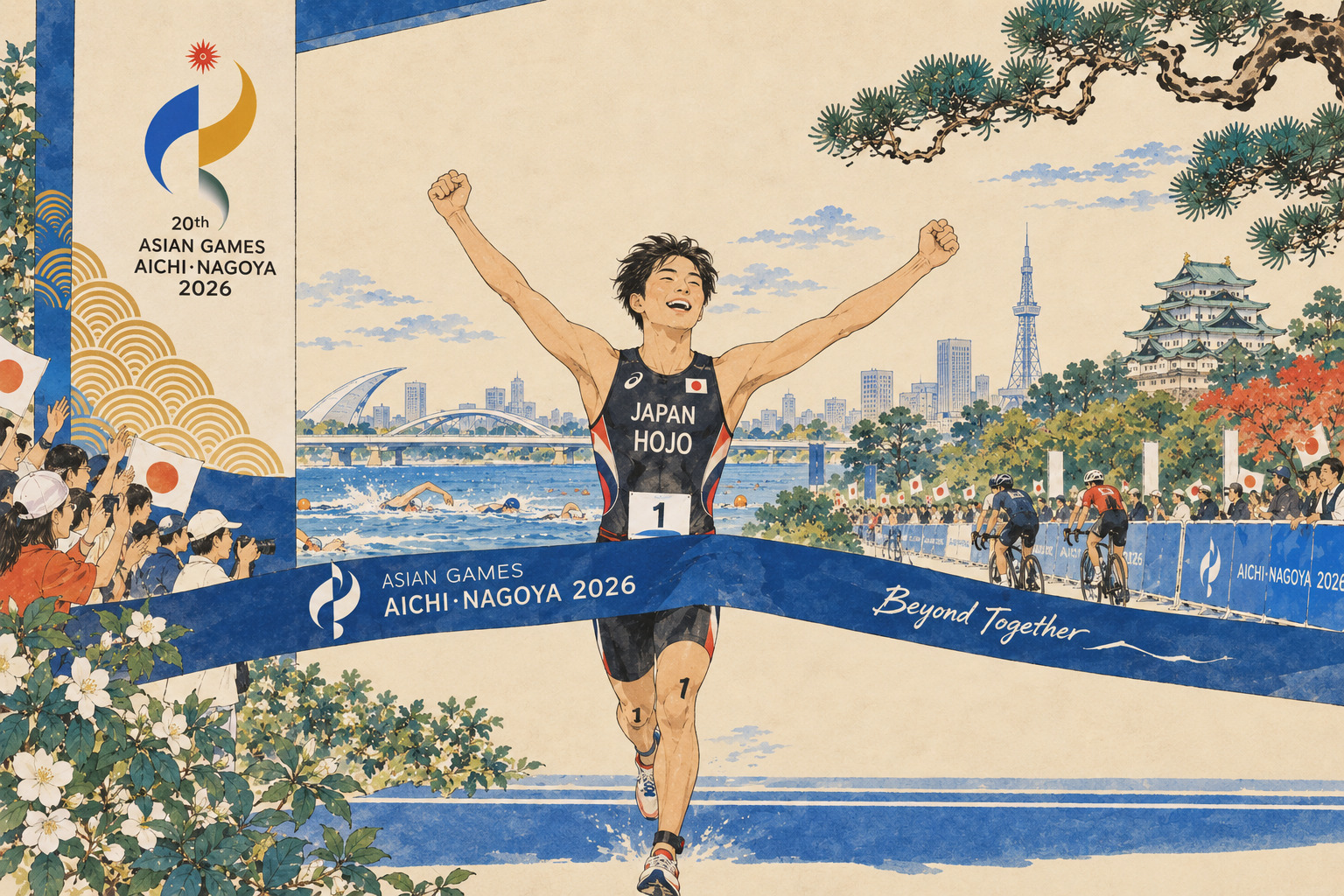
The first gold medal of the Aichi-Nagoya 2026 Asian Games did not come in a stadium or a pool. It came on the waterfront at Gamagori. On the morning of September 20, Japan's Takumi Hojo emerged from the 750-meter swim in fourth position, reached the second transition in fifth, then broke clear over the final five-kilometer run to win the men's individual triathlon in 52:56. China's Zhang Xirui finished nine seconds behind. [1][2][3]
The result was larger than the first gold of the host nation's Games. Japan had won the men's individual Asian Games triathlon in 2010, 2014, 2018 and the Hangzhou 2022 edition held in 2023. Hojo extended that streak to five consecutive Games. [1][8][11]
Later the same day, China's Lin Xinyu won the women's race in 57:37, with Huang Anqi taking silver 21 seconds later. Manami Hayashi, born in nearby Nishio, Aichi Prefecture, earned bronze for Japan in 58:36. China's one-two ended Japan's four-Games run of women's individual gold medals. [1][5][6]
The race was not won in the swim or on the bike
The Gamagori individual race used the sprint format: 750 meters swimming, 20 kilometers cycling and five kilometers running. Hojo did not escape from the water. World Triathlon reports that he was fourth out of the swim and fifth at the end of the bike. The decisive move came on the run. [1][2]
That pattern fits a career that cannot be reduced to one discipline. Hojo spent 14 years in competitive swimming, but only began serious triathlon training after entering Nippon Sport Science University in 2015. He progressed through Asia Cups and U23 racing, won the Japan Championships in 2018 and 2019, returned to the national title in 2024 for a third career championship, and added major international wins along the way. [4][14]
In 2023 he won his first World Triathlon Cup at Yeongdo, the first Japanese men's World Cup victory since 2007. In 2025 he won the Asia Triathlon Sprint Championships and finished the season ranked No. 1 domestically. Gamagori therefore looks less like a single-day upset than a race in which a long-developed skill set came together at the right event. [3][4]
Hojo's own explanation: win through the fundamentals
World Triathlon quoted Hojo saying he felt highly motivated, the rain stayed away and his condition remained strong right through the start. He also said he is not the type of racer who produces a sudden “spark,” so he has to compete by relying on the fundamentals. [2]
The placing data support that self-description. Fourth after the swim and fifth after the bike meant he never allowed the race to get away from him. On the run he created the separation, beating Zhang by nine seconds and Kazakhstan's Arlan Zhanabay by 15. Thirty-three athletes finished or started the men's individual; Japan's other entrant, Aoba Yasumatsu, placed eighth in 54:11. [1][2]
Hojo had already won the dress rehearsal on the same course
The venue was familiar. On September 20, 2025, Gamagori hosted an Asia Triathlon Cup on the same venue used for Aichi-Nagoya 2026. The event functioned as a test event for the Games, and Hojo won the men's race with a finishing surge over New Zealand competitors. [9]
The format was also the same: 750 meters, 20 kilometers and five kilometers. One year later, he raced the course again with the Asian Games title attached to it. [1][9]
Public materials cannot quantify the value of that familiarity. Still, triathlon rewards knowledge of transitions, turns, road surface, wind, positioning and how a pack behaves on a particular course. Winning both the test event and the Games suggests that Gamagori suited Hojo's execution as much as his fitness.
A flat but technical course under Takeshima's gaze
The organizing committee describes the Gamagori course as a swim around a calm inner bay overlooking Takeshima, one of the city's symbols, followed by bike and run circuits that are visually flat but technically demanding. [7]
The individual race consisted of one 750-meter swim lap, three 6.6-kilometer bike laps and two 2.5-kilometer run laps. The sprint format increases the value of seconds lost in transition, cornering and pack positioning because the entire race is much shorter than the Olympic-standard distance. At Hangzhou, for example, the men's individual used 1.5 km swimming, 40 km cycling and 10 km running. [1][11]
Five consecutive Japanese men's golds were won by four different athletes
The streak itself is revealing. Yuichi Hosoda won in Guangzhou 2010 and Incheon 2014. Junpei Furuya won in 2018. Kenji Nener won the Hangzhou 2022 edition in 2023. Hojo won in Gamagori. Four different Japanese men have carried the title across five Asian Games. [8][11]
That is different from one dominant champion holding a title for a decade. It points instead to continuity in Japan's athlete pipeline, selection process and ability to peak for the continental Games.
Hojo himself did not race the Hangzhou individual. Nener won gold there and Makoto Odakura took silver. Hojo's Asian Games title at Hangzhou came in the mixed relay, where he joined Nener, Yuko Takahashi and Yuko Sato to secure Japan's third consecutive relay gold. Gamagori was therefore Hojo's first individual Asian Games title. [10][11]
From relay champion at Hangzhou to individual champion at home
Japan's mixed relay win in Hangzhou in October 2023 extended a streak that had begun in Incheon 2014 and continued in Jakarta-Palembang 2018. [10]
Before Aichi-Nagoya, Triathlon Japan highlighted a rare triple streak: Japanese men had won four consecutive individual titles, Japanese women four consecutive individual titles, and Japan had won three consecutive mixed relays. Gamagori produced a split outcome. Hojo extended the men's run to five. China ended the women's run. The following morning China also took the mixed-relay gold, leaving Japan with silver. [6][8][12]
Japan did not retain all three titles, but it did medal in every triathlon event at these Games: Hojo's gold, Hayashi's bronze and the relay silver.
The morning after gold, Hojo anchored Japan to relay silver
On September 21, the mixed relay used four legs—woman, man, woman, man—with each athlete completing a 300-meter swim, 6.6-kilometer bike and two-kilometer run. Japan selected Mahoro Hiraizumi, Rishin Jozuka, Manami Hayashi and Hojo, in that order. [12]
China won in 1:25:54. Japan finished 51 seconds back in 1:26:45, with Hong Kong China third. Hojo returned to the course less than a day after his individual victory and collected his second medal of the Games as the final Japanese athlete. [12]
At Hangzhou, Japan had beaten China to relay gold. In Gamagori, the order reversed. Hojo preserved Japan's men's individual dominance, while China changed the balance in the women's race and relay.
Manami Hayashi's bronze is more than a hometown medal
Hayashi was born on November 5, 2004 and comes from Nishio, Aichi Prefecture. She is a student at Nihon Fukushi University and competes with NTT East and NTT West support. She swam from childhood, began running for a school road race and entered aquathlon before being introduced to triathlon around fifth grade. [5]
At 17, while still in high school, she became the youngest champion in Japan Triathlon Championships history in 2022. She won four Asia Continental Cup races in 2024, ranked No. 1 domestically in both 2024 and 2025, and placed fourth at the 2025 U23 World Championships. [5]
In Gamagori, however, the Chinese pair were stronger. Lin Xinyu led the swim, ran the final five kilometers in 16:36 and won in 57:37. Huang Anqi finished in 57:58. Hayashi took bronze in 58:36, 59 seconds behind the winner. [1][6]
World Triathlon quoted Hayashi saying that competing in this home race had been a goal and that the support she received was deeply moving. [6]
China ends Japan's four-Games women's streak
Japan's women's individual title run stretched from Mariko Adachi in Guangzhou 2010 to Ai Ueda in 2014 and Yuko Takahashi in both 2018 and the Hangzhou edition. Lin Xinyu's victory ended that sequence. [6][8]
That does not make Hayashi's bronze a simple story of decline. She is 21 and part of the generation building toward Los Angeles 2028. Gamagori offered a precise competitive reference point: China occupied the top two places, and Hayashi was 59 seconds from gold over a sub-hour sprint race.
The gold medal is not solid gold
Aichi-Nagoya's gold medal is 80 millimeters in diameter, five millimeters thick and weighs about 265 grams. It is made of pure silver with at least one gram of gold plating. The organizers also used some metal recovered from small electronic devices through the Games' recycling-medal project. [13]
The design was inspired by the Games slogan, “IMAGINE ONE ASIA,” and developed through repeated experiments breaking ceramic discs to find the final irregular form. The medal case is made from Aichi-grown hinoki. These details do not change the result, but they show how the host region tried to turn the medal into a local object as well as an international sporting award. [13]
Asian champion does not yet mean world-front-runner
The Asian Games title is significant, but it should not be conflated with world-level dominance. World Triathlon listed Hojo at No. 51 in the world rankings and No. 50 in the 2026 World Triathlon Championship Series rankings around the time of the Games. His recent WTCS results included 19th in Weihai and 28th in London. [3]
World Triathlon's race report also noted that he had struggled for consistency since his Hangzhou relay gold. That makes Gamagori particularly valuable: it was a target event, at home, with expectation, and he delivered. [2]
But times from a sprint race in Gamagori cannot be compared directly with results from another venue or a standard-distance world event. Course design, weather, pack dynamics and distance all change the race.
His first individual Asian Games title came at age 30
Hojo was born April 7, 1996 and was 30 at these Games. He grew up in Kitamoto, Saitama Prefecture, attended Kumagaya High School and Nippon Sport Science University, and came to triathlon after 14 years in swimming. [4][14]
He won his first national title in 2018, repeated in 2019, won a World Cup in 2023, regained the Japanese championship in 2024, won the Asian sprint title in 2025 and then, in 2026, upgraded his Asian Games history from relay champion to individual champion.
That progression matters because triathlon is not simply swimming plus cycling plus running. Pack riding, transitions, race positioning, course reading and pacing have to be learned together. Hojo's 11 years in the sport are also the story of converting a swimmer's base into a complete elite triathlete.
The pressure of being the Games' first gold-medal opportunity
Triathlon was scheduled early enough that organizers and Triathlon Japan promoted the men's event as the competition that would decide the first medal of the Games. For the host nation, the first gold carried symbolic weight beyond the sport itself. [8]
Hojo said afterward that winning the first gold gave the Japanese team momentum and allowed him to pass the baton to the women and relay teammates. [2]
The baton did not produce three Japanese golds. It did produce medals in all three triathlon events.
What the public results do not establish
The official summaries confirm the final results, race distances and, through World Triathlon, Hojo's position after the swim and bike. The Japanese primary sources reviewed for this article do not publish a full set of official split times for Hojo's swim, bike, transitions and run. Japan.co.jp therefore does not reconstruct or estimate those splits.
Nor can the value of winning the 2025 test event, the effect of the home crowd, or the benefit of dry weather be measured from public data. Those are relevant context, not quantifiable causes.
A streak preserved—and a balance of power changed
The two days in Gamagori showed continuity and change at the same time.
Hojo preserved Japan's five-Games men's individual gold streak and delivered the host nation's first gold medal. Hayashi took bronze in the race that ended Japan's women's four-Games winning streak. The next morning, China took the relay title and Japan silver. [1][6][12]
If the historical headline is Japanese men's dominance, the future-facing story is more complicated: Hayashi is 21, China's women have arrived at the top, the relay hierarchy has shifted, and Hojo's next challenge remains converting continental success into more consistent world-series results.
His 52 minutes and 56 seconds in Gamagori were one race and one gold medal. They also carried forward a Japanese men's Asian Games streak that now stretches across more than 15 years.
Sources & documents
- Triathlon Japan: Takumi Hojo wins the Games' first gold; Manami Hayashi takes bronze (Sept. 20, 2026; Japanese primary source)
- World Triathlon: Japan's Takumi Hojo claims first gold of Aichi-Nagoya 2026 Asian Games (Sept. 20, 2026)
- World Triathlon: Takumi Hojo athlete profile and results
- Triathlon Japan: Takumi Hojo athlete profile
- Triathlon Japan: Manami Hayashi athlete profile
- World Triathlon: Champion Lin Xinyu leads China one-two at Asian Games (Sept. 20, 2026)
- Aichi-Nagoya 2026: Gamagori City Triathlon Venue
- Triathlon Japan: Aichi-Nagoya 2026 triathlon preview and Japanese team history
- Triathlon Japan: 2025 Gamagori Asia Triathlon Cup results—Hojo wins test event
- Triathlon Japan: Japan wins Hangzhou 2022 Asian Games mixed relay
- Triathlon Japan: Hangzhou 2022 men's result and Japan's four-race individual gold streak
- Triathlon Japan: Japan takes mixed-relay silver at Aichi-Nagoya 2026 (Sept. 21, 2026)
- Aichi-Nagoya 2026: Medal design and materials
- Triathlon Japan: 2024 Japan Championships program—Takumi Hojo profile