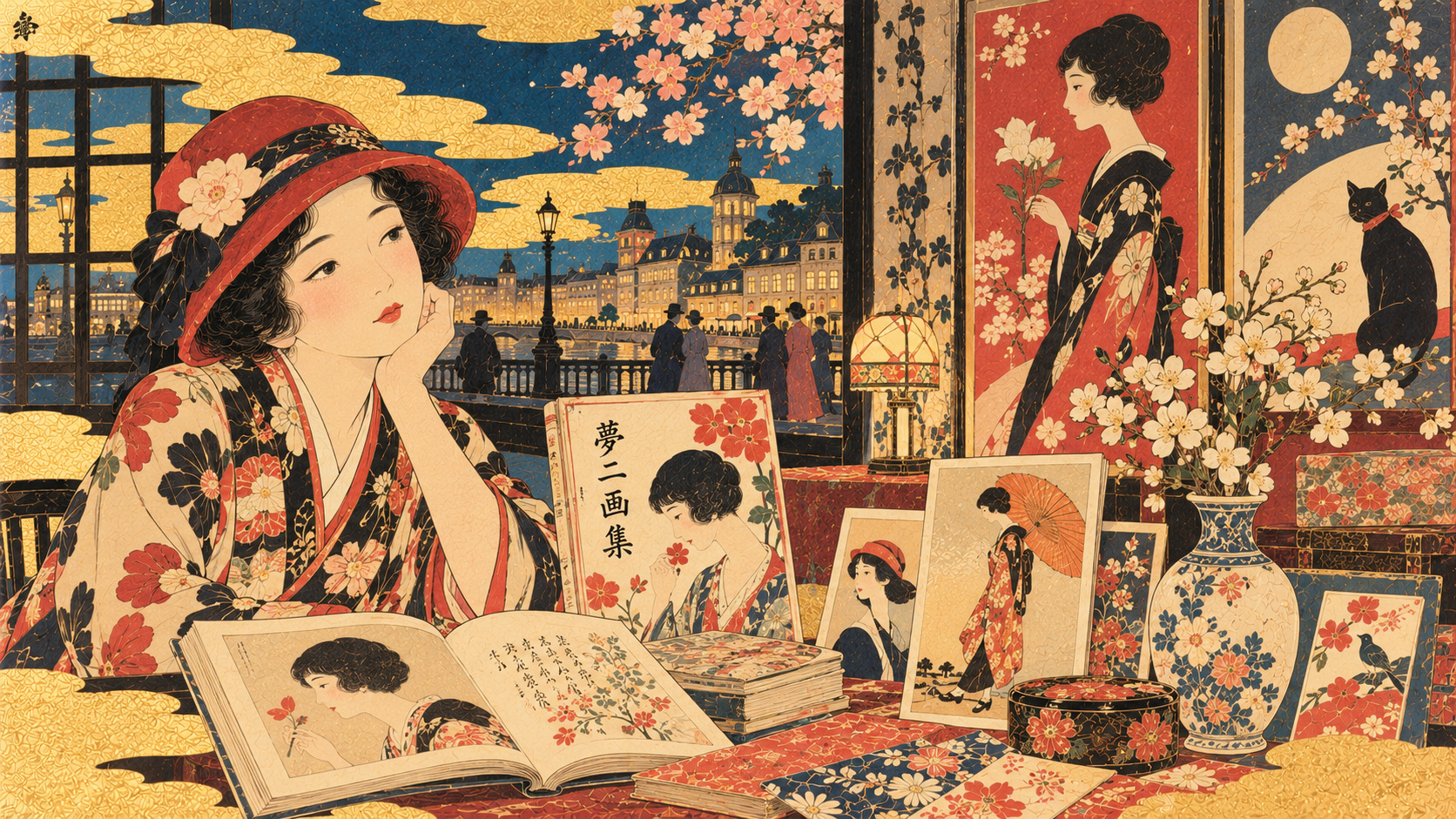
Yumeji’s revolution was not confined to the painted woman. He helped make beauty something people could buy, wear, read and carry.
The woman, the black cat, and a city looking back
A woman in a yellow kimono sits holding a black cat. Black, gold, orange and green meet in a composition that feels both intimate and deliberately modern. Kurofuneya, the painting Takehisa Yumeji made in 1919, has returned to a Tokyo exhibition after roughly four decades, according to the organizers. It is the arresting centerpiece of Takehisa Yumeji: An Artist Who Defined His Era, which opened October 23 at the National Museum of Modern Art, Tokyo.
But the picture offers a misleadingly narrow introduction to its maker if it is treated as the whole story. Yumeji worked in illustrated magazines, poetry, sheet music, retail design, textiles, postcards and disaster sketches. This new exhibition presents approximately 500 works and related materials. Its most provocative question is not who his ideal woman was, but how art became something millions could encounter in ordinary life.
A museum exhibition about a world beyond museums
The exhibition gathers material from major collections around Japan, including the Takehisa Yumeji Ikaho Memorial Museum and Yumeji Art Museum. Its five sections follow his early images, commercial design, hybrid visual language, unrealized visions of art and everyday living, and changing depictions of modern women. Some works rotate between the first and second exhibition periods.
Why show envelopes, handkerchief patterns, sheet-music covers and scrapbooks beside paintings? Because the boundaries between fine art and the designed object obscure how Yumeji reached his public. A postcard traveled; a patterned sheet of paper was bought and used. In those moments, a painter was participating in a much larger conversation about taste, identity and the democratization—and commercialization—of beauty.
Before the celebrity, an ambitious young contributor
Born in Okayama Prefecture in 1884 as Takehisa Mojirō, Yumeji moved to Tokyo in 1901 at 17. According to the official exhibition history, he struggled financially, submitted work to publications and began making drawings and text for newspapers and magazines. The show traces that development through a 1905 illustration in the political journal Chokugen and editions of his picture collection Yumeji gashū, first issued in 1909.
His elongated female figures, large eyes and interiorized expressions came to be called Yumeji-shiki, or the Yumeji style. They did not simply document how Japanese women looked. They established a recognizable commercial and emotional image for a rapidly changing society, a visual language that readers could identify from one publication to the next.
What Taishō romance leaves out
Yumeji is routinely associated with Taishō romanticism, a blend of nostalgia and modern life. The phrase is useful, but it can turn a complex career into a picturesque period style. His art absorbed earlier Japanese print traditions alongside European-looking silhouettes, fashionable textiles and the expanding circulation of commercial magazines. A single image might seem old-fashioned in its pose and startlingly contemporary in its layout.
Organizers suggest that the black cat in Kurofuneya evokes a folk belief linking cats with recovery from tuberculosis and may refer to his ill lover Hikono. That is a curatorial interpretation, not a verified transcription of Yumeji’s intention. The painting can hold personal meaning without a reporter presenting every biographical association as established fact.
In 1914, the artist opened a shop
In Tokyo’s Nihonbashi district, Yumeji opened Minatoya Ezōshiten in 1914. Rather than consigning his work solely to galleries, he sold paper designs, envelopes, handkerchiefs, fans, clothing patterns and related goods. The exhibition includes Minatoya-produced primrose-patterned paper from 1914–16 and a design for a decorative kimono collar with red berries and a bird. They demonstrate a designer attentive to repeatable patterns and to how images worked when handled and worn.
The shop was also a gathering place for younger artists and writers, according to exhibition documentation. It invites comparison with the broader evolution of modern graphic design, but the evidence does not justify claiming Yumeji invented branding or originated every practice recognizable in modern design retail. What he did demonstrably accomplish was to make artistic authorship visible across a connected range of consumer objects.
Printed songs, private feelings
The exhibition includes a Senoo sheet-music publication bearing the title Machiyoigusa, issued in 1921, with its first edition dated 1918. Yumeji also wrote the lyrics to the well-known song Yoimachigusa. Japanese source titles and the song title are not always written identically; they should be kept distinct rather than standardized carelessly.
A sheet-music cover is a small but potent cultural object. It is both a practical interface for performance and an advertisement for a mood. Yumeji’s association with songs reminds us that illustration, words and music were not separate channels to a young urban audience. Together they created a marketplace of feeling in which images could become instantly familiar.
The earthquake shattered more than buildings
The Great Kantō Earthquake of September 1, 1923 destroyed vast sections of Tokyo and Yokohama and disrupted the world of publishing and retail on which Yumeji depended. His Earthquake Sketch: Tsukiji Trinity Church, dated 1923 and listed in the show, recalls that an artist celebrated for wistful elegance also recorded traumatic events.
It would be simplistic to say the disaster alone ended his popularity, and the exhibition does not establish a single cause for the shift. But the contrast between romantic images and earthquake documentation places him inside history rather than outside it. This was an artist affected by the same upheavals that changed where people lived, how they dressed and what they expected of modern culture.
Haruna: the art community that never opened
In later years, Yumeji developed a vision for an art research institute near Mount Haruna in Gunma Prefecture, combining making, craft, nature and everyday living. He also designed a home and studio known as Shōnen Sansō, where he explored creative dolls. Harunasan-fu and Tatsutahime, both dated 1931 and featured in the exhibition, evoke the broader concerns of his late work.
Crucially, the proposed Haruna art institute did not come into existence. Travel to study industrial art abroad delayed the initiative, and it remained unrealized. That distinction gives the story its tension: an artist experienced at distributing fashionable goods imagined a place where craft and daily life might be joined in a different, perhaps more deliberate way.
A visual history of the “modern girl”
The show ends with women who wear Western clothes and short hair, who pair fashionable waves with kimono, or who use imported-looking accessories. In these images, Yumeji’s earlier signature type changes with the possibilities and pressures of urban life in the late Taishō and early Shōwa years.
A woman’s representation is not the same as her testimony. These pictures were made by a male artist within particular commercial systems, and they tell us as much about the gaze of consumers and publishers as they do about changing women’s lives. Rather than celebrating them as an uncomplicated story of liberation, readers can ask whose taste was being sold, and who was able to choose the fashions on display.
Original paintings and printed objects tell different stories
Kurofuneya is dated 1919 and held by the Takehisa Yumeji Ikaho Memorial Museum. Other showcased paintings include Autumn Repose (Aki no ikoi), 1920, held by the Yumeji Art Museum, and Kurunkan, 1918, in a private collection and listed for the Tokyo and Osaka venues. The object information matters: it separates an actual work included in this show from a tempting but unrelated picture commonly associated with Yumeji.
Stand before a painting and the subtlety of a brushstroke matters. Handle a printed design, and the relationship between art and everyday use is transformed. Those are not competing forms of meaning. The exhibition’s scale allows audiences to trace ideas as they moved between single paintings, repeated printing and products intended to circulate widely.
A viewing guide, with dates that actually matter
The Tokyo exhibition opened October 23, 2026 and runs through January 11, 2027. The first display period closes November 23; the second begins November 25. The museum closes November 24 and December 28 through January 1, as well as most Mondays, with exceptions on November 23 and January 11. Hours are 10 a.m.–5 p.m., extended to 8 p.m. Fridays and Saturdays; entry closes 30 minutes earlier. Day-of-admission tickets are ¥2,100 for adults, ¥1,200 for university students and ¥700 for high-school students, with exceptions outlined by the organizer.
The roughly 40-year interval cited for Kurofuneya concerns its appearance in exhibitions, according to the organizers. It does not mean that no one has viewed the painting for four decades. Visitors should consult the official work listings before traveling, especially if a specific painting matters to them, because the show changes some displays partway through its run.
An artist who understood how images travel
It is easy to turn Yumeji into a shorthand for nostalgic Japanese beauty. Harder—and more rewarding—is to see a working artist navigating new markets, developing recognizable images, recording catastrophe and dreaming of a craft-centered future. His significance is not that he foresaw every part of modern design culture, but that he participated in a moment when art escaped the frame and entered daily exchange.
In an age of screens, reproduced images, merchandise and shared visual identities, Yumeji’s story feels contemporary without needing invented parallels. The durable question is what happens when art becomes part of ordinary objects—and who gets to shape the desire those objects carry.
Sources and reporting notes
Verified against organizer and museum exhibition materials. Approximately 500 is the organizers’ estimated total; individual work displays may rotate. No original interviews or onsite reporting.