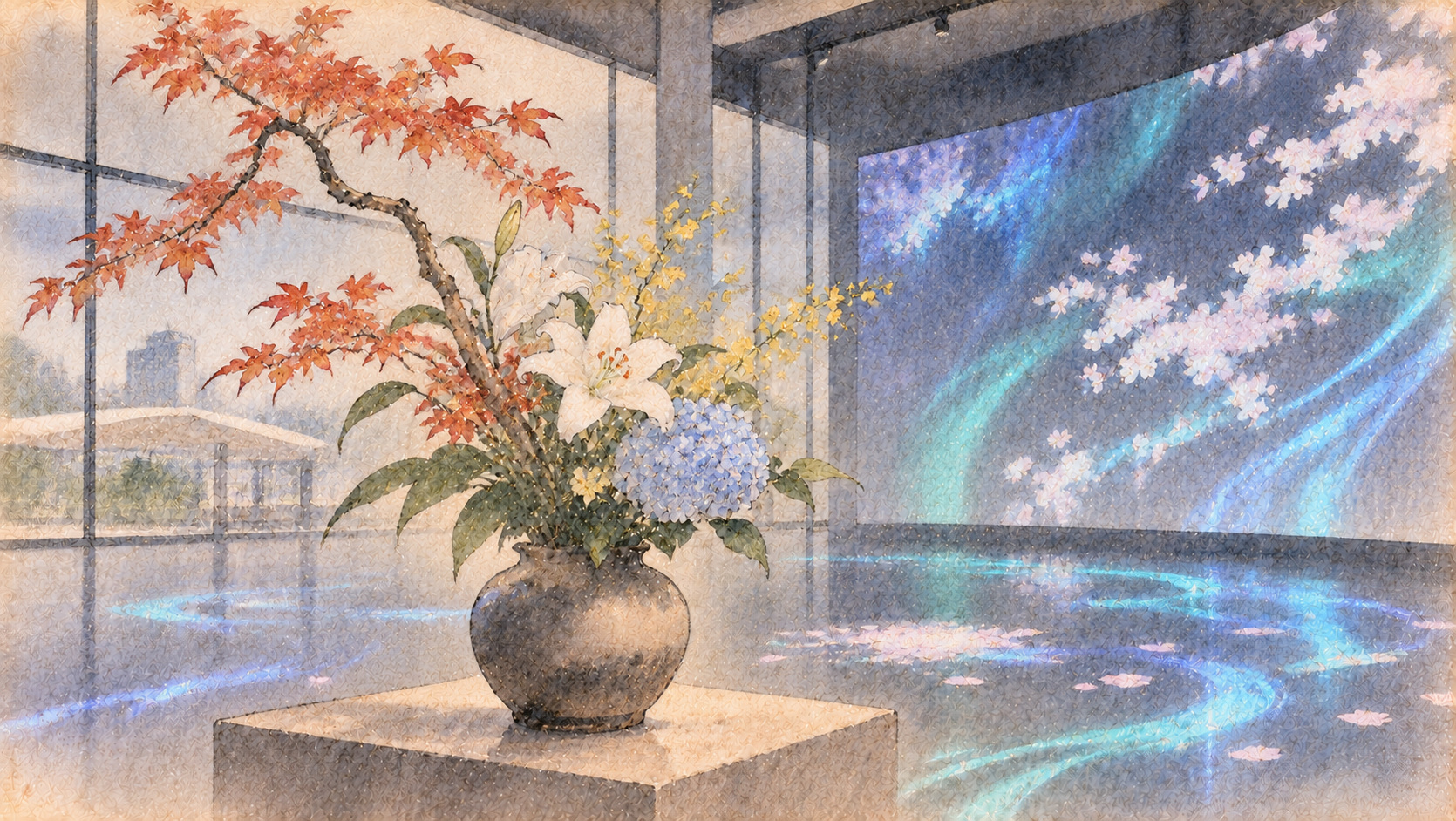
- An arrangement of flowers meets a programmed world
- Inside the exhibition: four free works and a separate fourth floor
- Laser sculpture and an altered language of flowers
- Painting with moving liquids and composing repetition
- The 1688 textile house and electronic art
- A dry garden, a human voice and a sliding screen
- A new museum in a railway city
- The longer history of Japan’s hybrid aesthetics
- Does immersion deliver understanding?
- What visitors should know — and what is not yet verified
An arrangement of flowers meets a programmed world
An ikebana arrangement is not simply a collection of flowers. Space between stems, the direction of a branch and the passing life of the plant help determine what an observer perceives. An audiovisual installation also organizes space and time, but with projected light, sound and software. The meeting between these disciplines raises a question more demanding than whether old and new look beautiful together: can digital media reveal something about inherited artistic knowledge that a conventional display leaves unseen?
That is the proposition of ETERNAL Art Space Exhibition 2026, RESONANCE — Tradition Reimagined, presented at MoN Takanawa in Tokyo from November 20 through 23. Organized by MUTEK Japan and co-organized by East Japan Railway Company, it places contemporary installations alongside references to flower arrangement, Nishijin textiles, Japanese gardens and shoji screens. The organizers call this a meeting of cultural heritage and digital creativity; whether it succeeds aesthetically remains a question for audiences and critics rather than an established fact.
Inside the exhibition: four free works and a separate fourth floor
The second-floor entrance lobby and third-floor Land Lab and Sun Lab offer free installations. The upper Tatami floor has an audiovisual program costing ¥1,000 per session as well as a free spatial-audio experience for which advance reservations are required. The overall event runs four days, November 20–23, but the fourth-floor program ends November 22. The organizers stress that general MUTEK.JP passes do not provide access to this separate Tatami experience.
This distinction matters. A visitor who sees the word “free” in an event listing may discover that the particular work they hoped to see requires a reserved place or payment. Published schedules vary by floor and date, and the last session on Sunday is earlier than the general closing time. The organizer’s programme, not a general description of the museum, should govern a visit.
Laser sculpture and an altered language of flowers
Shohei Fujimoto’s intangible #form occupies the entrance lobby. Its laser-generated geometry suggests volume without relying on an ordinary solid sculpture. In a place devoted to “narratives,” the work asks a deceptively simple question: when does an arrangement of light become something people experience as an object?
On the third floor, Interpreted Scape is presented by ike-bana, a collaborative initiative involving the Ikenobo school of flower arrangement and creative partners. The historical practice of ikebana gives form to asymmetry, seasonality and the relationship between an object and the space around it. Reframing that practice for a contemporary installation need not mean replacing flowers with digital spectacle. It can instead expose the decisions that have long made an arrangement expressive.
Painting with moving liquids and composing repetition
Akiko Nakayama’s Hemispherical Portraits draws on the movement of ink, bubbles and liquids. Unlike a painting fixed when the brush leaves the paper, a moving fluid artwork lets the physical behavior of its materials participate in the image. The result can be read in conversation with Japanese traditions that value changing seasons and the evidence of time, although the exhibition is not claiming that all such traditions are identical.
FLIGHTGRAF’s LOOP uses light, motion and sound to explore repetition. That word can suggest an endless mechanical cycle, but cycles also characterize music, weaving and practices of sustained attention. A display description can identify its method and intention; it cannot establish exactly how visitors will feel while standing before it.
The 1688 textile house and electronic art
Perhaps the exhibition’s most compelling historical collision is WAVE WEAVE, made by Carsten Nicolai in collaboration with Kyoto textile maker HOSOO. According to HOSOO’s own company history, its roots reach back to 1688 in Nishijin, a district associated with elaborate yarn-dyed weaving. Production traditionally involves numerous specialized steps and a division of skilled labor. For generations those processes have preserved knowledge in the hands, eyes and judgment of craftspeople.
Nicolai’s artistic world takes shape through sound, pattern and electronic systems. A textile, too, is an organized pattern of repetitions and variations, but it is also material, tactile and painstakingly made. This suggests a genuine critical question: can a new audiovisual work help audiences appreciate the intelligence embedded in a woven surface rather than treating centuries of craft merely as luxurious visual texture? The sources establish the collaboration, not a measurable cultural outcome.
A dry garden, a human voice and a sliding screen
Hyperbolic Scape, by Shuhei Matsuyama and Tetsuji Ohno, takes inspiration from karesansui, the Japanese dry landscape garden. Such gardens use rocks, gravel and carefully arranged space to evoke landscape without literally reproducing it. Digital reimagining therefore encounters an aesthetic already built on abstraction. The challenge is whether animation deepens imagination or simply supplies an image where earlier viewers were free to invent one.
Hatis Noit’s Aura builds on layers of the artist’s own voice. A separate installation, Awai Ma, uses the Yamaha Group’s Sound xR spatial-audio technology, with changes in light, imagery and sound responding to the opening and closing of shoji screens. The Japanese term awai evokes an interval or in-between space. Here, the threshold separating one room from another becomes an instrument for experiencing sound and perception.
A new museum in a railway city
MoN Takanawa opened on March 28, 2026, within TAKANAWA GATEWAY CITY. Its operator, the JR East Cultural Foundation, describes the complex as an experimental cultural museum. The name MoN carries the Japanese associations of mon, a gate, and mon, a question. Rather than presenting art, science and technology as separate worlds, the museum says it wants programs that make those categories interact.
This setting is especially suggestive. Rail stations have long coordinated the circulation of people and goods; here, a major railway developer is also investing in the circulation of ideas. Such programming may enrich a district’s public cultural life. It does not automatically establish that the space is socially accessible, artistically successful or financially sustainable. Those conclusions require years of audience experience and transparent evaluation.
The longer history of Japan’s hybrid aesthetics
There is a temptation to describe any fusion of traditional technique and computers as unprecedented. Japanese art history argues for greater caution. Decorative screens, textile patterns, gardens, theatrical staging and modern media have repeatedly adapted older forms to unfamiliar materials and audiences. Meiji-era painters confronted new technologies of reproduction and new systems of exhibition; postwar artists experimented with electricity, moving images and performance.
What distinguishes this show is not that heritage is meeting technology for the first time, but the specific artists, tools and institutions brought together over four days: an ikebana collaboration, a centuries-old Nishijin maker, laser sculpture, moving pigments and spatial audio. These differences deserve attention because the word “innovation” can obscure the actual process of making a work.
Does immersion deliver understanding?
Immersion is often treated as an artistic virtue in itself. Yet a bright projection or powerful sound system can overwhelm as easily as it can illuminate. A critical appraisal should ask what visitors learn about craft processes, historical choices and the makers involved, not merely whether a space feels spectacular. The distinction is particularly important when a commercial partner or technology supplier helps present an experience.
There is also an access question. Some work is free, some ticketed, and some free only with advance booking. Bright or loud environments may not suit every visitor. An innovative museum experience is not judged solely by the sophistication of its equipment; the clarity of its interpretation and the accessibility of its program also matter.
What visitors should know — and what is not yet verified
The official venue address is 3-16-1 Mita, Minato-ku, Tokyo. The museum lists a six-minute walk from the north ticket gate of Takanawa Gateway Station or approximately three minutes from Sengakuji Station Exit A4. The exhibition is scheduled for November 20–23, with the fourth-floor installations ending November 22. Visitors should consult the official website for session-specific booking requirements and any subsequent changes.
This report is based on the official programme, the organizer’s announcement, the museum’s institutional history and HOSOO’s company record; it is not an eyewitness review of the installations. The exhibition offers a distinctive way to consider an old dilemma: preservation can protect cultural knowledge, but renewal asks whether that knowledge can speak in forms that people have not yet learned to recognize.
Sources and reporting limitations
This analysis relies on published organizers’ programme information, the museum’s own institutional material and HOSOO’s company history. No on-site viewing or independent artist interviews were conducted. Announced schedules, admission arrangements and artistic intentions may change; descriptions do not constitute independent critical verification.