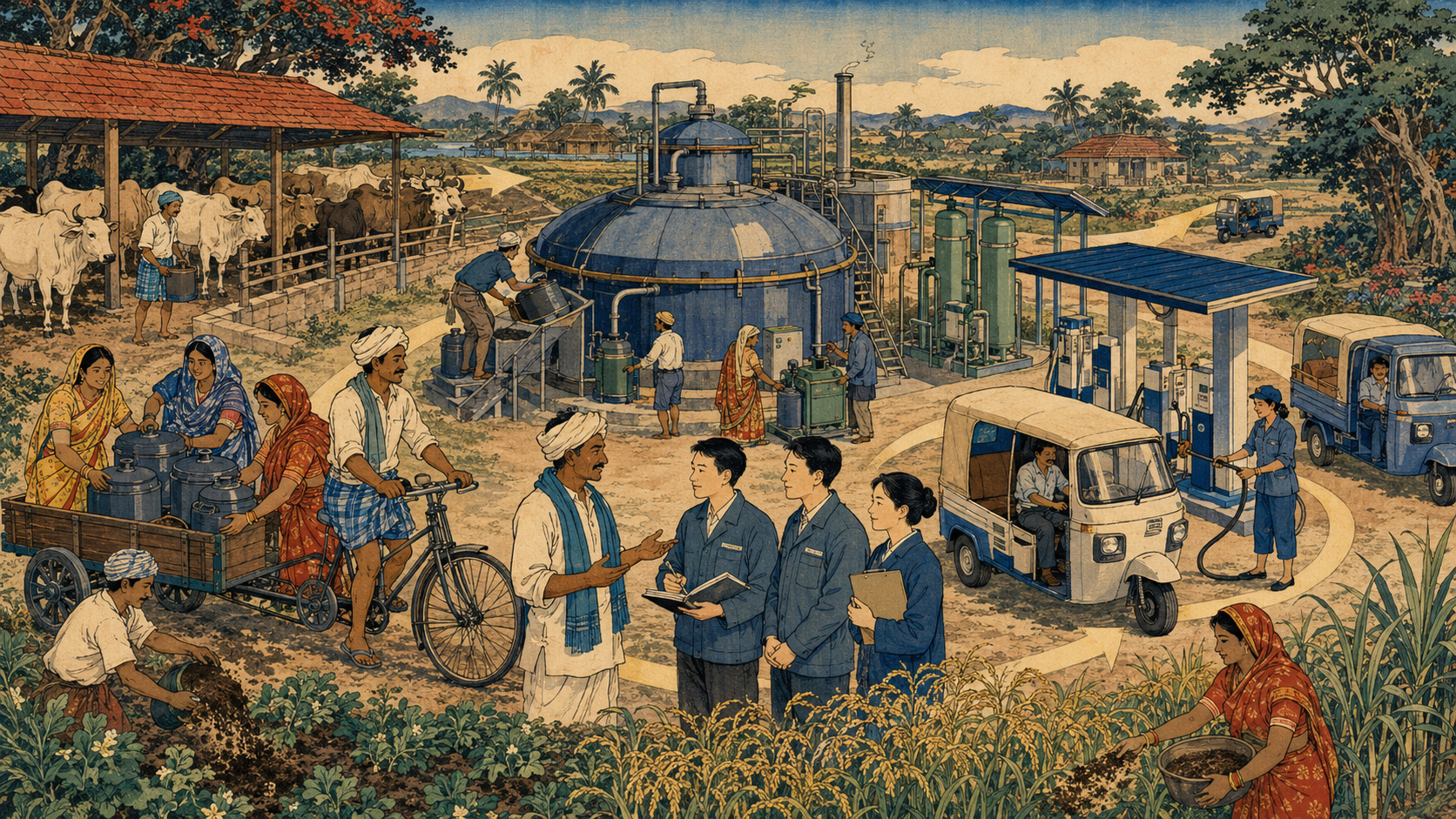
Before sunrise, a second commodity leaves the cowshed
Before the heat settles over Banaskantha, milk begins its daily journey. A farmer pours the morning yield into a village cooperative’s collection system. The milk is tested, weighed, chilled and joined with the production of thousands of other households. That disciplined chain—small quantities gathered into an industrial river—helped turn a dry district of Gujarat into one of India’s great dairy regions.
Now another material is being assigned a price and a route. Cattle dung that might be dried for fuel, spread on fields, left in a heap or washed into drains can be collected and carried to an anaerobic digester. Microbes break down its organic matter without oxygen. The resulting gas is cleaned, enriched in methane and compressed. A Suzuki Wagon R designed for CNG need not know whether its methane came from an underground gas field or yesterday’s cattle feed.
This is Suzuki’s most unusual Indian strategy. A Japanese automaker is not merely changing a car. It is trying to make fuel, fertilizer, farm income and rural mobility parts of one local circuit. Japan’s 2026 White Paper on International Economy and Trade gives the effort a five-page corporate case because it represents a broader proposition: foreign investment can endure when it solves a host country’s problems rather than simply selling into its market.
What exists today
The first commercial Banas Suzuki Biogas Plant opened at Agthala in Gujarat’s Banaskantha district on December 6, 2025. The second opened at Bhukhala on January 18, 2026. Suzuki R&D Center India, the National Dairy Development Board and the Banas Dairy cooperative built the partnership.
Each site is designed to handle as much as roughly 100 tonnes of cattle dung a day and produce about 1.5 tonnes of compressed biogas. Each has an attached filling station, and the digested residue is to be sold as organic fertilizer. Suzuki equates one plant’s daily fuel with the needs of about 850 CNG cars, assuming a Wagon R CNG efficiency of 33.47 kilometres per kilogram and 60 kilometres of driving per car per day.
Together, the two rated plants imply 200 tonnes of dung entering daily, three tonnes of CBG leaving, and fuel for roughly 1,700 vehicle-days. These are design and conversion figures published by Suzuki, not independently audited annual production. Commissioning a digester is different from keeping it full, maintaining gas quality and selling every kilogram through monsoon, drought and market changes.
The White Paper’s five-page argument
METI’s 2026 Trade White Paper places Suzuki on pages 423–427 in a column on investment strategy in India. It begins in 1982, when Osamu Suzuki pursued India’s national-car project, and ends at the two biogas plants. The structure is deliberate: the ministry argues that Suzuki became accepted not only through a low-cost product but by reading public priorities and investing alongside India.
The white paper reports that India represented about 42% of Suzuki’s consolidated sales in its cited corporate profile, and that Maruti Suzuki held roughly 40% of India’s 2025 passenger-vehicle market. It presents biogas as the next version of the company’s “By Your Side” philosophy: purchase a rural waste material, sell locally made fuel into a large CNG fleet, return organic fertilizer, reduce imported gas and create employment.
Government white papers are policy narratives, not independent project audits. METI repeats plant capacity and benefit estimates supplied by Suzuki and cites outside sources for population, methane and energy-security context. The case is genuinely present and substantial; its positive framing still needs to be tested against operating data.
Inside the digester: four microbial acts
Anaerobic digestion is old biology engineered into a controlled vessel. In hydrolysis, complex organic material is broken into smaller compounds. Acid-forming microbes convert those compounds into organic acids. Acetogenic organisms produce acetate, hydrogen and carbon dioxide. Methanogenic archaea make methane. Temperature, acidity, water, retention time, mixing and feed consistency determine whether the microbial community remains productive.
Raw biogas is not ready for a vehicle. It contains methane and carbon dioxide along with water vapour, hydrogen sulphide and trace contaminants. Upgrading removes much of the carbon dioxide and impurities; drying and compression create biomethane that can meet a fuel specification. India’s Bureau of Indian Standards maintains IS 16087 for biogas/biomethane.
The solids and liquids left behind are digestate. They retain plant nutrients and organic matter, so they can become fertilizer or soil improver. But “organic” does not automatically mean agronomically perfect. Nutrient content, pathogens, salts, heavy metals, application rate, storage and farmer demand all need control. A plant that cannot sell or responsibly return its digestate has converted one waste problem into another.
CNG and CBG: same molecule, different story
| Fuel | Origin | Vehicle and climate meaning |
|---|---|---|
| CNG | Natural gas extracted from fossil reservoirs, then compressed | Established Indian vehicles and stations; lower tailpipe CO₂ than petrol in many comparisons, but still fossil carbon |
| Raw biogas | Anaerobic digestion of manure, crop residues, food waste, sewage or other organic matter | Contains CO₂, water and contaminants; normally must be upgraded before vehicle use |
| CBG / biomethane | Biogas cleaned to a methane-rich specification and compressed | Can use compatible CNG engines and distribution; lifecycle benefit depends heavily on feedstock and methane leakage |
| CBG blend | Biomethane mixed into fossil natural gas | Allows gradual substitution without replacing every vehicle or station at once |
The chemical compatibility gives Suzuki an unusual advantage. Its March 2026 India presentation said 15 of 19 Maruti Suzuki models offered a CNG version and put the company’s share of passenger CNG sales at 71% for April–December 2025. It counted about 8,000 CNG stations. India’s gas regulator later reported 8,980 stations as of May 2026 across 312 geographical areas.
That installed base turns biomethane into a fuel problem rather than a vehicle-replacement problem. A new charging network, battery supply chain or customer habit is not required for each kilogram. But the bridge can lock in combustion vehicles and fossil CNG if biomethane volumes remain small. Calling a CNG-capable car “CBG-ready” describes compatibility; it does not prove that renewable gas reaches its tank.
The arithmetic behind “850 cars”
Suzuki’s calculation is transparent enough to reconstruct. A car travelling 60 kilometres at 33.47 kilometres per kilogram uses about 1.79 kilograms of gas. Multiply by 850 and the result is approximately 1.52 tonnes—close to the plant’s stated daily output.
The result is a vehicle-day, not 850 permanently supplied cars. Drive 30 kilometres and the fuel reaches twice as many daily users; drive 120 and it reaches half. Actual energy value, station losses, vehicle efficiency and gas quality matter. At full rated output, the two plants would produce about 1,095 tonnes of CBG a year if they ran 365 days without interruption—an upper-bound arithmetic figure, not a reported annual total.
The feedstock side is equally revealing. One hundred tonnes of dung is 100,000 kilograms every day. If a collected animal contributes around ten kilograms, one plant needs the daily recoverable output of roughly 10,000 animals. Suzuki has summarized the relationship as about ten to twelve cattle supporting one vehicle-day. That density is available in a great dairy district, but only a cooperative-scale logistics system can gather it economically.
Long before fuel, Gujarat learned to aggregate milk
The institutional ancestor of Suzuki’s gas plants is not an oil refinery. It is Amul. In 1946, milk producers around Anand organized to escape private traders and sell collectively. Village societies joined district unions; professional managers handled processing and marketing; farmers retained representation and received a regular market.
The National Dairy Development Board was established in 1965. Operation Flood began in 1970 and extended the “Anand pattern” across India. European dairy commodities financed early infrastructure; a national milk grid connected rural producers to urban consumers. By the end of its second phase in 1985, the programme counted 43,000 village cooperatives and 4.25 million milk producers. Its third phase concluded in 1996 after strengthening animal health, feed, artificial insemination and member education.
India’s White Revolution did more than increase litres. It created routes, quality tests, payment systems, village institutions and trust. Those are the hidden assets of a dung-to-gas project. Anaerobic digestion is mature technology. Persuading thousands of farms to supply uncontaminated feedstock every day, paying them fairly and returning fertilizer is the harder social machine.
Banas Dairy: prosperity built in dry country
Banaskantha was not an obvious industrial centre. Banas Dairy’s own history describes a dry, economically marginal district. Founder Galbabhai Nanjibhai Patel began organizing eight village milk societies in 1966. The union was registered in 1969, and its dairy plant began operating near Palanpur in 1971 under Operation Flood.
From a few hundred litres, Banas became one of India’s largest dairy cooperatives. Its published history says average milk handling reached about 5.7 million litres a day. Milk collection connected remote households to cash income; cattle became productive assets inside a vast cooperative.
Biogas attempts a second harvest from that same animal. Milk remains the primary product. Manure becomes a saleable input. Digestate returns nutrients. If the accounting works, the cooperative can turn a disposal burden into a second payment stream. If it fails, farmers may return to the cheapest local use of dung, and the digester becomes an expensive empty stomach.
Suzuki’s first Indian wager
Suzuki began as a loom maker in Hamamatsu in 1920 and became a specialist in small vehicles. In 1982, India’s government was looking for a foreign partner for state-owned Maruti Udyog and a “people’s car.” Osamu Suzuki pursued a market larger manufacturers considered difficult. A joint-venture agreement followed in October.
The first Maruti 800 reached a customer on December 14, 1983. Small, affordable and economical, it arrived as India was beginning to loosen a heavily controlled industrial system and as an urban middle class was expanding. Maruti crossed 100,000 annual production by fiscal 1988. Suzuki made the venture a subsidiary in 2002; the Indian government sold its remaining shares by 2007, and the company became Maruti Suzuki India.
By November 2025, Suzuki reported 30 million cumulative domestic vehicle sales in India. The Maruti 800 accounted for about 2.68 million. The company’s history is therefore embedded in ordinary mobility, dealer workshops and fuel choices. Its biogas wager tries to use that installed trust the way the dairy movement uses cooperative trust.
Why Suzuki built a CNG bridge before a biomethane supply
Maruti Suzuki introduced factory CNG variants in 2010. It reached one million cumulative CNG sales in 2022 and expanded the technology across mini cars, sedans, vans, utility vehicles and commercial models. The attraction was practical: gas could reduce fuel cost and tailpipe CO₂ compared with a similar petrol model, while fitting buyers for whom a battery car or charger remained expensive.
In Suzuki’s March 2026 comparison, a Wagon R CNG cost ₹90,000 more at retail but used ₹16,000 less fuel over 10,000 kilometres under stated Delhi prices and emitted 158 kilograms less CO₂ under the cited method. Those are company calculations at a moment in time, not universal ownership economics. Cylinder space, station queues, fuel availability and maintenance affect the choice.
The strategy is “multi-pathway”: battery EVs, strong and mild hybrids, CNG/CBG, ethanol flex-fuel and other options matched to local energy systems. India’s coal-heavy electricity mix is central to Suzuki’s argument that one propulsion answer should not be imposed everywhere. The danger is obvious too: multi-pathway can become an excuse to delay the fastest low-emission option. Each path must earn its place through lifecycle evidence.
Two networks make the business plausible
Most waste-to-energy schemes have a chicken-and-egg problem. A fuel plant needs dependable feedstock; farms are dispersed. A vehicle fuel needs dependable buyers; stations hesitate without supply. Suzuki’s model overlays two mature networks.
Banas Dairy and NDDB can organize farmers, collection, testing and agricultural returns. Maruti Suzuki supplies a dominant CNG vehicle base and national commercial relationships. An onsite filling station closes the local loop. The company does not have to gather manure farm by farm without an institution, or invent a market for methane without vehicles.
This is why the project may be more exportable than the exact digester design. Other agricultural countries may not have Gujarat’s cattle density, cooperative trust or CNG fleet. The replicable lesson is to map an existing commodity network to an existing energy user before building the plant.
The rural income promise needs a payslip
Suzuki and METI say buying dung can create additional farm income and improve living standards. The logic is credible: a material with low or negative disposal value gains a buyer. Collection creates jobs. Fertilizer may reduce expenditure or create a new cooperative product.
But the public releases do not provide a full income ledger. A serious assessment needs the price paid per kilogram, moisture and contamination rules, who bears collection cost, distance by village, payment timing, participation by smallholders and women, and the value at which digestate returns. Gross dung purchases are not the same as net household income.
There can also be competition for dung. Families use it as field manure, building material or dried cooking fuel. Removing it without returning nutrients can impoverish soils or shift household energy costs. A fair project pays for the feedstock and makes the fertilizer loop accessible, not merely profitable at the plant gate.
“Clean kitchen” is a valuable plan, not yet a measured outcome
Suzuki’s March presentation puts household-scale digesters under a “clean kitchen” programme. It associates cooking biogas with reduced indoor air pollution and greater opportunity for women, alongside rural CNG mobility. The connection has a strong public-health basis: the World Health Organization classifies biogas as clean at the point of use and says women and children bear disproportionate harm from smoky solid-fuel cooking and fuel gathering.
Yet the two commercial Banas plants sell CBG for vehicles; that does not automatically pipe gas into homes. Household digesters are a separate scale, service and adoption challenge. A family system needs enough animals and water, daily feeding, sound construction, safe stoves, maintenance and an alternative when gas output falls. India has promoted family biogas plants since 1981–82 and reports millions installed, but installation is not the same as sustained operation.
The health claim therefore belongs in the conditional tense. If Suzuki or its partners install maintained household systems that displace wood, dung cakes, crop waste or kerosene—and if households actually use the cleaner stove consistently—smoke exposure can fall. The company had not published household counts, measured kitchen pollution or long-term usage results in the sources reviewed.
The climate ledger begins with avoided methane
Manure can release methane when it decomposes without oxygen in unmanaged heaps, pits or liquid storage. Capturing that methane and burning it converts it mainly to CO₂ and water. METI uses the familiar estimate that methane has about 28 times the warming effect of CO₂ over 100 years. Because the carbon in feed ultimately came from plants, replacing fossil gas can add another benefit.
But not every kilogram of Indian dung would otherwise emit the same methane. Drying manure in the open can produce far less methane than liquid storage. Dung already used as dry fuel or quickly spread on fields has a different baseline. Collection tractors consume energy. Upgrading and compression use power. Digestate can release methane or nitrous oxide. The correct measure is lifecycle change against the actual previous practice, not a generic “cow waste equals avoided methane” formula.
Leakage is decisive. The International Energy Agency says evidence places methane emissions from today’s biogas and biomethane plants at roughly 2% to 5.5% of output, with wide variation. Closed digestate storage, treatment of upgrading off-gas, leak detection and repair, and accurate metering can sharply improve the result. Methane is the product and the pollutant; losing it damages both economics and climate performance.
Energy security in a gas-importing nation
India wants a greater role for gas while limiting dependence on imported LNG. Domestic biomethane can enter CNG and piped-gas markets, retain spending in rural economies and reduce exposure to international prices. METI cites an Institute for Energy Economics and Financial Analysis estimate that replacing 20% of natural-gas consumption with biogas and biomethane by 2030 could avoid $29 billion in LNG import costs over fiscal 2025–2030. That is a scenario, not a forecast guaranteed by existing plant construction.
The Indian government made compressed-biogas blending mandatory from fiscal 2025–26, beginning at 1% of CNG and domestic piped-gas consumption, then scheduled 3%, 4% and 5% in subsequent years. Procurement rules, pipeline connections, fertilizer support and the GOBARdhan “waste to wealth” programme are intended to create a market.
Hours before this edition, India’s Cabinet approved a much larger GOBARdhan national circular-bioenergy scheme with a reported ₹237.31 billion outlay. The initial wire report described support for production and distribution of compressed biogas; full official implementation detail was not yet available in the sources checked. The timing makes Suzuki’s two plants look less like an isolated corporate experiment and more like an early position in a rapidly subsidized national system.
India has tried “gobar gas” for forty-five years
Cattle-dung gas is not a new discovery in rural India. The Ministry of New and Renewable Energy has supported family-size plants since 1981–82. Its published programme history says 4.31 million family plants had been installed and estimates potential for about 12 million based on available dung. From 2005–06 it also supported medium systems for decentralized electricity and heat.
Newer policy moved from household cooking to industrial biomethane. SATAT—Sustainable Alternative Towards Affordable Transportation—was launched in 2018 to encourage CBG supply for transport. GOBARdhan linked sanitation, organic waste, fertilizer and gas. The 2023–24 Union Budget proposed 500 new waste-to-wealth plants, including 200 CBG facilities and 300 community or cluster plants.
India’s portal showed 1,887 registered CBG/bio-CNG projects and 216 commissioned when checked for this article; the figures are submitted by stakeholders and change. The gap between registration and commissioning is the warning embedded in the dashboard. Policy creates a queue. Feedstock contracts, finance, offtake, permits, pipeline access and plant operation determine how much gas emerges.
From two operating plants to nine projects
The September 2023 NDDB agreement initially described four dung-based CBG plants in Banaskantha. Suzuki’s later release says the partners agreed on five, including Agthala and Bhukhala. By July 2, 2026, President Toshihiro Suzuki said the company was “handling” nine biogas plants in India, of which two were operating. On that day Suzuki R&D Center India signed an Assam memorandum with NDDB and North East Dairy & Foods.
The wording matters. Nine is not nine operating plants. It includes projects at different stages, and the Assam item was a memorandum, not a commissioned facility. The next proof is construction, then stable production, then independently measured economics and emissions.
Suzuki is also testing biogas inside manufacturing. Maruti Suzuki expanded a Manesar plant from 0.2 to 0.7 tonnes per day using food waste, Napier grass and rice straw, with provision for dung. A planned 10-tonne-per-day Kharkhoda plant is intended to supply about 20% of that factory’s gas demand. These facilities make gas for industrial heat and canteen use, a different business from purchasing village manure and retailing vehicle fuel. They should not be mixed into one operating rural-plant count.
Scale can break the elegant circle
A digester works best with regular, predictable feed. Rural dung is wet, heavy and low in energy per truckload. Collection radius can erase value. Monsoon roads, drought-driven herd changes, competing uses and contamination affect supply. Water is required for many wet-digestion systems in regions where Banas Dairy itself calls scarcity a persistent concern.
Gas must then meet specification every day. Hydrogen sulphide corrodes equipment. Compression consumes electricity. An onsite station needs enough traffic, uptime and safety control. If the gas cannot be sold locally, a pipeline or cascade transport adds cost. Fertilizer needs certification, storage, transport and farmer confidence.
Social design is just as fragile. Large farms may supply more cheaply than remote households. Intermediaries may capture the margin. Women may perform the extra manure work without controlling payment. A cooperative name does not guarantee equitable distribution; transparent membership rules and payment data do.
A ledger of Suzuki’s 2026 claim
| Claim | Evidence by August 7, 2026 | Status |
|---|---|---|
| Suzuki operates two rural CBG plants | Agthala and Bhukhala opening releases; capacities and partners identified | Confirmed as commissioned |
| Each can process 100 tonnes of dung and make 1.5 tonnes of CBG daily | Suzuki design figures | Rated capacity, not audited annual output |
| Each fuels 850 cars a day | Explicit Wagon R efficiency and 60-km assumptions | Equivalent vehicle-days |
| Nine Suzuki plants are operating | July release says nine projects “in hand,” only two operating | No |
| CBG works in CNG vehicles | Fuel standards and compatible methane system | Yes, if gas meets specification |
| Farmers receive more income | Dung-purchase model is stated; detailed payment ledger not published | Plausible, outcome not quantified publicly |
| Organic fertilizer is produced | Digestate sale is part of both plant descriptions | Product confirmed; agronomic uptake not reported |
| The project reduces indoor air pollution | Household biogas is in Suzuki’s clean-kitchen plan; no outcome study found | Conditional, not demonstrated by vehicle-fuel plants |
| CBG is automatically carbon neutral | Depends on baseline manure handling, leakage, energy and digestate | Requires lifecycle measurement |
| Suzuki is a named Trade White Paper case | METI 2026 white paper, pp. 423–427 | Verified |
Eight decades of milk, mobility and methane
1946 Farmers around Anand form the cooperative that becomes Amul.
1965 India establishes the National Dairy Development Board.
1966–1969 Galbabhai Patel organizes village milk societies; Banas Dairy is registered.
1970 Operation Flood begins building a national cooperative milk system.
1971 Banas Dairy’s plant starts in Banaskantha.
1981–82 India begins its national programme supporting family biogas plants.
October 1982 Suzuki signs the Maruti Udyog joint-venture agreement with India.
December 1983 The first Maruti 800 is delivered.
1996 Operation Flood’s third and final phase concludes.
2002–2007 Suzuki makes Maruti its subsidiary; India exits ownership and Maruti Suzuki is renamed.
2010 Maruti Suzuki begins offering factory CNG variants.
2018 India launches SATAT to develop compressed biogas for transport.
2022 Suzuki and NDDB begin a biogas demonstration partnership; Maruti passes one million CNG sales.
September 2023 Suzuki R&D India, NDDB and Banas Dairy sign the commercial plant agreement.
December 2025 Agthala, Suzuki’s first commercial vehicle-fuel CBG plant, opens.
January 2026 The Bhukhala plant opens.
March 2026 Suzuki’s India presentation links CBG vehicles, rural mobility, household digesters, fertilizer and women’s opportunity.
June 2026 Maruti expands Manesar biogas and announces a larger Kharkhoda industrial plant.
July 2026 Suzuki says it has nine Indian biogas projects in hand and signs an Assam memorandum.
August 6, 2026 India’s Cabinet approves a reported ₹237.31 billion national circular-bioenergy scheme.
What a successful village-to-vehicle system must publish
- Plant reality: monthly dung intake, CBG output, methane content, downtime and capacity factor.
- Farm economics: number and size of suppliers, price, collection deduction, payment time and net household gain.
- Inclusion: participation and payment control by women, smallholders and remote villages.
- Fuel delivery: kilograms sold onsite, injected into networks or left unsold; fossil gas actually displaced.
- Methane control: plant-wide measurement, upgrading off-gas, digestate storage and leak-repair records.
- Fertilizer loop: nutrient testing, contamination limits, volume returned, farmer price and field outcomes.
- Lifecycle carbon: previous dung practice, collection distance, electricity source, leakage and avoided fossil fuel.
- Clean kitchens: household installations, sustained use, stove stacking, measured PM2.5 and time saved.
The hidden product is institutional trust
A hundred tonnes of dung does not arrive because a corporation draws a circular-economy diagram. It arrives because someone visits the farm, weighs a wet and variable material, applies an understood quality rule and pays on time. Fertilizer returns because farmers trust its nutrient value. Gas sells because drivers trust the station and fuel quality.
Gujarat’s dairy movement spent generations building those habits around milk. Suzuki spent four decades building confidence around small cars and service. The Banas plants ask whether trust can migrate: from milk fat testing to manure solids, from petrol pumps to biomethane, from a vehicle brand to a rural waste contract.
If that migration works, the system becomes difficult to copy by purchasing equipment alone. The competitive advantage would be the relationships between farmer, cooperative, fuel producer, station and vehicle—not the stainless steel tank.
A fair verdict in August 2026
Suzuki’s Indian biogas strategy is more substantial than a concept. Two commercial rural plants have opened, each with stated capacity to process 100 tonnes of dung and make 1.5 tonnes of vehicle-grade gas a day. The partners are not incidental: NDDB and Banas Dairy provide the farmer network; Maruti Suzuki provides CNG demand. The 2026 Trade White Paper accurately presents the project as a major case in Japan’s investment relationship with India.
The story is also smaller than its full promise. Two operating plants cannot materially transform a national fleet. Nine projects are not nine commissioned plants. “850 cars” is a daily equivalence based on stated assumptions, not an annual sales record. Farmer-income, fertilizer, women’s empowerment and indoor-air benefits have plausible mechanisms but limited public outcome data. Carbon neutrality depends on the manure baseline and ruthless control of methane leakage.
The idea deserves attention precisely because it is not a futuristic fuel. India already has cattle, cooperatives, digesters, CNG cars and filling stations. Suzuki is trying to connect them so that one animal supports two daily economies: milk in the morning, methane after. The decisive question is whether the second harvest can be collected as reliably, paid as fairly and measured as carefully as the first.
Reporting notes and principal sources
Public information was checked through August 7, 2026, 9:02 a.m. JST. Suzuki, Maruti Suzuki, Suzuki R&D India, Banas Dairy and government descriptions are treated as interested-party or policy accounts. Rated capacity is distinguished from annual output; projects and memoranda are distinguished from operating plants; CNG compatibility is distinguished from actual CBG use; and clean-cooking and farm-income benefits are presented as conditional until measured. The late August 6 Cabinet decision is based on an initial wire report pending full official scheme detail.
- METI: 2026 White Paper on International Economy and Trade, pp. 423–427
- Suzuki: Agthala plant opening, design capacity and CBG/fertilizer model
- Suzuki: Bhukhala plant opening, 100-tonne intake and 850-car equivalence
- Suzuki: March 17, 2026 India business presentation—CNG, CBG, rural mobility and clean kitchens
- Suzuki: nine-project statement and Assam memorandum
- Maruti Suzuki: Manesar expansion and planned Kharkhoda industrial biogas plant
- NDDB: 2023 Suzuki–Banas commercial CBG agreement
- NDDB: founding, cooperative scale and Operation Flood
- NDDB: three phases and achievements of Operation Flood
- Banas Dairy: cooperative history, 1966 origins and processing scale
- Suzuki: 30 million Indian vehicle sales and Maruti 800 lineage
- Suzuki: history of CNG variants and cumulative sales
- India MNRE: national biogas programme history since 1981–82
- India MNRE: family-biogas installations and estimated potential
- Government of India GOBARdhan portal: registered and functional biogas plants
- Government of India GOBARdhan CBG portal: registered and commissioned projects
- Bureau of Indian Standards: IS 16087 biomethane specification
- Petroleum and Natural Gas Regulatory Board: CNG-station network statistics
- WHO: household air pollution, clean fuels and disproportionate burden on women and children
- IEA: biomethane potential, leakage evidence and mitigation
- Reuters: August 6 Cabinet approval of the ₹237.31 billion circular-bioenergy programme