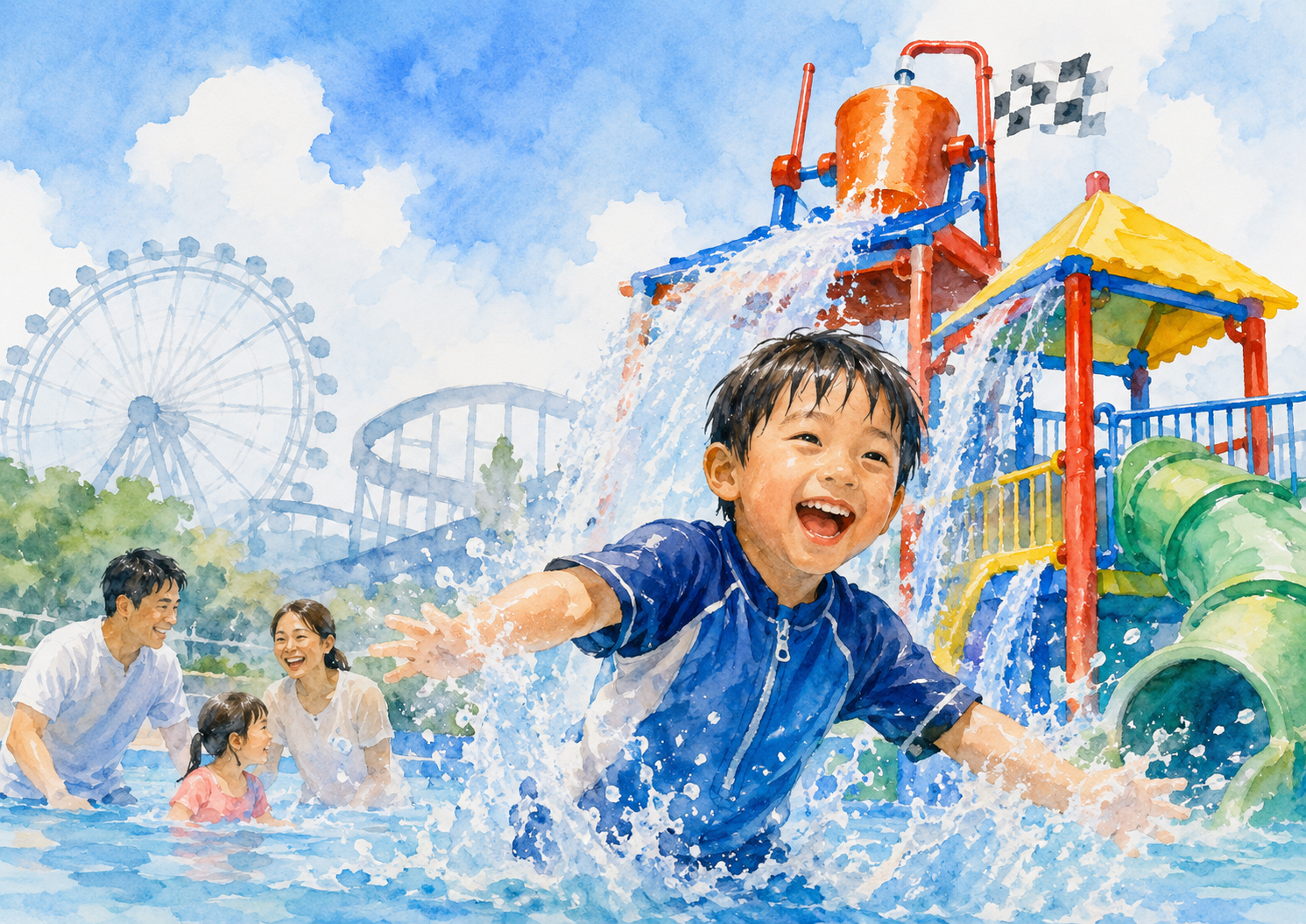
Suzuka Circuit is usually introduced with the language of speed. Figure-eight layout. Honda. Formula 1. The 130R. The Japanese Grand Prix. Motorcycles leaning through corners. Engines turning humid Mie air into thunder. But in summer, another Suzuka appears. It is smaller, wetter, gentler and closer to the ground. Children step into shallow water. Parents check towels. Sprays rise from colorful play equipment. The famous circuit is still nearby, but the sound of the season becomes laughter, splashing and the careful first bravery of a child entering a pool.
For 2026, Suzuka Circuit Park’s Water Park Aqua Adventure opens from June 27 to September 27. The official English guide describes the pool as an adventure that children can enjoy according to age and growth, with pool areas for everything from a baby’s first water play to more active sliding and exploration. The official park page also connects the pool season with the Soaking Wet Festival, running across the same summer period. This is not only a pool opening. It is Suzuka doing what Suzuka has always done best: teaching movement as joy.
The pool beside the temple of speed
The charm of Aqua Adventure begins with contrast. Suzuka Circuit is one of Japan’s most internationally recognized sports venues. It is the place where race fans measure time in laps and corners, where Honda’s engineering ambition became a landscape, and where Japan learned to host global motorsport with confidence. Yet Suzuka Circuit Park was never only a racetrack. It has long presented itself as a mobility theme park: a place where children do not merely watch vehicles but learn to steer, balance, decide, accelerate and stop.
That makes a water park more logical than it first appears. Water, like driving, teaches motion. It teaches balance, confidence and response. A toddler standing in a 15-centimeter pool is learning risk in miniature. A child choosing a slide is negotiating excitement. A parent standing nearby is watching independence arrive one splash at a time. Suzuka’s family attractions are built around the same idea as its racing culture: movement should be safe enough to try and thrilling enough to remember.
Soichiro Honda’s larger idea
Honda’s own history explains why Suzuka became more than a circuit. Honda’s corporate history says Soichiro Honda wanted to build not only a private test track but a full international racing course, opening Suzuka Circuit in September 1962 at a time when many Japanese roads were still unpaved and expressways had not yet been built. The project was about technology, safety and ambition. Japan needed a place where high-speed driving could be understood, tested and respected.
But Honda was also a teacher by temperament. He believed people learn by doing. That philosophy helps explain why the circuit grew into a place for families. The park’s attractions are not simply decorative add-ons beside the track. They introduce children to mobility culture before they can drive. They put steering wheels, small vehicles, tracks, water, balance and coordination into children’s hands. Aqua Adventure belongs to that same educational tradition, even if the classroom is a pool.
Aqua Adventure’s family design
The official Aqua Adventure guide emphasizes children’s stages of growth. Its pool-area page describes shallow spaces for babies and small children, including a baby pool with a water depth of 15 centimeters and facilities positioned for family convenience. The English overview frames the entire pool as an adventure that begins with a child’s pool debut and grows into broader curiosity. That design matters. In a summer when many amusement parks compete to be bigger, faster or louder, Suzuka’s pool is carefully scaled.
Parents understand the value of that. A good family pool is not just a place with water. It is a map of confidence. There must be a first safe step, a next challenge, a rest area, food nearby, shade, toilets, equipment, and a layout that does not punish families for moving slowly. Suzuka Circuit Park appears to understand that its summer audience includes not only thrill-seeking older children but also babies, preschoolers and parents carrying too many bags.
From Formula 1 to first swims
Suzuka’s international image is built on the Japanese Grand Prix, which Formula 1 lists at a 5.807-kilometer circuit with its first F1 Grand Prix in 1987. To motorsport fans, Suzuka is a test of nerve, rhythm and precision. It is one of those tracks where drivers cannot fake commitment. That racing mythology gives the family park a special charge. A child playing in Aqua Adventure may not know the names of the corners, but the larger landscape says something powerful: this is a place where Japan takes movement seriously.
That seriousness does not make the pool stern. It makes it trustworthy. The family version of Suzuka is not about pushing children too fast. It is about letting them grow into adventure. The same facility that hosts elite riders and drivers also makes room for a baby pool, splash events and parents looking for a safe day in the heat. That range is rare. It is why Suzuka is not simply a racetrack with an amusement park attached. It is a layered resort with speed at the center and family memory around it.
Mie’s summer advantage
Geography matters. Suzuka sits in Mie Prefecture, a region often framed by motorsport, Ise Shrine, seafood, coastal travel and access from Nagoya and Kansai. For families, that makes the park useful. It can be a main destination, a summer stop between regions, or part of a broader Ise-Shima trip. In a country where summer travel often means heat, crowds and logistics, a place that combines a hotel, restaurants, amusement rides, racing culture and water play has obvious appeal.
The timing also helps. Running from late June through late September, Aqua Adventure covers the long Japanese summer: the end of rainy season, school holidays, Obon travel, and the first softening of heat in September. That long calendar gives families more than one way to use the park. It can be a school-vacation highlight or a quieter September escape.
The Soaking Wet Festival mood
The 2026 pool season is paired with the official Soaking Wet Festival message: get soaked and blow away the heat. This is the language of modern Japanese summer amusement parks. Heat is no longer something to ignore. Parks are redesigning summer around water, evening programs, mist, shade, cooling food and events that make getting wet part of the entertainment. Suzuka’s answer is especially natural because Aqua Adventure already sits at the center of family summer.
In that sense, the pool is also a climate-era attraction. Japan’s summers have become more difficult for families. A good park must give visitors not only fun but strategy: when to arrive, where to cool down, how to rest, how to let children burn energy without overheating. Aqua Adventure’s strongest selling point may be that it turns the practical problem of heat into the emotional promise of play.
Why the story belongs in a summer amusement park edition
Some amusement-park stories are about spectacle. A new coaster, a night show, a drone display, an anime collaboration. Suzuka’s Aqua Adventure story is quieter, but perhaps more important for families. It is about the infrastructure of summer happiness: shallow water, slides, splash zones, access, rest areas and the confidence that a parent can bring a small child into a major park without feeling overwhelmed.
That is why this story sits naturally beside USJ, Fuji-Q, Yomiuriland, Huis Ten Bosch, Nagashima and Seibuen in this Japan.co.jp summer package. The national theme is clear. Japan’s amusement parks are not simply opening attractions. They are adapting to summer itself. Suzuka’s version is the most family-centered: a racing landmark becoming, for three months, a carefully designed water classroom.
| Feature | Why it matters |
|---|---|
| Season | June 27 to September 27, 2026, covering the heart of the Japanese summer. |
| Five pool areas | Designed around different ages, growth stages and comfort levels. |
| Three slides | Enough thrill for older children without losing the family-first identity. |
| Baby-friendly zones | Shallow areas make the park useful for first pool experiences. |
| Suzuka Circuit setting | Connects family water play with Japan’s most famous mobility playground. |
Japan.co.jp view
Suzuka Circuit’s Aqua Adventure is compelling because it refuses to separate excitement from care. The pool does not need to be the biggest in Japan to matter. Its strength is that it understands progression. A child starts at the edge, learns the feel of water, watches others, chooses a slide, returns to parents, tries again. That is how confidence is made.
And that is also the deeper Suzuka story. Since 1962, Suzuka has been a place where Japan studies motion. The fastest version is Formula 1. The family version is a child learning to steer a small ride or splash through a pool. Both belong to the same philosophy: movement should be designed, safe, exciting and memorable.
For summer 2026, Aqua Adventure gives Suzuka Circuit Park a softer headline. Engines may still define the place, but water now carries the season. In the heat of Mie, beside a circuit built for speed, families will find something slower and just as valuable: the sound of children discovering that adventure can begin in shallow water.
Sources and references
This article uses official Suzuka Circuit / Suzuka Circuit Park information, Honda history, Formula 1 circuit information, and regional travel references. Dates, hours, tickets, areas and operations can change, so confirm with the official site before visiting.
- Suzuka Circuit: WATER PARK AQUA ADVENTURE official English guide.
- 鈴鹿サーキット: アクア・アドベンチャー2026公式ガイド。
- PR TIMES / Honda Mobilityland: 2026 Aqua Adventure opening announcement.
- Honda: Suzuka Circuit history and Soichiro Honda context.
- Formula 1: Japanese Grand Prix / Suzuka circuit information.
- Visit Mie: Suzuka Circuit Park family travel context.