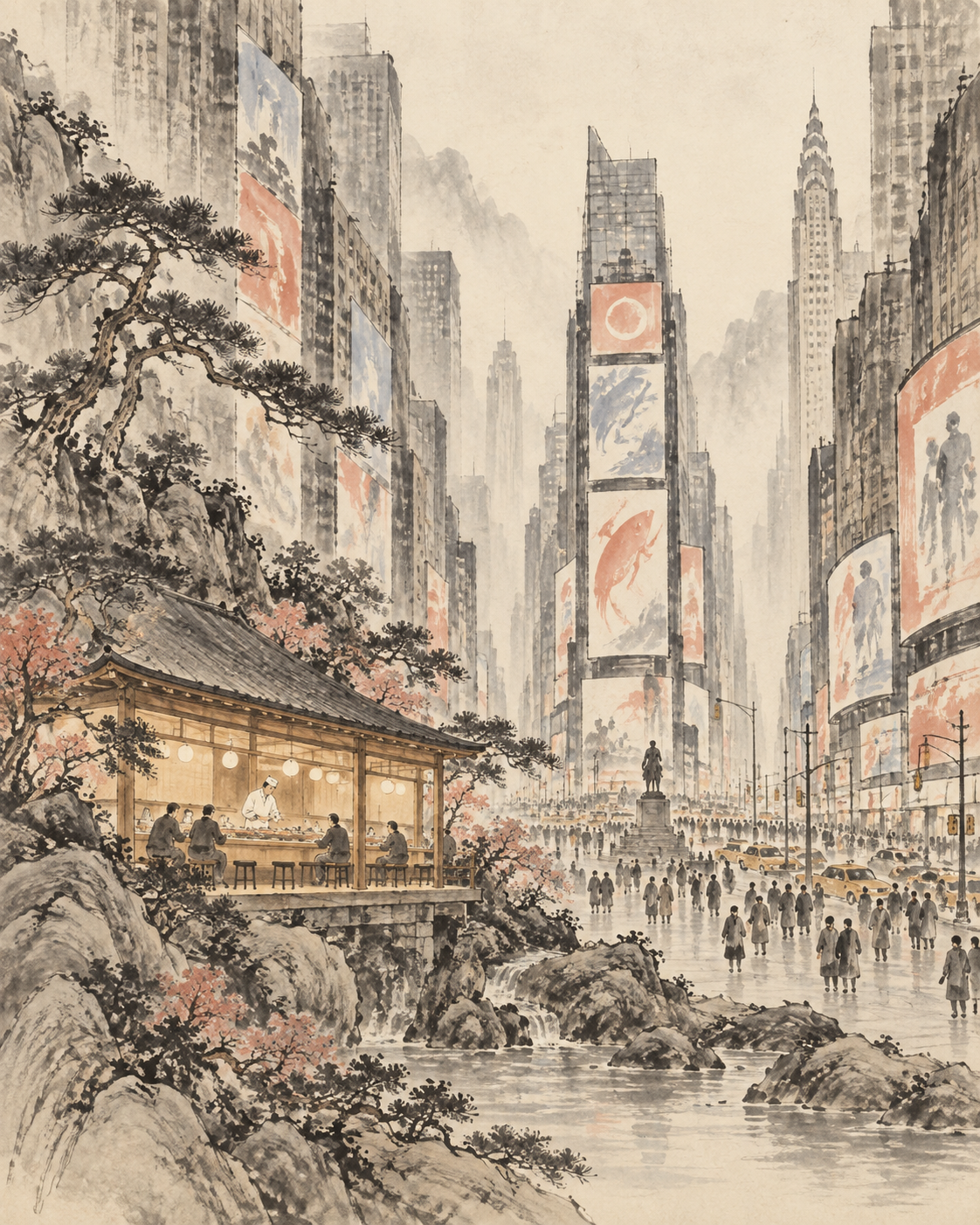
At Eighth Avenue and 42nd Street, close to Times Square and the Port Authority Bus Terminal, one of Japan’s most familiar mass-market dining formats is about to face a distinctly American test. FOOD & LIFE COMPANIES (F&LC) plans to open the first permanent U.S. location of its flagship Sushiro kaiten-sushi chain in October.[1]
The significance is larger than a single restaurant. Sushiro has spent decades turning sushi into a high-volume, standardized dining business built around procurement, rapid service, digital ordering and broad menu choice. New York will test whether that operating system can travel to a market with different labor costs, rents, tipping customs, supply chains and consumer expectations.
It also arrives at a strategic moment for the parent company. F&LC has made international growth central to its long-range plan, targeting at least ¥1 trillion in revenue and a 55% international-sales share for the fiscal year ending September 2035.[2] Times Square is therefore both a restaurant opening and a test case for how a mature Japanese consumer brand becomes a global one.
After Asia, the next proving ground is America
Sushiro’s international growth to date has been concentrated in Asia. F&LC’s monthly data show 325 overseas Sushiro restaurants at the end of August 2026. Adding six overseas Sugidama locations brings the group’s overseas restaurant count to 331. In Japan, Sushiro itself had 669 restaurants at the end of August.[3]
In July, F&LC announced that its international business had passed 300 restaurants. The company also says Sushiro has ranked first in annual sales in Japan’s kaiten-sushi industry for 14 consecutive years, citing Fuji Keizai data covering 2011 through 2024.[4]
Three levels, about 150 conveyor-belt seats and a very large menu
Details presented at an August 31 briefing in New York, as reported by Jiji Press and other outlets, point to an unusually ambitious first location. The restaurant is planned across three levels, from the basement through the second floor. The first and second floors are expected to contain roughly 150 seats in the kaiten-sushi dining area, while the basement is planned for table seating and Japanese-style private rooms. Eater New York reported the space at approximately 9,000 square feet.[5][6]
The menu is expected to exceed 200 items, extending well beyond nigiri to noodles, steamed egg custard, fried dishes and desserts. Reported U.S.-specific offerings include a shrimp double-cheese roll. At the briefing, bigeye tuna and shrimp were priced at $5 per plate, bluefin otoro at $10 and the shrimp double-cheese roll at $14.[5]
At the reference exchange rate supplied for this edition—US$1 = ¥157.31—a $5 plate is about ¥787 and a $10 plate about ¥1,573. That does not make a direct Japan-versus-America price comparison especially useful. Manhattan rent, wages, insurance, logistics and ingredient sourcing impose a radically different cost structure. The more revealing question is whether customers perceive the full experience as good value relative to other New York dining options.
No tipping is part of the proposition
One feature may be nearly as important as the conveyor belt itself: the restaurant plans not to require tips, according to Jiji Press coverage of the New York briefing.[5]
That is both a pricing decision and an operating statement. In much of U.S. full-service dining, customers mentally add a gratuity to the menu price. Kaiten sushi is organized differently. Digital ordering, food-delivery lanes and a standardized service flow shift part of the dining process away from conventional table service. If Sushiro can make a no-tip system work economically, the clarity of the final bill could become part of the brand.
No tipping does not automatically mean inexpensive dining, however. What matters is the combined judgment customers make about food quality, portion size, speed, convenience and the total check. New York already offers sushi at nearly every level—from supermarket trays and neighborhood rolls to omakase counters costing hundreds of dollars.
Sushiro is arriving after another Japanese conveyor-belt chain
The U.S. market is not empty. Kura Sushi USA’s official location directory currently lists 96 U.S. restaurants, including four in New York State: Carle Place, Flushing, Lake Grove and Scarsdale.[7] Its expansion means Sushiro is entering a market where another Japanese company has already spent years learning American site selection, construction, hiring and restaurant operations.
Bloomberg framed Sushiro’s Times Square opening as part of an emerging contest among Japanese sushi businesses in America.[8] The comparison is useful, but the strategies are not identical. Sushiro is beginning with a conspicuous Manhattan flagship rather than a gradual suburban footprint.
Times Square offers something difficult to measure in restaurant economics alone: global visibility. The customers passing through are New Yorkers, commuters, domestic tourists and international visitors. A successful store there can function as a restaurant and a brand showroom at the same time.
From an Osaka standing-sushi shop to a mass-market system
F&LC’s corporate history begins in 1975, when its founder opened a standing sushi shop called Tai Sushi in Osaka’s Abeno Ward. In 1984, the business opened its first restaurant in Toyonaka, Osaka Prefecture, under the name Sushi Taro and established a company that would eventually become part of today’s Sushiro business. In 1996 it opened a restaurant built around a uniform ¥100-per-plate model.[9]
That history matters because conveyor-belt sushi is often reduced to the visible belt. The harder part is the system behind it: buying seafood at scale, managing freshness, forecasting demand, moving orders quickly through kitchens, keeping waste under control and turning tables fast enough to sustain low unit prices.
Sushiro refined those capabilities in Japan and then carried them into markets including Taiwan, Hong Kong, South Korea, Singapore and Thailand. New York introduces a different mix of regulation, labor, supply logistics and customer habits. Success in Asia does not guarantee success in the United States.
The strategic target is 55% of sales from overseas
F&LC’s FY2035 vision makes the stakes unusually clear. The company is targeting revenue of at least ¥1 trillion, an operating margin of 10% or more, return on equity of at least 20%, and an international-sales ratio of 55%. Its FY2026 medium-term targets include ¥485 billion in revenue, ¥59.5 billion in EBITDA and ¥40.5 billion in operating profit.[2]
Reaching a 55% international mix will require more than adding restaurants in markets where Sushiro is already established. North America is too large to remain peripheral. The real significance of Times Square, then, is not whether one flagship produces impressive opening-week sales. It is whether F&LC can establish a repeatable U.S. store model.
The company is not arriving in America entirely cold. F&LC opened the sushi-izakaya concept Sakabayashi in Boston in 2024. But introducing the core Sushiro brand is a different commitment. A flagship brand carries the expectations of hundreds of restaurants and millions of customers in Japan and Asia.
What “bringing the Japanese brand as it is” really means
When F&LC announced the U.S. plan in May, it described the strategy as bringing the brand refined in Japan directly to the world.[1] In practice, transporting a restaurant brand “as it is” requires selective adaptation. Prices change. Local rolls appear. Staffing practices must meet U.S. rules. Suppliers and distribution networks change.
What can remain constant is the core proposition: sushi that is approachable rather than ceremonial, broad choice, visible prices, a technology-assisted service flow and a dining experience designed to handle large numbers of customers.
For Japanese restaurant companies, overseas expansion itself is no longer unusual. The more difficult phase begins after the first high-profile opening: producing consistent economics, retaining workers, building a supply chain and finding sites where the concept can be repeated.
Times Square will give Sushiro visibility on day one. The more consequential question is what comes afterward. If the model can move from one Manhattan flagship to a second store, then ten, then fifty, the October opening may eventually look less like a novelty and more like the point at which one of Japan’s largest restaurant chains became an American operator.
The first plate is only the beginning.
