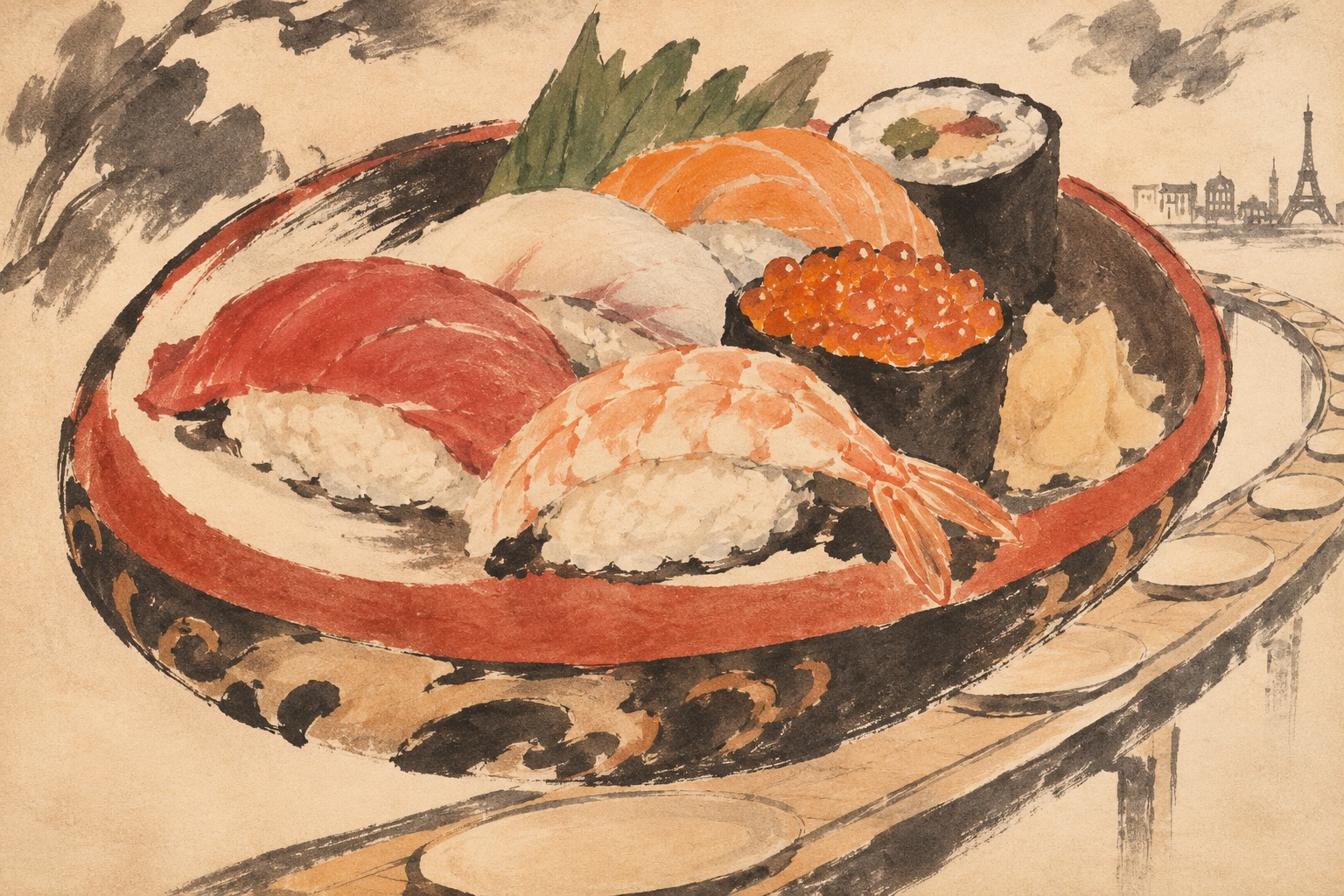
- A plate of sushi becomes a global business strategy
- Record results, carefully defined
- From Osaka’s Tai Sushi to Sushiro
- What 120 overseas openings a year actually means
- China, Southeast Asia and the North American experiment
- Why the FY2029 numbers are demanding
- A smaller portfolio, a bigger ambition
- Digiro: experience technology, not a robot-chef fantasy
- The fish supply chain is the real global test
- Where ¥170 billion in planned investment goes
- The risks beyond the growth chart
- Can Sushiro become synonymous with sushi?
A plate of sushi becomes a global business strategy
The conveyor belt is the most recognizable part of a sushi chain. The less visible machinery is what makes international expansion possible: refrigerated supply routes, trained managers, predictable quality, local real-estate decisions and enough repeat customers to justify the next opening. FOOD & LIFE COMPANIES, the Osaka-rooted owner of Sushiro, now wants to replicate that system on a scale few Japanese restaurant companies have attempted.
On November 6, 2026, the company unveiled its FY2027–FY2029 medium-term plan, branded in Japanese as “F&LC MTP 27-29 — Umaisushi o Sekai e,” or bringing delicious sushi to the world. It targets ¥831 billion in revenue and ¥88 billion in operating profit by the fiscal year ending September 2029, along with approximately 1,570–1,580 stores. They are management ambitions, not achieved results. The larger story is a deliberate shift in where the company expects its next customers to be.
Record results, carefully defined
For the year ended September 30, 2026, F&LC reported revenue of ¥515.334 billion, up 26.9%, and operating profit of ¥51.506 billion, up 47.0%. Profit attributable to owners of the parent reached ¥35.380 billion, up 54.2%. These are figures from the company’s IFRS consolidated financial report, not estimates based on restaurant traffic.
There is an accounting caveat. Following the transfer of the Kyotaru business, F&LC presents certain historical comparisons on a continuing-operations basis and identifies discontinued operations separately. The headline growth rates should not be mechanically compared with older total-group figures that include a different business perimeter. Details matter when a company simultaneously restructures and expands.
From Osaka’s Tai Sushi to Sushiro
The historical path began in July 1975, when the founder opened Tai Sushi in Osaka’s Abeno ward. In June 1984 the first conveyor-belt outlet opened in Toyonaka under the name Sushi Taro; the company behind it was established that October. A ¥100-per-plate format appeared in 1996, and the Akindo Sushiro name followed in 2000, according to the group’s own corporate chronology.
Other milestones reveal a company repeatedly changing its operating model: a 2003 listing on the Tokyo Stock Exchange’s Second Section, the abolition of its headquarters processing facility in 2004, a Korean subsidiary in 2011, and a holding-company structure in 2015. Its Taiwanese subsidiary was established in 2017. Sushiro’s overseas plans therefore emerge from decades of experimentation with price, freshness, store operations and corporate organization—not from the sudden discovery that the world likes Japanese food.
What 120 overseas openings a year actually means
F&LC reported 340 overseas Sushiro-business stores at the end of FY2026 after opening 108 overseas locations during the year. The new plan envisages approximately 120 overseas openings annually and an overseas count of 700–710 in FY2029. Its overseas-business revenue target rises from ¥212.9 billion to ¥460.6 billion, with operating profit increasing from roughly ¥27.5 billion to ¥55.8 billion.
The domestic Sushiro network follows a different trajectory: approximately 25 openings a year, from 671 stores to a target of 740–750. Japan is not disappearing from the strategy. It is being treated as a more mature market in which returning guests and same-store performance carry more weight, while international openings produce the larger incremental store count. The two markets require different measures of success.
China, Southeast Asia and the North American experiment
The most important overseas engine is mainland China, with other established Asian markets contributing to scale. The company also intends to build a workable North American model. In May 2026 it announced plans for an initial U.S. Sushiro conveyor-belt restaurant in New York City’s Times Square area. An announced location and projected opening season are not proof that the restaurant has already begun serving customers.
The U.S. is an especially revealing test. A concept built around affordable, consistent sushi must confront different wage structures, rents, fish distribution, food-safety rules and consumer expectations. A packed opening week may be encouraging; a sustainable store needs repeat traffic and attractive economics months later. The plan itself describes North American development as a business model to establish, not a guaranteed source of profit.
Why the FY2029 numbers are demanding
F&LC’s consolidated target implies average annual revenue growth of 17.3% and operating-profit growth of 19.6% from FY2026. The interim path is explicit: ¥610 billion in revenue and ¥61.3 billion in operating profit for FY2027; ¥723 billion and ¥73.2 billion for FY2028; then ¥831 billion and ¥88 billion for FY2029. The operating margin is expected to rise modestly to 10.6%.
The FY2029 overseas Sushiro plan includes a 12.1% operating margin, compared with 7.1% for domestic Sushiro. Those are segment targets, not promises about every Chinese, Taiwanese or American store. When store openings accelerate, new-unit capital costs and the time needed to reach steady customer volumes become crucial. Growth in sales alone cannot settle whether shareholders’ money is being used effectively.
A smaller portfolio, a bigger ambition
The transfer of Kyotaru and related corporate restructuring are at the heart of the new plan. Management is concentrating resources on Sushiro rather than trying to scale every restaurant format simultaneously. That choice should make decisions about investment, technology and recruiting more coherent, although it creates greater dependence on the performance of the central brand.
It would be inaccurate to claim F&LC has become a one-format company. The Japanese Sugidama business remains in the plan, with its own profitability and store-growth targets. The guiding phrase “One Company” refers to a shared operating culture and stronger centralized capabilities. Whether it becomes more than a slogan depends on execution across very different labor markets and consumer habits.
Digiro: experience technology, not a robot-chef fantasy
Digital innovation appears in the company’s account of its domestic recovery. It reports FY2026 comparable-store sales at 107.9% of the prior year and cites promotions, intellectual-property collaborations and its Digiro digital ordering experience as contributing factors. The next plan emphasizes digital transformation, data skills and AX—the more advanced use of AI built on a digital foundation.
The distinction between a digitally enabled experience and a fully automated restaurant is essential. A customer may encounter a large interactive display, while the hard work of food preparation, supply coordination, safety and hospitality continues behind the scenes. F&LC explicitly credits people with creating and supporting its experience. The useful question is whether technology improves consistency, worker productivity and repeat visits—not whether every step can be removed from human hands.
The fish supply chain is the real global test
Sushi expansion is also a procurement story. Reliable sourcing of fish, rice and other ingredients becomes harder as store counts rise across different regulatory jurisdictions and climates. Product quality and affordability must survive shipment delays, changing catch volumes and swings in the yen. A trusted brand must demonstrate more than a familiar logo.
F&LC says it will strengthen collaboration with producers and partners. In October it announced operations by FOOD&LIFE KYORITSU MARINE, a joint venture related to marine-resource supply, and on November 5 it disclosed collaborative research into land-based aquaculture of white horsehead fish with partners including Yamaguchi Prefecture. These initiatives document work on supply resilience; they do not prove that future seafood availability or sustainability risks have been solved.
Where ¥170 billion in planned investment goes
Over the three-year plan F&LC envisages approximately ¥170 billion in growth investment, allocating ¥102 billion internationally and ¥68 billion domestically. New stores and refurbishment are among the uses. This 60/40 split makes the company’s geographic priority visible without relying on a marketing catchphrase.
The financial challenge is that stores require cash long before their lifetime returns are known. Leasing commitments, fit-outs, equipment, training and supply networks all precede mature revenue. As expansion intensifies, analysts will need to examine cash flow, capital efficiency, store productivity and investment timing alongside operating-profit targets. A strong historic margin is encouraging, not a guarantee that each new overseas site will succeed.
The risks beyond the growth chart
An international restaurant company faces exposure to currency swings, imported food costs, seafood resources, labor availability and food safety. Country-specific regulation and geopolitical tension can alter a market rapidly. Consumer taste can also punish a chain that assumes success in one city will simply transfer to another.
The management plan explicitly identifies risk management, information security, safe dining and compliance among the functions that need strengthening. Such commitments are important but difficult to evaluate from a presentation alone. Future reports should track same-store demand, opening costs, overseas operating margins, staff retention and supplier diversification rather than treating store counts as the final verdict.
Can Sushiro become synonymous with sushi?
F&LC’s chosen formulation is audacious: “SUSHI to ieba SUSHIRO”—the ambition that, when people think sushi, they think Sushiro. Its longer-range image now aims for more than ¥1 trillion in revenue around FY2031–FY2032, earlier than its previous long-term timeline. Those are strategic objectives, not promises about what customers will choose.
Japan’s food culture is extraordinarily powerful overseas, but cultural appeal and repeatable restaurant economics are not the same thing. F&LC’s next chapter will be written in thousands of ordinary decisions about freshness, value, wages, supplier relationships and the convenience of the next visit. The company began with one sushi shop in Osaka. Its global future will depend on whether it can make that everyday promise credible far beyond Osaka.
Sources and methodology
Primary Japanese disclosures underpin the financial and strategic figures. We distinguish historical results, continuing operations and management targets. The company was not independently interviewed.
- FOOD & LIFE COMPANIES:中期経営計画「F&LC MTP 27-29-うまいすしを世界へ-」(2026年11月6日)
- FOOD & LIFE COMPANIES:2026年9月期 通期決算説明資料(2026年11月6日)
- FOOD & LIFE COMPANIES:2026年9月期 決算短信〔IFRS〕(連結)
- FOOD & LIFE COMPANIES:公式沿革
- FOOD & LIFE COMPANIES:IRニュース
- FOOD & LIFE COMPANIES:海外300店舗達成(2026年7月14日)
- FOOD & LIFE COMPANIES:サステナビリティ・水産資源調達
- FOOD & LIFE COMPANIES:2026年11月5日シロアマダイ陸上養殖の共同研究など