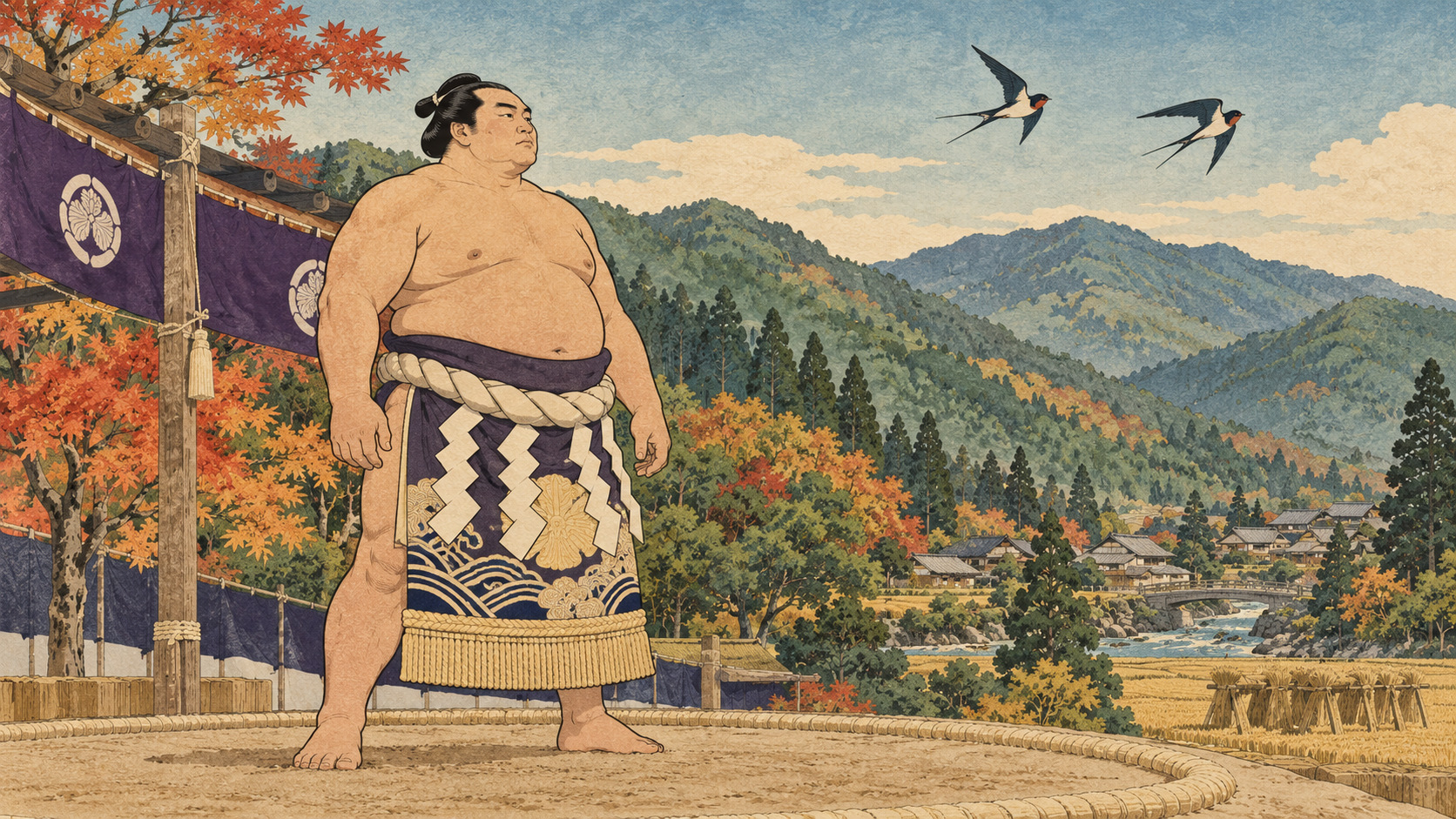
At nine in the morning, a gymnasium in a small town in Okayama Prefecture is scheduled to become a temporary stage for one of Japan’s most recognizable traditions. Professional sumo wrestlers are coming to Wake on Thursday, October 22—not for one of the six grand tournaments that decide rankings, but for a regional tour that invites audiences to see the sport's training, ceremony and theatrical side at unusually close range.
Officially titled the 2026 Autumn Regional Tour: Grand Sumo Wake Event (令和八年 秋巡業 大相撲 和気場所), the gathering commemorates the 20th anniversary of the present Wake Town administration. Japan Sumo Association and Wake Town schedules confirm the date and venue: Wake Town Gymnasium, 312-1 Fukutomi, Wake, Okayama. Doors are due to open at 9 a.m., with the event scheduled to finish at 2:30 p.m. The town expects top-division wrestlers, including yokozuna and ōzeki ranks, although the precise roster can change.
A regional sumo tour offers something a television broadcast seldom can: an encounter with the preparation, performances and people surrounding the contest itself.
Why a small venue changes the experience
Wake Town promotes the intimate scale of its gymnasium as one of the event's main attractions. The appeal is straightforward: spectators may see the wrestlers train, hear the impact of bodies colliding and appreciate the footwork and timing that the camera often compresses into a few dramatic seconds. That is an expectation based on the tour format, not a claim drawn from on-site interviews.
The town lists ringside S seating at ¥17,000, ringside A at ¥14,000 and first- and second-floor chairs at ¥10,000. Accessible seating is listed at ¥20,000 for two people, or ¥10,000 per person. Availability is not guaranteed. The official organizer says a limited selection of same-day tickets is planned for sale from 8:30 a.m. on October 22 outside the venue entrance, accepting cash and credit cards.
The real work begins before the bouts
Sumo's six grand tournaments, or honbasho, establish competitive standings. A regional jungyō tour has different purposes. Japan Sumo Association says it aims to promote the sport, foster local communities and support the development of young people.
Its general timetable begins with training by lower-ranked wrestlers, followed by practice among higher-ranked professionals. Matches by younger wrestlers commonly begin before noon, with top-division ring-entering ceremonies, headline bouts and the closing bow-twirling ceremony later in the afternoon. The association's timetable is a guide to the touring format, not a minute-by-minute promise for Wake.
For first-time spectators, training may be the revelation. Sumo can look like a contest decided in a flash. Practice reveals the many hours of repetition behind that instant: balance, grip, leverage and the ability to recover after an opponent's sudden movement.
A sport that also knows how to make people laugh
Regional tours can feature shokkiri, a comic demonstration of forbidden moves and unusual techniques. Another traditional performance, sumō jinku, involves rhythmic singing by wrestlers. Hairdressers known as tokoyama sometimes demonstrate the intricate topknots associated with professional sumo. The Japan Sumo Association describes these as examples of touring entertainment; the organizers' material reviewed for this report does not establish that every performance will occur in Wake.
Such events show why sumo is difficult to categorize neatly as only athletics or only ritual. Drums, the ring-entering ceremony and the elaborate ceremonial aprons of top-ranked wrestlers form part of its appeal. The moments of humor are not incidental: they help newcomers understand the rules and humanize a sport frequently presented with austere solemnity.
A modern town with a much older memory
The current Wake Town dates from a 2006 municipal reorganization, making 2026 an appropriate twentieth-anniversary milestone. The event creates a chance for local families to share a major national cultural experience without traveling to Tokyo, Osaka or another major tournament city.
Wake's identity reaches much further back. Municipal historical material identifies the area as the traditional birthplace of Wake no Kiyomaro (733–799), an important figure in the politics of the Nara period, particularly in accounts of the Dōkyō affair. The town also documents ancient burial mounds and iron-working remains. None of this proves a particular ancient connection with the modern sumo tour. It does, however, remind visitors that the host community has its own history well beyond the arena.
One stop in a constantly moving cultural institution
The October tour itinerary runs through Okayama City on October 21, Wake on October 22, Kasaoka on October 23 and Hiroshima on October 24. Wrestlers, stablemasters, referees, announcers, hairdressers and event crews must move with the tour. The Japan Sumo Association says approximately 200 people usually travel with such an event, although that is not a verified attendance or staffing figure specific to Wake.
The consequences for local commerce are plausible but must not be exaggerated. Restaurants, transport providers and nearby shops may benefit from visitors; no independent estimate of Wake's expected economic gain or an audited impact study was available in the sources reviewed. Similarly, the value for children who encounter sumo close to home is important to the story but cannot be measured simply from the ticket schedule.
What visitors need to know
The organizers say there is no ordinary visitor parking at the gym. A temporary parking facility is planned at the Yoshii River riverfront park grounds, served by shuttle buses, but spaces will be limited; visitors are encouraged to use JR's San'yō Main Line where practical. Outdoor shoes are not permitted inside the gym, so bring slippers. Re-entry is allowed with the ticket stub. Check the organizer's page for the latest arrangements and available ticket types.
There is also an important reporting boundary: this story is published for the October 22 edition based on advance official information. It does not claim that the matches have already taken place, quote spectators who have not been interviewed, or describe the outcome of a live event.
The meaning of bringing sumo to town
Regional tours may never command the championship stakes of Tokyo's Ryōgoku Kokugikan. Their achievement is different. They move a nationally familiar institution into places where the people who sustain it can be seen at human scale. In Wake, a single day in an ordinary gymnasium can make Japan's formidable national sport feel surprisingly close to home.