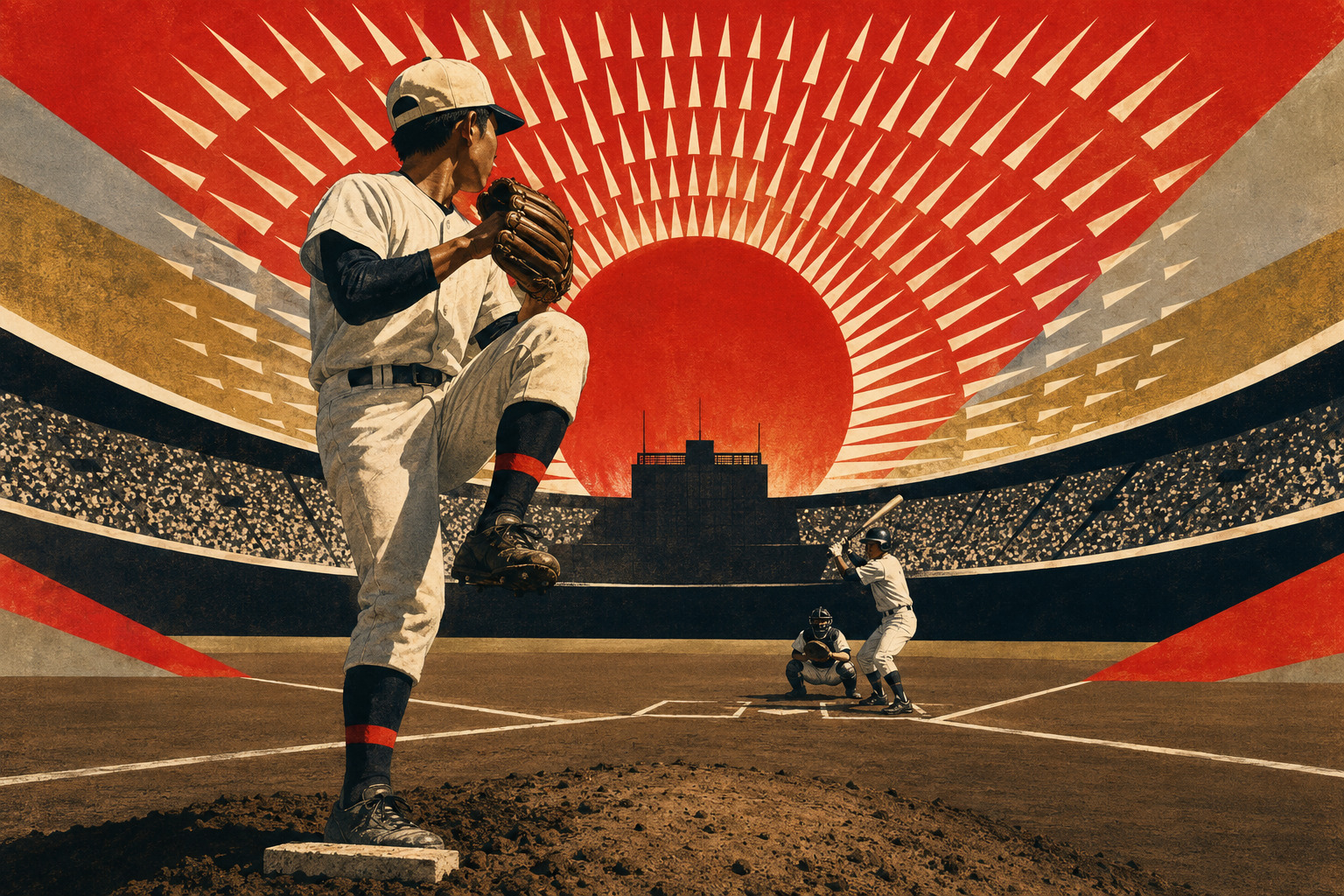
Until the names appear on the draw screen, the country’s 49 summers remain separate. From Shirakaba Gakuen in northern Hokkaido to defending champion Okinawa Shogaku, every regional winner knows it is going to Koshien but does not yet know the opponent, the date or the path. Fifteen schools will begin in the second round. The other 34 must play one of 17 first-round games. A single draw can add recovery time, create an immediate collision between favorites or decide where a first-time school writes the opening line of its national history.
That random element matters even more in the 108th National High School Baseball Championship. Osaka Toin, winner of the spring invitational, fell in its prefectural tournament. So did runner-up Chiben Gakuen and semifinalists Senshu Matsudo and Chukyo University Chukyo. Not since 1994 had all four spring semifinalists failed to reach the summer national tournament. Of the spring’s final eight, only Hanasaki Tokuharu and Eimei qualified for August.
The spring hierarchy has been erased. What remains is a defending champion in Okinawa Shogaku; Yokohama and 157 km/h right-hander Shoki Oda; an explosive Riseisha team that scored 66 runs and allowed five in seven Osaka games; former national champion Sendai Ikuei; and established powers Chiben Wakayama, Hanamaki Higashi, Kanto Daiichi and Kamimura Gakuen. Four first-time qualifiers and Yokote, returning after 57 years, enter the same draw. Institutional memory and blank school history occupy the same bracket.
The complete field: familiar names and first songs
The standard 49-team field grew from the 60th tournament in 1978, when organizers established one representative from every prefecture and two apiece from Hokkaido and Tokyo. It is a map of Japan, not a seeded ranking. Matsusho Gakuen of Nagano makes a field-leading 39th summer appearance, Sendai Ikuei its 32nd, Tenri its 31st and Chiben Wakayama its 29th. Higashi Nichidai Shohei, Hachioji Jissen, Fukuyama and Ariake have never heard their school songs played at Koshien.
| Region | Prefecture and representative (summer appearances) |
|---|---|
| Hokkaido / Tohoku | North Hokkaido—Shirakaba Gakuen (5); South Hokkaido—Sapporo Nihon University (2); Aomori—Aomori Yamada (13); Iwate—Hanamaki Higashi (14); Akita—Yokote (2); Yamagata—Tsuruoka Higashi (9); Miyagi—Sendai Ikuei (32); Fukushima—Higashi Nichidai Shohei (first) |
| Kanto / Tokyo | Ibaraki—Kasumigaura (4); Tochigi—Sano Nihon University (7); Gunma—Kendai Takasaki (6); Saitama—Hanasaki Tokuharu (9); Yamanashi—Tokai University Kofu (15); Chiba—Takushoku University Koryo (6); East Tokyo—Kanto Daiichi (11); West Tokyo—Hachioji Jissen (first); Kanagawa—Yokohama (22) |
| Hokushinetsu / Tokai | Nagano—Matsusho Gakuen (39); Niigata—Nihon Bunri (13); Toyama—Takaoka Shogyo (23); Ishikawa—Yugakukan (7); Fukui—Tsuruga Kehi (13); Shizuoka—Seirei Christopher (2); Aichi—Kyoei (9); Gifu—Chukyo (8); Mie—Mie (15) |
| Kinki | Shiga—Hachiman Shogyo (8); Kyoto—Ritsumeikan Uji (5); Nara—Tenri (31); Wakayama—Chiben Wakayama (29); Osaka—Riseisha (6); Hyogo—Yashiro (3) |
| Chugoku / Shikoku | Okayama—Okayama Gakugeikan (5); Tottori—Tottori Johoku (8); Hiroshima—Fukuyama (first); Shimane—Rissho University Shonan (4); Yamaguchi—Takagawa Gakuen (4); Kagawa—Eimei (5); Ehime—Nitta (2); Tokushima—Naruto Uzushio (9); Kochi—Meitoku Gijuku (24) |
| Kyushu / Okinawa | Fukuoka—Tochiku (7); Saga—Saga Shogyo (17); Nagasaki—Nagasaki Nihon University (10); Kumamoto—Ariake (first); Oita—Oita Shogyo (16); Miyazaki—Nichinan Gakuen (10); Kagoshima—Kamimura Gakuen (9); Okinawa—Okinawa Shogaku (12) |
The numbers carry time. Kyoei returns after 31 years, Takushoku University Koryo after 24, Sano Nihon University and Nagasaki Nihon University after 16, and Hachiman Shogyo after 15. When Yokote last came in 1969, metal bats had not yet entered Japanese high school baseball. At the other extreme, Hanamaki Higashi and Kamimura Gakuen arrive for a fourth consecutive summer; Kendai Takasaki, Kanto Daiichi, Chiben Wakayama, Okayama Gakugeikan and Tottori Johoku make it three straight. Teams with players accustomed to the stadium share the field with schools arranging their first national trip.
The favorite did not disappear; the list grew longer
Okinawa Shogaku owns the cleanest headline. In 2025 it returned the crimson championship flag to Okinawa for the first time in 15 years and won the school’s first summer title. Left-handers Ryosuke Sueyoshi and Yuito Arakaki anchor a bid to repeat. Defending a title requires more than pitching quality. Every opponent has studied the champion, and the sequencing of two valuable arms across a single-elimination tournament becomes as important as either pitcher’s best game.
Yokohama brings the loudest radar-gun reading. Oda reached 157 km/h in the ninth inning of the Kanagawa final and completed the game, carrying one of Japan’s great programs to a second straight summer appearance and its 22nd overall. Yokohama has not won the summer tournament since Daisuke Matsuzaka led the 1998 spring-summer double. Velocity will dominate the advance coverage. The deeper tactical question is whether Yokohama can create days when Oda does not have to rescue it.
Riseisha’s Osaka numbers were startling: 66 runs scored, five conceded in seven games, capped by a 16–2 final over Minoh Gakuen. Osaka Toin’s prefectural elimination removed the spring champion, but the prefecture still sends the 2019 national winner. Chiben Wakayama brings recent championship-game experience. Sendai Ikuei knows how to win the tournament, having delivered Tohoku’s first summer title in 2022. Hanamaki Higashi has become a national power without yet claiming the summer championship, a distance that can be motivation rather than baggage.
Kamimura Gakuen won four straight Kagoshima tournament games by the mercy rule on its way to a fourth consecutive berth. Kanto Daiichi completed a third straight East Tokyo title. Nikkan Sports placed those two alongside Hanamaki Higashi, Sendai Ikuei, Yokohama, Chiben Wakayama and Okinawa Shogaku in its top evaluation tier. Evaluations are not predictions. If the prefectural tournaments established anything, it is that a spring résumé cannot purchase an August place.
What the draw decides: 15 byes and 17 first-round games
A 49-team field requires 17 opening-round games to produce a round of 32. Thirty-four teams play; 15 receive a place directly in the second round. This is not a reward for ranking. It is a scheduling difference created by the draw. A champion beginning in the first round must win six games; one beginning in the second must win five. In August heat, that changes pitching volume, hotel time, recovery days and preparation.
The August 1 draw will be conducted online and will set the path through the third round. The event will not use the Festival Hall gathering in Osaka that brought every team together in previous years. From the quarterfinals, the established ritual remains: captains of third-round winners draw again immediately after their games. The late bracket is therefore not prewritten. A teenager celebrating one victory reaches into a box and determines the next problem.
Opening day consists of the 4:00 p.m. ceremony and a single 5:30 game. Day 2 begins at 4:00 p.m. with two games. From Days 3 through 8, there is one 8:00 a.m. game, a spectator changeover, then games at 1:30, 4:00 and 6:30 p.m. Days 9 and 10 also use afternoon schedules. The structure expands heat-conscious scheduling to 10 days and avoids more play in the period when heat illness has been most common. Rest days follow the end of the third round, the quarterfinals and the semifinals.
- Designated hitter: Japanese high school baseball adopted the DH for the 2026 season, bringing a new separation between pitcher and batting order to Summer Koshien.
- Video review: National high school tournaments introduce replay review. A team generally may request one review through nine innings for eligible plays.
- Women umpires: Five women have been appointed, the first to serve as umpiring officials at the national tournament.
- Heat measures: Evening opening ceremonies, split sessions, cooling time, heat-index monitoring and on-site medical staffing operate together.
Four first songs, and a return after 57 years
The four debutants arrived by different routes. Higashi Nichidai Shohei scored 42 runs in six Fukushima games. Its staff held Seiko Gakuin’s powerful lineup to two hits in the semifinal, then beat Gakuhou Ishikawa 10–7 in the final. Right-handers Yutaka Terunuma and Yuma Shirata give the newcomer more than one route through a game.
Hachioji Jissen reached Koshien in the school’s centennial year by beating Soka 1–0 in the West Tokyo final. Its breakthrough was not a festival of offense but the defense of one run. Fukuyama defeated the storied Hiroshima Shogyo program 4–3, becoming a first-time spring-or-summer qualifier from eastern Hiroshima Prefecture. Ariake beat Tokai University Kumamoto Seisho 4–1, reversing a loss to the same opponent in the previous summer’s prefectural final.
Then there is Yokote. The public school defeated Omagari Kogyo 7–1 in the Akita final to qualify for only the second time, 57 years after 1969. Since Yokote’s last appearance, high school baseball has introduced metal bats, pitch limits, a DH and video review. The tournament around it is almost a different sport. The essential transaction remains: win the prefecture and carry its name to Koshien.
Ariake’s five games: two left arms and last summer’s hurt
Ariake did not simply bludgeon its way through Kumamoto. It beat Chiharadai 5–0 in the second round, Kaishin 5–0 in the third and Taishi 10–0 in the quarterfinal. The semifinal became an 11-inning tiebreaker against Kumamoto Kogyo, won 5–4. Then came the 4–1 final against defending prefectural champion Tokai University Kumamoto Seisho. Across five games, Ariake scored 29 and allowed five. Left-handers Shuya Takumi and Ryotaro Saito combined for a no-hitter against Chiharadai.
The final showed the team’s method. Haruki Nagata led off the first inning with a single, stole twice and scored on captain Soshi Saneda’s sacrifice fly. In the second, Akira Sakai reached, stole and came home on Haruki Takahashi’s single. Takumi worked five scoreless innings. Saito, whose fastball has reached 146 km/h, took over in the sixth. Nagata’s two-run single in the seventh expanded the margin. Ariake did not need one overwhelming swing; it stole 90 feet at a time and divided 27 outs between two left arms.
A year earlier, Tokai University Kumamoto Seisho had beaten Ariake in the prefectural final. Saneda said the returning group spent the next year pointed toward that day. “Revenge” is an efficient label for a long process. The actual work became a pair of first-inning steals, a clean handoff between pitchers and the final out in the ninth.
| Kumamoto round | Result | What Ariake showed |
|---|---|---|
| Second round: Chiharadai | 5–0 | Takumi and Saito combine for a no-hitter |
| Third round: Kaishin | 5–0 | A second straight shutout confirms the pitching base |
| Quarterfinal: Taishi | 10–0 | Double-digit offense and a shortened game preserve pitching |
| Semifinal: Kumamoto Kogyo | 5–4, 11 innings | A comeback in the tiebreaker and survival under pressure |
| Final: Tokai University Kumamoto Seisho | 4–1 | Speed, the Takumi-to-Saito relay and redemption after 2025 |
Four days after the title, an earthquake changed the trip
The Kumamoto final was played July 24. Four days later, an earthquake registering the maximum 7 on Japan’s seismic-intensity scale struck the prefecture. Ariake is in Arao, in northern Kumamoto, where the intensity was 4. The school confirmed the safety of all students, including the baseball team, and no major damage was reported among players’ families. Across the prefecture, however, rescue operations, aftershocks, outages and transport disruption continued. Courtesy visits scheduled for July 29 were canceled.
The earthquake altered the team’s July 30 departure. Ariake had planned to board the Shinkansen at Shin-Tamana. Service disruption forced a bus trip to JR Hakata Station instead, followed by the train to Kansai. The team arrived in time for its planned Koshien practice. The national federation said it would consider flexible arrangements, including a possible game-date change, if the school requested help because travel or cheering preparations could not be completed.
Saneda is from Nishihara village in Aso District. He experienced the 2016 Kumamoto earthquakes as a child; his home was damaged and his baseball ground became unusable. Before this trip he spoke of gratitude for being able to play and reach Koshien, and of wanting Ariake’s baseball to give courage to those affected. The captain has set a quarterfinal target.
That does not make a group of 17- and 18-year-olds responsible for a prefecture’s recovery. A win cannot restore power, repair a road or return a lost home. Baseball is possible because adults checked safety, families allowed the trip, school staff reorganized it and other people remained in Kumamoto doing essential work. The players can do something much narrower: play. Recognizing that limit protects their humanity and keeps their appearance from being flattened into an easy inspirational story.
From 10 teams in 1915 to 49 in 2026
The summer championship began in 1915 with 10 representatives at Toyonaka Stadium near Osaka. Organizers had to establish 11 tournament rules because the sport did not yet possess a fully unified domestic code, and they introduced the formal greetings before and after games. The 1918 national tournament was canceled after regional qualifying because of the Rice Riots. In 1924, the 10th tournament moved into the newly completed Hanshin Koshien Stadium. The venue’s name eventually became shorthand for the dream itself.
The 1941 competition stopped midway through regional tournaments as war deepened, and there were no editions from 1942 through 1945. The event returned at Nishinomiya Stadium in 1946 and came back to Koshien the following year. The 1958 anniversary tournament first assembled one team from every prefecture, 47 in all. The modern 49-representative structure became permanent in 1978. After the 1995 Great Hanshin-Awaji Earthquake, players and cheering sections commuted to the stadium by train through a region still bearing visible damage. That tournament also adopted the antecedent of today’s draw, setting matchups through the third round in the initial process.
History is not adequately described by the word “tradition.” The championship has been canceled, displaced by war and disaster, challenged by dangerous heat and revised through new rules. In 2026, the DH, video review, women umpiring officials and expanded split-session schedule arrive together. The apparently timeless image of white uniforms on brown dirt has survived because the institution keeps changing around it.
1915: First championship, with 10 representatives at Toyonaka Stadium.
1924: The 10th tournament moves to the new Hanshin Koshien Stadium.
1941–45: Wartime interruption; the championship resumes in 1946.
1958: An anniversary field includes one representative from every prefecture.
1978: The 49-team structure—every prefecture, plus second teams from Hokkaido and Tokyo—takes hold.
1995: Tournament held after the Great Hanshin-Awaji Earthquake; first draw begins setting the bracket through Round 3.
2026: Forty-nine teams; DH, video review, women umpires and expanded split-session scheduling.
Before anyone takes the dirt home, one pitch remains unwritten
Summer Koshien crowns one champion by ending the summers of 48 other schools. A second-round bye, the opening game on an August evening, a 157 km/h fastball or the confidence of a defending champion cannot put a run on the scoreboard before the first pitch. Every advantage still has to survive nine innings and a single-elimination bracket.
The tournament is larger than the celebrated aces. Can Riseisha’s Osaka offense travel? Can Hanamaki Higashi close the gap to its first national title? How quickly will the four debutants adjust to the stadium and national velocity? How much will the 15 byes influence pitching plans? Who becomes the first school to gain from a DH decision or have a critical call changed by review? Even the regulars are entering a version of Koshien they have never played.
And Ariake: the left-handed tandem of Takumi and Saito, Nagata’s speed, Saneda’s defense and voice have already answered one set of questions in Kumamoto. At Koshien, the opponent and calendar will change. The story of a team from an earthquake-stricken prefecture will spread through television and the stands. The work on the field remains concrete. Reach base. Take the next 90 feet. Live at the bottom of the strike zone. Record 27 outs.
Once the draw begins, 49 separate stories become one tournament. In the brief time before those lines are connected, Shirakaba Gakuen, Okinawa Shogaku and Ariake still stand in the same place: a summer without a loss. That equal, temporary moment is why Koshien can begin new every year.
Reporting Notes and Sources
Information was checked through July 31, 2026, at 2:05 p.m. Japan Standard Time. Because that cutoff precedes the national draw, confirmed pairings are not included. Schools, appearance totals, dates, players and prefectural results are based on organizer, local broadcaster and published competition records.
- Japan High School Baseball Federation: Tournament overview and draw procedure
- Japan High School Baseball Federation: 2026 representatives
- Japan High School Baseball Federation: Tournament schedule
- Japan High School Baseball Federation: Heat and health measures
- Japan High School Baseball Federation: Introduction of video review
- Japan High School Baseball Federation: The 2026 DH rule
- Japan High School Baseball Federation: Championship history
- Nikkan Sports: Field analysis and leading contenders
- Kumamoto Asahi Broadcasting: Ariake’s five Kumamoto tournament games and roster
- Kumamoto Asahi Broadcasting: Ariake’s prefectural final
- Television Kumamoto / FNN: Ariake’s post-earthquake departure and captain Saneda’s experience
- Nikkan Sports: Safety confirmation and possible federation flexibility