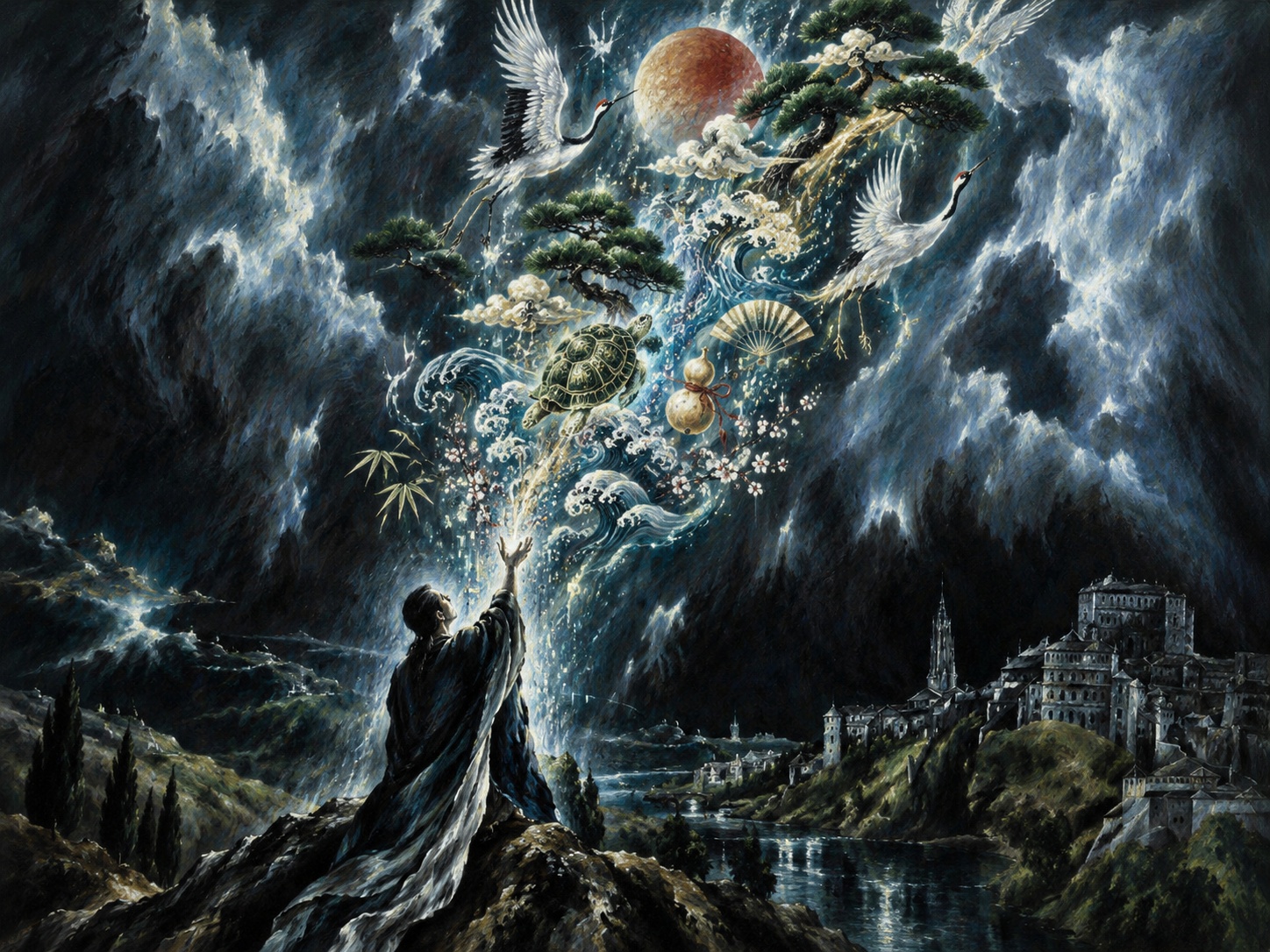
A good omen has traditionally depended on scarcity.
An iridescent cloud appears near the sun for a moment. A halo forms around the light. A cloud shape suddenly resembles a phoenix. The physics may be explainable, the resemblance accidental, but a person looking upward can still feel that something extraordinary has happened.
What happens when extraordinary signs can be manufactured on demand?
That is the question at the center of Sputniko!’s new installation A Sky of Infinite Wishes, which received its world premiere on September 11 and 12 at Ars Electronica Festival 2026 in Linz, Austria. Commissioned by Julius Baer Bank with Ars Electronica, the work was created for Deep Space 8K, an immersive projection environment in which an evolving dusk sky fills with simulated East Asian signs of good fortune.[1][2][3]
Iridescent clouds, sun halos and a phoenix-like cloud appear, multiply and overwrite one another. Detection boxes and visible moments of replacement remain on screen, deliberately refusing to conceal the machine. A landscape that initially looks blessed becomes quiet and increasingly uncanny as the number of “blessings” approaches excess.[1][2][4]
An artificial sky across a 16-by-9-meter wall and floor
Ars Electronica Center’s Deep Space 8K uses a 16-by-9-meter wall projection and an equally large floor projection, with 8K imagery, 3D capability and laser tracking.[5]
The scale changes the role of the sky. Visitors are not simply watching a framed landscape; the image extends around and beneath them, turning a distant atmospheric phenomenon into an environment.
Sputniko! served as artist and art director. Riku Ueno of P.I.C.S. TECH is credited as creative coder, Hironori Terai as producer, Kyoda Kanji as AI engineer, The Original Jaermulk as sound composer and Minako Sera as assistant.[1][2]
One technical point remains unresolved: the public materials do not identify the generative model, training dataset, image-generation architecture or detailed AI pipeline. Japan.co.jp does not infer a specific model from the finished imagery.
| Item | Published information |
|---|---|
| Artist | Sputniko! |
| World premiere | September 11-12, 2026, Ars Electronica Festival, Linz |
| Venue | Ars Electronica Center, Deep Space 8K |
| Projection | 16×9m wall plus 16×9m floor in the Deep Space environment |
| Primary signs | Iridescent clouds, sun halos and phoenix-like cloud forms associated with East Asian good fortune |
| Commission | Julius Baer Bank with support from Ars Electronica |
| Not disclosed | Specific generative model, training data and detailed AI processing pipeline |
Saiun is a real atmospheric phenomenon before it is an omen
The iridescent cloud at the center of Sputniko!’s recent work is not an invented magical object.
Japan’s Meteorological Agency explains that saiun occurs when relatively thin cloud appears separated into red, yellow, green and other colors as sunlight diffracts around cloud droplets. A solar halo, or higasa, is a different phenomenon caused by refraction through ice crystals in high cloud.[6]
That distinction matters. Sputniko! is not simply creating fantasy weather. She is taking real optical phenomena to which people have attached cultural meaning and making their appearance programmable.
A natural iridescent cloud depends on conditions, position and chance. A generated one becomes reproducible.
In 2024, she asked AI to simulate one lucky cloud
A Sky of Infinite Wishes has a direct precursor.
In her 2024-25 exhibition Can I Believe in a Fortunate Tomorrow? at KOTARO NUKAGA in Tokyo, Sputniko! presented a video of the same title in which AI analyzed passing clouds and synthesized the rainbow shimmer of saiun. The gallery described the resulting image as simultaneously capable of producing genuine wonder and as a kind of technologically fabricated phenomenon.[7]
The 2026 commission scales that problem dramatically. Instead of one artificial sign, the whole sky fills with them.
The question has shifted from “can a simulated omen feel real?” to “what does belief look like when omens are infinitely reproducible?”
She has already industrialized the search for luck
Sputniko! explored a parallel idea in Drone in Search for a Four-Leaf Clover.
A drone flies above a clover field while image-recognition algorithms search for four-leaf clovers — a childhood symbol of luck that traditionally requires patience and chance.[8][9]
If a machine can scan a field quickly and discover dozens of rare clovers, the definition of “lucky find” becomes unstable. The result is technically successful and emotionally strange.
The new sky reverses the operation. The earlier work used AI to find scarce lucky objects already present in the world. A Sky of Infinite Wishes uses computation to make the signs themselves.
Auspicious design has always been visualized hope
Japan’s traditional auspicious patterns are not merely decorative. They convert hopes for longevity, prosperity, fertility, health and good fortune into visible form.
The Tokyo National Museum divides many Japanese auspicious motifs into forms transmitted from China and forms that developed within Japan. Dragons, phoenixes, peonies, pine-bamboo-plum combinations, cranes and treasure motifs belong to long East Asian lineages; fans and treasure ships developed particularly Japanese associations.[10]
The Kyoto National Museum’s own 2026 New Year display presented phoenix, treasure ship, Mount Fuji, pine-bamboo-plum, cranes and turtles as motifs used to express hopes for happiness.[11]
A textile, lacquer object, fan or ceramic vessel could therefore function as more than ornament. It placed desired futures onto the surface of daily life.
The phoenix was powerful precisely because it never needed to exist biologically
One of the AI-generated forms in Sputniko!’s work resembles a phoenix.
Japanese heritage records describe the phoenix as a mythic auspicious bird inherited from ancient Chinese traditions. It became associated with virtuous rule and favorable omens and was naturalized into Japanese painting, textile and decorative design, often paired with paulownia, bamboo or peony.[12][13][14]
There is a productive paradox here. A phoenix is already an image of something that does not exist in the empirical world. It has carried real political, ceremonial and emotional meaning for centuries anyway.
AI can also create something that never physically existed. The difference lies not simply in “real versus fake,” but in who or what participates in making the image and how meaning accumulates around it.
Auspicious clouds were objects long before screens existed
Japan’s visual culture also materialized good-fortune clouds.
An eighth-century silver hairpin in the Tokyo National Museum collection uses a symmetrical zuiun, or auspicious-cloud, form at its top. The object is preserved as an Important Cultural Property and associated with Horyuji.[15]
The sequence is revealing: people see clouds, interpret them as favorable signs, transform them into stable motifs and carry those motifs onto the body.
A Sky of Infinite Wishes does something different. It returns the motif to a moving sky — but a sky that never has to stop generating.
Why dusk?
The installation is set at dusk rather than under a clear midday sky. Ars Electronica describes twilight as a threshold in East Asian cultural imagination, a transition in which the visible world can feel temporarily less fixed.[2]
Japanese Buddhist visual culture gives the sunset an especially rich precedent.
The Kyoto National Museum explains nissokan, the “sun contemplation” described in the Contemplation Sutra, as a practice of looking at the setting sun and overlaying its radiance with an imagined vision of Amida Buddha’s Western Pure Land. That visual practice became entangled with Japan’s equinoctial higan traditions.[16]
Sputniko!’s installation is not a Pure Land image. But the older link between the setting sun and the act of imagining another, desired world gives her artificial dusk an important cultural resonance.
The AI boxes remain visible — the magician shows the machinery
Many generated images try to hide the fact of generation. The viewer receives a finished visual object.
Sputniko!’s installation deliberately keeps detection boxes and overwriting events visible. Ars Electronica emphasizes that the system does not conceal its own intervention.[2][17]
That decision changes the work.
Without the boxes, a sufficiently convincing sky might briefly pass as documentary footage. With them, the installation repeatedly tells the visitor: this blessing is being produced.
The more interesting question follows. Does knowing that fact destroy the experience? Can something declared artificial still feel beautiful, sacred or emotionally lucky?
An artwork that fabricates images is not the same thing as a deceptive deepfake
The age of generative AI often collapses many different image problems into one word: fake.
Art has always depicted things that did not literally exist. Phoenixes, dragons, Pure Lands, utopian cities and fictional futures are not new because a computer can render them.
Context matters. A Sky of Infinite Wishes is openly presented as media art using AI, and its visual machinery is partly exposed. A fabricated news clip pretending to document a real event makes a different social claim.
Sputniko!’s work nevertheless presses on a genuine instability. If generated images become perceptually indistinguishable from captured images, “I saw it” becomes weaker evidence about what actually happened.
Ars Electronica 2026 asked who gets to negotiate humanity
Ars Electronica Festival 2026 took place across Linz from September 9 through 13 under the theme “NEGOTIATING HUMANITY.” Its curatorial frame asked how AI agents, humanoid robots, ecological crisis and political instability are changing the definition of the human and who has authority to shape that definition.[18][19]
Sputniko!’s contribution approaches the question through belief.
AI does not need to decide whether a cloud is lucky. Humans do.
But if algorithms increasingly generate, select and recommend the images through which we encounter the world, then even the raw material of belief — what we see — is no longer independent of computation.
This artist has long built machines that make myths or identities physically testable
It would be misleading to describe the new work as Sputniko!’s sudden response to the generative-AI boom.
Her 2010 Menstruation Machine imagined a wearable device that could simulate menstrual pain and bleeding, turning a private bodily experience into a designed and manipulable system. MoMA has discussed the work in terms of identity, biology and choice.[20]
In Red Silk of Fate, Sputniko! took the East Asian myth of the red thread connecting destined lovers and reimagined it through genetically engineered silk, including installations shaped around spaces of blessing and worship.[21]
Across these works, the method is consistent: take something usually located in myth, biology, fate or social convention and ask what happens if technology makes it materially operable.
In 2026, generative AI is the latest machine for that thought experiment.
A long relationship with Ars Electronica
Gallery and artist records place Sputniko!’s engagement with Ars Electronica back to 2009. She later taught at the MIT Media Lab from 2013 to 2017, founding the Design Fiction Group, and served as an associate professor in Tokyo before continuing work across art, design and technology.[7][22]
Her artist archive lists an Ars Electronica Interactive Art Honorary Mention for Menstruation Machine in 2012 and a Hybrid Art Honorary Mention for Nanohana Heels in 2013.[22]
The 2026 commission therefore sits inside a long relationship with the festival rather than a first encounter.
Does repetition weaken a blessing?
Traditional auspicious imagery already uses repetition. Cranes can cover a robe; phoenixes repeat across textiles; New Year objects gather several lucky motifs at once. Repetition can intensify rather than diminish a wish.
So the work is not making the simplistic argument that “many blessings mean no blessing.”
Its more radical condition is limitlessness.
A human artisan repeats within the limits of labor, material and time. A generative system can continue indefinitely. The sky can receive another halo, then another iridescent cloud, then another phoenix form, without fatigue.
When the omen no longer interrupts the ordinary world because the whole world has become omen, what is it still signaling?
The worldwide tour will test whether the same symbol survives translation
After Linz, Ars Electronica Solutions says the content will be available to the international Deep Space Community for touring through the end of 2027.[23]
That creates a second experiment.
An audience familiar with saiun, auspicious phoenixes or Japanese sunset associations may read the image differently from an audience with none of those references. To one viewer the sky can be blessing; to another, visual spectacle; to another, a warning about synthetic media.
The work’s global circulation may therefore reveal how much an omen depends on shared cultural memory.
How should an AI artwork like this be judged?
AI art becomes obsolete quickly if its only achievement is “using the newest model.”
Japan.co.jp’s analysis is that the useful questions here are cultural rather than computational.
- Scarcity: does an infinitely reproducible omen retain the emotional force of a rare natural event?
- Authenticity: can we experience an image as beautiful or sacred while knowing it is artificial?
- Transparency: does exposing the machine increase trust, or puncture the experience?
- Cultural translation: do East Asian auspicious signs retain meaning when the work travels globally?
- Memory: after the installation, does the viewer remember the AI, the beautiful sky, or the discomfort of not knowing what to believe?
Is AI a machine for granting wishes — or merely for manufacturing signs that look like wishes?
Generative AI is increasingly sold as a technology that shortens the distance between desire and output. Ask for text and text appears. Ask for an image and an image appears.
But desire is not necessarily satisfied simply because the requested object arrives.
The time spent searching for a four-leaf clover, the surprise of seeing a rare cloud, the cold morning waiting for the first sunrise of the year, the act of choosing an auspicious gift for somebody else — these rituals give wishes social and emotional structure.
Sputniko!’s sky does not grant wishes. It produces the signs that wishes might be granted.
That may be an unusually accurate image of the generative-AI era. Humanity has acquired the ability to manufacture pictures of happiness before it has learned how to manufacture happiness itself.
Once the sky is full of good omens, belief returns to the viewer
Iridescent clouds can be explained through diffraction. Solar halos can be explained through ice-crystal refraction. A phoenix in a cloud can be explained as a human tendency to perceive meaningful forms.
Scientific explanation does not prevent somebody from finding the sight beautiful or lucky.
The same can be true of an artificial sky.
The crucial distinction is between feeling something and believing a claim about reality.
A Sky of Infinite Wishes does not promise that the machine can produce good fortune. It asks what humans will value when the machine can produce good fortune’s visual language without limit.
For centuries, an omen was something that appeared in the sky. In 2026, the sky can be generated.
If people continue to wish anyway, perhaps the last scarce thing is not the image of luck. It is the human act of deciding what deserves to be believed.
Sources & Reference Material
- IMAGICA GROUP / P.I.C.S. TECH, Sputniko!'s A Sky of Infinite Wishes and production credits, Sept. 14, 2026
- Ars Electronica Festival 2026, A Sky of Infinite Wishes
- Ars Electronica Export, A Sky of Infinite Wishes by Sputniko!
- Ars Electronica Festival 2026, Deep Space 8K program description
- Ars Electronica Center, Deep Space 8K projection environment
- Japan Meteorological Agency, atmospheric optics FAQ — iridescent clouds and solar halos
- KOTARO NUKAGA, Can I Believe in a Fortunate Tomorrow? exhibition
- Sputniko! official site, Drone in Search for a Four-Leaf Clover and related works
- KOTARO NUKAGA, Japanese exhibition text for Can I Believe in a Fortunate Tomorrow?
- Tokyo National Museum, auspicious patterns in Noh — transmitted and Japanese-developed motifs
- Kyoto National Museum, 2026 display of auspicious textile patterns
- Cultural Heritage Online, Atsuita with phoenix-lozenge pattern — phoenix as auspicious sign
- Cultural Heritage Database, Phoenix Screens — Japanese adaptation of the auspicious phoenix image
- Cultural Heritage Online, Katabira with paulownia and phoenix pattern
- e-Museum, Silver Hairpin with auspicious-cloud form, Nara period
- Kyoto National Museum, Higan and the Pure Land — sunset contemplation
- Ars Electronica Export, Negotiating Humanity — Knowledge, Belief, and Truth in the Age of AI
- Ars Electronica Festival 2026, Time & Locations — Sept. 9-13, 2026
- Ars Electronica Mediaservice, NEGOTIATING HUMANITY festival framing, Aug. 31, 2026
- MoMA, Menstruation Machine (Sputniko!), 2010
- Sputniko! official site, Red Silk of Fate — The Shrine
- Sputniko! official site, biography and Ars Electronica history
- Ars Electronica Solutions, A Sky of Infinite Wishes and Deep Space Community touring
Sources checked through September 14, 2026. A Sky of Infinite Wishes had already received its world premiere on Sept. 11-12 at Ars Electronica Festival 2026. Official materials describe iridescent clouds, sun halos, a phoenix-like cloud, AI generation/overwriting and visible detection boxes, but do not disclose the specific generative model, training data or detailed inference pipeline; Japan.co.jp does not infer them. Historical discussion of auspicious imagery uses museum and cultural-property sources and does not claim that the installation itself generates pine-bamboo-plum, cranes, turtles or other motifs used only as historical context. For touring, this article follows the current Ars Electronica Solutions notice that makes the content available to the Deep Space Community through the end of 2027. Analysis is by Japan.co.jp.