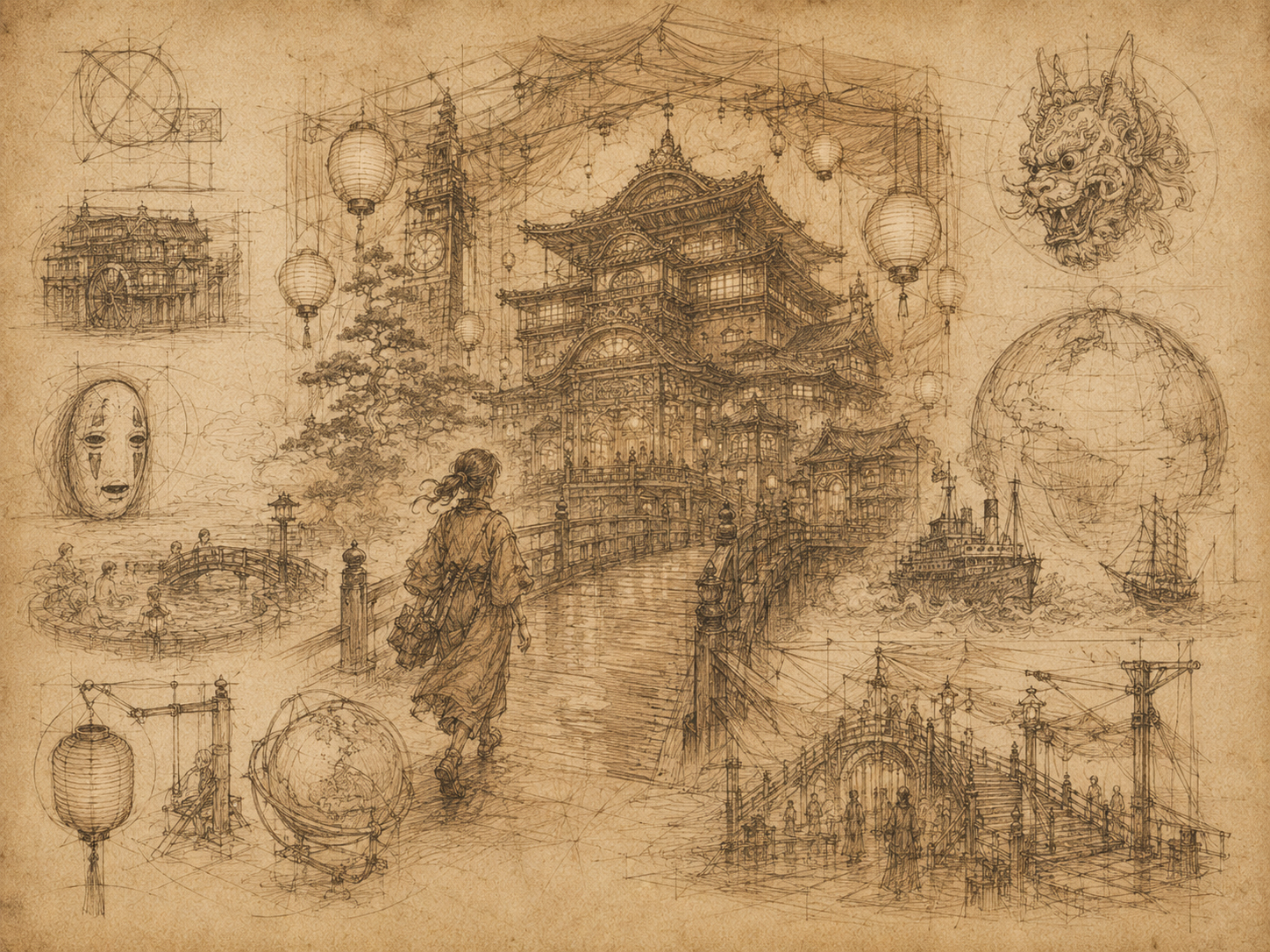
Spirited Away was always a story about crossing a border. A family takes a wrong turn. A girl walks through a tunnel. Her parents are transformed, her name is stolen, and the only way home is to work, remember, help, and grow. In the film, Chihiro is the traveler. In 2026, the story itself is traveling. Toho’s stage adaptation of Hayao Miyazaki’s Spirited Away is heading into a major 2026–2028 world tour, moving from Taipei to Japan, then to Toronto, Los Angeles, and London.
According to Toho’s official site, the stage version has passed 491 performances and more than 900,000 admissions across Japan and overseas from its 2022 Imperial Theatre premiere through the Seoul closing in March 2026. During its Taipei run, beginning in December 2026, the production is expected to pass 500 performances and 1 million total admissions. After successful long engagements in London, Shanghai, and Seoul, the new route turns Spirited Away into something larger than a beloved adaptation. It becomes one of the clearest examples yet of Japanese theater entering the global cultural circuit on its own terms.
The key phrase is “on its own terms.” This is not a locally remade version with local casts and local language. As with the London, Shanghai, and Seoul productions, the Japanese-born company travels abroad and performs in Japanese, with surtitles for international audiences. The voices remain Japanese. The bodies remain theatrical. Joe Hisaishi’s music remains central. The bathhouse is built not from computer graphics, but from actors, puppets, set changes, costumes, shadows, and disciplined human labor. That is why this tour matters. It is not only an anime story going global. It is Japanese stagecraft going global.
The world tour in numbers
The film that changed the scale of Japanese animation
To understand why this tour feels historic, it helps to return to 2001. By the time Spirited Away opened in Japan, Studio Ghibli was already a national institution. My Neighbor Totoro, Kiki’s Delivery Service, and Princess Mononoke had made Hayao Miyazaki one of Japan’s defining filmmakers. But Spirited Away changed the scale.
Nippon.com’s Ghibli box-office ranking places Spirited Away at ¥31.7 billion in Japanese box office, including revival screenings. It held Japan’s all-time box-office record for more than two decades until Demon Slayer: Mugen Train overtook it. In 2002, it won the Golden Bear at the Berlin International Film Festival. In 2003, it won the Academy Award for Best Animated Feature. The Academy Museum describes its place in history as the first hand-drawn, non-English-language animated film to win that Oscar category.
That mattered because Spirited Away refused to dilute itself. It was not a story flattened for export. It was full of Japanese textures: gods and spirits, bathhouse labor, name magic, food temptation, polluted rivers, trains over water, old-fashioned buildings, and a young girl learning how to survive in a strange economy. International audiences did not understand every reference, and that was part of the power. The film trusted viewers to feel before they decoded.
From screen to stage: the impossible assignment
Adapting Spirited Away for the stage sounds almost impossible. The film moves like water. Tunnels, grasslands, a bathhouse, Kamaji’s spider-like arms, No-Face, Haku’s dragon form, Yubaba’s enormous head, paper birds, flooded train tracks, spirits of every shape. Animation can transform a world instantly. Theater cannot. Theater has bodies, boards, light, fabric, pulleys, breath, timing, and risk.
That is precisely why the adaptation became interesting. Olivier and Tony-winning director John Caird, known globally for Les Misérables, adapted and directed the production, with Maoko Imai as co-adaptor. The show uses Hisaishi’s original score, performed live. The official London site emphasizes wildly imaginative puppets, dazzling set and costume designs, and a live orchestra. The Guardian’s reporting from the London run described a production built from visible mechanics: puppets, stagehands, performers, and set pieces working together so that the machinery of theater becomes part of the magic.
The point is not to replace animation with spectacle. The point is to translate animation into the grammar of theater. A dragon does not need to be photorealistic if the audience can see ten people breathing it into motion. No-Face does not need digital smoothness if the stage gives him stillness, scale, silence, and appetite. The bathhouse does not need to be infinite if it can feel crowded, vertical, hot, greedy, and alive.
What London proved
The turning point was London. Toho Entertainment reported that the 2024 London Coliseum engagement ran for 135 performances and drew about 300,000 people. The production filled one of the West End’s largest venues, with about 2,300 seats, and did so in Japanese with Japanese performers. For Toho, it was a first-of-its-kind overseas undertaking at that scale. For the wider theater world, it showed that a Japanese-language production tied to anime could become a serious commercial and artistic event outside Japan.
That success changed the conversation. It is easy to say that Ghibli sells itself. But theater is not streaming. It requires travel, rehearsal, technicians, surtitles, local marketing, ticket buyers, and trust that audiences will sit together in a room for hours. The London audience did not simply consume a brand. It entered a ritual: live music, live bodies, live puppetry, live Japanese speech, and a familiar film memory reawakened in public.
Then came Shanghai in 2025, with 42 sold-out performances according to Toho Entertainment, followed by Seoul in 2026. By the time Toho announced the 2026–2028 tour, the production had already proven something rare: an original Japanese stage company could carry a large, technically demanding, Japanese-language production through major overseas cities and fill houses for extended runs.
Why Taipei comes first
The new world tour begins at Taipei’s National Theater, running from December 17, 2026 to January 31, 2027. That starting point makes cultural sense. Taiwan is one of the world’s most receptive markets for Japanese pop culture, anime, food, travel, design, and language learning. A Japanese-language Spirited Away can open there with less cultural distance than it might face elsewhere, while still signaling that the show is now moving beyond the Japan–London axis.
After Taipei, the production returns to Japan for a five-city national tour, including Tokyo, Aichi, Osaka, Fukuoka, and Hokkaido. That matters too. International success can sometimes make a work feel distant from its home audience. This route does the opposite. It sends the show out, brings it home, and then sends it further across the Pacific.
The North American leg is especially symbolic. Toronto’s Princess of Wales Theatre and Los Angeles’ Ahmanson Theatre are major stages in major cultural cities. Toho notes that the Los Angeles engagement represents the first Toho theatrical production in the United States since the musical Scarlett in 1973 — a 54-year gap. That makes the Los Angeles stop more than an anime event. It is a return of Toho theater to the American stage after half a century.
The power of remaining Japanese
International theater usually localizes. Producers cast locally, translate the script, adjust references, and rebuild the production for each market. Spirited Away is choosing a different path. The show travels as a Japanese production, performed in Japanese by a Japanese-born company. That is risky. Audiences must read surtitles. Some nuance will be missed. The language barrier is real.
But the strength is also real. Japanese is not incidental to Spirited Away. Names matter in the story. Politeness matters. Silence matters. The rhythms of the bathhouse, the sound of Chihiro becoming Sen, the authority of Yubaba, the tenderness of Haku, the comedy of Kamaji and the soot sprites — all of these sit inside a Japanese performance culture as much as inside plot. Remove too much of that and the work becomes easier, but thinner.
This reflects a broader change in global Japanese media. Earlier waves of export often removed cultural markers: names were changed, foods were redrawn, settings were blurred. Today, international audiences often want the texture. They want the untranslatable parts. They accept subtitles. They learn the terms. They travel to the places. The friction becomes part of the attraction.
From anime tourism to theater tourism
The world tour also points to a new stage in anime tourism. For years, anime tourism meant traveling to Japan to visit the real or imagined locations connected to a work: Ghibli Museum, Ghibli Park, Akihabara, Nakano, Kyoto, Kamakura, rural towns turned into pilgrimage sites by films and series. Fans moved toward the story.
Now the story moves toward the fans. A viewer in Taipei, Toronto, Los Angeles, or London can encounter Spirited Away not as a streamed film but as a Japanese stage event. That encounter may then pull them toward Japan: to Ghibli Park in Aichi, the Ghibli Museum in Mitaka, old hot-spring towns, wooden inns, bathhouse architecture, river landscapes, and the broader world of Japanese folklore and hospitality.
That is why this is a tourism story as well as a theater story. The stage show does not replace Japan travel. It creates desire for it. A fan who sees the bathhouse come alive onstage may want to understand the real traditions behind public bathing, ryokan work, shrine culture, kami, polluted rivers, and the old built environment that gives Miyazaki’s fantasy its emotional weight.
The bathhouse as national memory
The bathhouse is the heart of Spirited Away. It is not just a fantasy hotel for spirits. It is a workplace, a social machine, a place of ritual cleansing, greed, hierarchy, exhaustion, and hospitality. Japan’s bathing culture links hot springs, sentō, ryokan, pilgrimage, healing, neighborhood life, and public etiquette. The film compresses all of that into the towering, breathing, impossible structure of the Aburaya.
For the stage, the bathhouse is the greatest challenge. Film can move the camera anywhere. Theater fixes the audience in place. Stairs, railings, doors, boilers, elevators, guest rooms, bridges, and steam must be arranged so that a single stage feels endless. That is why the production’s design matters so much. The bathhouse has to become a character.
When audiences watch the stage version, they are not only asking whether it looks like the film. They are asking how humans will make the impossible visible. How does Haku fly? How does No-Face expand? How does Kamaji’s boiler room function? How does Yubaba dominate the space? The pleasure is not in hiding the labor. The pleasure is in watching labor become enchantment.
A 2001 story for a 2026 world
Spirited Away was born in post-bubble Japan. Its anxieties were those of a society living after the collapse of easy growth: consumption, work, pollution, memory loss, disappearing landscapes, adults turned into appetites, children forced to mature. Chihiro survives not by becoming superhuman, but by learning attention, gratitude, courage, and responsibility.
The world of 2026 has different anxieties: AI, climate stress, war, inflation, overtourism, loneliness, migration, and unstable identity. Yet Chihiro’s story remains painfully current. A child enters a system she does not understand. Her name is shortened. Her parents are compromised by appetite. Work is frightening but necessary. Allies appear in strange forms. The way home depends on memory.
In some ways, the stage version may feel even more relevant now than the film. In a digital era, it insists on handmade transformation. It shows the people who move the puppets. It lets the audience feel the coordination required to sustain wonder. The magic is not less powerful because it is visible. It is more moving because it is visible.
Japan.co.jp view
The Spirited Away world tour marks a new phase in Japan’s cultural exports. The first phase was distribution: Japanese animation reached overseas screens. The second phase was pilgrimage: fans came to Japan to find the worlds they loved. The third phase is presence: a Japanese-language stage company arrives in world cities and asks audiences to meet the work in a live, shared room.
This is a business story: tickets, theaters, touring logistics, merchandise, tourism, brand value, training, translation, and IP management. But it is also a cultural story. Spirited Away carries ideas that are difficult to franchise cheaply: names have power; work changes people; appetite can deform adults; spirits deserve respect; rivers can be wounded; hospitality can be both beautiful and exploitative; memory is a form of rescue.
Chihiro traveled in order to return home. The stage production now travels in order to show the world that Japanese fantasy, Japanese language, and Japanese theater can stand together under the lights of global stages. That is more than a tour. It is a sign of confidence.
Reader guide
| Item | How to read it |
|---|---|
| What happened | Toho announced a major 2026–2028 world tour for the stage adaptation of Spirited Away. |
| Where it goes | Taipei, five Japanese cities, Toronto, Los Angeles and London. |
| Why it matters | The Japanese-born company performs overseas in Japanese, making this a major test of Japanese theater as global cultural export. |
| Historical context | The 2001 film grossed ¥31.7 billion in Japan and won both the Golden Bear and the Academy Award for Best Animated Feature. |
| Japan.co.jp view | This connects anime, theater and tourism into a new international circuit for Japanese culture. |
Sources and references
This article draws on public information from Toho, the official London site, Pia, SPICE, Toho Entertainment, Nippon.com, the Academy Museum, Japan House London, The Guardian, and Playbill.
- Toho official site: 2026–2028 world tour, 491 performances, more than 900,000 admissions, projected 1 million admissions, Japanese-language touring company.
- Spirited Away UK: 2028 London Coliseum return, John Caird adaptation/direction, Joe Hisaishi score, puppets, set, costume and live orchestra.
- Pia: Taipei, Japan, Toronto, Los Angeles and London route for the 2026–2028 tour.
- Toho Entertainment: 135 London performances in 2024 with about 300,000 admissions, 42 sold-out Shanghai performances in 2025, and Seoul in 2026.
- Nippon.com: Spirited Away’s ¥31.7 billion Japanese box office, Golden Bear and Academy Award context.
- Academy Museum: the film’s historical importance as a hand-drawn, non-English animated Oscar winner.
- The Guardian: reporting on the London stage craft, puppetry and production mechanics.