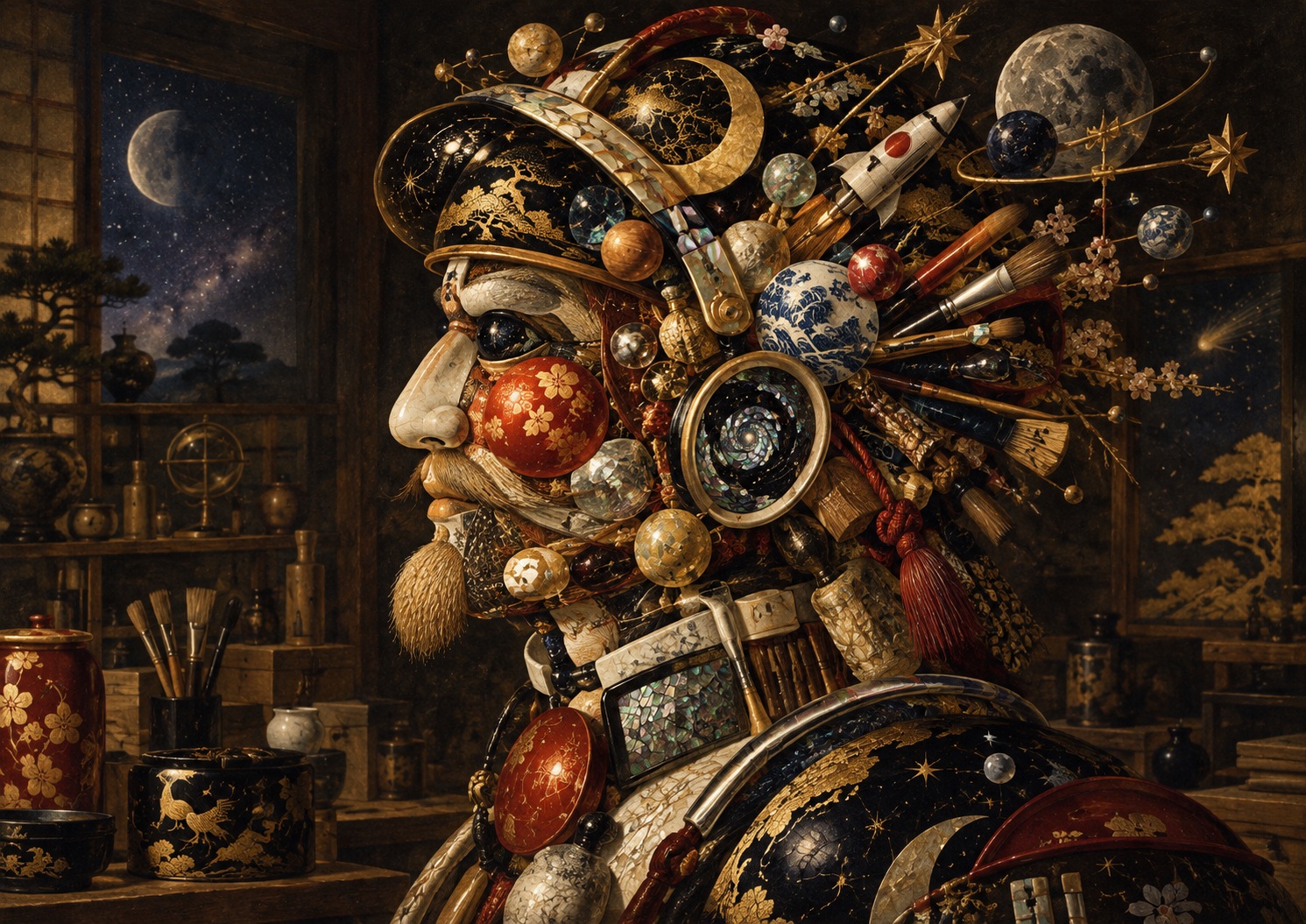
Space is usually far away. The Moon is roughly 380,000 kilometers from Earth. On September 16, 2026, however, the Moon and Earth became a pair of sake cups about six centimeters wide. A star field became shell inlay and gold powder on black lacquer. Mutta and Hibito Nanba became small clay figures from Seto.
Nakagawa Masashichi Shoten’s collaboration with the completed manga Space Brothers is more than licensed characters printed on existing merchandise. It translates the story into eight product categories using hand-blown glass, Echizen lacquer, Seto ceramics, Kyoto hand-printing and embroidery, and Nara kaya-woven cloth. [1]
The three craft anchors are the Moon-and-Earth blown-glass cups by Sugahara Glassworks, a pair of Echizen lacquer cups made with Arai Shojikido, and clay figures by Seto Togei-sha. Around them are comic pouches, card pouches, eyeglass cases and two styles of cloth. Prices range from ¥770 for a kitchen cloth to ¥29,700 for the glass set. [1]
The manga ended this year; the objects begin another life
Chuya Koyama’s Space Brothers began serialization in Morning with the issue released December 6, 2007. Its central promise is simple and durable: brothers Mutta and Hibito Nanba promise as children that they will become astronauts and reach space together, then pursue that promise by very different routes. [9]
The series won both the Shogakukan Manga Award and Kodansha Manga Award in general categories in 2011, then expanded into a live-action film and television anime in 2012 and an animated film in 2014. Kodansha reported circulation above 34 million copies in March 2026; Nakagawa’s later August collaboration release says more than 35 million. Japan.co.jp treats the latter as the collaborator’s more recent company figure rather than trying to reconcile two differently dated totals. [17] [1]
The final chapter, No. 432, appeared on June 11, 2026. Volume 46, the final collected volume, followed on July 22. Exact dates make the serialized run about eighteen and a half years; Kodansha described it at the finish as roughly nineteen years. [7] [8] [9]
That timing changes the meaning of the collaboration. This is not merely merchandise for an ongoing hit. It is a new physical form arriving just after a long narrative has reached its end. A manga advances through pages and time. A cup, figurine or cloth sits in the same room and acquires time through use.
A glass accident, controlled for ten years, became the Moon
The Moon-and-Earth cups come from Sugahara Glassworks in Kujukuri, Chiba. Founded in 1932, Sugahara continues to make handmade glass with a workshop culture in which craftspeople frequently design the products they themselves produce. [12]
The surface treatment called void was not invented for Space Brothers. Glass artisan Kenji Matsuura had been developing it for about a decade. A very small amount of sodium bicarbonate is applied to molten glass; heat triggers a reaction that creates irregular cavities and texture on the surface. As the glass expands, the marks spread unpredictably. No two surfaces are identical. [2] [3]
Matsuura himself named the technique “void,” borrowing the term for vast empty regions in cosmic structure because the finished glass suggested space to him. Nakagawa’s designer later saw that existing technique and made the same visual connection. Matsuura also happened to be an avid reader of the manga. [2]
One cup becomes the Moon through yellow-gold surface color and crater-like relief. The other becomes Earth, shifting from deep blue toward green depending on transmitted light and viewing angle. The collaboration works because the physical behavior of glass does the representing rather than a printed illustration pasted on top. [2] [3]
More than 1,000°C: where craft and astronaut metaphor meet
In Nakagawa’s workshop interview, Matsuura compares glassmaking to athletic performance. Summer working conditions can exceed 40°C, and the material itself is worked at temperatures above 1,000°C. Poor sleep or physical condition, he says, immediately dulls the senses needed for consistent work. [2]
He also draws a comparison with astronauts: neither can touch the environment directly. An astronaut relies on suits and tools; a glassworker relies on rods, shears and metal hand tools to manipulate material that cannot be touched bare-handed. Matsuura still uses a metal tool he has kept since joining Sugahara in 2000. [2]
That is the artisan’s own analogy, not a scientific equivalence. But it explains why Space Brothers, a manga obsessed with training, equipment, teamwork and repeated failure, can feel unusually compatible with a workshop story.
Shell and gold turn black lacquer into space
The Echizen lacquer cups are made with Arai Shojikido in Fukui. Magnolia wood forms the base, the reverse is finished in true black lacquer, and the upper surface uses raden shell inlay and maki-e to render Mutta, Hibito and a field of stars. [4]
Raden decorates lacquer or wood by embedding shell. Japan’s Agency for Cultural Affairs says the technique reached Japan from Tang China in the Nara period and became one of the country’s major lacquer-decoration methods from the Heian period onward. Its iridescent color changes with the viewing angle — an old optical effect repurposed here as starlight. [15]
Maki-e uses lacquer as the drawing medium and scatters gold, silver or colored powder onto the design. Its roots are visible in the Nara period and it became highly developed in Japan from the Heian period. Historically, maki-e and raden have frequently been combined. [14]
The collaboration therefore does not need modern reflective plastic or LED light to suggest space. Shell and metal powder have been producing changing light on black lacquer for centuries.
Echizen carries roughly fifteen centuries of craft history
The Echizen Lacquerware Cooperative traces the craft’s origin, as local tradition, to the sixth century and a story involving the future Emperor Keitai and a lacquer artisan in what is now Sabae. The narrative is a production-area tradition rather than a fully documented archaeological origin, but Echizen’s long history as a major lacquer center is well established. [13]
The cooperative says Kyoto maki-e expertise was introduced in the late Edo period and chinkin carving techniques came from Wajima. In modern industry, Echizen developed a major commercial-lacquerware business serving hotels and restaurants. [13]
The Space Brothers cups are tiny objects inside that history. Their novelty lies not in hiding the old technique but in making the technique itself carry the new image.
Seto chose warmth over photorealism
The third centerpiece is a pair of clay figures made by Seto Togei-sha in Seto, Aichi. Mutta and Hibito wear spacesuits, but the makers deliberately avoided the hyper-accurate language of a modern collectible figurine. Rounded forms, clay texture and individually painted details give the brothers a softer presence. [5] [6]
Nakagawa’s production story describes repeated discussion over whether greater resemblance to the manga was actually the right goal. The final direction drew on ceramic figures made in Seto more than a century ago. Tiny suit markings, including “N.MUTTA,” are painted by hand. [5] [6]
A handmade-washi base suggests the lunar surface, and a folding screen shows Earth viewed from the Moon. A manga panel has been translated into the Japanese display logic of small figures, base and screen. [5]
Seto has always made more than tableware
Seto describes itself as a ceramic city with roughly a thousand years of history. Its deposits of high-quality clay supported tableware, glazes and white ceramics, but modern Seto also became known for Seto novelties — ceramic figurines and decorative objects made heavily for export — as well as sanitary ware, electrical insulators, tiles and advanced ceramics. [16]
Seto Togei-sha has been making ceramic figures since 1951, and Nakagawa explicitly places the company within the technical inheritance of the Seto novelty industry. Its work moves through model making, mold making, slip casting, firing and painting. [1] [6]
Seen in that context, turning manga characters into ceramic figures is not a rupture with Seto history. It is a contemporary subject entering a production tradition that has long converted human figures and narrative motifs into clay.
Kyoto hand-printing turns manga covers into fabric
The three expensive objects are only part of the line. Comic pouches, card pouches and eyeglass cases turn cover imagery from the manga into textile surfaces.
Kyoto’s Hisayama Senko applies the imagery through hand printing, while Mutta and Hibito are finished in embroidery. The resulting fabric is used in three formats, each offered in character variants. [1]
There is a neat circularity to the comic pouch in particular. Cover art originally made to wrap a book becomes fabric designed to carry that book.
Nara’s kaya cloth gets stars that appear in the dark
The most everyday objects are two kinds of cloth: hana-fukin and kaya-woven kitchen cloth. Phrases from the manga are scattered across the fabric, while phosphorescent star printing appears after the room goes dark. [1]
The hana-fukin uses two layers of cotton kaya weave; the more robust kitchen cloth uses five. Kaya weave originated in loosely woven mosquito-net fabric and became valued in household cloth because repeated washing makes it softer while retaining useful absorbency and quick drying. Nakagawa says its hana-fukin line has been sold since 1995 and has reached cumulative sales of 4.8 million. [1]
If the glass cups are a small universe to contemplate, the cloth is a universe meant to be washed, wrung out and used until it softens. The price range is part of the design philosophy: craft is not presented only as a precious display object.
Why a company founded in 1716 is working with a 2007 manga
Nakagawa Masashichi Shoten began in Nara in 1716 as a merchant of Nara-sarashi, a fine hemp textile historically used for garments including samurai formal wear and Buddhist robes. Three centuries later, it designs, manufactures and retails contemporary household goods and says it works with roughly 800 makers around Japan. [10] [11]
Its stated corporate vision is to “revitalize Japanese craft.” Since 2009 it has also worked in management support for craft manufacturers. In 2026 it launched a growth-investment business for makers; company sales exceeded ¥10 billion for the first time in the fiscal year ended February 2026. [18]
For the Space Brothers project, Nakagawa says it saw a connection between space and craft in accumulated technique and the human effort required to turn dreams into real things. That is the company’s promotional framing. The actual objects, however, make the idea less abstract.
Space exploration is not only a futuristic machine appearing on launch day. It is training, testing, material knowledge, tooling, failure and team coordination. Craft survives by similar repetitions: understanding material, making process reliable, and finding new uses without erasing what the process can do.
Tradition and future are not opposite ends of the line
The easy story would be “space equals future, craft equals tradition.” The products complicate that.
Sugahara’s void treatment began only about ten years ago. Seto’s makers looked back to century-old clay figures to design manga characters. Echizen uses techniques with Nara- and Heian-period roots to render a contemporary fictional starscape. Hand-printing and embroidery move comic art onto modern accessories. Traditional kaya cloth receives phosphorescent printing.
None of those objects is “craft preserved exactly as it used to be.”
- Moon-and-Earth hand-blown cups: ¥29,700 / Sugahara Glassworks / void surface technique
- Echizen lacquer brothers cups: ¥25,300 / Arai Shojikido / raden and maki-e
- Seto-yaki brothers clay figures: ¥24,200 / Seto Togei-sha / hand painting
- Comic pouch: ¥4,400 each / hand printing and embroidery
- Card pouch: ¥2,970 each / hand printing and embroidery
- Eyeglass case: ¥5,940 each / hand printing and embroidery
- Star-glow hana-fukin: ¥1,980 each / kaya weave and phosphorescent printing
- Star-glow kaya kitchen cloth: ¥770 each / kaya weave and phosphorescent printing
Why Space Brothers fits craft unusually well
Space Brothers is about space, but much of its emotional life occurs on Earth: training, failed tests, preparation, tools, waiting, colleagues and family. The rocket launch is never the whole story.
Craft has the same visibility problem. A finished cup can be understood in seconds, while the years of failed surfaces that preceded it disappear. The concentration required to place shell inlay cannot be seen in a catalog price. The hand that paints one tiny suit patch disappears when the figurine reaches a shelf.
Manga can narrate invisible preparation. Craft leaves that preparation embedded in a surface.
Space Brothers finished its serialized journey in June. Three months later, parts of that universe moved into glass texture, shell light, gold powder, clay and cloth.
The people who made the universe small enough to hold were not astronauts. They were craftspeople.
- Nakagawa Masashichi Shoten, Space Brothers craft collaboration, Aug. 26, 2026
- Nakagawa Masashichi Shoten, interview with glass artisan Kenji Matsuura, Sept. 16, 2026
- Nakagawa Masashichi Shoten, hand-blown Moon-and-Earth sake cups
- Nakagawa Masashichi Shoten, Echizen lacquer Space Brothers cups
- Nakagawa Masashichi Shoten, Seto-yaki Space Brothers clay figures
- Nakagawa Masashichi Shoten, story of the Seto clay-figure collaboration, Sept. 16, 2026
- Kodansha Morning, Space Brothers concludes June 11, 2026
- Kodansha Morning, final volume 46 released July 22, 2026
- Official Space Brothers site, serialization began Dec. 6, 2007
- Nakagawa Masashichi Shoten, company history — founded in 1716
- Nakagawa Masashichi Shoten, company profile and network of craft makers
- Sugahara Glassworks, handmade glass since 1932
- Echizen Lacquerware Cooperative, 1,500-year craft history
- Agency for Cultural Affairs, maki-e technique and history
- Agency for Cultural Affairs, raden technique and history
- Seto City, thousand-year ceramic tradition and Seto novelty production
- Kodansha Morning, awards, adaptations and circulation of Space Brothers
- Nakagawa Masashichi Shoten, craft-industry growth investment, June 3, 2026
