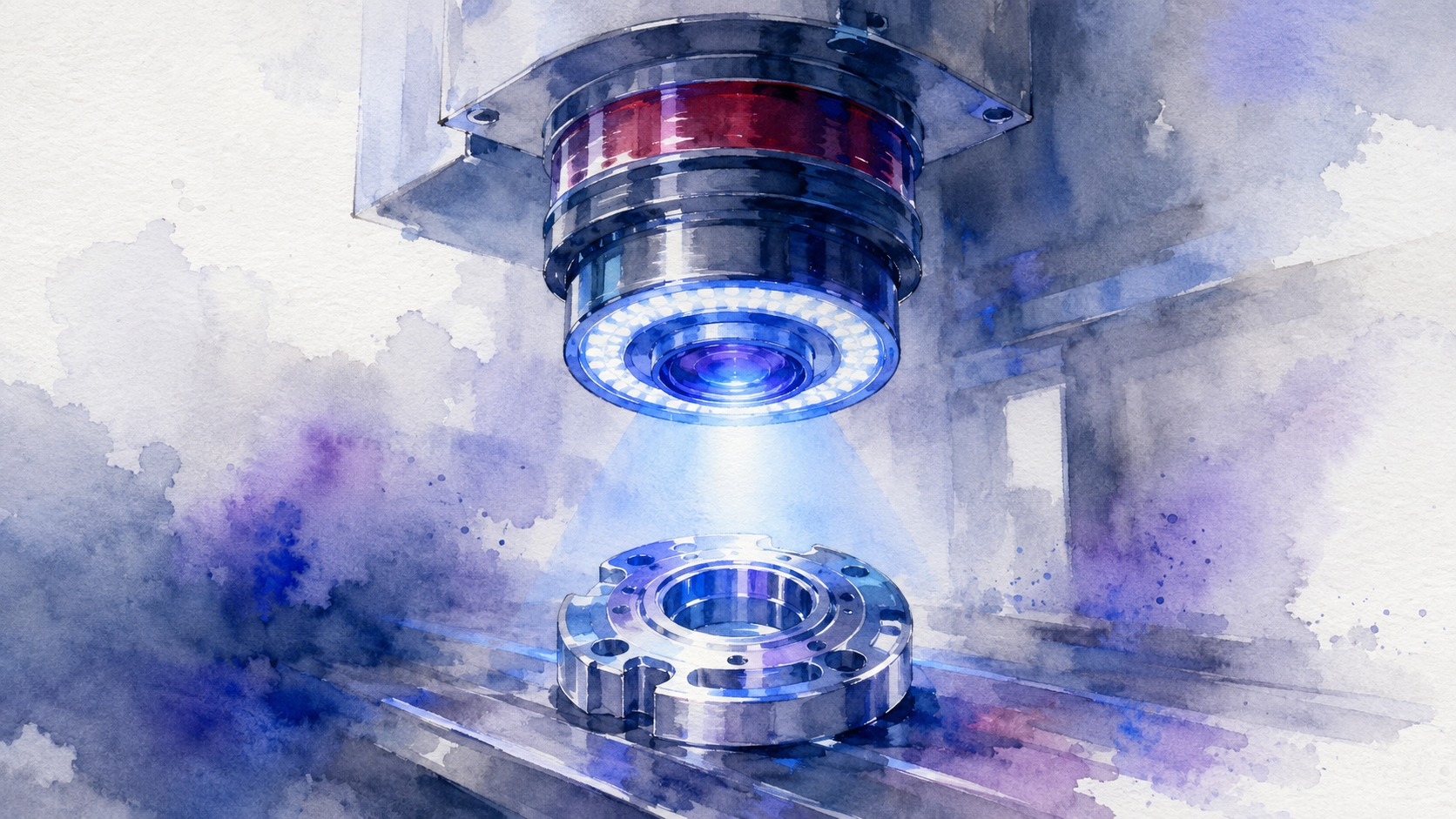
For decades, the factory camera was an inspector: it found the mistake. The next machine eye must do more. It must understand what changed, decide what it means and make the equipment act. Advanced Vision Solutions, the venture being formed by Sony Semiconductor Solutions and Mitsubishi Electric, is designed to shorten that distance from sight to motion.
Under the definitive agreement announced July 22, 2026, operations are scheduled to begin in October, subject to regulatory approvals. Mitsubishi Electric will own 60% and Sony Semiconductor Solutions 40%. The company will be headquartered in Minatomirai, Yokohama, with Tamiki Kobayashi as representative. This is not a vague memorandum: name, address, leader and ownership are specified.
Not a camera—a vision sensor
A camera makes an image. A vision sensor converts the position, shape, orientation, defect or movement of an object into information a machine can use in real time. On a production line it may reject a scratched component, guide a robot toward a randomly oriented part or slow equipment when a worker enters a hazardous zone.
Traditional systems send large video streams to an industrial PC or server for processing. Sony’s edge AI places inference near—and sometimes on—the image sensor. Instead of exporting raw footage, it can emit meaning: “defect,” “X coordinate 42,” or “87% anomaly probability.”
Local analysis cuts latency and bandwidth, keeps proprietary production imagery inside the factory and continues when cloud links fail. But a tiny sensor has limited memory and compute. Models must be compressed and engineered to survive changing light, vibration, dust and heat.
Sony’s journey beyond the human eye
Sony developed a 110,000-pixel CCD imager in 1978 and commercialized its first CCD image sensor in 1980. From the XC-1 color camera adopted on jumbo jets through Handycam, digital cameras and smartphones, Sony turned light-to-electron conversion into a mass industry.
It shifted from CCD to CMOS beginning around 2004, commercialized column-parallel analog-to-digital conversion in 2007, a back-illuminated CMOS sensor in 2009 and a stacked CMOS sensor in 2012. Copper-to-copper connections followed in 2015. Stacking pixels above logic led naturally to the 2020 IMX500/501 intelligent vision sensors, capable of AI processing beside image capture.
Smartphone photography powered Sony’s rise, but a maturing handset market makes cars, robots and factories—the eyes of machines—the next frontier. Japan approved up to ¥60 billion for a new Sony sensor plant in 2026, while Sony and TSMC are discussing another sensor venture. Advanced Vision Solutions is not a manufacturing project; it is a route for turning sensor capability into industrial outcomes.
Mitsubishi Electric’s advantage: factories that cannot stop
Founded in 1921, Mitsubishi Electric supplies MELSEC programmable logic controllers, servo motors, inverters, CNC systems, robots, operator panels and industrial networks. A PLC reads inputs, executes deterministic logic in milliseconds and commands motors or valves. It is the factory nervous system.
The most accurate AI benchmark is insufficient on a production line. A system must run continuously, respond within a guaranteed time, fail safely and remain maintainable for a decade or more. Mitsubishi Electric contributes controls, distribution, system integrators and knowledge earned from customers for whom downtime is measured in lost output.
Its Serendie digital platform, launched in 2024, connects data from devices, systems and services. Combining vision with vibration, temperature, motor current, process settings and quality history can elevate inspection into plant-wide decision-making.
Five jobs transformed by the closed loop
| Operation | What the sensor sees | Decision and control |
|---|---|---|
| Quality | Scratches, stains, shape, printing | Reject, adjust speed, correct upstream process |
| Robotics | Part position, pose, overlap | Calculate grip and change motion |
| Maintenance | Wear, leakage, wobble, discoloration | Schedule service and derate equipment |
| Safety | People, protective gear, danger zones | Warn, limit speed or stop |
| Manual work | Sequence, tool and completion | Guide, prevent errors and record |
The difficult step comes after “anomaly detected.” The system must decide how much control to change. If defects rise, is the cause tool wear, temperature or a material lot? Multiple streams can guide an adjustment to speed or pressure. This is what the partners mean by connecting recognition, decision-making and control.
The multimodal factory
Images cannot see wear inside a motor or an invisible temperature increase. A vibration sensor cannot identify uneven color on a product. Combining cameras, sound, vibration, temperature, current, PLC logs and production schedules reveals early signs that a single data type misses.
If a weld’s shape and color shift while the current waveform changes, AI may infer electrode wear, slow the line and order maintenance. Unlike a chatbot response, physical AI’s answer becomes machine motion. An error can mean scrap, downtime or injury.
Labor scarcity is the need; lights-out production is the challenge
Japanese manufacturing faces skilled-worker retirement and recruitment difficulty. Visual inspection is tiring, variable and hard to staff overnight. The venture promises products usable without specialist optics or AI knowledge, targeting labor savings, unmanned operation, better quality and advanced maintenance.
Yet veterans do not merely look at defects. They combine sound, smell, touch, memory and material behavior. Transferring that skill requires normal data, rare failure examples, seasonal light, equipment differences and continuous recalibration when products change.
“No specialist expertise” is a product objective, not a present fact. Successful systems will hide routine complexity while allowing engineers to inspect models, thresholds and evidence when necessary.
Strengths and limits of in-sensor AI
- Speed: avoid network round trips before control.
- Bandwidth: transmit results instead of video.
- Confidentiality: keep raw product and process imagery on site.
- Resilience: continue local operation through cloud outages.
- Energy: monitor continuously without a large GPU server.
The constraint is compute. Giant vision models cannot simply be loaded onto a sensor; quantization, distillation and model partitioning are required. A practical hierarchy will make fast first-pass decisions on the sensor and send difficult cases to an industrial computer or cloud.
Thousands of edge devices also create model-update, cybersecurity and version-control problems. A compromised or misconfigured model can directly affect machinery. Signed models, permissions, audit logs and separation from safety PLCs will matter as much as recognition accuracy.
The competition is larger than camera companies
Keyence, Cognex, Omron and Basler are powerful in machine vision. Nvidia and Intel supply edge-computing platforms. Fanuc, Yaskawa, Siemens, Rockwell and Schneider Electric are integrating AI and control.
The venture’s advantage is the direct connection of Sony’s pixels, stacked logic and sensor AI with Mitsubishi Electric’s control assets from PLCs to servos. Its weakness may be joint-venture speed. Semiconductor product cycles and industrial-equipment qualification move differently; unclear responsibility or sales channels could erase the integration benefit.
The numbers that will prove it works
The partners disclosed no revenue target, capitalization, workforce or first-product date. The correct scorecard is therefore missed-defect and false-positive rates, downtime, configuration time, payback period and interoperability—not the ambition of the announcement.
If Mitsubishi Electric keeps the system inside its own FA ecosystem, deployment may be fast but the market narrower. If Sony’s sensing is to spread across mixed factories, open communication standards and integrator partnerships will be essential. Real plants are rarely supplied by one vendor.
In 1980, Sony’s CCD helped cameras see the world from an aircraft. Mitsubishi Electric’s controllers quietly moved Japanese factories. The 2026 venture attempts to close those histories into one loop. It marks a shift from machines that see to machines that act responsibly on what they see. Advanced Vision Solutions will not be judged in a polished demonstration, but amid oil, vibration, shadows and the night shift.