- Why choose Soga Shōhaku for November 13?
- A life partly known, and therefore vividly felt
- What “eccentric” really means
- Work 1 | Dragon and Clouds: a dragon that bends the room around it
- Work 2 | Shoki Ensnaring a Demon in a Spider Web: humor with teeth
- Work 3 | Tiger: the face that is both ferocious and oddly lovable
- Brushwork, emptiness and theatrical timing
- Why modern audiences keep rediscovering him
- A public-domain master, but not a museum postcard
- Curating three images: force, wit and wildness
- Reading Shōhaku now
Inline story images: soga-shohaku-dragon-clouds-folding-screens.jpg / soga-shohaku-shoki-demon-spider-web.jpg / soga-shohaku-eccentric-tiger-edo-painting.jpg
Why choose Soga Shōhaku for November 13?
An art-choice feature for a newspaper does not have to be polite. Some artists soothe; others electrify. Soga Shōhaku belongs to the second category. His dragons do not float decorously through decorative clouds. They lunge. His tiger does not stand as a zoological specimen. It stares with an unnerving, almost comic consciousness. His demon-quelling hero Shoki is triumphant, but also awkward, human and strange. That emotional instability is exactly why Shōhaku still feels modern.
For JAPAN.co.jp, Shōhaku offers more than visual spectacle. He reminds readers that Japanese art history is not only a story of restraint, refinement and balance. It is also a story of exaggeration, theatricality, anxiety, wit and deliberate distortion. To choose him for November 13 is to choose a public-domain artist whose work can unify a whole editorial image set while still jolting the eye awake.
A life partly known, and therefore vividly felt
The outlines of Shōhaku’s life are clear enough to establish his historical importance, yet blurred enough to preserve a sense of mystery. The Kimbell Art Museum lists him as born in 1730 in Ise or Kyoto and dead in Kyoto in 1781. That uncertainty is not trivial. It reminds us that major Edo-period painters do not always come to us with neat modern biographies. In Shōhaku’s case, the paintings have done much of the biographical work themselves.
They suggest a painter who learned deeply from inherited models while refusing to stay obedient to them. The Metropolitan Museum of Art’s description of Eight Views of Ōmi places him in Kyoto in the second half of the eighteenth century, developing a style distinct from the Kano, Nanga and Shijō schools. He was not a naïve rebel working outside tradition. He was a sophisticated insider willing to stress, twist and animate tradition from within.
What “eccentric” really means
The Kimbell identifies Shōhaku as one of the celebrated eccentric painters of the Edo period. In everyday English, eccentric can mean little more than odd. In art history, however, it means something sharper: a refusal to leave inherited themes in their inherited emotional register. Shōhaku’s figures and animals are elongated, enlarged or destabilized; their expressions are often startling; the surrounding space may be vast and unnervingly empty. Yet the paintings are not chaotic. Their exaggeration is controlled.
That control is why the work still carries force. He could paint in monochrome ink or in more detailed and colorful modes, but the same artistic personality emerges across those formats: a desire to push conventional subjects until they become psychologically alive. Dragons, demon-quellers and tigers are perfect examples because they sit on the border between symbol and feeling. Shōhaku turns them into full dramatic presences.
Work 1 | Dragon and Clouds: a dragon that bends the room around it
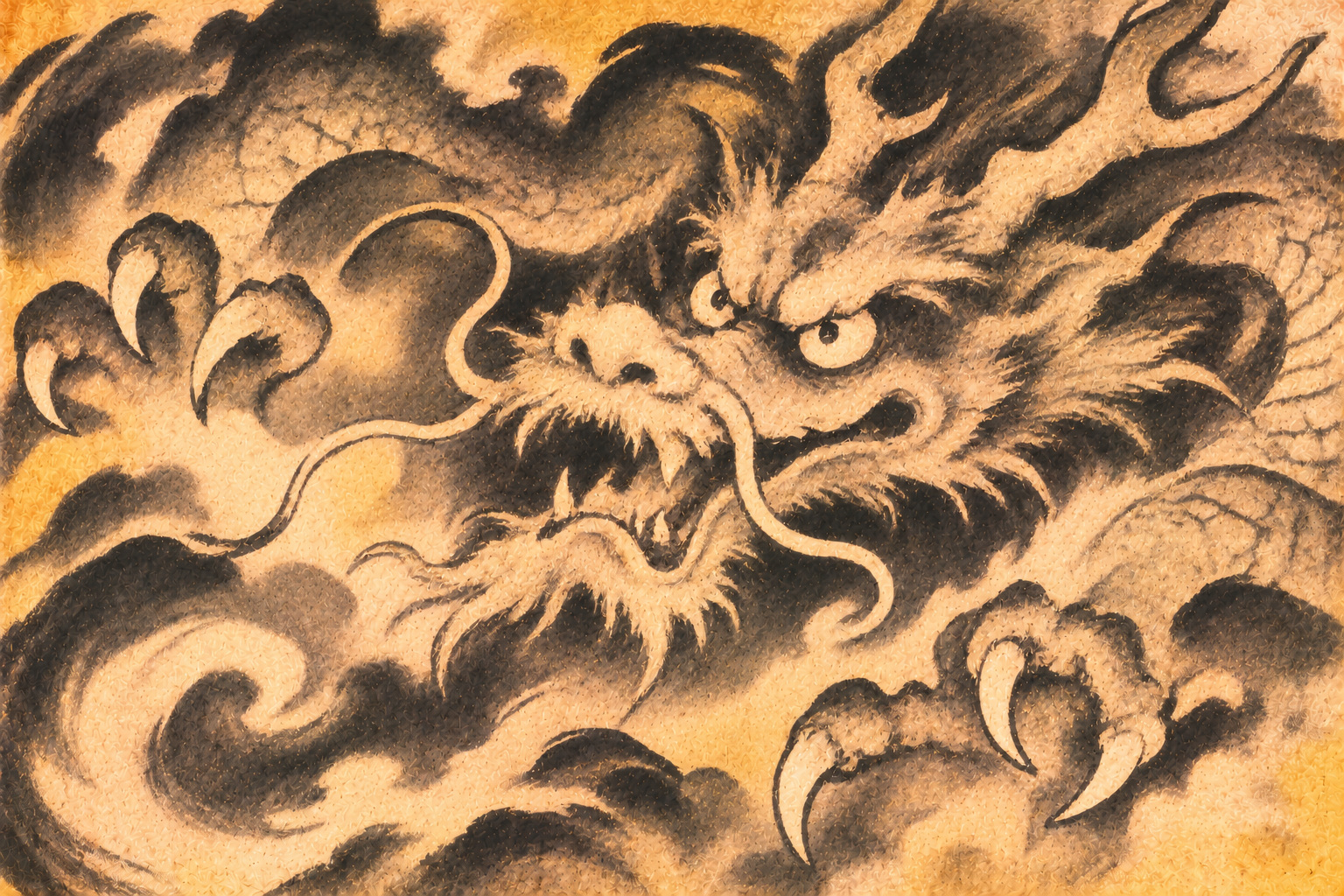
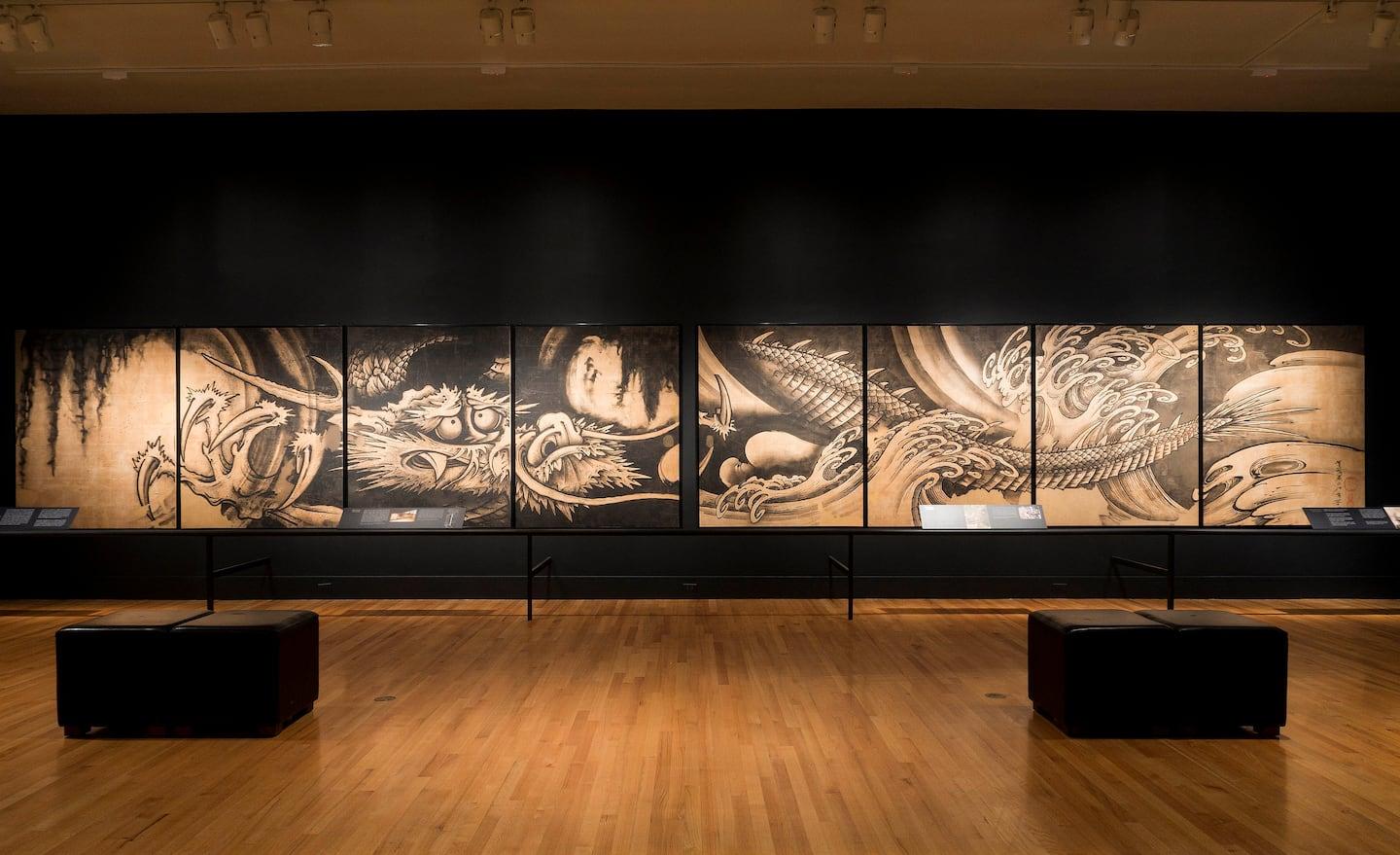
The first of our three curated images is Dragon and Clouds. According to the Museum of Fine Arts, Boston and Canon’s Tsuzuri Project, the work dates to 1763 and originally formed an eight-panel set of fusuma sliding doors, probably made for a temple interior. Four central panels depicting the missing middle of the dragon’s body are believed to have been lost. The surviving sections entered the William Sturgis Bigelow Collection and, after significant conservation, were restored to a form closer to their original architectural presence.
The emotional power of the work lies in more than scale. The dragon’s enormous eyes, whip-like whiskers and clawed momentum do not simply occupy space; they seem to torque the atmosphere around them. Ink washes become weather, muscle and pressure all at once. The beast emerges from cloud, but it also appears to generate the storm. Shōhaku’s imagination is not fantasy as escapism. It is fantasy used as a pressure chamber for feeling.
Work 2 | Shoki Ensnaring a Demon in a Spider Web: humor with teeth
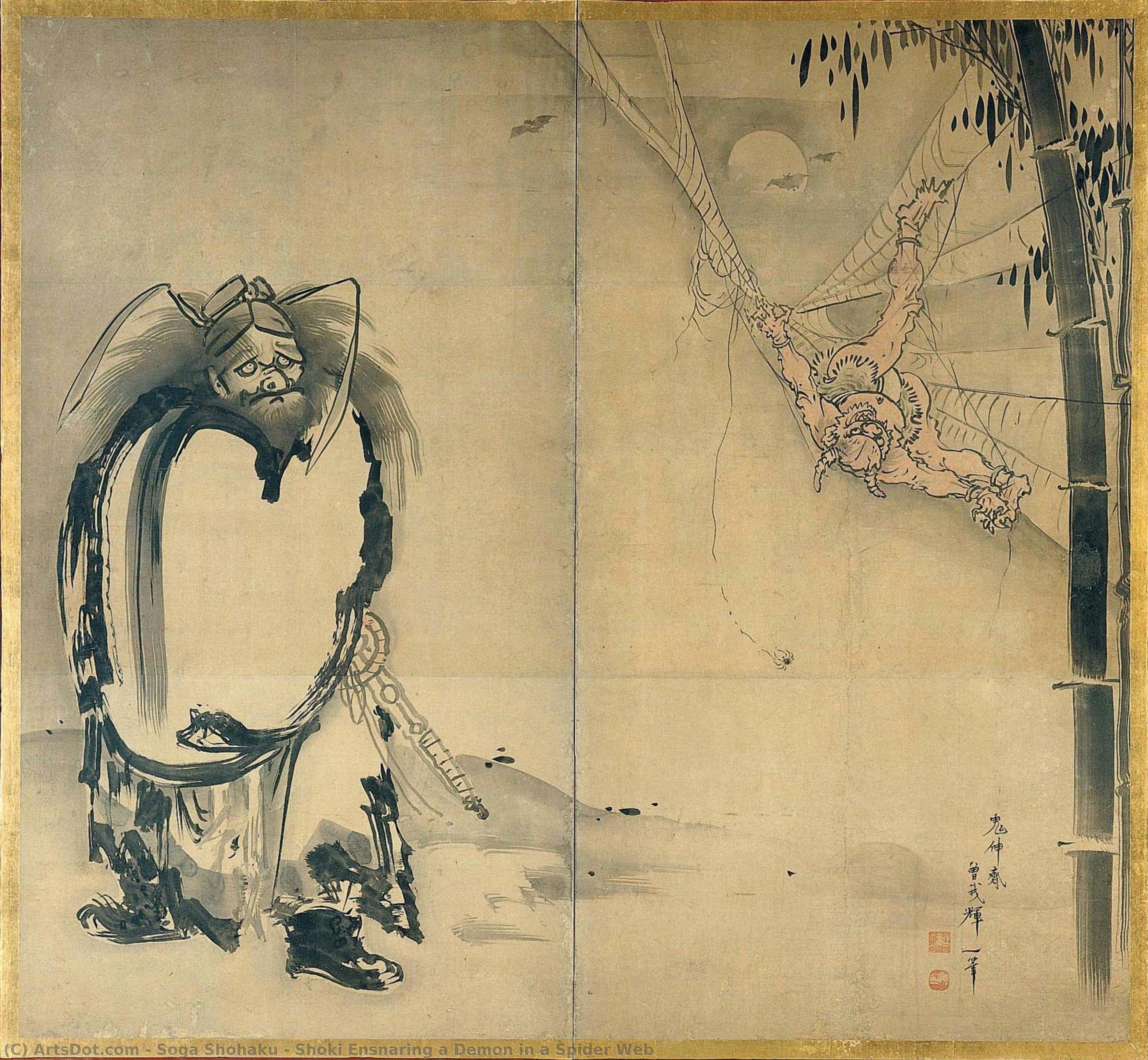
The second work is the Kimbell Art Museum’s Shoki Ensnaring a Demon in a Spider Web. The museum explains that Shoki is the Japanese form of the Chinese hero Zhong Kui, who, after being unjustly denied success in the civil examinations and dying in despair, became a demon-quelling spirit protecting the realm. Edo-period painters returned to the subject often, but Shōhaku approached it with unusual wit.
What makes this picture unforgettable is that it resists a simple heroic reading. Shoki is determined, but not solemn; the demon is trapped, but also pathetic. The spider-web conceit adds a layer of comic invention. Viewers may smile, yet the smile never fully settles into comfort. That is one of Shōhaku’s great gifts: he keeps triumph entangled with absurdity. The supernatural remains vivid, but the emotional tone never becomes one-note.
Work 3 | Tiger: the face that is both ferocious and oddly lovable
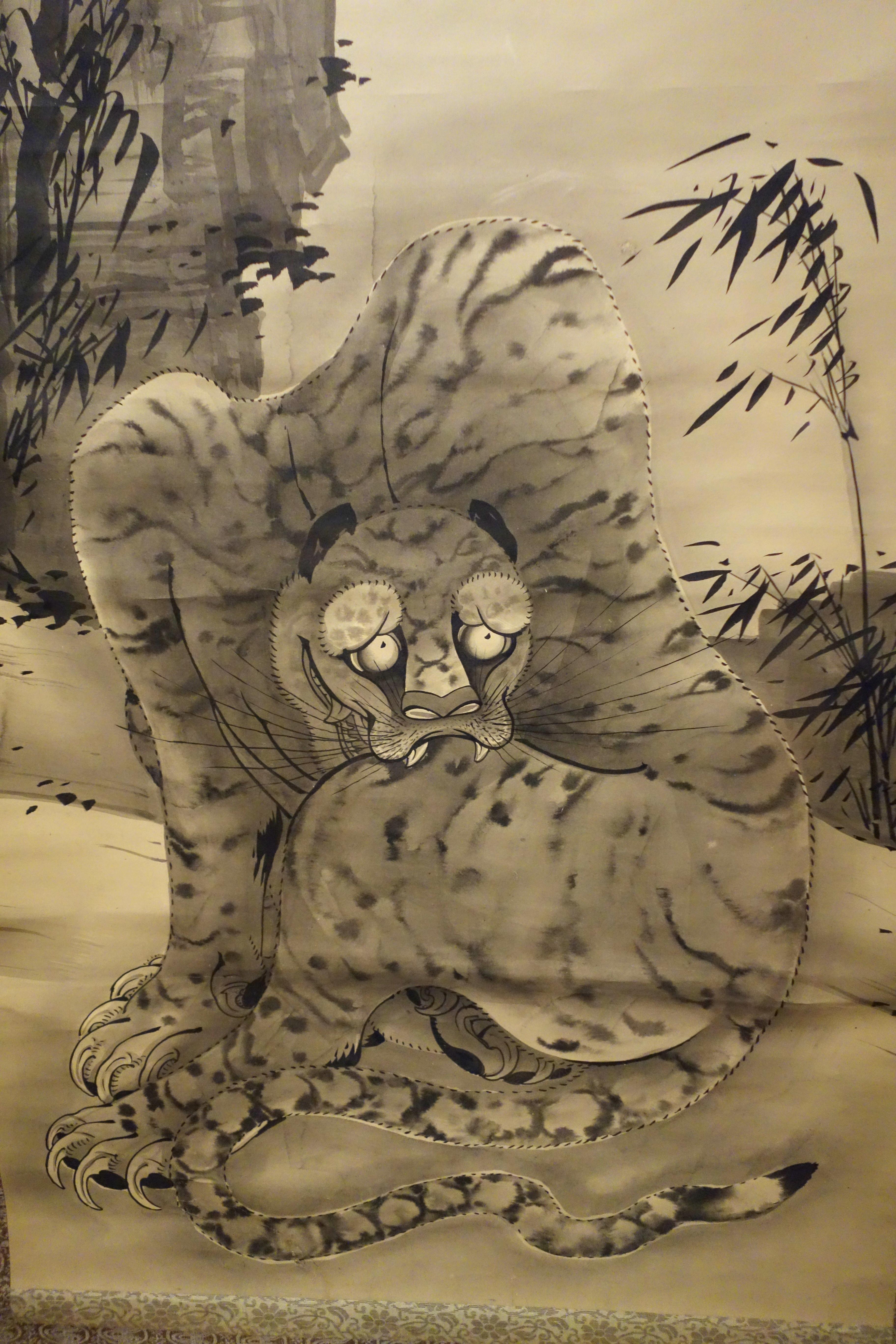
The third image in our story corresponds to the Museum of Fine Arts, Boston credit for Tiger, late 1770s, from the William Sturgis Bigelow Collection. The crouching animal, viewed nearly head-on, is among the most memorable creatures in Edo painting. Its body curls into a compact mass of readiness; its claws press forward; its eyes bulge with hypnotic intensity. Yet the same face also feels strangely vulnerable, even faintly comic.
This doubleness matters. If one asks for naturalism alone, the picture may appear distorted. But distortion is the point. Shōhaku is not cataloguing an animal. He is amplifying the idea of a tiger until terror, curiosity and sympathy occupy the same body. The result is emotional complexity rather than biological description. Few painters make an animal seem at once so threatening and so intimate.
Brushwork, emptiness and theatrical timing
Shōhaku’s art is inseparable from timing. His figures and beasts often appear caught at a charged instant: just before a leap, just as a face turns, just as a supernatural presence breaches the visible world. Dragon and Clouds gives us the split second when force tears through atmosphere. Shoki and the demon gives us the clever instant of capture. Tiger gives us the held breath before movement. These are not static icons. They are dramatic interruptions.
Equally important is what he leaves empty. Large intervals of unpainted or lightly activated space amplify the strangeness of the subject. The eye lands on the creature, then feels the silence around it. That is where the psychological weather of a Shōhaku painting gathers. Ink is not just a medium in his hands; it is a system for measuring pressure, pause and release.
Why modern audiences keep rediscovering him
Shōhaku enjoyed strong appreciation in his own lifetime, yet in later narratives of Japanese art he could appear marginal beside more orderly masters. That changed dramatically in modern scholarship and exhibition practice. Major museums including the MFA Boston, the Kimbell and the Met now present him as a central figure in any discussion of Edo-period eccentricity and imaginative power.
The reasons are easy to understand. In an age saturated with polished images, Shōhaku feels gloriously undisinfected. His creatures are not smoothed into decorative comfort. They retain friction. The dragon really looks dangerous. The tiger really looks weird. The demon scene is genuinely funny and faintly unsettling at the same time. Contemporary viewers recognize this unstable energy as truthful, even when the subject is fantastical.
A public-domain master, but not a museum postcard
The Met explicitly marks Mountain Landscape as public domain, making clear that Shōhaku belongs to a historical world open to wide study and editorial discussion. That does not mean every reproduction carries identical image rights; museum photography and derivative reproductions can differ. It does mean, however, that Shōhaku is ideally suited to an editorial project that wants to connect history, visual pleasure and public access.
Our purpose here is not to flatten him into a “famous weird painter” label. It is to curate a meaningful sequence. Dragon and Clouds shows elemental force. Shoki shows narrative intelligence and humor. Tiger shows animal psychology pushed into the realm of myth. Taken together, the three works demonstrate not one mood, but a range of emotional temperatures.
Curating three images: force, wit and wildness
We selected these three images because each reveals a different emotional center of Shōhaku’s art. Dragon and Clouds gives us force: weather turned into personality. Shoki Ensnaring a Demon in a Spider Web gives us wit: menace transformed by comic imagination. Tiger gives us wildness: a creature so intensely characterized that it becomes almost a portrait of feeling itself.
If we showed only the dragon, Shōhaku would seem merely heroic. If we showed only Shoki, he might seem primarily narrative and playful. If we showed only the tiger, he could be mistaken for a brilliant animal painter. Together, the three images reveal a larger truth. Shōhaku’s art is about how emotion mutates under pressure—how fear can become humor, how power can become theater, and how strangeness can become beauty.
Reading Shōhaku now
Soga Shōhaku was never simply an oddity of the Edo period. He was a painter who challenged inherited norms without abandoning the weight of tradition. He studied deeply, then painted as if rules were there to be made more alive. That is why his images still move so well across time. They do not ask to be admired from a distance. They demand a response.
For JAPAN.co.jp, that makes him a perfect Art Choice feature. He widens the international image of Japanese art beyond quiet elegance alone. He offers another Japan: fierce, funny, haunted, extravagant and profoundly alive. On a crowded news day, that is not an escape from reality. It is a reminder that the history of imagination is part of the history of the country too.
Primary sources and editorial cautions
This feature is based on museum and institutional sources. It does not claim independent conservation analysis or firsthand object examination. Subject explanations, including the Shoki legend, are attributed to museum materials.
- The Metropolitan Museum of Art | Mountain Landscape (Public Domain)
- Kimbell Art Museum | Shoki Ensnaring a Demon in a Spider Web
- Museum of Fine Arts, Boston | Return of the Dragon
- Museum of Fine Arts, Boston | Preview the Exhibition (Tiger credit)
- Museum of Fine Arts, Boston | Mobile credits (Dragon and Tiger)
- Canon Tsuzuri Project | Dragon and Clouds
- The Metropolitan Museum of Art | Eight Views of Ōmi
- Kyoto National Museum official website