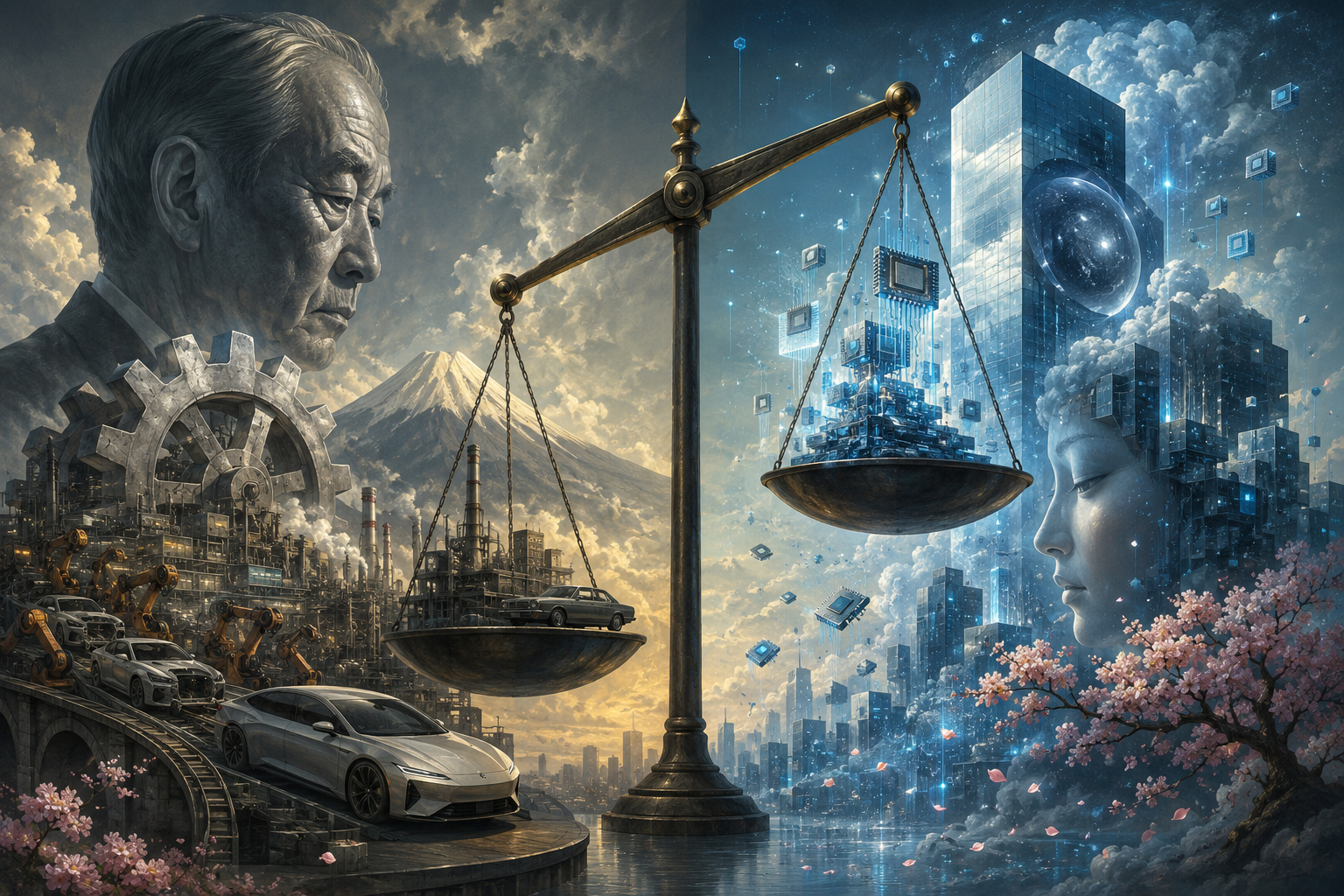
A quiet but symbolic reshuffling has taken place at the top of Japan Inc. SoftBank Group, the company built by Masayoshi Son around software, telecom, internet investing and now artificial intelligence, overtook Toyota Motor in market value. That is not just a stock-market headline. It is a change in what investors are willing to pay for: less certainty from factories, more optionality from AI, chips, data centers, private-company stakes and global capital allocation.
Reuters reported on June 1 that the Nikkei crossed 67,000 for the first time on an AI-driven rally, with SoftBank becoming Japan’s most valuable listed company. Japan Times, citing Bloomberg, reported that SoftBank shares rose as much as 10% in Tokyo trading as AI-related shares climbed across Asia, marking a milestone in the country’s corporate hierarchy.
Toyota represents Japan’s 20th century. SoftBank represents Japan’s wager on the 21st. One built one of the world’s great manufacturing systems. The other tries to connect Japanese capital to whatever global technology wave comes next. In June, at least for the moment, the market put the richer price tag on the wager.
The numbers behind the new order
Market capitalization is not a complete measure of a company. Revenue, profit, debt, employment, technology, social trust, brand, cyclicality and resilience all matter. But market value does reveal what investors believe about future profits. When SoftBank rose above Toyota, it showed where the market imagination had moved.
Toyota’s value is close to physical reality. It makes vehicles, sells them, finances them, services them and runs a vast global supply chain. It faces hybrids, EVs, hydrogen, software-defined vehicles, tariffs and China’s rise with the discipline of a real industrial giant. SoftBank’s value is closer to the future. It bundles Arm, OpenAI, AI data centers, semiconductors, robotics, telecom and investment exposure into one giant instrument of possibility.
That distinction is the story. The 20th-century champion won through manufacturing and exports. The 21st-century contender wants to win through intelligence, compute, chips, data, cloud platforms and capital speed.
Toyota as Japan’s industrial standard
Toyota’s history is the history of Japan as an industrial power. Sakichi Toyoda’s automatic loom, Kiichiro Toyoda’s move into automobiles, the 1937 establishment of Toyota Motor, the postwar crisis, the rebuilding of labor relations, the Toyota Production System, kanban, just-in-time, kaizen and quality control. Toyota is not only a large car company. It is the method by which postwar Japan regained global trust.
Toyota’s strength is not always visible. It is how a line stops, how inventory moves, how defects are surfaced, how suppliers are developed, how workers improve processes, how quality becomes culture. Toyota carried Japanese production into American factories, European markets and emerging economies. It turned hybrid technology into a global bridge between combustion and electrification.
But the auto industry is now in a difficult transition. EVs, software-defined vehicles, batteries, advanced driver assistance, autonomous systems, Chinese competition, U.S. trade policy and supply-chain realignment all challenge the old order. Toyota is not weak. It remains a cash-generating machine. But markets buy future narratives, not only present strength. In the heat of the AI rally, Toyota’s solidity was overshadowed by SoftBank’s upside.
SoftBank as the outsider inside Japan Inc.
SoftBank is an unusual Japanese corporate story. Masayoshi Son founded Nihon SoftBank in 1981 as a packaged-software distributor. From there came computer magazines, trade shows, internet bets, Yahoo Japan, telecom, the Vodafone Japan acquisition, Sprint, Arm, the Vision Fund and now OpenAI and AI infrastructure.
SoftBank’s core skill is not manufacturing. It is capital allocation around technological waves. Son looks for a large shift and bets at extreme size. When he is right, as with Alibaba, the result becomes legend. When he is wrong, as with WeWork, the damage is spectacular. SoftBank is less a conventional Japanese company than a publicly traded venture-capital machine wrapped in telecom cash flow.
That makes valuation difficult. Look at it as a telecom group and you see operating cash. Look at it as an investment company and you see gains, losses and private-market marks. Look at it as an AI-infrastructure company and you see Arm, OpenAI, data centers and chip architecture. Look at it as Masayoshi Son’s story and you see a bid to become a platform company for artificial superintelligence. The market changes which face it values most.
Arm, OpenAI and Stargate put SoftBank near the center
The market-value reversal came from global enthusiasm for AI. Arm, controlled by SoftBank, is already foundational to the smartphone era and increasingly important to power-efficient compute. SoftBank has also moved aggressively into OpenAI, AI data centers, semiconductors and robotics.
The Stargate Project, announced by OpenAI with Oracle, SoftBank and other partners, set out an ambition to invest up to $500 billion over four years building AI infrastructure in the United States, beginning with $100 billion. Whether the economics ultimately work is a separate question. For the stock market, the signal was clear: SoftBank had placed itself inside the story of global AI infrastructure.
Reuters reported on July 1 that SoftBank had renewed talks for a roughly $10 billion loan backed by its OpenAI stake, adding concessions including repayment guarantees. The financing story shows both momentum and risk. AI ambition requires capital. Capital requires collateral, credit, liquidity and future valuations. SoftBank’s stock price reflects both the excitement and the danger.
What the market is really buying
Investors have not decided that Toyota is unimportant. Toyota remains one of Japan’s greatest real businesses. But in an AI market, exponential possibility can be more valuable than steady profit. Globally, money is flowing into models, GPUs, chips, data centers, power systems, cooling, cloud, robots, agents and enterprise AI.
Within Japan’s equity market, SoftBank has become the largest window into that theme. For overseas investors buying Japan, SoftBank is not merely a domestic conglomerate. It is exposure to OpenAI, Arm, Stargate and AI infrastructure through a Tokyo-listed stock. When the Nikkei is lifted by AI, SoftBank becomes the symbol.
Symbols can overheat. OpenAI’s IPO timing and valuation, AI monetization, data-center returns, power constraints, interest rates, leverage and private-market marks all matter. If any part of the story weakens, SoftBank can reprice quickly. The company absorbs future expectations faster than almost anyone else in Japan — and future disappointment just as fast.
The old Japan Inc. and the new Japan Inc.
The postwar Japanese corporate order was built around manufacturing: steel, shipbuilding, electronics, automobiles, machinery and precision parts. Banks, trading houses, ministries, suppliers, unions and local communities supported a model that earned foreign currency through exports and created stable domestic employment. Toyota was the masterpiece of that order.
But in 2026, value is being created differently. Factories still matter. But so do intelligence models, chip design, software, platforms, capital speed and global investment networks. A factory may compound efficiency by 1%. An AI company’s valuation can multiply in a year. Markets are drawn to that asymmetry.
For Japan, this is both hopeful and unsettling. Hopeful, because a Japanese company has positioned itself in the global AI capital stack. Unsettling, because much of the future being bought may sit outside Japan: U.S. AI labs, U.S. data centers, foreign chip ecosystems. A higher Japanese market value does not automatically mean more domestic jobs, domestic infrastructure or domestic capability.
Is Toyota finished?
No. Toyota is not finished. Global vehicle demand remains vast, and Toyota’s hybrid strategy still has strong logic in many markets. EV adoption depends on charging infrastructure, battery costs, consumer habits, durability, policy and regional energy systems. Toyota’s caution has reasons. Its factories, distribution networks, finance operations, parts relationships, brand and quality reputation are not easily displaced.
Toyota’s challenge is not survival but translation. Can its manufacturing strength become software strength? Can kaizen work in battery supply chains, AI-driven vehicles, robotics and mobility services? Can Toyota turn vehicles into digital platforms without losing the trust that made it great?
SoftBank’s lead over Toyota does not prove Toyota lost. It reveals a difference in time horizon. Toyota is valued on real earnings. SoftBank is valued on future optionality. Reality is strong. But the future often sells at a premium.
The Masayoshi Son premium
You cannot tell the SoftBank story without Son. He is founder, capital allocator, narrator and risk-taker. He draws large futures: internet, mobile, AI, artificial superintelligence. Sometimes markets laugh. Sometimes they follow. Either way, his story is embedded in SoftBank’s valuation.
That is a strength and a weakness. Founder vision allows SoftBank to make bets that normal Japanese corporations would never make. But because valuation is tied to the founder’s future narrative, the shares can swing when that narrative is doubted. After WeWork, Vision Fund losses and Sprint’s difficulties, Son has returned to the center through AI.
Markets do not value him as a cautious executive. They value him as a climber of technological mountains. The SoftBank-versus-Toyota reversal is also a rare Japanese example of founder mythology being fused so tightly with national corporate value.
Japan.co.jp view
SoftBank overtaking Toyota is more than a business headline. It unsettles Japan’s self-image. Japan has long explained itself through manufacturing: quality, shop floors, kaizen, discipline, long-term relationships and exports. That identity was earned.
But the AI-era market values something else: compute, data, chip architecture, cloud infrastructure, models, capital speed, private-company access and a tolerance for enormous risk. Those qualities do not always fit comfortably with traditional Japanese corporate culture. That is why SoftBank’s rise is so symbolic. Inside Japan is a company that behaves unlike most of Japan’s old giants, and investors are rewarding it.
Still, betting on the future is not the same as building the future. If SoftBank is to become Japan’s new summit, the gains must eventually return to Japan in the form of talent, research, data centers, power infrastructure, startups, education and regional investment. Otherwise the story is only a Japanese market value attached to overseas AI upside.
Toyota’s era has not ended. SoftBank’s era has not fully begun. What we are seeing is two Japans being valued in the same market: the Japan that makes and the Japan that bets; the Japan of the factory and the Japan of AI capital. In June, the market placed the second above the first. That is a big sentence in the story of Japan Inc.
Reader guide
| Question | Answer |
|---|---|
| What happened? | SoftBank Group overtook Toyota Motor as Japan’s most valuable listed company during an AI-driven rally. |
| Why it matters | It symbolizes a shift from manufacturing-led corporate value toward AI, capital allocation, chips and infrastructure optionality. |
| SoftBank’s strength | Exposure to Arm, OpenAI, Stargate, AI infrastructure, telecom cash flow and global investment networks. |
| Toyota’s strength | Manufacturing power, quality, distribution, brand, cash generation and a global supply chain. |
| Japan.co.jp view | This is not the end of Toyota. It is the moment investors widened Japan’s value standard from “ability to make” to “ability to place capital on the future.” |
Sources and references
This article draws on Reuters, Japan Times / Bloomberg, OpenAI, SoftBank Group and Toyota official materials.
- Reuters: Nikkei tops 67,000; SoftBank becomes Japan’s most valuable firm.
- Japan Times / Bloomberg: SoftBank overtakes Toyota as Japan’s most valuable company.
- Reuters: SoftBank renews talks for $10 billion loan against OpenAI stake.
- OpenAI: Announcement of the Stargate Project.
- SoftBank Group: Company history.
- Toyota Motor Corporation: History of Toyota.