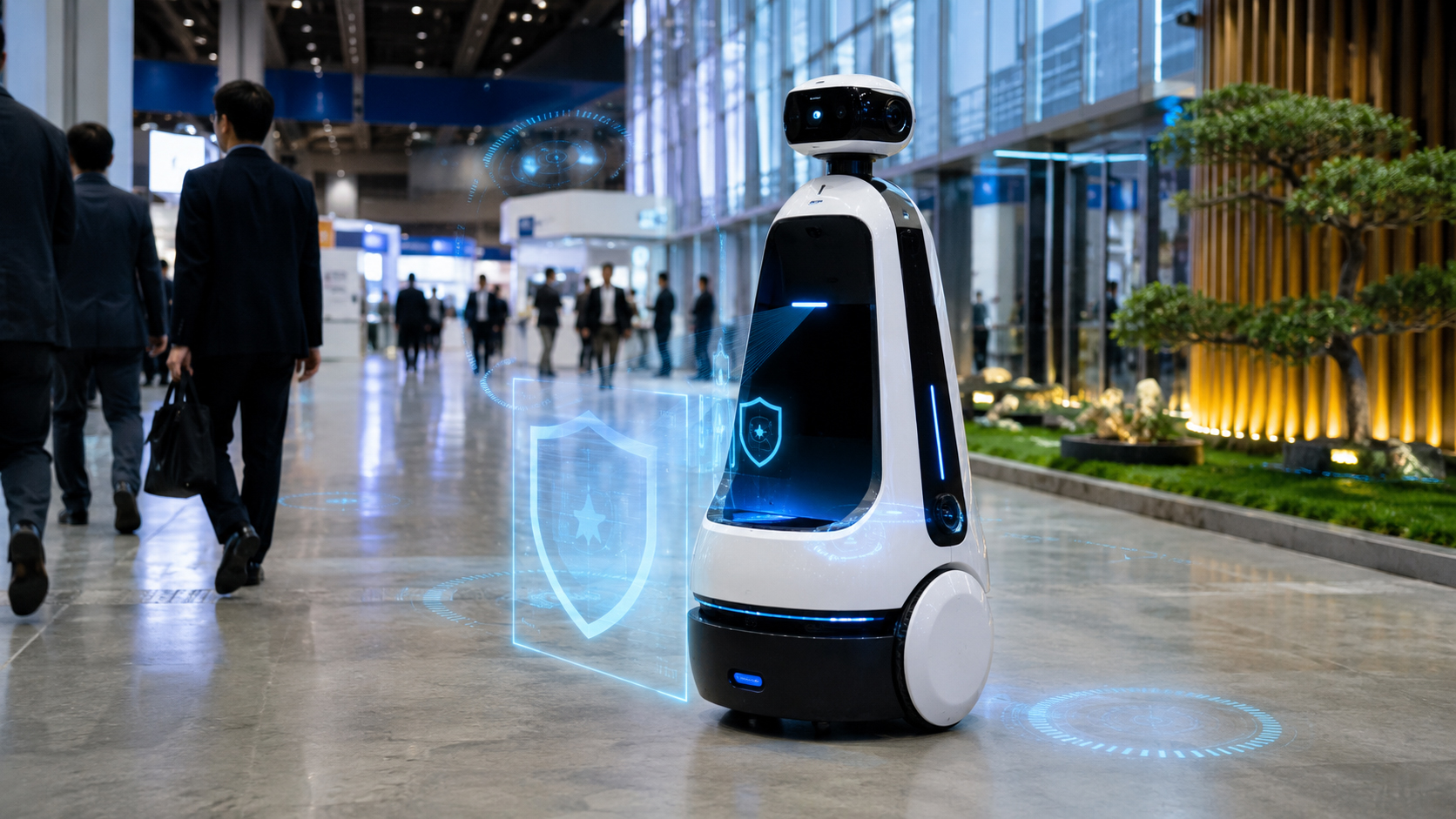
In Osaka, the future of security will not arrive as a movie hero. It will arrive as a machine that rolls quietly across a floor, watches camera feeds, learns what a normal building looks like, and moves toward the place where something feels wrong. SoftBank Robotics is bringing that practical vision to SECURITY SHOW OSAKA 2026, scheduled for July 2 and 3 at INTEX Osaka.
The Osaka story is not just about a robot
The key point is the system. The SECURITY SHOW OSAKA product listings say SoftBank Robotics will present “SBX AI Security Powered by ICETANA AI” and the autonomous AI security robot “SBX Security Robot S1.” SBX AI Security uses self-learning AI to analyze surveillance and security-camera footage, detect what the company describes as video “違和感,” or something that feels out of place, and issue alerts around the clock.
S1 adds movement to that detection layer. According to SoftBank Robotics’ product announcement, the robot can patrol while avoiding obstacles, move toward the site of a potential incident when AI detects a warning sign, issue sound-and-light warnings, and transmit live video. A fixed camera can watch, but it cannot walk to the scene. A human guard can go to the scene, but cannot watch every angle at the same time. The new security model tries to close that gap.
Why security, why now?
Japan’s reason for taking security robots seriously is not just fascination with machines. It is labor. Aging, night shifts, large facilities, logistics centers, commercial complexes, data centers and infrastructure sites all create a need for reliable monitoring at exactly the moment when hiring enough people is becoming harder.
A Reuters survey in 2026 found that about one-third of Japanese companies are already using, planning to use, or considering AI-powered robots. Manufacturing remains the most common use case, but hazardous tasks and customer-facing work are also part of the adoption picture. Security sits between those categories. It is repetitive, but it also requires judgment. It is physical, but also observational. It is exactly the kind of work where AI and robotics can support human staff without making the human role disappear.
SoftBank Robotics’ long road from Pepper to patrol
For many people, SoftBank Robotics still means Pepper. Announced in 2014, the white humanoid robot appeared in bank branches, mobile-phone shops, schools and events. Pepper was not a perfect business machine, but it changed the public imagination. Japan became used to seeing a robot stand in front of people and attempt to interact.
The market has since become more sober. Companies do not want robots simply because they are cute or futuristic. They want robots that perform specific work: cleaning floors, delivering food, moving shelves, checking inventory, patrolling buildings, inspecting equipment. A robot does not have to look human. Often it is better if it does not. If Pepper belonged to the era of social robots, S1 belongs to the era of task robots.
The older history of robot security
Security robots did not appear overnight. Automated guided vehicles, patrol machines, airport robots, shopping-mall guidance robots, building-management systems and data-center monitoring have all contributed pieces of the puzzle. Japan’s industrial-robot strength goes back decades; service robots became a serious dream in the 1990s and 2000s; by the 2010s, autonomous navigation, LiDAR, cloud management and image recognition began to converge.
Older security robots had obvious limits. They were expensive. They were not very adaptive. They could follow routes, but not always understand context. Cameras could record events, but humans had to decide what mattered. The difficult task was not only seeing movement. It was knowing when ordinary movement had become suspicious.
That is where modern AI video analytics changes the conversation. A system can learn what normal looks like for a particular facility, then identify deviations: people where they should not be, doors open at odd hours, abandoned objects, falls, unusual crowding, unexpected motion or activity in a restricted area. The goal is not to make humans stare at more video. The goal is to make video tell humans where to look.
The Japanese meaning of “something feels wrong”
One of the most interesting phrases around SBX AI Security is “違和感,” a Japanese word that can mean discomfort, mismatch or something that feels off. It is broader than a hard alarm. It points toward the judgment of an experienced guard who knows a building well: a hallway that feels too active, a door that should not be open, a visitor who moves against the expected flow, a package left too long in one place.
Whether AI can truly understand that kind of intuition depends on implementation and training. But the direction is clear. AI security is trying to move from reviewing incidents after they happen to detecting warning signs before they become incidents. When an autonomous robot is connected to that system, the alert does not remain trapped on a dashboard. A machine can go to the scene, send video, warn people with lights or sound, and let human staff decide what comes next.
Why Osaka matters
SECURITY SHOW OSAKA 2026 is described as the largest trade fair for the security and safety industry in western Japan. That regional focus matters. Kansai has factories, logistics hubs, shopping centers, ports, tourist facilities, data centers and post-Expo urban infrastructure. Security automation is not only a Tokyo story.
For large urban headquarters, human staffing may still be relatively manageable. For logistics centers, suburban factories, night facilities and regional infrastructure, staffing can be harder. Robots offer one more set of eyes and one more set of wheels. That is why Osaka is an important stage for this kind of product: it speaks to practical facility operators, not only futuristic technologists.
Price can change the market
SoftBank Robotics’ March announcement said S1 would be offered from ¥49,800 per month before tax. That matters. Robots have often been treated as expensive experiments. If the monthly price becomes approachable, a facility can think in narrower and more practical terms: night patrol support, blind-spot coverage, incident confirmation, data-center checks, closed-hours commercial patrols or backup for fixed cameras.
Price alone is not enough. The robot has to avoid false alarms, fit existing workflows, be easy to maintain, maintain stable communications, respect facility rules and avoid making visitors uncomfortable. A security robot is visible. Visibility can create reassurance, but it can also create anxiety. Design and operation matter as much as the technical specification.
The risks of AI security
AI security also raises difficult questions. Camera analytics involve privacy. Too many false alerts will exhaust the staff who must respond. Missed events will damage trust. Robots moving near people require careful safety design. Connectivity failures, cyberattacks, bad data and cloud outages all need operating plans.
Robotics security research has warned that robots performing important tasks need holistic security assessment across physical systems, networks, firmware and applications. A security robot protects a facility, but it is also a system that must be protected. Its cameras, mobility, lights, audio, remote-control features and cloud links are useful tools — and potential attack surfaces.
Will robots take guard jobs?
The question cannot be avoided. If security robots spread, will guards lose work? The better answer is that guard work will change. Some routine patrols, some monitoring and some risky first responses may shift to machines. But final judgment, visitor interaction, crisis communication, disaster guidance and legal or facility-rule decisions remain human responsibilities.
The real shift is from walking endlessly to supervising, judging and responding. If AI and robots take over some of the most repetitive parts of the job, human guards can focus on the moments that actually require human judgment. That will require training. A future guard may need to understand robot routes, AI alerts, privacy rules, video data and remote operations.
Japan’s robot future may be practical, not spectacular
Japan has long been called a robot country. Fanuc, Yaskawa Electric, Kawasaki Heavy Industries and others helped define industrial robotics. Aibo and Pepper shaped the cultural imagination of companion and social robots. But the AI-robot era is more competitive. China, the United States and Europe are all combining sensors, cloud systems, AI models and robot hardware.
Japan’s advantage may be the discipline of its real-world sites. Factories, railways, airports, hospitals, logistics centers and building-management operations all demand reliability. A robot that can work in Japan’s precise, rule-heavy, safety-conscious environments may have value beyond Japan. Security robots are not glamorous, but they are close to the practical needs of an aging society.
A quiet machine in the hallway
What people will see in Osaka is not science fiction. It is a camera system that learns normal patterns, a robot that patrols, a facility tool designed to reduce night-work strain and a way to notice small signs before they become large incidents. That may sound modest. But modest automation is often what changes society.
Japan’s future will not be built only from giant breakthroughs. It will be built from thousands of small systems in train stations, warehouses, hospitals, shopping centers, factories and office buildings. Machines will carry, clean, guide, watch and patrol. Humans will decide, explain, comfort and intervene.
SoftBank Robotics’ AI security robot is one small scene in that larger story. The future is not replacing the guard. It is rolling quietly beside the guard.
Sources and references
This article draws on SoftBank Robotics, SECURITY SHOW OSAKA official exhibitor information, Reuters, robotics-security research, and public materials. Exhibition details, product specifications, pricing and service terms may change.
- SECURITY SHOW OSAKA: July 2–3, 2026 at INTEX Osaka.
- SECURITY SHOW OSAKA product listing: SBX AI Security Powered by ICETANA AI.
- SECURITY SHOW OSAKA product listing: SBX Security Robot S1.
- SoftBank Robotics: SBX Security Robot S1 press release.
- Reuters: One in three Japan firms using or considering AI robots.
- Robot Security Framework: security assessment methodology for robotics.