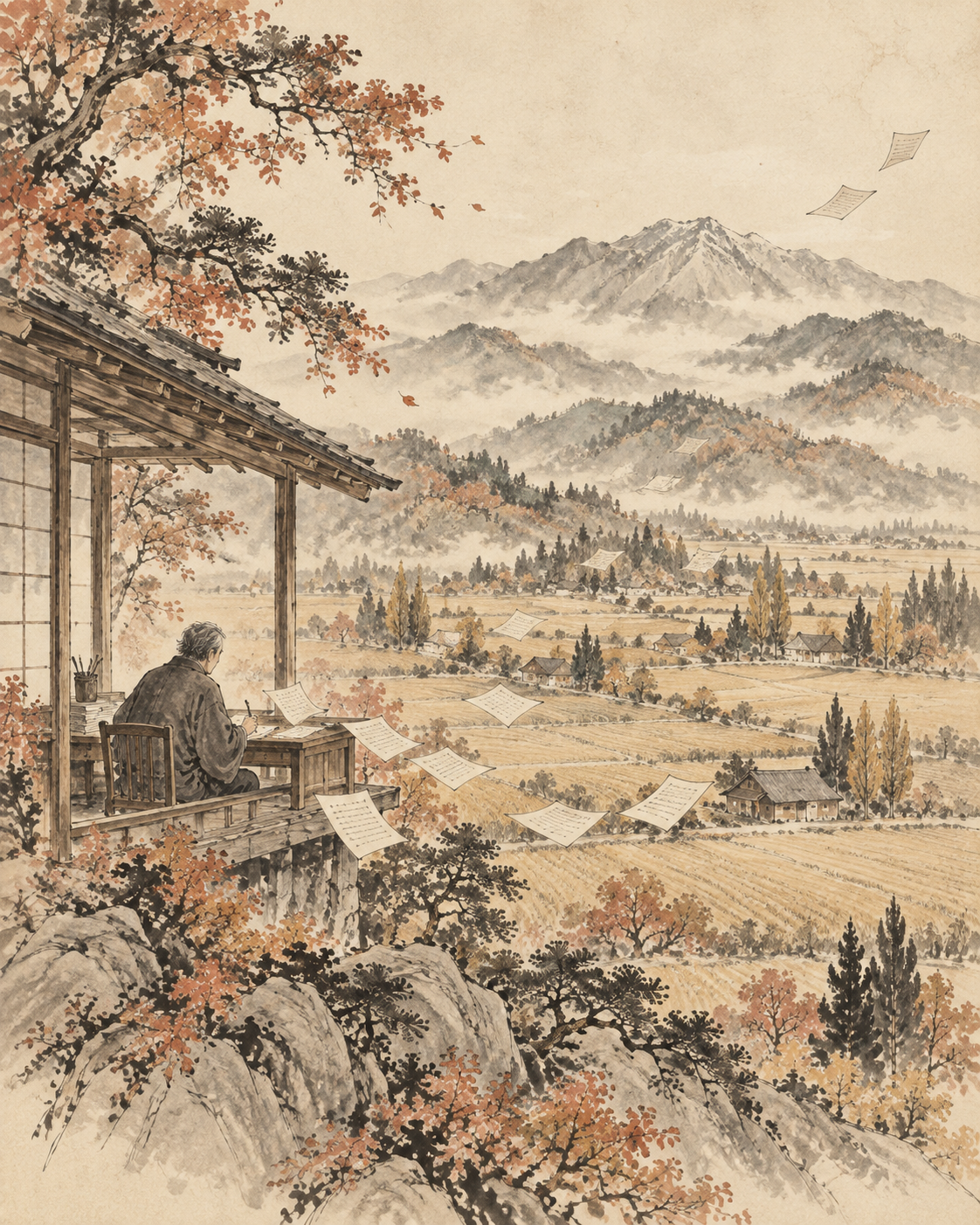
So Kuramoto, the screenwriter, playwright and director whose work made Furano one of the most recognizable landscapes in Japanese television, died at his home on the evening of September 18 from multiple organ failure. He was 91. The Kuramoto Foundation formally announced his death on September 28.[1]
A private funeral has already been held for close family. The foundation says a public farewell gathering, requested in accordance with Kuramoto’s wishes, is planned for November 3 at the Furano Theater Factory.[1]
Kuramoto’s importance cannot be measured only by the number of television scripts he wrote. He moved his life and creative base from Tokyo to Furano in 1977, turned the rhythms of snow, forests, agriculture and family silence into dramatic material, trained generations of writers and actors through the Furano Juku school, and later extended the same philosophy into environmental education.
Furano City, which had named him an honorary citizen, said his work on Kita no Kuni kara, Furano Juku and local theater culture had contributed profoundly to the city’s cultural development and regional vitality. Hokkaido Governor Naomichi Suzuki called the stories and ideas Kuramoto left in Hokkaido a major asset for the prefecture.[2][3]
From Tokyo broadcasting to Furano
Kuramoto was born in Tokyo on January 1, 1935. After graduating from the University of Tokyo’s Faculty of Letters, he joined Nippon Broadcasting System in 1959 and later left to work independently as a screenwriter. Fuji Television’s biographical material records his move to Furano in 1977.[4]
His official site describes that move as a response to things he felt could not be experienced in Tokyo: human warmth, vivid air and the force of nature. Furano became not a retreat from professional television but the place from which much of his most enduring work was created.[5]
For a television writer in the 1970s, relocating far from the production center was unusual. Kuramoto turned that distance into a creative method. Nature in his dramas was not scenic decoration; it changed what characters could do, how they lived and what they valued.
Kita no Kuni kara: a family story told across 21 years
Kita no Kuni kara began on Fuji Television in October 1981. The serial followed Goro Kuroita and his young children Jun and Hotaru after they left Tokyo for a difficult new life in Furano. The original series ran for 24 episodes through March 1982.[6]
The story did not stop when the weekly series ended. Eight television specials followed, beginning with ’83 Winter and ending with 2002 Testament. As the actors grew older, the characters did too. Childhood became adolescence, work, romance, marriage, separation and the aging of parents.[7]
Most television characters effectively stop aging when a series is cancelled. The Kuroita family continued for more than two decades. Viewers who began with them in 1981 were invited to grow older alongside them.
Furano became a character, not simply a filming location
The physical legacy remains visible. The Furano Tourism Association still directs visitors to locations such as Goro’s Stone House, the House Made from Found Materials and Rokugo Forest. The association notes that filming continued in Hokkaido from 1981 through 2002 and that fans still travel to the locations.[8]
Kuramoto repeatedly blurred the distinction between set and place. Buildings central to his dramas were constructed in Furano and left within the landscape. For the 2008 drama Kaze no Garden, a British-style garden of roughly 600 tsubo was developed over two years, with 365 plant varieties selected to create the seasonal world of the story.[9]
The production design did not disappear when the cameras stopped. It became part of Furano.
The Furano trilogy: family, mortality and nature
Fuji Television describes Kita no Kuni kara, Yasashii Jikan and Kaze no Garden as Kuramoto’s “Furano trilogy.”[9]
Yasashii Jikan, broadcast in 2005, centered on a café in Furano and the possibility of reconciliation between an estranged father and son. Fuji presented it as a new message from Furano after the close of the long-running Kita no Kuni kara saga in 2002.[10]
In 2008, Kaze no Garden followed a doctor facing death as he returned toward an estranged family. The series used Furano’s changing seasons to explore life, death and familial repair.[9]
Kuramoto repeatedly returned to apparently ordinary questions: what happens when families fail each other, what work does to a person, how people behave when death becomes unavoidable, and what nature reveals about human scale.
In 1984, he created a tuition-free school in the mountains
Kuramoto’s influence extended directly into the next generation. In spring 1984 he founded Furano Juku, a private training school for screenwriters and actors in the mountains outside Furano.[11]
According to the official Furano GROUP history, about 20 students were selected each year by nationwide audition and lived together for two years. Kuramoto taught without charge, and the school charged no admission or tuition. Students earned living expenses by working on nearby farms and shared responsibility for daily life; early students even built residences and rehearsal spaces themselves. By the time the school closed in 2010, 375 people had graduated.[11]
This was neither a conventional acting conservatory nor a screenwriting seminar. Physical work, nature and communal life were treated as part of artistic education.
The school closed; the method continued
Furano Juku formally closed in spring 2010, but graduates continued through Furano GROUP, producing theater and educational workshops. The Furano Tourism Association says many of the 375 graduates have gone on to careers in film, theater, screenwriting, broadcasting and related fields.[12]
Even in September 2026, the old Furano Juku site was being used for an intensive workshop combining acting, communal living and farm work. Kuramoto’s training philosophy continued to be practiced almost to the end of his life.[11]
His late work kept testing what television could contain
In 2017, Kuramoto wrote TV Asahi’s Yasuragi no Sato, set in a retirement community for people who had worked in television and film. The network described it as a drama “by adults, for adults,” confronting aging, romance, mortality and the entertainment industry itself.[13]
In 2024, his long-developed film project Umi no Chinmoku was released. Kuramoto wrote the original story and screenplay. The film’s official materials described it as something he had long wanted to put into writing, asking who determines artistic value and what remains at the end of a life.[14]
Then, on August 29, 2026, Kuramoto’s “Private Library” series at the Furano Theater Factory reached its 90th night and was brought to what the foundation called “a pause,” at Kuramoto’s own request. It was only 20 days before his death.[15]
From writing about nature to rebuilding a forest
Kuramoto’s later years also included direct environmental work. Furano Nature School operates a “return to nature” project that plants trees on a former golf course to restore forest, while using the land for environmental education.[16]
The method still carried Kuramoto’s theatrical instincts. Participants are asked to experience the ground, darkness, weather and their own senses rather than simply listen to a lecture about environmental problems.
The writer who spent decades dramatizing the relationship between people and nature had moved from representing that relationship to creating a place where people could physically encounter it.
The continuing life of Kita no Kuni kara
In 2026, Kita no Kuni kara marked 45 years since its broadcast began. Fuji Television organized a commemorative concert and streamed the Furano performance. In 2025, the network had rebroadcast all 24 episodes of the original serial, describing it as a human story that remained vivid 44 years later.[17]
Some long-running television classics survive primarily as nostalgia. Kuramoto’s drama remains unusually open to reinterpretation because its central conflicts have not disappeared: city and countryside, convenience and self-reliance, parent and child, development and environment.
As Japan confronts depopulation, rural decline, migration and ecological pressure, the questions embedded in the series can look less like memories of the early 1980s and more like unfinished arguments.
A legacy built into a town
Kuramoto spent almost half a century in Furano. The city’s response to his death emphasized not only television but his contribution to theater, education, culture and regional development.[2]
The evidence is physical. The locations from Kita no Kuni kara remain. The Furano Theater Factory remains. Furano GROUP remains. Furano Nature School remains. Generations of graduates remain in the industry.
Television ordinarily vanishes when the transmission ends. Kuramoto’s work accumulated as houses, landscapes, institutions and people.
A farewell in Furano
The Kuramoto Foundation says the funeral was held privately. A farewell gathering is planned for November 3 at the Furano Theater Factory, with further details to be announced.[1]
Kuramoto did not stop being a television writer when he left Tokyo. He changed what television could contain.
Snow taking time to fall. The silence before someone speaks. Hands working because there is no easier machine nearby. Children growing older in real time. The recognition that human beings are not larger than the land around them.
So Kuramoto leaves behind more than famous dialogue and celebrated scripts. He leaves a model of creation in which stories come from a place—and in which a writer allows that place to change the writer in return.
