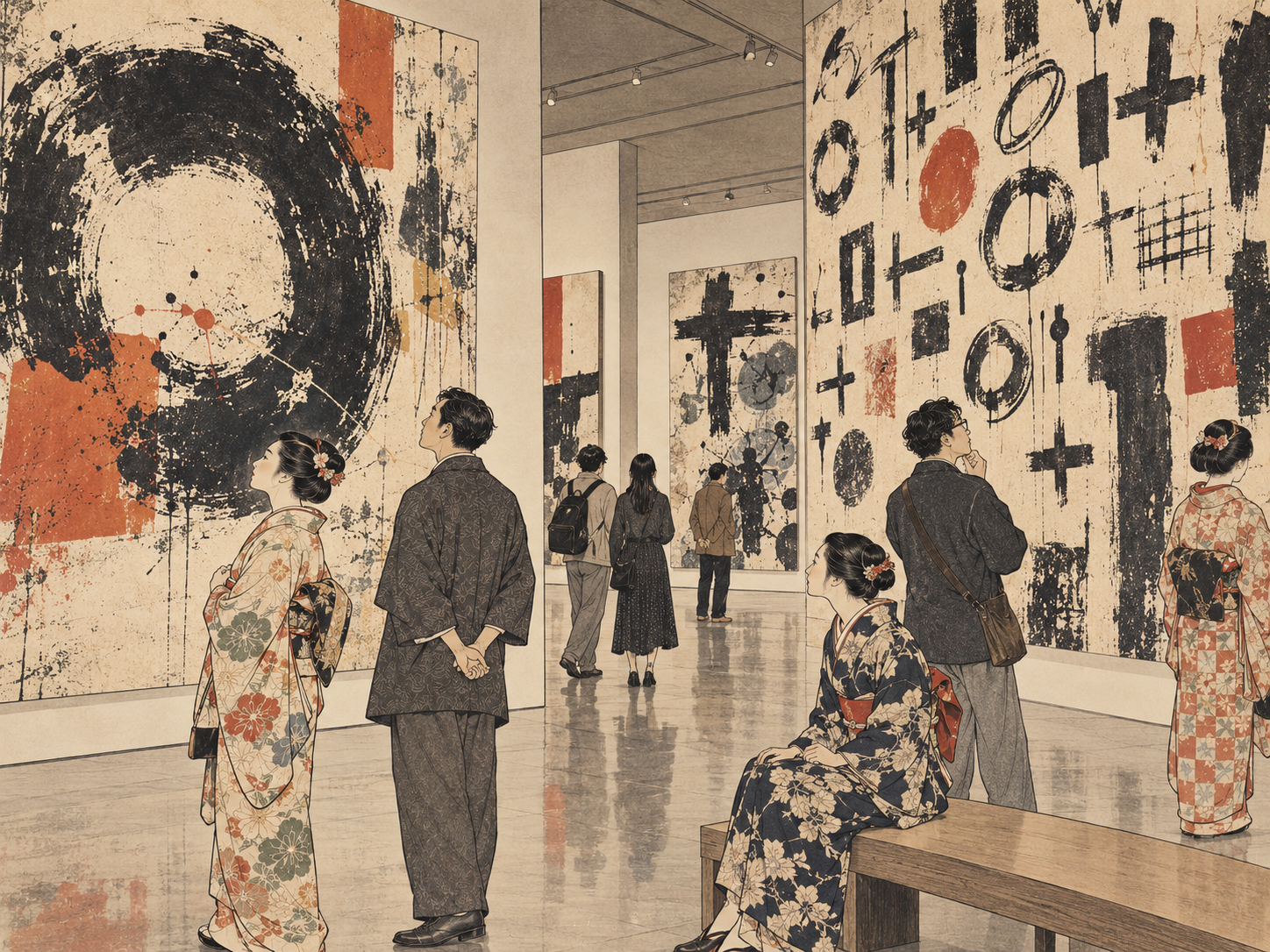
Shuji Mukai’s signs are not designed to tell you something. They cannot be read. They refuse stable meaning. That is precisely why they become disruptive when they multiply across a desk, a chair, a wall—or a human body. The object remains physically present, but the category we automatically assign to it begins to wobble.
That process is now being staged in Osaka at ICHION CONTEMPORARY, where the collection exhibition EVANESCENTIA presents work by Gutai veteran Shuji Mukai inside a narrow concrete gallery designed by Tadao Ando. The gallery’s current website lists the exhibition from Oct. 5 through Nov. 13, 2026.
Gutai’s youngest generation chose unreadable signs
Mukai was born in Hyogo Prefecture in 1940. In 1959, while studying at the Osaka Art School, he encountered Gutai founder Jiro Yoshihara and participated in the 8th Gutai Art Exhibition. He formally joined the Gutai Art Association in 1961 as one of its youngest members and remained with the group until its dissolution in 1972.
Gutai itself was founded in Ashiya, Hyogo in 1954 around Yoshihara. Japan’s National Museum of Art, Osaka describes the group as trying, through painting and other forms, to give concrete evidence of the freedom of the human spirit. Kazuo Shiraga painted with his feet, Saburo Murakami burst through paper screens and Atsuko Tanaka wore electric lights. Their challenge was not only what art should depict, but what an artwork could physically be.
Mukai’s answer was a language that was not a language. His invented forms can resemble letters, numerals or coded writing, yet they do not resolve into readable information. Repeated by the hundreds and thousands, they became less like messages than a method for undoing the usual meanings attached to a surface.
He tried to negate painting — without abandoning it
In a later interview with critic Kunio Motoe, Mukai recalled trying to negate all previous “painting.” He stopped relying on conventional paint and brushes and experimented with materials such as sand. But the deeper move was not simply a change of materials. It was an attack on the assumption that painting belonged inside a rectangular surface.
At the 10th Gutai Art Exhibition in 1961, Room of Signs covered furniture, objects and Mukai’s own body in his invented symbols. The sign moved from canvas to furniture, wall and person. Painting was no longer something viewed from outside; the viewer entered its field.
In 1966, an Osaka jazz café became the artwork
One of Mukai’s defining interventions came at the modern jazz café Check in Umeda, Osaka in 1966. Accounts preserved by Whitestone Gallery describe him covering the walls, furniture, tableware and even people working there with signs.
A visitor could no longer stand politely in front of an object and call it a painting. To enter the café, sit, drink and listen to music was to enter the work. Today the language of installation, environment and immersion is familiar. In mid-1960s Osaka, Mukai was already collapsing the border between artwork and lived space.
Then he burned his own work
In 1969, Mukai staged an action in which he burned his tableaux. It was a blunt challenge to the normal art-world logic of completing, preserving, owning and accumulating objects.
Yet destruction did not become a permanent rejection of painting. The signs returned to canvases and expanded again into rooms and architecture. In Mukai’s practice, erasure and creation are not opposites. One system of meaning is removed so another relationship can appear.
From MoMA to the Guggenheim
Mukai entered international circulation early. ICHION’s exhibition materials note his inclusion in The New Japanese Painting and Sculpture, a U.S.-touring exhibition shown at New York’s Museum of Modern Art in 1966. MoMA holds his 1963 Untitled in its collection.
In 2013, the Solomon R. Guggenheim Museum’s major retrospective Gutai: Splendid Playground returned Mukai to a room-scale format. He recreated Symbol Room and covered surfaces including an elevator and restroom with vast numbers of signs. Half a century after the original experiment, the symbols still refused to return obediently to the picture frame.
His later installations have appeared at the Hyogo Prefectural Museum of Art, Palazzo Fortuny in Venice, Louis Vuitton’s SoHo store in New York and other sites. A practice born in the Kansai avant-garde repeatedly re-entered museums, commercial architecture and urban space overseas.
Why returning to Osaka matters
Gutai was not a Tokyo-centered postwar movement. It emerged in Ashiya and developed through Osaka, Kobe and the wider Kansai region. When the National Museum of Art, Osaka and Nakanoshima Museum of Art organized the major 2022 retrospective Into the Unknown World — GUTAI: Differentiation and Integration, they described the group’s 18-year history as a foundational part of postwar Japanese art.
Mukai’s 1960 Work is held by the National Museum of Art, Osaka, and Nakanoshima Museum also holds his work. Osaka is therefore not merely another stop on a touring career. It is where his signs first escaped the canvas and occupied lived space.
Signs inside Tadao Ando’s “small treasure box”
ICHION CONTEMPORARY opened in 2025 in Osaka’s Nozakicho district. Designed by Tadao Ando, it occupies an exceptionally narrow urban site of roughly 65 square meters with a frontage of about four meters. One basement and five above-ground levels create a vertical gallery of about 233 square meters.
The exposed concrete, stairs, voids and changing natural light make it anything but a neutral white cube. Visitors repeatedly turn, climb and look across levels. ICHION describes the current installation as placing Mukai’s objects—already separated from ordinary meaning by signs—inside this assertive architectural volume.
That makes the building unusually compatible with a question Mukai first posed in 1961: is the artwork the object on a wall, or can the room and the viewer inside it become part of the painting?
| Year | Mukai / Gutai milestone |
|---|---|
| 1954 | Gutai Art Association founded in Ashiya around Jiro Yoshihara |
| 1959 | Mukai meets Yoshihara and participates in the 8th Gutai exhibition |
| 1961 | Formally joins Gutai; presents Room of Signs |
| 1962 | Solo exhibition at Gutai Pinacotheca |
| 1966 | Transforms Osaka jazz café Check with signs |
| 1969 | Stages a work-burning happening |
| 1972 | Gutai dissolves |
| 2013 | Participates in Guggenheim’s Gutai: Splendid Playground |
| 2022 | Work revisited in Osaka’s major Gutai retrospective |
| 2026 | EVANESCENTIA at ICHION CONTEMPORARY |
What do the signs mean?
The productive answer may be that they resist meaning. Whitestone Gallery’s Gutai Dictionary describes Mukai as covering all kinds of objects with his own signs until the method expanded to rooms and buildings and the distinction between painting and sculpture ceased to be useful.
Mukai himself has described his early position as a negation of conventional painting. He uses forms that resemble the mechanisms of communication while withholding readable content. As the signs multiply, information does not become clearer. The name and function of the underlying object become harder to see.
That paradox may feel even more contemporary in a world saturated with icons, QR codes, interface symbols and notifications. Modern life constantly adds signs in order to explain and categorize the world. Mukai adds signs until explanation begins to fail.
Gutai was not simply a performance movement
Gutai is often remembered through dramatic actions: Shiraga’s feet, Murakami’s paper-breaking, Tanaka’s electric dress. Yet the National Museum of Art emphasizes that Gutai’s installations and performances were also investigations into painting itself.
Mukai is a useful example. Covering a room with symbols did not necessarily mean abandoning painting. It expanded the support surface from canvas to wall, furniture, restroom, elevator or building. The repeated act of marking remained; what changed was the scale of the surface and the position of the viewer.
A collection exhibition, not simply a new-work show
EVANESCENTIA is presented as part of ICHION CONTEMPORARY’s collection series. That matters. The exhibition is not only a display of a new 2026 body of work; it is an attempt to reconfigure Mukai works and objects from different moments inside a specific building.
The gallery says the works gain new meaning through their relationship with the architecture and with viewers entering the space. In that sense, “disappearance” is followed by reconstruction: ordinary classifications are weakened, then new relationships form in the room.
- How the signs resemble writing while refusing to be read
- How an individual object changes when seen as part of an entire marked room
- The contrast between Ando’s exposed concrete and Mukai’s repeated marks
- How stairs and vertical sightlines change the work as the viewer moves
- Where the 1960s Gutai logic continues into later installations—and where it changes
- Whether the exhibition’s idea of “disappearance” makes the viewer conscious of his or her own habit of categorizing objects
Osaka’s avant-garde is not only past tense
Gutai dissolved in 1972. Mukai’s continuing practice makes it difficult to seal the movement safely inside history. An action that covered a jazz café in 1960s Osaka can still connect to a New York museum in 2013, an Osaka retrospective in 2022 and a narrow Ando building in 2026.
The international canonization of Gutai also brings a risk: the name itself can become a label applied too easily to very different artists. Mukai’s work is almost perversely suited to resisting that fate. It distrusts labels. “Gutai,” “painting,” “sculpture,” “furniture,” “architecture”—his signs ask what remains when those names stop doing all the work for us.
The pleasure of EVANESCENTIA may therefore lie less in decoding Mukai than in failing to decode him. Stand inside a room whose meanings have been partially rubbed away, and the act of looking becomes part of the work.
Sources & Reference Material
- ICHION CONTEMPORARY, current exhibition page for Shuji Mukai: EVANESCENTIA.
- Art Distribution Support LLC / ICHION CONTEMPORARY, EVANESCENTIA announcement, Sept. 15, 2026 (Japanese).
- National Museum of Art, Osaka, Into the Unknown World — GUTAI: Differentiation and Integration.
- Whitestone Gallery, “Symbols (Shuji Mukai).”
- Whitestone Gallery, Shuji Mukai biography and exhibition history.
- Shuji Mukai interview with critic Kunio Motoe on negating conventional painting and developing signs.
- National Museum of Art, Osaka, archive discussion of Mukai’s sign-covered automobile and everyday objects.
- National Museum of Art, Osaka / Nakanoshima Museum of Art, Gutai exhibition work list including Mukai’s 1960 Work.
Reporting cutoff: Oct. 6, 2026, 1:21 PM JST. ICHION CONTEMPORARY’s current website lists Oct. 5–Nov. 13, while its Sept. 15 press release announced Oct. 6–Nov. 14. This article uses the gallery’s newer live schedule. A complete checklist, full provenance for each exhibited work and any planned rotations are not established in the public materials reviewed.