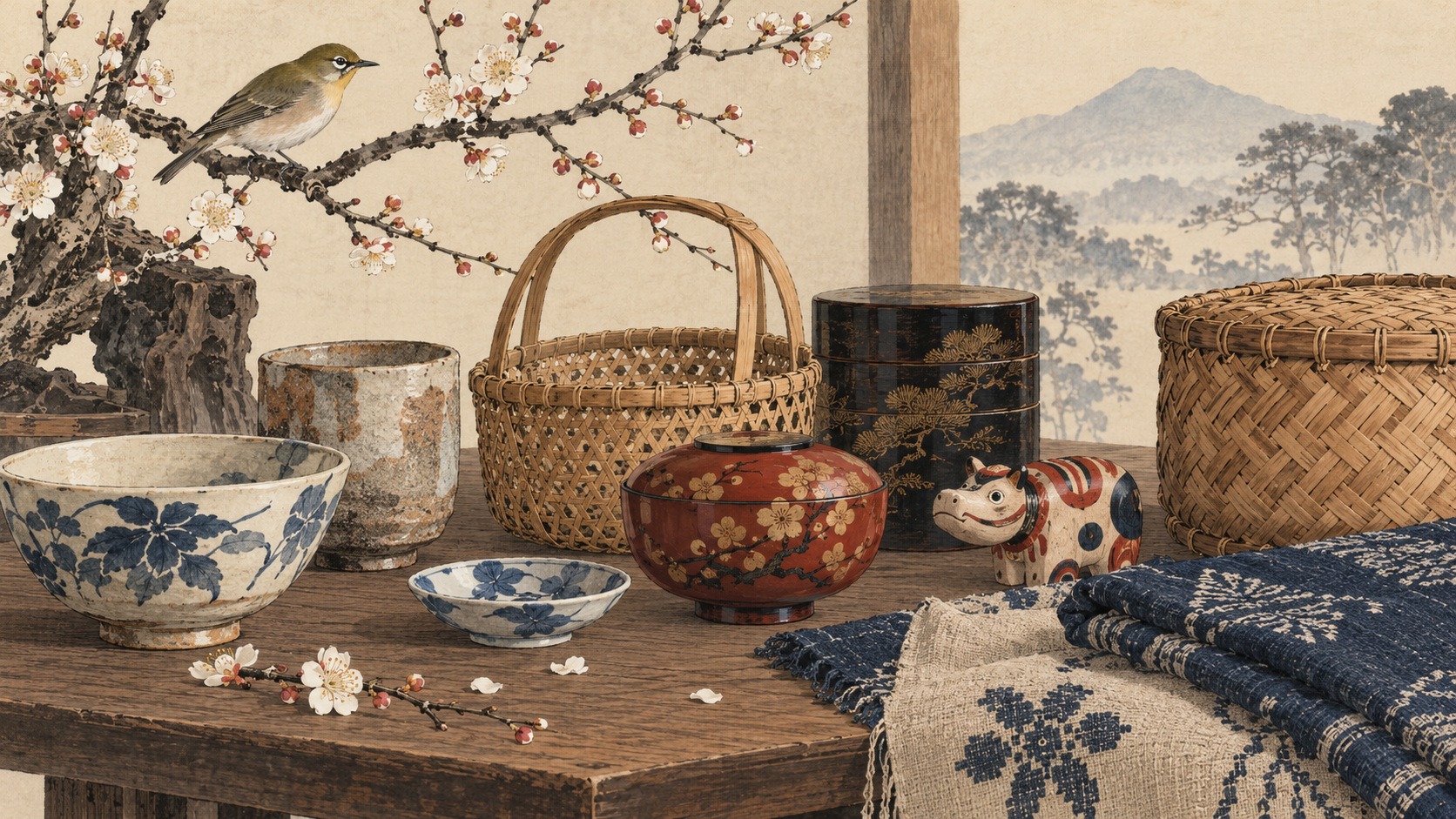
An exhibition about making beauty work
There is a familiar way to tell the story of Japanese folk craft: an artist discovers the beauty of an old bowl, and a museum saves it from obscurity. The life of Yoshida Shoya demands a less comfortable, more interesting account. He wanted people to make new bowls—and then to build the workshops, shops, institutions and habits that would allow those bowls to remain part of ordinary life.
On October 15, the Panasonic Shiodome Museum of Art in Tokyo opened The Designs of Yoshida Shoya: Imagining the Future with the New Mingei Movement. Running through December 20, the exhibition brings together approximately 300 objects and documents. Its protagonist, Yoshida (1898–1972), was a Tottori-born ear, nose and throat physician whose influence extended to ceramics, furniture, textiles, retail, architecture, museums and conservation.
From the discovery of folk craft to its reinvention
The word mingei emerged in Japan in the 1920s, especially through the work of Yanagi Muneyoshi and fellow advocates who argued that humble, useful objects made by largely anonymous craftspeople possessed qualities overlooked by conventional fine-art hierarchies. The emphasis was on beauty inseparable from use, materials and skill.
Yoshida encountered Yanagi’s thought after absorbing the idealism of the Shirakaba literary circle while studying medicine. Yet admiration alone was not enough. He saw that a craft tradition could not survive on exhibitions and nostalgia if contemporary households no longer needed—or could not buy—its products. His answer was shinsaku mingei, newly designed folk craft made with established techniques for a changing way of life.
A plate that changed a regional economy
An encounter in 1931 with Ushinoto ware, a pottery tradition in Tottori Prefecture, gave that idea practical form. According to the prefectural government, Yoshida collaborated with fourth-generation potter Kobayashi Hideharu on new work, including the celebrated plates divided into green and black glaze fields. This became an enduring design associated with Tottori’s New Mingei.
The collaboration was neither solitary genius nor simple preservation. Yoshida contributed design proposals; pottery specialists possessed the knowledge of clay, glaze, kilns and making. The resulting products were recognizably rooted in place while being conceived for buyers living in the twentieth century. The lesson was economic as well as artistic: craft cannot endure unless craft workers have work.
The missing piece in many design histories: distribution
In 1932 Yoshida opened the Takumi Folk Crafts Shop in Tottori, and in 1933 expanded retail activity to Tokyo. The Tottori Folk Crafts Museum describes the shop as Japan’s first specialist mingei store. It also credits Yanagi with giving Takumi its name.
Those shops connected products with a market and offered artisans a route beyond occasional commissions or exhibitions. Yoshida thought across an unusually broad chain of activities: choosing materials, proposing designs, commissioning production, collecting, teaching, selling and promoting use. His self-description as a producer of folk craft was unusually literal. He built institutions and distribution channels, not only a visual vocabulary.
A hospital as a design experiment
The new Tokyo exhibition makes clear how far Yoshida’s ideas extended from plates and bowls. A working otolaryngologist, he began shaping the interior of his clinic in the early 1930s. The museum says he considered examination chairs, storage for medicine bottles, furniture and even waste baskets while working across Japanese and Western fittings.
Sections of the former Yoshida Clinic and his residence have been re-created for the exhibition. They are not evidence that attractive surroundings improved clinical outcomes. Their importance lies elsewhere: Yoshida did not divide taste, tools and work into separate worlds. Medical practice and the experience of an everyday room belonged within his project to make useful things well.
The war years complicate the legacy
The chronology should not erase history’s difficult chapters. Official accounts record Yoshida’s wartime military service and work in northern China; a chronology maintained by the Tottori craft institutions also documents design and retail initiatives in Beijing. How those undertakings intersected with Japanese military occupation deserves serious, separately sourced historical study rather than an uncritical success narrative.
Back in Tottori after the war, Yoshida helped build the Tottori Mingei Cooperative, association and museum organizations in 1949. The hospital and home were destroyed in the devastating 1952 Tottori fire and subsequently rebuilt. His ambitions survived because they were not confined to one studio or to the lifetime of one collection.
The museum where you can eat
The Takumi Kappo restaurant, opened in Tottori in 1962, offers an especially direct way to understand Yoshida’s proposition. Conceived as a “living museum,” it placed patrons among furnishings and utensils designed in the New Mingei spirit. The bowl was meant to carry food, the chair to support a diner and the room to welcome everyday conversation.
The restaurant is known for a beef hot-pot dish called susuginabe. Tottori Prefecture connects its development to a Beijing dish Yoshida encountered, but that does not settle the more contested question of a single point of origin for all Japanese shabu-shabu. What matters here is the meeting of food, design and use: craft as lived experience rather than protected display.
Why the landscape mattered
Yoshida’s work reached beyond domestic objects to efforts involving Tottori’s natural and architectural heritage, including the dunes and the historic Jinpukaku building. Such efforts suggest an expansive sense of place: local materials, landscapes, public memory and working craftspeople form part of the same cultural ecosystem.
That connection feels contemporary as Japanese regional industries confront workforce shortages, aging makers and difficult questions about the value of local production. Selling an attractive object abroad can generate attention; maintaining a functioning production network at home requires institutions, skills and reliable customers. Yoshida tried to think about all of them at once.
What visitors should look for
The museum’s approximately 300 exhibits include ceramics, wooden objects, textiles and related material, as well as reconstructed spaces associated with Yoshida’s clinic and home. Visitors should look not only at whether an object is beautiful, but at what it was designed to do, who made it, what existing skill it relied upon and how a prospective customer would encounter it.
The exhibition runs October 15–December 20, 2026, generally 10 a.m.–6 p.m., closing Wednesdays except December 16. Time-specific bookings are required for weekend and holiday visits from November 28 through December 20, according to the museum. Conditions should be checked on its website before traveling. The lasting achievement under examination is not a particular ceramic glaze or signature. It is the audacious proposal that a regional craft tradition might possess a future because people keep using it.
Sources and further reading
- パナソニック汐留美術館:吉田璋也のデザイン(展覧会概要)
- Panasonic Shiodome Museum of Art: exhibition details
- 鳥取県:吉田璋也(人物紹介)
- 鳥取県:牛ノ戸焼
- 鳥取民藝美術館:沿革と施設
- 鳥取県:たくみ割烹店
- 鳥取民藝美術館・たくみ工芸店:吉田璋也年譜
- 鳥取県:民藝の歴史と吉田璋也
Source review: October 15, 2026. This report does not claim an on-site exhibition visit or original interviews.