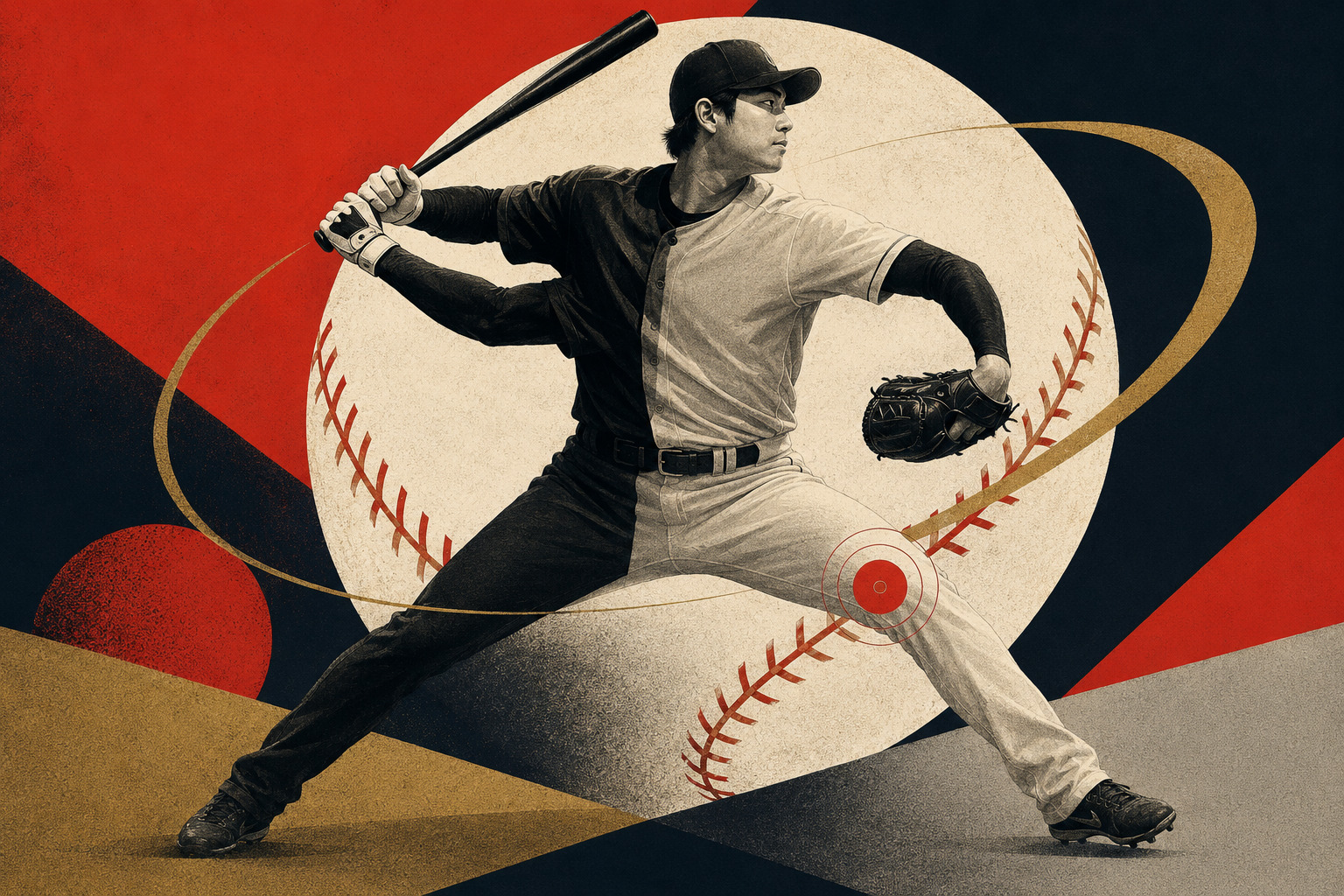
The absence of “Ohtani, DH” from a Dodgers lineup card looked, at first, like the smallest kind of baseball news: one star, one night, one prudent day off. It was larger than that. The blank space changed the question surrounding Shohei Ohtani’s 2026 season. Not merely: When will he pitch again? Also: How long can he keep hitting? And must the Dodgers occasionally surrender the hitter they need in order to recover the pitcher no other team possesses?
Los Angeles left Ohtani out of the lineup for the July 30 series finale against the Seattle Mariners after his left knee became more sore during treatment. The training staff recommended rest. Ohtani wanted to play, Roberts said. In the previous two games he had gone 5-for-7 with a home run and four runs batted in. He was not sitting because he could not hit. The very success that kept him on base — seven times in two nights — may have added to the accumulated work on the knee.
That paradox is the heart of treating a two-way player. The ability to perform one job is not proof that the other is safe. For a left-handed hitter, Ohtani’s left knee is the back knee. For a right-handed pitcher, it is the landing knee, the leg that must accept his forward motion and stabilize a delivery powerful enough to send a baseball near 100 miles per hour. One knee can tolerate the first assignment while rejecting the second.
The two-way riddle: able to hit, unable to pitch
The inflammation first became public on June 11 in Pittsburgh. Ohtani missed the following day’s game, returned as the designated hitter and continued making his weekly pitching starts. The lingering soreness was felt primarily when he pitched. On July 3 against San Diego, he completed six innings, allowing three runs on seven hits while striking out nine. He has not appeared in a major-league game as a pitcher since.
A delivery is not an arm action performed above an incidental pair of legs. Ohtani drives from his right leg, rotates through the pelvis and trunk, then braces on the left. Baseball biomechanics research describes the stride leg as a stabilizer and a conduit: it helps absorb landing force and transfer energy up the kinetic chain. The Dodgers said Ohtani and the pitching coaches explored adjustments designed to reduce torque on the knee. They could not remove the impact of landing altogether.
Then came discomfort in the right biceps. According to Roberts, it first appeared around the July 3 start, and protecting the sore knee created unintended stress higher in the chain. That does not establish a medical diagnosis that one injury caused another. It explains the club’s concern: when a pitcher changes how force travels through the body to avoid pain, a healthy area can begin paying the bill.
| Area | Status at the reporting cutoff | What shapes the decision |
|---|---|---|
| Hitting | The club says his swing is not materially compromised. In 36 games since the knee first flared, he hit .263/.344/.526 with 10 homers and 25 RBIs. | The knee is his back leg in the box. The staff must also judge the cumulative effect of running and repeated games. |
| Pitching | No game since July 3. Discomfort followed a 30-pitch bullpen on July 22, and mound work was paused. | The landing knee must approach full function, while the right biceps must allow normal velocity without compensation. |
| Testing and treatment | An All-Star-break MRI found no structural issue. Ohtani received an Orthovisc injection in the knee. | Reassuring imaging does not replace a symptom-free response to game-level pitching intensity. |
| Return | A quick return to the batting order was considered likely. No pitching date is set, though the club has not ruled out the stretch run or postseason. | Catch play, bullpens, competitive intensity and recovery between sessions must be rebuilt in sequence. |
How a six-week problem erased the schedule
The sequence is more revealing than the shorthand “sore knee.” Los Angeles repeatedly opened a path back to the mound, tested it at greater intensity and closed it when symptoms answered. During the All-Star break, Ohtani underwent an MRI that the club said was clear. He also received Orthovisc, a high-molecular-weight hyaluronan injection commonly described as a lubricant or viscosupplement. The product was identified publicly; a specific diagnosis such as osteoarthritis was not. It would be wrong to infer one from the treatment alone.
After rest and the injection, Ohtani threw a 30-pitch bullpen on July 22. The knee did not respond as hoped. A subsequent bullpen was postponed, the right-biceps issue became public and the throwing program stopped. He has kept the arm active with plyometric medicine-ball work that does not require him to land again and again on his left leg. The tentative first step back was catch play over the weekend or early the following week — a beginning, not a return date.
All the while, Ohtani remained an almost everyday hitter. In 63 games before the knee flared, he produced a .305/.421/.543 line with 13 homers and 40 RBIs. In the next 36, he still slugged .526 and hit 10 home runs. On July 28 he had three hits, including his 10th leadoff homer of the season. A player who still looks dangerous makes a day off harder to grant and easier to misunderstand.
June 11: Left-knee soreness surfaces in Pittsburgh. Ohtani sits the next day.
July 3: Six innings, three runs and nine strikeouts against San Diego. Right-biceps discomfort also emerges around this period.
July 10: He is scratched from his scheduled final start before the All-Star break.
All-Star break: MRI shows no structural problem; Ohtani receives an Orthovisc injection and skips the All-Star Game.
July 22: He throws 30 pitches in the bullpen, then experiences more discomfort.
July 29: The Dodgers explain the biceps issue and why his throwing progression is paused.
July 30: Renewed soreness during treatment costs him his first regular DH start of the season.
The echo of 2019 — relevant, but not a diagnosis
Any history of Ohtani’s left knee must return to September 2019. Then with the Los Angeles Angels, he underwent surgery to repair a bipartite patella, a congenital condition in which portions of the kneecap do not fully fuse. The projected recovery was eight to 12 weeks. Ohtani was already rehabilitating from the Tommy John operation performed on his right elbow in October 2018. When the intensity of his bullpen sessions rose, the knee became troublesome and the elbow throwing program stopped for roughly two months.
Angels officials at the time worried that protecting the knee could compromise his delivery and invite an unforeseen problem elsewhere. Seven years later, that concern sounds familiar. But a historical echo is not evidence of an identical injury. In 2019, the operation addressed a known congenital kneecap condition. In 2026, the club has described soreness more toward the back of the knee and says imaging found no structural damage. No public information directly links the current episode to the old surgery.
The useful parallel is functional. In 2019, Ohtani could hit while his knee could not tolerate the increasing demands of pitching. He played 106 games as a designated hitter, batting .286 with 18 home runs and 62 RBIs, but did not throw a competitive pitch. Offensive production was a poor measuring stick for mound readiness then. It remains one now.
- A clear MRI is reassuring, but it does not mean “no pain” or prove that full-intensity pitching is safe.
- Orthovisc is a hyaluronan product; the treatment name alone does not establish Ohtani’s diagnosis.
- The Dodgers have described a connection between altered mechanics and biceps discomfort. Outsiders cannot determine causation or severity from public information.
- This article organizes reported information. It is not a diagnosis or medical advice.
From Babe Ruth to a rule built for Ohtani
The convenient historical comparison is Babe Ruth. With Boston in 1918 and 1919, Ruth appeared in 37 games as a pitcher and 225 as an offensive player. After the Yankees acquired him, his mound career was essentially closed and he became one of history’s greatest full-time hitters. Modern baseball spent the next century moving toward sharper specialization.
Ohtani turned the exception into a sustainable roster plan. As an MLB rookie in 2018, he made 10 starts with a 3.31 ERA and hit 22 home runs, winning the American League Rookie of the Year Award. After elbow surgery and a brief, troubled return in 2020, his 2021–23 peak produced 542 strikeouts in 428⅓ innings and 124 home runs at the plate. In 2022, Major League Baseball adopted a rule allowing a starting pitcher who bats for himself as the designated hitter to remain at DH after leaving the mound. The “Ohtani rule” was an institutional acknowledgment that his two jobs could no longer be forced into an old lineup card.
The achievement has always included interruption. Tommy John surgery in 2018. A second major procedure on the same right elbow in 2023, repairing the damaged ligament while reinforcing healthy tissue. A full 2024 season without pitching, during which he became the first full-time DH to win an MVP Award. Surgery on a torn labrum in his left shoulder after the 2024 World Series then delayed his pitching preparation again. His Dodgers mound debut did not arrive until June 16, 2025.
The reward for patience came in an almost impossible form. In Game 4 of the 2025 National League Championship Series, Ohtani threw six scoreless innings with 10 strikeouts and hit three home runs, carrying Los Angeles into the World Series. His regular-season return had been managed to just 47 innings over 14 starts. In October, that deliberately limited runway produced a game without precedent. The Dodgers therefore understand the equation: the marginal value of one July start is smaller than the potential value of a healthy two-way Ohtani in October.
The competitive luxury — and discipline — of waiting
Medical caution is shaped by the standings. Late in July the Dodgers were 67–40, tied for baseball’s best record and 11½ games ahead of San Diego in the National League West. Roberts said the benefit of sending Ohtani out did not appear to outweigh the cost at this point of the season. A large lead allows the club to ask not whether he can pitch, but whether he should.
A pitching return also cannot be switched on the morning the soreness disappears. Ohtani must increase distance and intensity in catch play, return to the bullpen, work through his pitches, simulate or face hitters, and demonstrate that the knee and biceps recover after the session. As the layoff lengthens, his starter’s volume must be rebuilt. The postseason role — conventional starter, abbreviated outing or hitter only — can change depending on how many steps the calendar allows.
Los Angeles built a six-man rotation and has Yoshinobu Yamamoto among the arms carrying the schedule. President of baseball operations Andrew Friedman said Ohtani’s absence had not created an emergency need at the trade deadline. That does not diminish Ohtani’s pitching value. It expresses it. The Dodgers can assign replaceable July innings to someone else precisely because Ohtani’s October ceiling cannot be replaced.
Continuing to use him almost every day as a hitter contains its own contradiction. A leadoff man with 23 home runs and 65 RBIs is difficult to remove. The Seattle day off, however, may be the beginning of a more flexible definition of availability: four or five games before a break, perhaps three if soreness returns, perhaps a bench role on carefully chosen nights. Protecting a two-way player is not only about designing his pitching days. It is about designing his absences from DH.
What matters before the next headline
When Ohtani next plays catch, it will be progress, not an answer. A successful bullpen will still require a check of the knee and biceps the next day. A home run in his first game back in the lineup will say nothing definitive about whether the landing leg can handle a full delivery. In two-way rehabilitation, good news from one role cannot simply be carried over to the other.
- At the plate: How the knee responds to consecutive games, hard running and repeated trips on base.
- In the throwing program: Whether intensity can rise from catch play to bullpens without altered mechanics.
- In the right arm: Whether the biceps is comfortable when velocity is generated without protecting the left leg.
- During recovery: Whether symptoms remain stable 24 to 48 hours after a high-intensity session.
- For October: Whether starting, abbreviated pitching or hitting alone offers the best balance of value and risk.
The day Ohtani disappeared from the lineup was not the day his two-way experiment failed. It was the day the Dodgers accepted a visible absence to protect it. In 2019, the left knee interrupted right-elbow rehabilitation. In 2023, the right elbow created a hitter-only 2024. That season’s left-shoulder surgery delayed the pitcher in 2025. Each time, Ohtani preserved one role while rebuilding the other.
The choice now is not merely play or rest. It is hit, run, throw, recover — four actions moving at four speeds inside the same body. Ohtani changed baseball by making two careers coexist. The present test is whether he and the Dodgers can preserve that achievement without letting urgency pull the careers apart.
The next at-bat may be close. The next start is not yet close enough to date. Ohtani’s two-way 2026 season truly resumes only when those two clocks point to the same hour again.
Reporting Notes and Sources
Information was checked through July 31, 2026, at 2:05 p.m. Japan Standard Time. Statistics and schedules reflect published figures at that cutoff. Ohtani’s diagnosis, return timetable and postseason role may change with further club announcements.
- MLB / Dodgers: July 30 lineup absence and batting splits
- MLB: Latest on the left knee, right biceps and pitching outlook
- MLB: Landing-knee demands, postponed start and delivery adjustment
- Associated Press: MRI, Orthovisc treatment and the Dodgers’ caution
- MLB: Ohtani’s 2019 bipartite-patella surgery
- MLB: The 2023 elbow operation and Ohtani’s 2021–23 two-way peak
- MLB: The 2022 starting-pitcher/designated-hitter rule
- MLB: Ohtani’s 2025 pitching return and performance
- Current Reviews in Musculoskeletal Medicine: A clinician’s guide to pitching biomechanics
- U.S. FDA: ORTHOVISC product information