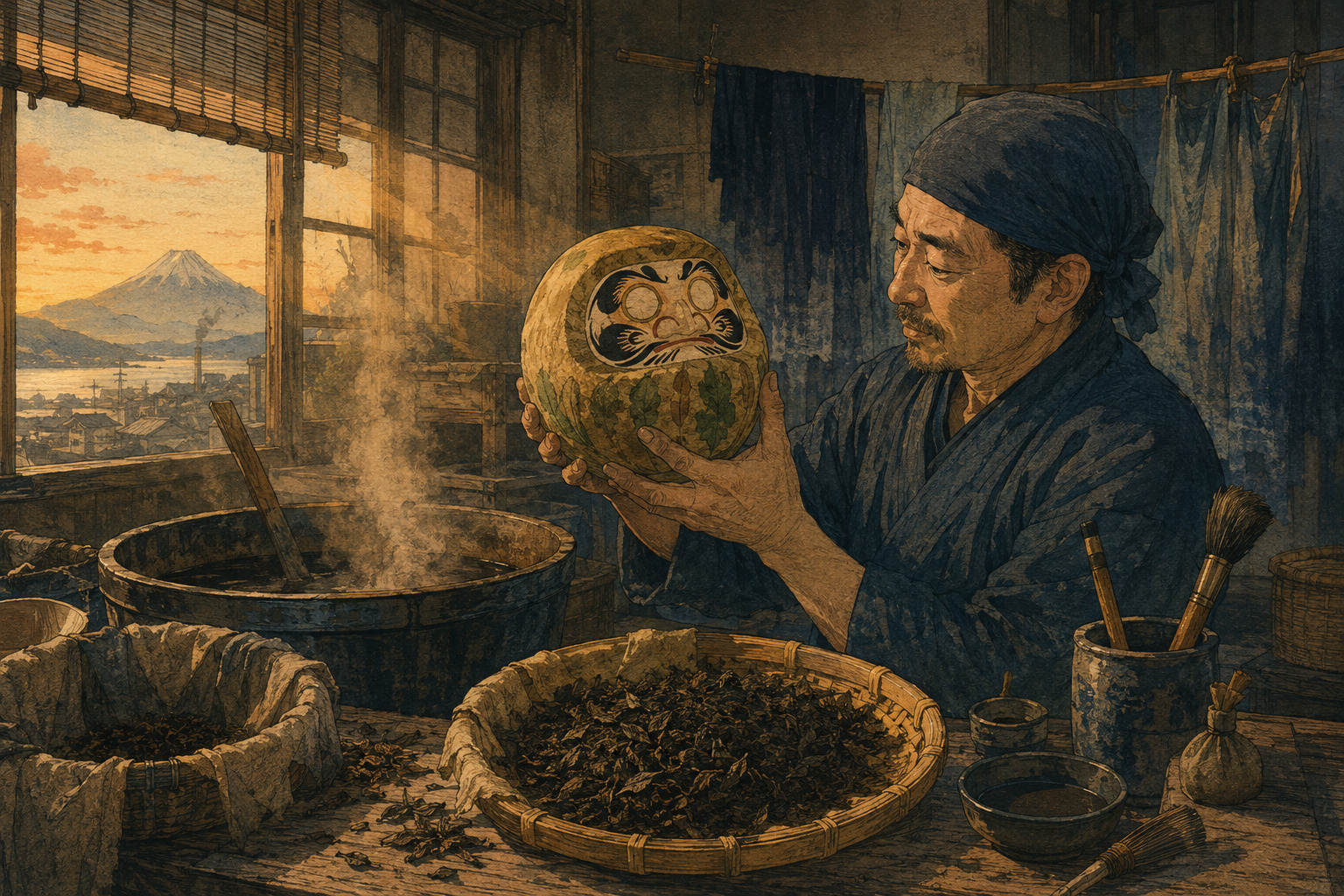
It would have been easy to make the doll green. That is the international shorthand for Japanese tea: bright leaf, clear liquor, instant place-branding. Washizu's daruma takes the less obvious route. Its dominant colour is a grey so dark it approaches black. An ochre pattern crosses it in long curves, abstracted from the parallel rows of a Shizuoka tea field. The face conceals the characters for “Shizuoka tea” inside the familiar movements of brows and beard.
On August 27, the operator of Shizuoka City's Sunpu Takumishuku craft complex announced that the ochazome daruma—literally, tea-dyed daruma—would make its formal trade presentation at Dainipponichi, a retailer exhibition at Tokyo's TFT Hall from September 2 to 4. The object is 170 millimetres high and wide, 160 millimetres deep, and weighs 410 grams. Its tax-inclusive price is ¥77,000.
The presentation should not be mistaken for a first day of sale. An official Shizuoka Prefecture article published June 30 already described the daruma as available at Takumishuku, and the centre's online store lists it now. The September gathering requires advance registration and is intended for retailers and media. “Formal unveiling” is a trade-marketing milestone, not the beginning of public availability.
A supply chain built inside one small object
Tea dyeing begins after the drinkable product has taken its own path. Material rejected during manufacture is simmered to extract colour. The operator says mokusakusan-tetsu, an iron mordant made with wood vinegar, is added. The workshop repeatedly dyes the fabric to build shades from grey to black. This is not a light stain from placing a tea bag in water; it is a controlled plant-dye process that uses heat, water and an iron-based mordant.
The body's textile is 100 per cent silk in satin weave. Bleached cotton is used for the face. Washizu's signature design, chaen fukanzu—a tea-field view from above—is applied through the Suruga wazome vocabulary of stencil dyeing and bassen, discharge printing that removes colour to reveal a pattern. Repetition determines the depth of the ground; the hand process prevents every surface from being microscopically identical.
Then the work leaves the dye bath. A specialist fits the cloth over tōso, a body made by binding powdered paulownia with paste. The method is kimekomi: grooves are cut into the form and the edges of the textile are tucked into them, clothing the body without sewing a loose costume. Japan's official traditional-craft association describes the same material and basic construction for Edo kimekomi dolls.
| Stage | Published process | What remains undisclosed |
|---|---|---|
| Tea input | Unmarketable material from tea manufacture | Supplier, annual weight and share diverted from disposal |
| Extraction | Boil or simmer the tea material for dye | Water, energy and time per batch |
| Mordant and dye | Add mokusakusan-tetsu; dye repeatedly | Chemical concentration, reuse and effluent management |
| Pattern | Stencil dye and discharge the Tea-Field Overlook design | Production time and reject rate |
| Form | A kimekomi specialist fits cloth to a tōso core | The named artisan and workshop |
| Blessing | Delivered after a ritual at Kanshō-in, a Sōtō Zen temple in Mariko | Reported by the operator |
Care instructions expose the material bargain. The seller warns that sunlight can fade the natural dye, water can release the adhesive and pressure or shock can deform the paulownia body. A product called natural is not maintenance-free or permanent. Its service life depends on owners understanding how it was made.
A tea wholesaler remembers that it once made daruma
The shape is not a generic mould purchased for the project. According to the launch material, it was taken from a daruma associated with Ken Wada, described as the fourth generation of Wada Kiyo Shoten. The formal Japanese company name makes the history more legible: 有限会社だるまや和田清商店 (Yūgen Kaisha Darumaya Wada Kiyo Shoten).
The Shizuoka Tea Commerce and Industry Cooperative identifies the company as a tea business, then explains the unusual “Darumaya” name. Before beginning tea manufacture, the founding business made daruma. The older occupation survived as a nickname after the commercial centre shifted to tea.
The new object completes an unexpected circuit. A family's daruma form remained after the family became a tea wholesaler. Tea-factory fragments now colour a new daruma based on that form. What returns is not an untouched relic; it is occupational memory reorganized by the industry that replaced it.
Promotional histories often trace the limbless doll directly to a legend that Bodhidharma lost his arms and legs through prolonged meditation. The story belongs to popular religious culture, not a secure manufacturing chronology. Municipal evidence offers firmer points. Takasaki City dates the beginning of its own famous daruma production to roughly 210 years ago, records a daruma market in an 1829 text and connects red dolls with protection during smallpox outbreaks. It also describes conventional Takasaki bodies as papier-mâché formed over a wooden mould. Washizu's textile-clad tōso object is therefore a contemporary hybrid, not a reproduction of one historically fixed daruma type.
Succession is the real material under pressure
Washizu was born in 1979. His official profile says he entered training at his family's Washizu Dyeing Shop in 2001 and began developing tea dyeing in 2006. He is the fifth generation of the family business, representative of Ochazome Washizu, chair of the Shizuoka City dyeing association's Suruga wazome group, and head of the dyeing studio at Sunpu Takumishuku.
Shizuoka City awarded him its Arts and Culture Encouragement Award in 2025. The city's citation emphasized the combination of tea with Suruga wazome, his teaching and workshop activity, and his role training participants at Takumishuku. That institutional work matters because a private technique survives only if people can enter it.
Two apprentices have done so. Shizuoka Prefecture's official profile gives their names and readings as Yuki Maeda and Mao Mori. Maeda studied design in Shizuoka and approached traditional workshops seeking a place to learn; repeated rejections, she told the prefecture, often came because the workshops lacked a system to take on successors. Washizu, who had taught her, accepted her. Mori encountered his class while still in high school and joined after graduation. The three now form the production team.
In the product release, Washizu described the daruma as a symbol of succession, intended to help later makers acquire skill and continue work they could take pride in. That is a verified statement of purpose, not evidence that the economics have succeeded. Public sources do not disclose production time, sales volume, wages, margins or how revenue is divided among dyeing, kimekomi and retail.
The ¥77,000 price should be read in that light. This is not a cheap mass solution for handling tons of agricultural residue. It adds several artisans' labour, design, provenance and retail support to a small amount of low-value material. The theory is value per unit, not volume throughput: sell fewer objects at a price capable of paying for the human system around them.
Suruga wazome has already survived by changing
Shizuoka City's history of Suruga wazome begins with geography and language. Place names such as Asahata, Shizuhata and Hatori preserve associations with cloth and weaving. The city says dyeing developed during the Imagawa period and that dyers gathered in the district still called Kōyamachi, the dyers' quarter.
In the Edo period, local workshops made banners and battlefield standards for samurai households, and shop curtains, work coats, clothing and monogrammed wrapping cloths for townspeople. Mechanization reduced artisan work after the Meiji Restoration. The craft was later reoriented through the folk-craft movement and the influence of Keisuke Serizawa, the Shizuoka-born stencil dyer designated a Living National Treasure. Local dyers formed study groups around new design, and strong contrast between dyed colour and white became one recognized characteristic. Suruga wazome is now designated a Shizuoka Prefecture local craft.
That history makes claims of “unchanged tradition” especially unhelpful. The practice had already incorporated new design as demand and technology changed. Washizu's aerial tea-field pattern belongs to the same problem: how can a stencil vocabulary produce an image that reads as Shizuoka now, rather than imitate what a predecessor sold?
Tea has a founding legend and an industrial record
Shizuoka tells its tea history in two registers. A local tradition says the monk Enni, honoured as Shōichi Kokushi, returned from Song China and had tea seeds planted at Ashikubo. The city itself uses careful language—tea growing is “said” to have begun there. The account is cultural memory, not a datable agricultural ledger.
The modern expansion is documented more concretely. Former Tokugawa retainers and workers displaced from the Ōi River crossing helped open the Makinohara plateau in the early Meiji period. The Shizuoka Prefectural Central Library notes that tea, with silk, was a major export; government policy encouraged production, and cultivation and processing knowledge arrived from Uji and elsewhere. Fields, factories and trading networks made tea an industrial identity rather than only a local beverage.
That identity remains large but competitive. Shizuoka still accounts for more than 30 per cent of Japan's tea-growing area. The prefecture returned to first place for first-flush crude-tea output in 2026 after placing second in 2025. Scale, however, guarantees side streams as well as saleable tea: stems, powder and particles caught in equipment do not all enter retail packets.
No comprehensive public figure located for this report shows how much demono Shizuoka produces each year or how it is divided among food ingredients, feed, compost, fuel, dye and disposal. A single daruma cannot stand in for that missing mass balance.
A circular story that still needs a ledger
Ochazome Washizu says the tea residue left after dye extraction is composted and returned to fields. Its own current explanation says the residue is mixed with spent malt from the brewery inside Takumishuku; other operator material mentions okara and wood scraps. The intention is clear: obtain colour from a factory side stream, then keep the extracted solids out of a final waste bin.
The evidence is not yet a life-cycle assessment. As of the reporting cutoff, the project's public material supplied no annual input weight, water or thermal energy per square metre, mordant concentration, effluent measurements, compost yield or field-performance data. It offered no comparison with a conventional dye of similar colour and durability. The operator's absolute statement that nothing is discarded is promotional language, not an independently audited zero-waste certification.
This distinction is more than a journalistic caveat. Plant-derived colour can still require repeated heating, large baths and metal salts. A material diverted from disposal may be transported farther or processed more intensively than an alternative. None of those possibilities proves the project harmful; they show why “natural” and “low impact” are separate claims.
- Kilograms of demono accepted each year, by source and previous destination.
- Water, energy and mordant used per square metre of finished cloth.
- How dye liquor and wash water are reused, treated and tested.
- Weight, quality and actual destination of compost made from extracted tea residue.
- Product life, repair or re-dye options, returns and material recovery at end of use.
Small craft and industrial waste treatment also perform different jobs. A dye studio is unlikely to absorb a prefecture's residue by volume. It can demonstrate that low-value material acquires cultural value when another skilled trade learns to read it. If that demonstration is accompanied by material accounting, other workshops and factories can judge what is transferable.
The “launch” began before Tokyo
More than a year of development preceded the daruma, according to the operator. Public milestones show a project moving from studio practice into a retail test and then a trade-sales test—not a single ceremonial release.
2001 — Washizu begins training at the family dyeing shop.
2006 — He begins research on tea dyeing.
2021 — He becomes head of the dyeing studio at the renovated Sunpu Takumishuku.
2025 — Shizuoka City awards him its Arts and Culture Encouragement Award.
June 30, 2026 — A prefectural article reports the tea-dyed daruma on sale at Takumishuku.
August 27 — The operator announces specifications and the formal Tokyo trade presentation.
September 2–4 — The daruma is scheduled to appear at the retailer-only Dainipponichi exhibition.
Tokyo will test whether buyers can carry the full account with the product. If it is sold merely as an exotic Japanese lucky charm, tea, dyeing and apprenticeship collapse into a decorative label. If the retailer explains why the colour is black, what demono actually is, who performs each process and why the object costs ¥77,000, provenance becomes part of the transaction rather than packaging around it.
That is also why unnamed labour matters. Washizu is publicly identified as designer, dyer and production manager; Ken Wada is identified with the source form; Maeda and Mori are named as the studio team. The published material does not name the kimekomi specialist. A collaborative product is strongest when every indispensable trade can be visible and paid.
A daruma is commonly associated with a wish carried forward over time. This one arrives with its face already composed, but its most consequential wish is unfinished. The test will not be whether it photographs well at a September exhibition. It will be whether apprentices build independent careers, the material balance becomes public, and repeated orders leave enough value at every workshop that made the object possible.
- Sōzōsha Co. — Product announcement, demono, dye process, collaborators, temple ritual, specifications and trade exhibition
- Ochazome Washizu — Official daruma page, price, dimensions, materials and care instructions
- Ochazome Washizu — Official profiles of Kyoichiro Washizu, Yuki Maeda and Mao Mori
- Shizuoka Prefecture Public Relations Strategy Division — Official name readings, workshop process, three-person team and June 2026 sale status
- Sunpu Takumishuku — Online retail listing, Tea-Field Overlook pattern, kimekomi, materials and care
- Shizuoka City — History, techniques, Keisuke Serizawa and prefectural local-craft status of Suruga wazome
- Shizuoka City — 2025 Arts and Culture Encouragement Award and official grounds for Washizu's recognition
- Shizuoka City, PADDLES SHIZUOKA — Tea stems and powder, composting, and supply challenges for tools and materials
- Shizuoka Tea Commerce and Industry Cooperative — Legal name and daruma-making origin of Darumaya Wada Kiyo Shoten
- Sōtō Zen Administrative Office — Official name, reading, denomination and address of Kanshō-in
- Association for the Promotion of Traditional Craft Industries — Official explanation of tōso and kimekomi construction
- Takasaki City — Documented daruma production, the 1829 market record, smallpox protection and papier-mâché technique
- Shizuoka City — Local tradition connecting Shōichi Kokushi and Ashikubo to the beginning of Shizuoka tea
- Shizuoka Prefectural Central Library — Meiji export tea, Makinohara development and transfer of cultivation and processing knowledge
- Shizuoka Prefecture — Tea-growing area, production regions and definition of crude tea
- Shizuoka Prefecture Tea Promotion Division — Governor's statement on Shizuoka returning to first place in 2026 first-flush crude-tea output